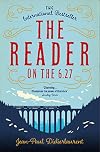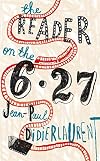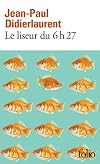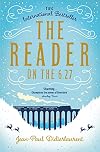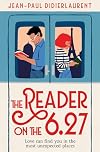
The Reader on the 6.27
by Jean-Paul Didierlaurent
On This Page
Description
Guylain Vignolles leads a dull and solitary life. He hates his job and his only company at home is a goldfish. Every morning he takes the 6.27 to his tedious job at a book pulping factory. He hates his boss and his assistant but he finds companionship with the factory's guard, an eccentric aficionado of classical literature. On the train each morning on the way to work, Guylain reads aloud to his fellow commuters the disparate pages that he rescues from the jaws of the monstrous pulping show more machine. One morning on the train, he finds a USB stick which contains the diary of a young woman. As Guylain reads the diary, he finds himself falling love with its author ...This enchanting novel is a warm and funny fable about literature's power to uplift even the most monotonous of lives; and how there can be dignity and poetry for even the most misunderstood. show lessTags
Recommendations






































Member Recommendations
Member Reviews
What a funny little book! The Reader on the 6.27 by Jean-Paul Didierlaurent is translated from French and is a short book that packs a punch. Our main character Guylain Vignolles works in a book pulping factory despite loving books. He retrieves a few pages from the machine every day and reads them aloud to commuters each morning on the 6.27am train.
That's the concept, but this quirky little book is really about Guylain's life and two people in it. A friend who lost his legs in an accident at the mill is on a quest to track down every copy of a book printed using the paper pulp produced the day he lost his legs. I loved this relationship between the two men but it was only briefly touched on given the brevity of the book.
The second show more person - and the highlight of the book - is someone Guylain's never met; the owner of a USB left on the train one morning. The USB contains diary entries from a lavatory attendant and Guylain is moved enough by her writing and her daily observations to track her down. The writing in Julie's diary entries is the real driver of the book, easily eclipsing the other sub-plots and eccentric characters.
I've never read a book like The Reader on the 6.27, and it could easily have been a short story containing just the USB discovery and Guylain tracking down Julie. I recommend this for booklovers and Francophiles; and at only 195 pages in length it won't take you long to read it. Definitely a little something different. show less
That's the concept, but this quirky little book is really about Guylain's life and two people in it. A friend who lost his legs in an accident at the mill is on a quest to track down every copy of a book printed using the paper pulp produced the day he lost his legs. I loved this relationship between the two men but it was only briefly touched on given the brevity of the book.
The second show more person - and the highlight of the book - is someone Guylain's never met; the owner of a USB left on the train one morning. The USB contains diary entries from a lavatory attendant and Guylain is moved enough by her writing and her daily observations to track her down. The writing in Julie's diary entries is the real driver of the book, easily eclipsing the other sub-plots and eccentric characters.
I've never read a book like The Reader on the 6.27, and it could easily have been a short story containing just the USB discovery and Guylain tracking down Julie. I recommend this for booklovers and Francophiles; and at only 195 pages in length it won't take you long to read it. Definitely a little something different. show less
Before I could enjoy this book I had to rid myself of the feeling I was being preached at. With its emotive language surrounding the book pulping plant where the main character works, clearly this was going to be a novel in which the pulping of books is tantamount to burning them. And naturally all the books that end their days in the "Zerstor" are works of genius, such that extracts rescued by the protagonist and read out on the train have everyone agog. Now my issue with this is that there are books that don't sell for a reason, and I've read my fair share of badly written self-published books whose authors couldn't spell, punctuate or be arsed with editing. I would have happily tipped them in and cranked the handle myself.
Having said show more all this, how could anyone read this book and maintain such an attitude of cynicism beyond the first few chapters? I was won over by its sheer charm and playfulness and willingness to go where most other novels don't (notably into subterranean public toilets). There is an individuality about it - not least in terms of its focus on people on the fringes of society - and a line in comedy that would have restored my faith in the French sense of humour, had it ever been in doubt. show less
Having said show more all this, how could anyone read this book and maintain such an attitude of cynicism beyond the first few chapters? I was won over by its sheer charm and playfulness and willingness to go where most other novels don't (notably into subterranean public toilets). There is an individuality about it - not least in terms of its focus on people on the fringes of society - and a line in comedy that would have restored my faith in the French sense of humour, had it ever been in doubt. show less
Well who wouldn't love a book about the love for books? Specially a book freak like me? This little novel is just that. It's the story of Guylain Vignolles, who ironically enough works at a book pulping company. That is, he destroys books for a living and nothing in life makes him sicker than this, him being a lover of the written word.
Every day, he salvages a few pages from the bottom of the pulping machine and reads them out loud the next morning to the people on the 6.27 train.
One good day, he reads a page from the diary of a young woman called Julie, with whom he identifies and decides to find her so they can meet.
The characters in this book and the way in which every day life is told to us is what makes it magical. You can feel the show more love for the written word bursting at the seams from this one.
There is one particular thread that grabbed me, and that is when Guylain goes to a retirement home to read out loud to the people living there and when he is done, he admits that in that moment was when he had felt more alive than he had in years.
The power of books is beyond words, yes? show less
Every day, he salvages a few pages from the bottom of the pulping machine and reads them out loud the next morning to the people on the 6.27 train.
One good day, he reads a page from the diary of a young woman called Julie, with whom he identifies and decides to find her so they can meet.
The characters in this book and the way in which every day life is told to us is what makes it magical. You can feel the show more love for the written word bursting at the seams from this one.
There is one particular thread that grabbed me, and that is when Guylain goes to a retirement home to read out loud to the people living there and when he is done, he admits that in that moment was when he had felt more alive than he had in years.
The power of books is beyond words, yes? show less
Really, REALLY enjoyed The Reader on the 6.27 by Jean-Paul Didierlaurent in the original French (Le liseur du 6h27) on audio, a novella I'd spotted at the library as a recent release and just pounced on when I saw the story was about a lonely young man who works in a book processing factory (i.e. destroying books for a living, to his ongoing horror). He makes up for this by picking up flyaway sheets he manages to rescue from the horrible machine he's paid to operate and reading them out loud on the metro on his way to work in the morning. Eventually he finds a USB key on said metro, on which is the diary of a young woman who works as a "Madame Pipi" (bathroom attendant) who obviously has talent and aspirations of being a writer and show more finds himself more and more vested in discovering the woman behind the writing hiding in one of many public bathrooms somewhere in or around Paris. Very very charming story which I think any true blue booklover will adore. Available in translations all over the world, as I understand it. show less
Very different and original. I struggled to get fully invested in the characters but otherwise really enjoyed this - the descriptive prose, personification of the book pulping machine and the pages saved from the machine, are all beautifully written. Didierlaurent captures the drudgery and monotony of the type of work his characters undertake in the book with such a depth of insight that you would expect him to have spent 15 years performing similar jobs himself (which I'm sure he hasn't!). Recommended particuarly for bibliophiles.
Every weekday morning Guylain boards the 6.27 commuter train, settles down on the jump seat and begins to read seemingly random excerpts from books, his voice charms the regulars. Guylain is a man living a restricted life, he lives in a small studio flat with only a goldfish for company and, despite his love for reading, he works in a job to destroy books and he hates it, his only friend is a crippled former colleague. One morning Guylain discovers a memory stick on the train and as he reads the documents it contains, he falls in love with the writer. All he knows is that she is a toilet cleaner in a shopping centre but Guylain sets out to meet her.
The book was such a change from my normal reading material and I really enjoyed it. The show more blurb describes it as being similar to 'Amelie' and I can see where that comes from. Guylain is such an engaging character and his quest is both romantic and also slightly picaresque. It is a slight novel but one which is real escapism, romantic without being smaltzy and a soft, gentle fantasy. show less
The book was such a change from my normal reading material and I really enjoyed it. The show more blurb describes it as being similar to 'Amelie' and I can see where that comes from. Guylain is such an engaging character and his quest is both romantic and also slightly picaresque. It is a slight novel but one which is real escapism, romantic without being smaltzy and a soft, gentle fantasy. show less
The Reader on the 6.27 by Jean-Paul Didierlaurent is a treat for booklovers. Guylain Vignolles has a superlative appreciation for the written word and spends his workdays tortured by the act of obliterating books. In a bid to maintain his sanity, he finds a means to con the system. Superbly translated from the French, this is a book to savour.
Members
- Recently Added By
Author Information

5 Works 790 Members
Jean-Paul Didierlaurent is an author who wrote The Reader on the 6.27, which made the New Zealand Best Seller List. (Bowker Author Biography)
Some Editions
Awards and Honors
Series
Belongs to Publisher Series
Common Knowledge
- Canonical title
- The Reader on the 6.27
- Original title
- Le liseur du 6h27
- Original publication date
- 2014
- People/Characters*
- Guylain Vignolles (Vilain Guignol); Yvon Grimbert; Félix Kowalski; Lucien Brunner; Giuseppe Carminetti; Monique Delacôte (show all 9); Josette Delacôte; Huguette Lignon; Julie
- Important places*
- Paris, France; Gagny, Île-de-France, France; Evry, Île-de-France, France; Résidence des Glycines, Gagny, Île-de-France, France
- Dedication*
- À Sabine,
sans qui ce livre ne serait pas,
à mon père,
qui, par son invisible présence,
continue de m'insuffler son amour éternel,
à Colette et à son indéfectible soutien. - First words*
- Certains naissent sourds, muets ou aveugles.
- Last words*
- (Click to show. Warning: May contain spoilers.)14718, ça faisait vraiment un beau nombre pour commencer une histoire.
- Original language
- French
*Some information comes from Common Knowledge in other languages. Click "Edit" for more information.
Classifications
Statistics
- Members
- 688
- Popularity
- 41,420
- Reviews
- 42
- Rating
- (3.68)
- Languages
- 16 — Catalan, Danish, Dutch, English, Estonian, Finnish, French, German, Greek, Hungarian, Italian, Portuguese, Russian, Spanish, Swedish, Turkish
- Media
- Paper, Audiobook, Ebook
- ISBNs
- 47
- ASINs
- 16