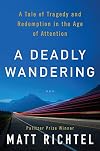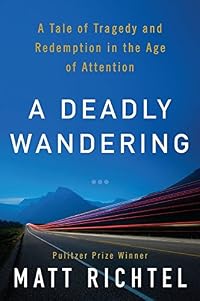
A Deadly Wandering: A Tale of Tragedy and Redemption in the Age of Attention
by Matt Richtel
On This Page
Description
"From Pulitzer Prize-winning journalist Matt Richtel, a brilliant, narrative-driven exploration of technology's vast influence on the human mind and society, dramatically-told through the lens of a tragic "texting-while-driving" car crash that claimed the lives of two rocket scientists in 2006. In this ambitious, compelling, and beautifully written book, Matt Richtel, a Pulitzer Prize-winning reporter for the New York Times, examines the impact of technology on our lives through the story of show more Utah college student Reggie Shaw, who killed two scientists while texting and driving. Richtel follows Reggie through the tragedy, the police investigation, his prosecution, and ultimately, his redemption. In the wake of his experience, Reggie has become a leading advocate against "distracted driving." Richtel interweaves Reggie's story with cutting-edge scientific findings regarding human attention and the impact of technology on our brains, proposing solid, practical, and actionable solutions to help manage this crisis individually and as a society. A propulsive read filled with fascinating, accessible detail, riveting narrative tension, and emotional depth, A Deadly Wandering explores one of the biggest questions of our time--what is all of our technology doing to us?--and provides unsettling and important answers and information we all need"-- show lessTags
Recommendations










Member Reviews
The book is about a car wreck in Utah in 2007 in which two scientists were killed. They were hit by a teenager who was tailgating a semi-tractor trailer and whose SUV crossed the center line multiple times before it finally clipped the oncoming car, causing it to careen into the oncoming traffic lane were it was hit by a heavily loaded pickup pulling a trailer. The teen driver said he had hydroplaned on wet roads. Later investigation showed that he had been texting while driving and he did not remember texting at all. How could that be? That is where the Attention Science part of the book comes into play and the reading becomes fascinating. The author goes back to the beginnings of Attention Science in WWII when scientists tried to show more figure out why RADAR operators missed so many incoming enemy planes when they plainly showed up on screens and follows the science throughout the investigation and into the court room.
Once the Utah Highway patrol figured out that the facts of the wreck didn't add up and started investigating, decisions had to be made about how to charge the driver who caused the wreck. Could he be tried? Did any laws currently on the books in Utah apply? Ultimately these questions led to the passage of some of the toughest distracted driving laws in the U. S. by the state of Utah in 2012.
Everybody thinks that they can multitask, but the scientific fact is that we can't. Our brains can only do one thing at a time and the brain selects what is the most important and puts the rest off to deal with later. That is what the science shows. The science is at war with business in this case. As the author points out, Telephone companies deliberately advertised the use of cell phones while driving and did so up until 2015. Cell phone towers were deliberately placed along interstate highways and popular main arterial highways to ensure that there would be few dropped calls. It turns out that even talking on a cell phone while driving is dangerous and increases the likelihood of an accident. There is little difference in the statistics of hands free talking on the phone or holding a phone while talking. The author takes the time to explain why, in general, talking to a passenger in the car with you is safer than using a phone - turns out that two pairs of eyes are better than one. The passenger acts as a second set of eyes and alerts the driver of things that they should notice. This book explains how the science, the implement, the driver, and our culture all come together to create a very dangerous situation for those who use cell phones while driving.
This was certainly an eye-opening book, and it will make any conscientious person put the wireless telephone in the trunk of the car each time they get in to drive, but it could have been a much better book than it was. The author gets into the weeds when he starts delving into the personal lives of everybody involved in this particular case and that part of the book gets monotonous. Even so, I think that the topic is so important that it should have many more readers than it seemed to get. show less
Once the Utah Highway patrol figured out that the facts of the wreck didn't add up and started investigating, decisions had to be made about how to charge the driver who caused the wreck. Could he be tried? Did any laws currently on the books in Utah apply? Ultimately these questions led to the passage of some of the toughest distracted driving laws in the U. S. by the state of Utah in 2012.
Everybody thinks that they can multitask, but the scientific fact is that we can't. Our brains can only do one thing at a time and the brain selects what is the most important and puts the rest off to deal with later. That is what the science shows. The science is at war with business in this case. As the author points out, Telephone companies deliberately advertised the use of cell phones while driving and did so up until 2015. Cell phone towers were deliberately placed along interstate highways and popular main arterial highways to ensure that there would be few dropped calls. It turns out that even talking on a cell phone while driving is dangerous and increases the likelihood of an accident. There is little difference in the statistics of hands free talking on the phone or holding a phone while talking. The author takes the time to explain why, in general, talking to a passenger in the car with you is safer than using a phone - turns out that two pairs of eyes are better than one. The passenger acts as a second set of eyes and alerts the driver of things that they should notice. This book explains how the science, the implement, the driver, and our culture all come together to create a very dangerous situation for those who use cell phones while driving.
This was certainly an eye-opening book, and it will make any conscientious person put the wireless telephone in the trunk of the car each time they get in to drive, but it could have been a much better book than it was. The author gets into the weeds when he starts delving into the personal lives of everybody involved in this particular case and that part of the book gets monotonous. Even so, I think that the topic is so important that it should have many more readers than it seemed to get. show less
First and foremost, this book is an example of American journalism at its very best. If you happen to subscribe to the notion promoted by one of our former presidents that the news media are the “enemy of the people,” read this book and if you have half a brain, you’ll quickly jettison that belief. This is a story that continues to be told, unfortunately, over and over: the story of auto deaths as a result of “distracted driving.” And, of course, as we all know, much of that distracted driving is from the use of cell phones by the driver, either talking or, more often, texting while driving. Matt Richtel cites many statistics in his book, but maybe the most concerning and telling is this: 98% of drivers polled agreed that show more texting and driving was dangerous. That sounds about right. But, of those 98%, a full 45% admit to texting and driving themselves. That is mind blowing. And think of your own experiences with drivers you’ve seen using cell phones, even after states have one by one passed laws making using cell phones illegal. Think of the last time you were behind another car at a stop light and the light changed to green. If that car just sat there while you waited to proceed, chances are pretty good that the driver is texting. Many times motorists will be talking on their cell phone in full view of anyone around them. And, after all, the chances of being pulled over for that are slim and none. Richtel’s book focuses on one case in Utah of distracted driving causing not one death but two, both fathers and both in the prime of their careers as rocket scientists. Utah is one of what I call “Don’t Tell Me What To Do” states, states that think requiring parents to have their children in child seats in the car is an infringement of their rights. Other states in this category are Mississippi, South Carolina, and even my own home state of Indiana. Since this accident happened in 2006, Utah and many of the rest of the DTMWTD states have come around and have passed texting and driving laws. Matt Richtel’s reporting, which resulted in a Pulitzer Prize, is largely responsible for getting the ball rolling. This book is that important. In fact, I think any driver taking Drivers’ Education should be required to read it as part of the course. One last thing: I listened to this book in its audio version. Kudos to narrator Fred Berman. If you’ve listened to any books, you know how important the reader is. Fred Berman did justice to this very important book. show less
This is great non-fiction that ought to be required reading for any parent with a teenage driver in the family. The teenage driver ought to read it, too.
The book is based on a tragic accident that took place on a highway in Utah back in 2006. In the accident, 2 brilliant scientists were killed when a car driven by a young 19 year old 'good kid', who had been texting his girlfriend as he drove, strayed into their lane, clipped their car, and caused them to spin out of control. The story is told from multiple viewpoints- his, the law-enforcement people who doggedly pursued justice, his family, and the families of the victims, woven through all of it a history from WWII to the present on the science behind the study of attention. It's a show more brilliant blend of technology, social science, and real-life events. The book is extremely well-written and researched beautifully, and it should scare you straight every time you think about what can happen when technology (or anything else) takes your attention away from driving. show less
The book is based on a tragic accident that took place on a highway in Utah back in 2006. In the accident, 2 brilliant scientists were killed when a car driven by a young 19 year old 'good kid', who had been texting his girlfriend as he drove, strayed into their lane, clipped their car, and caused them to spin out of control. The story is told from multiple viewpoints- his, the law-enforcement people who doggedly pursued justice, his family, and the families of the victims, woven through all of it a history from WWII to the present on the science behind the study of attention. It's a show more brilliant blend of technology, social science, and real-life events. The book is extremely well-written and researched beautifully, and it should scare you straight every time you think about what can happen when technology (or anything else) takes your attention away from driving. show less
So much has already been said about A DEADLY WANDERING, especially since Matt Richtel won a Pulitzer Prize for this book, I hesitate to repeat. But I will say this: if you talk on your cell phone or text while you drive, even if you use a hands-free device, you may not want to finish reading A DEADLY WANDERING because you won’t like what it says. Richtel would say that you are in denial. If you don’t talk on your cell phone or text while you drive, you know people who do, and this book will absorb you. Maybe you will want to highlight lines throughout the book.
I am one of those people who does not use my cell phone while I drive, and I don’t understand how this could be controversial. But Richtel tells the true story of Reggie show more Shaw, who, at first, proclaimed that he was not guilty of causing the deaths of two people even though he had been texting while he was driving. How could there be any question that he was distracted? And why do people insist that they can multitask while they drive?
Richtel proposes that some people are that addicted to their cell phones. And he backs it up with scientific proof.
But A DEADLY WANDERING does not read like a science book. The style of this book reminds me very much of Jon Krakauer's books. Here Richtel tells personal stories, some of people directly connected to Reggie’s story, others of the scientists who study the issues Reggie’s story brings up.
Everyone should read this. show less
I am one of those people who does not use my cell phone while I drive, and I don’t understand how this could be controversial. But Richtel tells the true story of Reggie show more Shaw, who, at first, proclaimed that he was not guilty of causing the deaths of two people even though he had been texting while he was driving. How could there be any question that he was distracted? And why do people insist that they can multitask while they drive?
Richtel proposes that some people are that addicted to their cell phones. And he backs it up with scientific proof.
But A DEADLY WANDERING does not read like a science book. The style of this book reminds me very much of Jon Krakauer's books. Here Richtel tells personal stories, some of people directly connected to Reggie’s story, others of the scientists who study the issues Reggie’s story brings up.
Everyone should read this. show less
A riveting book of personal stories and a court case with breaks for neuroscience and scientists. Hard to put down. And very timely for me.
My daughter just got her driver's license and drives my car. My rule -- turn off the smartphone ringer and put it in the way back where it cannot be seen or reached from the driver's seat. Some parents think I'm crazy. They don't understand the addictive quality of these devices and they need to read this book. Or others like it.
I once saw a young woman texting at the wheel going 70 mph in the fast lane of a 4-lane freeway. I shook my finger at her. She looked up at me, then back down to her device. Then I pulled way back to avoid the collision she was about to cause... if not this time, the next.
My show more only Internet is my PC and I'm happy to be away from it when out in the world so I can focus. My flip phone keeps me available for my kids. They can call or text which sends a buzz. But I never, ever, pick up while driving. (If it's an emergency, they can call 911!) And I do not get annoying, pushy pings or flashy colors demanding my attention. Don't get me wrong -- I love the Internet. But I prefer to keep it at home and not harassing me everywhere I go.
I was once forced to get a smartphone when the company discontinued its flip phone service. I hated it. So I found another company with a flip service. I'm now happily back to a flip phone, my focus, and my sanity.
This book is the most engaging I've read in a while. My driving daughter now wants to read it, as she should. It is highly recommended -- for its important message, but also for being a good, riveting read. show less
My daughter just got her driver's license and drives my car. My rule -- turn off the smartphone ringer and put it in the way back where it cannot be seen or reached from the driver's seat. Some parents think I'm crazy. They don't understand the addictive quality of these devices and they need to read this book. Or others like it.
I once saw a young woman texting at the wheel going 70 mph in the fast lane of a 4-lane freeway. I shook my finger at her. She looked up at me, then back down to her device. Then I pulled way back to avoid the collision she was about to cause... if not this time, the next.
My show more only Internet is my PC and I'm happy to be away from it when out in the world so I can focus. My flip phone keeps me available for my kids. They can call or text which sends a buzz. But I never, ever, pick up while driving. (If it's an emergency, they can call 911!) And I do not get annoying, pushy pings or flashy colors demanding my attention. Don't get me wrong -- I love the Internet. But I prefer to keep it at home and not harassing me everywhere I go.
I was once forced to get a smartphone when the company discontinued its flip phone service. I hated it. So I found another company with a flip service. I'm now happily back to a flip phone, my focus, and my sanity.
This book is the most engaging I've read in a while. My driving daughter now wants to read it, as she should. It is highly recommended -- for its important message, but also for being a good, riveting read. show less
This book is a journalist’s detailed examination of an early incident of texting while driving before most states made it illegal. It examines the circumstances surrounding then nineteen-year-old Reggie Shaw, living in Utah, who caused a crash that resulted in the deaths of two people. He was texting. Richtel delves into the lives of everyone associated with this event, including those who died and their surviving families, the lawyers involved in the court case, law enforcement personnel, a victim’s advocate, Reggie’s family members, and of course, Reggie himself.
The main reason I was attracted to this book is that it purported to be about the science of attention, and it does contain a few chapters on it, but I wanted more show more neuroscience about the impact of technology on our brains. What I got was a more detailed personal story that went way too far into the personal lives of the people involved for my taste. Did we really need to know about the child abuse experienced by one of the victim’s advocates at an early age? If the author had concentrated on Reggie and the victims, it would have been much more powerful. It also contains way more Mormon theology than I cared to read.
The good news is that it provides a comprehensive analysis of one event that was clearly related to texting while driving and how Reggie Shaw eventually took responsibility and spread the message about the dangers. This and other tragic examples led to massive changes in many states’ laws. It serves as a warning to all of us to put away the tech devices (if we haven’t already) and focus on the road. show less
The main reason I was attracted to this book is that it purported to be about the science of attention, and it does contain a few chapters on it, but I wanted more show more neuroscience about the impact of technology on our brains. What I got was a more detailed personal story that went way too far into the personal lives of the people involved for my taste. Did we really need to know about the child abuse experienced by one of the victim’s advocates at an early age? If the author had concentrated on Reggie and the victims, it would have been much more powerful. It also contains way more Mormon theology than I cared to read.
The good news is that it provides a comprehensive analysis of one event that was clearly related to texting while driving and how Reggie Shaw eventually took responsibility and spread the message about the dangers. This and other tragic examples led to massive changes in many states’ laws. It serves as a warning to all of us to put away the tech devices (if we haven’t already) and focus on the road. show less
This is an interesting and valuable book, and I was intrigued by some of the details related to attention and multitasking. However, I do question why there were so many errors in a book on technology (isn't technology designed to capture errors in the absence of actual human editors?) - just the ones I noticed: the city Winnipeg spelled both correctly and incorrectly; a name spelled incorrectly (once); the city Hartford spelled correctly and incorrectly, very closely together; the use of the word "fullest" which apparently is acceptable nowadays but still grates on my nerves; the use of "honed in" when it should be "homed in"; and one that I don't believe I have seen in a book before - a paragraph repeated (just in case we weren't show more paying attention, I guess, which is the theme of the book!). show less
Members
- Recently Added By
Lists

Top Five Books of 2015
811 works; 240 members

Favorite Books Published in 2014
27 works; 7 members

Books Read in 2021
5,361 works; 114 members
Author Information

20 Works 1,476 Members
Matt Richtel is a Pulitzer Prize-winning reporter at the New York Times. He lives in San Francisco.
Some Editions
Awards and Honors
Awards
Distinctions
Notable Lists
Common Knowledge
- Original publication date
- 2014-09
- People/Characters
- Reggie; Terryl
- Important places
- Utah, USA
- Important events
- car accident, September 22, 2006
- Epigraph
- We have Paleolithic emotions, medieval institutions, and godlike technologies. - E.O. Wilson
- Dedication
- For my family.
- First words
- "Are you comfortable, Reggie?"
- Last words
- (Click to show. Warning: May contain spoilers.)"An ethicist would say we all have a choice, but a brain scientist will tell you that choice starts in the brain."
- Blurbers
- Preston, Douglas; Duhigg, Charles
- Original language
- English
Classifications
- Genres
- Nonfiction, Technology, General Nonfiction, Science & Nature
- DDC/MDS
- 303.483 — Society, Government, and Culture Social sciences, sociology & anthropology Social processes Social change Causes of change Development of science and technology
- LCC
- HE5620 .D59 .R53 — Social sciences Transportation and communications Transportation and communications Automotive transportation
- BISAC
Statistics
- Members
- 368
- Popularity
- 84,358
- Reviews
- 16
- Rating
- (3.76)
- Languages
- English
- Media
- Paper, Audiobook, Ebook
- ISBNs
- 6
- UPCs
- 1
- ASINs
- 6