A Thing in Disguise: The Visionary Life of Joseph Paxton
by Kate Colquhoun
On This Page
Description
A brilliantly conceived biography of Joseph Paxton, horticulturist to the Duke & Duchess of Devonshire at Chatsworth, architect of the Crystal Palace at the Great Exhibition of 1851 and one of the greatest unsung heroes of the Victorian Age In the nineteenth century, which witnessed a revolution in horticulture and urban planning and architecture, Joseph Paxton, a man with no formal education, strode like a colossus. Head gardener at Chatsworth by the age of twenty-three, and encouraged by show more the sixth Duke of Devonshire whose patronage soon flourished into the defining friendship of his life, Paxton set about transforming this Derbyshire estate into the greatest garden in England. Visitors there were astonished by the enormous glasshouses and ambitious waterworks he built, the collection of orchids, the largest in all England, the dwarf bananas and the gargantuan lily, the trees and plants brought back from all over the world. Queen Victoria came to marvel and, increasingly, with the development of the railway in which Paxton was also involved, daytrippers from all over the country. It was the Crystal Palace, home of the Great Exhibition in 1851, that secured Paxton's fame. His design, initially doodled on a piece of blotting paper, was the architectural triumph of its time. Two thousand men worked for eight months to complete it. It was six times the size of St Paul's Cathedral, enclosed a space of 18 acres, and entertained six million visitors. By the time of his death fourteen years later, 'the busiest man in England' according to Dickens, was friends with Brunel and Stevenson and in constant demand to design public parks and gardens. His last, seemingly most eccentric project was for a Great Boulevard under glass, a crystal arcade that would connect all the main railway termini in London. Drawing on exclusive access to Paxton's personal letters, Kate Colquhouns's remarkable biography is a compelling story of a man who typifies the Victorian ideal of self-improvement and a touching portrait of one of that era's great heroes. show lessTags
Recommendations










Member Reviews
This was a fascinating biography of Joseph Paxton, who began as a working-class gardener on a country estate and ended up designing the Crystal Palace for the 1851 Great Exhibition and serving as Member for Parliament. Kate Colquhoun has little to say about Joseph Paxton's origins, because the details are sketchy, but once he's older, he apprentices at the Horticultural Society, and then he is hired as head gardener by William Cavendish, Sixth Duke of Devonshire. Paxton was an intelligent, enthusiastic man whose enthusiasms fed into a positive feedback loop with the Duke. Basically, anything Paxton wanted to do with the estate, the Duke would pay for. They amassed a huge collection of orchids, racing others to cultivate and flower show more species new to England. Paxton got the first Victoria regia (a giant water lily several meters wide) to flower, and was also the first person to cultivate a banana in England. The bananas we eat today are the Cavendish bananas, named after Paxton's patron.
Paxton taught himself architecture to build new glasshouses for the Duke's collection, and he put in a proposal for the building to house the Great Exhibition. This thrust him into the national spotlight, and soon he was designing public parks, on the boards of railway corporations, standing for Parliament, creating a daily newspaper edited by Charles Dickens, and organizing relief efforts in the Crimea! Colquhoun's account of his rise is a fascinating look at a fascinating life, and she peppers the book with little human details ably, especially the stories of Paxton and the Duke's appreciation for each other and for plant life. Their enthusiasm for rare plants is infectious even through the printed page. I loved her accounts of Victoria's two visits to the Duke's estate, one as a young princess, one with Albert in tow. The Duke of Wellington thought Paxton's gardeners so well organized that he said Paxton would have made a good general!
Arguably, the Victorian period was the first time we really became conscious that we were moving into the future, and Paxton was one of the people trying to design that future. "The Busiest Man in England" is a great story in itself, and also filled with connections to other stories of the nineteenth century: I was pleased to see, for example, that Jane Loudon (author of The Mummy!: A Story of the Twenty-Second Century) got a couple mentions, and Paxton's life brought him into contact with Dickens, Robert Louis Stevenson, John Tenniel, and many other familiar names. A nice personal story from my favorite period of history. show less
Paxton taught himself architecture to build new glasshouses for the Duke's collection, and he put in a proposal for the building to house the Great Exhibition. This thrust him into the national spotlight, and soon he was designing public parks, on the boards of railway corporations, standing for Parliament, creating a daily newspaper edited by Charles Dickens, and organizing relief efforts in the Crimea! Colquhoun's account of his rise is a fascinating look at a fascinating life, and she peppers the book with little human details ably, especially the stories of Paxton and the Duke's appreciation for each other and for plant life. Their enthusiasm for rare plants is infectious even through the printed page. I loved her accounts of Victoria's two visits to the Duke's estate, one as a young princess, one with Albert in tow. The Duke of Wellington thought Paxton's gardeners so well organized that he said Paxton would have made a good general!
Arguably, the Victorian period was the first time we really became conscious that we were moving into the future, and Paxton was one of the people trying to design that future. "The Busiest Man in England" is a great story in itself, and also filled with connections to other stories of the nineteenth century: I was pleased to see, for example, that Jane Loudon (author of The Mummy!: A Story of the Twenty-Second Century) got a couple mentions, and Paxton's life brought him into contact with Dickens, Robert Louis Stevenson, John Tenniel, and many other familiar names. A nice personal story from my favorite period of history. show less
Ratings
Members
- Recently Added By
Lists

John Carey's Sunday Best
82 works; 3 members
Author Information

6 Works 834 Members
Kate Colquhoun is the author of The Busiest Man in England, The Thrifty Cookbook, and Taste. As well as writing for several newspapers and magazines, she appears regularly on radio and television. She lives in London with her husband and two sons.
Common Knowledge
- People/Characters
- Joseph Paxton
- Disambiguation notice
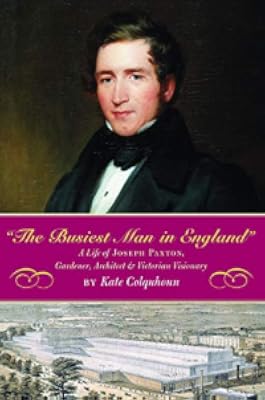
- This book was originally published in the UK as A Thing in Disguise: The Visionary Life of Joseph Paxton. For its US edition, it was retitled "The Busiest Man in England": A Life of Joseph Paxton, Gardener, Archite... (show all)ct & Victorian Visionary.
Classifications
- Genres
- Nonfiction, Home & Garden, Biography & Memoir, Art & Design, History, General Nonfiction
- DDC/MDS
- 712.092 — Arts & recreation Area planning & landscape architecture Landscape architecture (Landscape design) History, geographic treatment, biography Biography
- LCC
- DA565 .P18 .C65 — History of Europe, Asia, Africa and Oceania Great Britain History of Great Britain England History By period Modern, 1485- Victorian era, 1837-1901
- BISAC
Statistics
- Members
- 103
- Popularity
- 314,718
- Reviews
- 1
- Rating
- (4.20)
- Languages
- English
- Media
- Paper, Ebook
- ISBNs
- 4
- ASINs
- 1