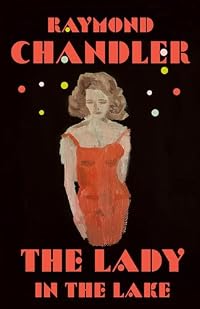
On This Page
Description
Crime fiction master Raymond Chandler's fourth novel featuring Philip Marlowe, the "quintessential urban private eye" (Los Angeles Times). In The Lady in the Lake, hardboiled crime fiction master Raymond Chandler brings us the story of a couple of missing wives--one a rich man's and one a poor man's--who have become the objects of Philip Marlowe's investigation. One of them may have gotten a Mexican divorce and married a gigolo and the other may be dead. Marlowe's not sure he cares about show more either one, but he's not paid to care. show lessTags
Recommendations



























Member Reviews
“Police business is a hell of a problem. It’s a good deal like politics. It asks for the highest type of men, and there’s nothing in it to attract the highest type of men. So we have to work with what we get...”
In this the fourth book in series, Philip Marlowe is hired by Degrace Kingsley, a perfume company executive, to track down a piece of lost property, his missing wife. What Marlowe discovers is a web of murder, extortion, and police corruption that extends beyond the borders of Bay City, a fictional suburb of Los Angeles.
As with the other books in the series Marlowe at times resorts to means that, while effective, are morally questionable, (feeding liquor to an alcoholic for information, breaking and entering, and not show more contacting the police after discovering a body immediately etc), but generally he does his best to act with integrity in a world where greed, corruption, and apathy seems prevalent. Marlowe manages to deport himself with class and wit despite being constantly warned off, bribery attempts, and police brutality. In each case, Marlowe doesn’t rattle under the pressure. Chandler presents a world in which good and evil—black and white—are inseparably mixed, meaning that Marlowe's grey areas appear significantly less dark than those around him.
As per usual Chandler writes the story from a first person point of view meaning that everything is filtered through Marlowe’s perspective, yet the readers learn little about the man directly. This can be both intriguing and frustrating at times.
'The Lady in the Lake' is a thrilling hard-boiled detective novel that reads at a fast pace but Chandler plays it straight and doesn't try and use any unnecessary gimmicks. I was a little underwhelmed by the last book (The High Window) but here Chandler is back on top form and proves himself to be one of the best of the genre. show less
In this the fourth book in series, Philip Marlowe is hired by Degrace Kingsley, a perfume company executive, to track down a piece of lost property, his missing wife. What Marlowe discovers is a web of murder, extortion, and police corruption that extends beyond the borders of Bay City, a fictional suburb of Los Angeles.
As with the other books in the series Marlowe at times resorts to means that, while effective, are morally questionable, (feeding liquor to an alcoholic for information, breaking and entering, and not show more contacting the police after discovering a body immediately etc), but generally he does his best to act with integrity in a world where greed, corruption, and apathy seems prevalent. Marlowe manages to deport himself with class and wit despite being constantly warned off, bribery attempts, and police brutality. In each case, Marlowe doesn’t rattle under the pressure. Chandler presents a world in which good and evil—black and white—are inseparably mixed, meaning that Marlowe's grey areas appear significantly less dark than those around him.
As per usual Chandler writes the story from a first person point of view meaning that everything is filtered through Marlowe’s perspective, yet the readers learn little about the man directly. This can be both intriguing and frustrating at times.
'The Lady in the Lake' is a thrilling hard-boiled detective novel that reads at a fast pace but Chandler plays it straight and doesn't try and use any unnecessary gimmicks. I was a little underwhelmed by the last book (The High Window) but here Chandler is back on top form and proves himself to be one of the best of the genre. show less
I thought that I had Chandler pegged. After reading The High Window, the third of his Philip Marlowe books, I said in my review that, by this point, readers won't be coming to these books "for anything other than lashings of style", and championed the books on these terms. But with the fourth book, The Lady in the Lake, Chandler defied my expectations and introduced a genuinely engrossing mystery and coherent plot to go along with all the style. Here, there's considerable steel to go with the silk.
It is true that the second book, Farewell, My Lovely, also had a great balance of style and substance, but even there it was sometimes hard to follow the plot. The Lady in the Lake actually – and surprisingly – allows you the reader to show more interact with the mystery. You identify clues and misdirects in the dialogue and the prose, formulate theories as to who killed who and why. Chandler is no longer pulling us through his detective's tangled web and hoping we emerge unscathed: this time we are fellow sleuths working alongside Marlowe. Indeed, it was so disconcerting to be able to follow a Chandler plot in its entirety that for a while I wasn't even sure if I liked it, as strange as that sounds. By now, I'm so used to rolling through his tangled threads and looking for some sweet simile or great melancholy passage of prose that this coherence of plot was unfamiliar to me.
It's a great strength of The Lady in the Lake that it manages to retain the qualities of previous books whilst adding new strengths to them. Published in 1943, some of the prose hints at what America was like in wartime – just enough detail to flavour the story but not enough to date it. The characters are as evocative as ever, and Marlowe still stands out as the scrappy everyman. ("A private dick can bother anybody," he says on page 20. "He's persistent and used to snubs. He's paid for his time and he would just as soon use it to bother you as any other way.") There are some chilling scenes, not only when murder victims are found (and described graphically) but also when a police corruption scene is introduced in the final act. This gives Chandler the opportunity for some great and dangerous lines. And that, after all, is what he's best at. "I'm sorry you had to walk into such a mess," Marlowe's client says on page 77. But, like Marlowe, we actually like walking into Chandler's messes, especially when they turn out not to be messes at all. show less
It is true that the second book, Farewell, My Lovely, also had a great balance of style and substance, but even there it was sometimes hard to follow the plot. The Lady in the Lake actually – and surprisingly – allows you the reader to show more interact with the mystery. You identify clues and misdirects in the dialogue and the prose, formulate theories as to who killed who and why. Chandler is no longer pulling us through his detective's tangled web and hoping we emerge unscathed: this time we are fellow sleuths working alongside Marlowe. Indeed, it was so disconcerting to be able to follow a Chandler plot in its entirety that for a while I wasn't even sure if I liked it, as strange as that sounds. By now, I'm so used to rolling through his tangled threads and looking for some sweet simile or great melancholy passage of prose that this coherence of plot was unfamiliar to me.
It's a great strength of The Lady in the Lake that it manages to retain the qualities of previous books whilst adding new strengths to them. Published in 1943, some of the prose hints at what America was like in wartime – just enough detail to flavour the story but not enough to date it. The characters are as evocative as ever, and Marlowe still stands out as the scrappy everyman. ("A private dick can bother anybody," he says on page 20. "He's persistent and used to snubs. He's paid for his time and he would just as soon use it to bother you as any other way.") There are some chilling scenes, not only when murder victims are found (and described graphically) but also when a police corruption scene is introduced in the final act. This gives Chandler the opportunity for some great and dangerous lines. And that, after all, is what he's best at. "I'm sorry you had to walk into such a mess," Marlowe's client says on page 77. But, like Marlowe, we actually like walking into Chandler's messes, especially when they turn out not to be messes at all. show less
Another great read from Raymond Chandler! Five pages in and I was hooked and addicted! This story moves fast - once the body is found in the lake, the search intensifies! And with poor alibis, confused identities, and a dedicated Marlowe hot on the trail, the action is whip snap! I love the way Chandler writes, and a sentence like, "I gobbled what they called the regular dinner, drank a brandy to sit on its chest and hold it down, and went out on the main street.", just leaves me in awe of his writing. I'm so glad I haven't read every one of his books - yet!
Meu primeiro Raymond Chandler. Meu primeiro Philip Marlowe.
Acho que o que mais impressiona na escrita do Chandler é que ele deixa o leitor investigar e chegar às mesmas conclusões do Marlowe, é uma jornada interessantíssima e cujo twist não importa porque o leitor seguiu as mesmas pistas e já está ciente de antemão. Isso é tratar o leitor com respeito e não como fosse um policial burro, né, hahaha. Adorei.
O engraçado é que apesar do meu Marlowe favorito de cinema ser o Elliott Gould, o tempo todo ao ler o livro visualizei o Bogart, mesmo sendo o Robert Montgomery quem estava na adaptação desse livro.
Acho que o que mais impressiona na escrita do Chandler é que ele deixa o leitor investigar e chegar às mesmas conclusões do Marlowe, é uma jornada interessantíssima e cujo twist não importa porque o leitor seguiu as mesmas pistas e já está ciente de antemão. Isso é tratar o leitor com respeito e não como fosse um policial burro, né, hahaha. Adorei.
O engraçado é que apesar do meu Marlowe favorito de cinema ser o Elliott Gould, o tempo todo ao ler o livro visualizei o Bogart, mesmo sendo o Robert Montgomery quem estava na adaptação desse livro.
*Partial spoilers ahead*
The high-maintenance wife of a perfume company executive is missing, and the exec hires Philip Marlowe to track her down. When Marlowe goes to the mountain vacation cabin where the woman was last seen, the caretaker's wife is found dead--drowned in the lake--and the plot thickens. Before he knows it, Marlowe is up to his neck in shady gigolos, shadier housecall doctors and typically nasty Bay City cops, as it becomes increasingly obvious that someone doesn't want him to put the pieces together.
The Lady in the Lake represents Raymond Chandler in his prime. It's far superior to The Big Sleep--which caught Chandler at a moment when he was still more of an episodic writer than a novelist--and occasionally approaches show more the brilliance of his late-career masterpiece The Long Goodbye. (Especially worthy of note is the vivid portrait that Chandler paints of rural lawman Jim Patton: it's one of his finest characterizations.) Here he's a total master of his craft, making Marlowe the lonely lens through which the reader views a world that is, at best, cruelly indifferent. In that regard, The Lady in the Lake may be the Chandler book to which Ross Macdonald owed the single greatest debt. At any rate, this is one of the quintessential hard-boiled detective novels, and it's an ideal point of entry if you're new to Chandler or to the subject matter in general. show less
The high-maintenance wife of a perfume company executive is missing, and the exec hires Philip Marlowe to track her down. When Marlowe goes to the mountain vacation cabin where the woman was last seen, the caretaker's wife is found dead--drowned in the lake--and the plot thickens. Before he knows it, Marlowe is up to his neck in shady gigolos, shadier housecall doctors and typically nasty Bay City cops, as it becomes increasingly obvious that someone doesn't want him to put the pieces together.
The Lady in the Lake represents Raymond Chandler in his prime. It's far superior to The Big Sleep--which caught Chandler at a moment when he was still more of an episodic writer than a novelist--and occasionally approaches show more the brilliance of his late-career masterpiece The Long Goodbye. (Especially worthy of note is the vivid portrait that Chandler paints of rural lawman Jim Patton: it's one of his finest characterizations.) Here he's a total master of his craft, making Marlowe the lonely lens through which the reader views a world that is, at best, cruelly indifferent. In that regard, The Lady in the Lake may be the Chandler book to which Ross Macdonald owed the single greatest debt. At any rate, this is one of the quintessential hard-boiled detective novels, and it's an ideal point of entry if you're new to Chandler or to the subject matter in general. show less
Another excellent installment in the Philip Marlowe series. There are some familiar workings in this one as there are in all the books, but it doesn’t feel repetitive or boring. I love to watch his tradecraft, hear his quips and wonder what he’ll find behind that slightly open door (a body? evidence of a fight? a woman with a gun? all three?). Trying to spot the liars, cheats and backstabbers is what makes these so fun. Part of the solution was easy to spot and I did, but some weren’t. The Degarmo/Mildred angle wasn’t and because it was so out of the blue, it seemed strange. I guess if I’d been paying more attention I might have spotted it, but since it didn’t really connect well it still jars. Doesn’t matter though; the show more story as a whole hung together well and was full of the usual gems -
“I gobbled what they called the regular dinner, drank a brandy to sit on its chest and hold it down…” p 49
“I decided I could lose nothing by the soft approach. If that didn’t produce for me - and I didn’t think it would - nature could take its course and we could bust up the furniture.” p 80
“After a long time his words came. They came through tight teeth and edgeways, and they scraped a little as they came out.” p 186 show less
“I gobbled what they called the regular dinner, drank a brandy to sit on its chest and hold it down…” p 49
“I decided I could lose nothing by the soft approach. If that didn’t produce for me - and I didn’t think it would - nature could take its course and we could bust up the furniture.” p 80
“After a long time his words came. They came through tight teeth and edgeways, and they scraped a little as they came out.” p 186 show less
Raymond Chandler, in my opinion, exceeds all other detective story writers by virtue of his thrillingly dry and low-key language, memorable characterizations, and intricate but believable plotting. But there’s something else, an undefinable quality of attitude and dialog that no one but Dashiell Hammett has ever come close to duplicating. This wonderful novel, a mashup of two splendid short stories, feels like a single original creation, so skillfully does Chandler meld the two. It involves a dead woman in a lake, another one in a garage, and a dead guy in a bathtub, and the knotty problem of who they were and how they got there. Crime fiction’s finest modern character, private eye Philip Marlowe takes on the case in one show more Chandler’s most engaging works. show less
Members
- Recently Added By
Lists

Best Noir Fiction
160 works; 14 members

Best Crime Fiction
262 works; 39 members
The Top 100 Crime Novels of All Time
100 works; 15 members

Crime and Mysteries to Read
746 works; 31 members

Top 100 Mystery Novels of All Time
98 works; 9 members

Novels from The Guardian's Great American Novelist Tournament
148 works; 24 members

Barzun and Taylor's Classics of Crime
93 works; 3 members

Books mentioned in Julian Symons’ Bloody Murder
438 works; 6 members

Favorite Books from the 1940s
38 works; 3 members

Books Read in 2015
3,298 works; 129 members

1940s
221 works; 25 members
20th Century Literature
1,161 works; 55 members

Books Read in 2020
4,379 works; 123 members

Books Read in 2012
815 works; 34 members
American Lit for Eng 11 Research Project
368 works; 6 members

Books With Water Words in the Title
186 works; 12 members
Best Mysteries With a Historical Setting
292 works; 160 members

Art Bourgeau's Favorites [Mystery Lovers Companion, 1986]
124 works; 2 members
Author Information

278+ Works 47,969 Members
Raymond Chandler was born in Chicago, Illinois on July 23, 1888. Before becoming a professional writer in 1933, he worked as a reporter, an accountant, bookkeeper, and auditor. He wrote several novels featuring private detective Philip Marlowe including The Big Sleep, The High Window, The Lady in the Lake, The Little Sister, and The Long Goodbye. show more In addition to novels and short stories, he wrote screenplays. He won two academy awards, for Double Indemnity (1944) and The Blue Dahlia (1946). He died on March 26, 1959. (Bowker Author Biography) show less
Some Editions
Awards and Honors
Awards
Distinctions
Series

Belongs to Publisher Series
NB-Roman (61)
SaPo (9)
detebe (70/6)
El País. Serie negra (27)
Mirabilia (35)
Ullstein Buch (702)
Colecção Vampiro (135)
Den svarte serie (114)
Zephyr Books (162)
Libro amigo [Bruguera] (671)
Penguin Books (867)
Work Relationships
Is contained in
The Lady in the Lake, The Little Sister, The Long Goodbye, Playback (Everyman's Library) by Raymond Chandler
The big sleep/Farewell my lovely/The high window/The lady in the lake/The long goodbye/Playback by Raymond Chandler
The Big Sleep / Farewell, My Lovely / The High Window / The Lady in the Lake / The Little Sister / The Long Goodbye / Playback by Raymond Chandler
The Raymond Chandler Omnibus: The Big Sleep / Farewell, My Lovely / The High Window / The Lady in the Lake by Raymond Chandler
Is an adaptation of
Has the adaptation
Is abridged in
Inspired
Common Knowledge
- Canonical title
- The Lady in the Lake
- Original title
- The Lady in the Lake
- Alternate titles*
- Die Tote im See
- Original publication date
- 1943
- People/Characters
- Philip Marlowe
- Important places
- Los Angeles, California, USA; San Bernardino, California, USA
- Related movies
- Lady in the Lake (1947 | IMDb)
- First words
- The Treloar Building was, and is, on Olive Street, near Sixth, on the west side. The sidewalk in front of it had been built of black and white rubber blocks. They were taking them up now to give to the government, and a hatle... (show all)ss pale man with a face like a building superintendent was watching the work and looking as if it was breaking his heart.
- Last words
- (Click to show. Warning: May contain spoilers.)Something that had been a man.
- Original language
- English
- Disambiguation notice
- This is the 1943 novel that was based on a 1939 short story with the same title. Please do not combine the novel and the short story.
*Some information comes from Common Knowledge in other languages. Click "Edit" for more information.
Classifications
Statistics
- Members
- 3,709
- Popularity
- 4,298
- Reviews
- 69
- Rating
- (4.04)
- Languages
- 20 — Bulgarian, Catalan, Chinese, Czech, Danish, Dutch, English, Estonian, Finnish, French, German, Greek, Hungarian, Italian, Norwegian (Bokmål), Norwegian, Polish, Portuguese, Spanish, Swedish
- Media
- Paper, Audiobook, Ebook
- ISBNs
- 130
- UPCs
- 1
- ASINs
- 49