On This Page
Description
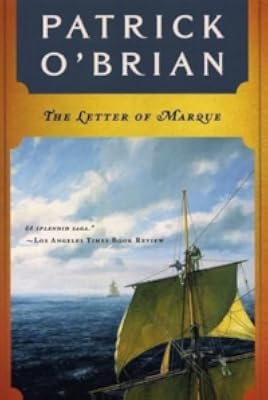
In The Letter of Marque, Jack is once again aboard his beloved Surprise but stripped of his post captaincy for a crime he did not commit. Bought by Stephen, the Surprise has become a privateer. Sailing into French waters, the two concoct a desperate mission which, if successful, may redeem Aubrey from his state of disgrace. A nighttime battle with an unusual climax, a jewel of great value and Stephen's fondness for opium make this segment of O'Brian's masterful series both original and show more profoundly exciting. show lessTags
Recommendations
















Member Reviews
I'm returning to this series after a very long break, and I'm glad that I did. It's possible, after all, to read books wrong, which can end up spoiling the book for reasons that are nothing to do with the book itself. In the case of the Aubrey/Maturin series, the uniformity of their excellence in terms of writing, their largely character-driven, relatively shapeless novelistic plotting compared poorly, I thought, to the more intricate, complex and subtle mechanisms of Dorothy Dunnett. Of course, that's the wrong approach. They don't suffer in comparison at all. They are completely different animals. To read them for the thrill of clever plot twists that have been deviously woven into eight massive volumes is both pointless and a bit show more stupid, and I'm glad now that I've achieved this perspective, because the pleasures of O'Brian's novels are in some ways richer than Dunnett's, for all that Dunnett will always edge out O'Brian as one of my favourite writers.
Jack Aubrey is in a sorry state at the start of The Letter Of Marque, struck off the naval lists after a trumped-up charge, he is morose, short-tempered and depressed. Stephen Maturin has purchased The Surprise, however, and with the titular letter and a crew half of old naval hands and half of doughty pirates, they set out to restore Jack's fortunes.
The aforementioned uniformity of excellence of these novels tends to render each succeeding novel susceptible to accusations of sameness. Certainly there is progression. Each book is a chapter in the ongoing history of our heroes' friendship and careers. They age and change in circumstances and temperament. There are voyages, there are battles, there are some exchanges of intelligence, observations of flora and fauna, and occasional visits to hearth and home and family, where Jack can blunder cheerfully and Stephen can mope for his estranged wife. The story develops, the characters grow, the world opens up around them, a world so fully and perfectly realised that we come to understand that what we mistook for sameness is, in fact, recognition and comfort and familiarity. Each book gives exactly what it sets out to give, and so long as we don't mistake it for something it's not, we can fully enjoy them in all their warmth and generosity. For all love. show less
Jack Aubrey is in a sorry state at the start of The Letter Of Marque, struck off the naval lists after a trumped-up charge, he is morose, short-tempered and depressed. Stephen Maturin has purchased The Surprise, however, and with the titular letter and a crew half of old naval hands and half of doughty pirates, they set out to restore Jack's fortunes.
The aforementioned uniformity of excellence of these novels tends to render each succeeding novel susceptible to accusations of sameness. Certainly there is progression. Each book is a chapter in the ongoing history of our heroes' friendship and careers. They age and change in circumstances and temperament. There are voyages, there are battles, there are some exchanges of intelligence, observations of flora and fauna, and occasional visits to hearth and home and family, where Jack can blunder cheerfully and Stephen can mope for his estranged wife. The story develops, the characters grow, the world opens up around them, a world so fully and perfectly realised that we come to understand that what we mistook for sameness is, in fact, recognition and comfort and familiarity. Each book gives exactly what it sets out to give, and so long as we don't mistake it for something it's not, we can fully enjoy them in all their warmth and generosity. For all love. show less
After being falsely accused and convicted of a complicated investment scheme, Jack Aubrey has been cast out of the service. He's been in the Royal Navy nearly all of his life, and the separation breaks his heart. In hopes of moderating his misery, his particular friend Stephen Maturin buys the Surprise and secures a letter of marque for the ship. Aubrey can captain the Surprise once more, but this time as a privateer. It is acutely painful to him, but leads to one of his greatest professional triumphs. Stephen, meanwhile, finally meets face-to-face with Diana once more.
Everything about this book was beautiful and perfect and much-longed for. The only flaw was that the voice the narrator gives Diana Villiers is cloying and fake, and it show more nearly ruined my enjoyment of her scenes with Stephen. But not quite, for nothing could take away my adoration for the slow, weird ways they reconcile with each other. show less
Everything about this book was beautiful and perfect and much-longed for. The only flaw was that the voice the narrator gives Diana Villiers is cloying and fake, and it show more nearly ruined my enjoyment of her scenes with Stephen. But not quite, for nothing could take away my adoration for the slow, weird ways they reconcile with each other. show less
Reading ‘The Letter of Marque’ was an attempt at escapism and distraction immediately before and after the American election. It didn’t work, but I’m not sure anything would have. It was nice to have Aubrey and Maturin for company while I was too anxious to sleep, in any event. This is quite a sombre outing for pair, as Jack has been struck off the naval lists and is captaining a privateer that Stephen bought to cheer him up. Nonetheless, there are delightful moments of levity as well as thrilling sea battles. Notable sub-plots include Stephen’s troubling relationship with laudanum, an exploding pudding, Babbington’s eye for the ladies, and Jack not talking about his feelings but Stephen understanding anyway. O’Brian show more continues to have a wonderful ear for dialogue, a deft touch with characterisation, and a magical ability to evoke the early 19th century. show less
In the last volume of the wonderful Maturin/Aubrey series, Jack had been court-martialed for what appeared to be his complicity in a stock market fraud. Being a naïve landlubber, he had no idea of what he was being fraudulently involved in, thought he was just helping someone out and making a killing in the meantime. He was kicked out of the navy and removed from the post-captain’s list, eliminating all his accumulated seniority. Stephen, having come into a considerable fortune, purchased The Surprise, Jack’s old ship, and bought a letter of marque so Jack could operate as a legal privateer.
Having been sent on a special mission (remember that he is still an English secret agent), Stephen obtained a special exemption for the men of show more The Surprise to prevent them from being pressed into service should they be stopped by an English naval vessel. O'Brian really has a delightful way of writing. Here's another example of that wry humor that pervades his books. Russell is declaiming how all Frenchmen are worthless and uses as examples some French proverbial expressions, ". . .when the French wish to describe anything mighty foul they say, 'sal come un peigne', which gives you a pretty idea of their personal cleanliness. When they have other things to occupy their mind they say they have other cats to whip: a most inhuman thing to do [at least we beat dead horses] And when they are going to put a ship about, the order is 'a- Diue-va', or 'we must chance it and trust to God', which gives you some notion of their seamanship." One can only guess about O'Brian's early relationship with publishers, but from numerous comments made by a variety of characters, I suspect it was not a happy one: "You were telling me about publishers," asks Stephen of Mowett. “ ‘Yes , sir: I was about to say they were the most hellish procrastinators--' " 'Oh, how dreadful,' cried Fanny. 'Do they go to special houses, or do they . . .' " 'He means they delay,' said Babbington." O'Brian was a big fan of opium apparently, for Maturin is constantly singing its praises as a cure for all sorts of ills, and when queried about its ostensible addictive qualities, he replied in this book: "The objections come only from a few unhappy beings, Jansenists for the most part, who also condemn wine, agreeable food, music and the company of women: they even call out against coffee, for all love! Their objections are valid solely in the case of a few poor souls with feeble willpower, who would just as easily become the victims of intoxicating liquors, and who are practically moral imbeciles, often addicted to other forms of depravity; otherwise it is no more injurious than smoking tobacco." One learns all sorts of interesting things. Jack returns to his ship only to discover the word Seth written on the side.
The Sethians were a Gnostic Christian group who believed that Cain and Abel were brought into the world by angels, and that Seth, who was born after Abel’s murder, was the Almighty’s direct and pure creation. Anyway, there were pockets of Sethians scattered throughout England and, naturally, there were two schools of Sethians, the old that wrote the S backwards, and the new that wrote it in the conventional manner. Unlike Quakers, “they have no dislike for warfare,” so Jack has several Sethian sailors who celebrated recent good fortune by honoring Seth by painting his name on the side of the ship. When ordered to remove the name, they refused, not wishing to dishonor Seth. What makes this interesting is Jack’s novel way of making everyone happy. Rather clever, I thought. (Check out the Sethians on the web. They have a rather different perspective on the universe.) show less
Having been sent on a special mission (remember that he is still an English secret agent), Stephen obtained a special exemption for the men of show more The Surprise to prevent them from being pressed into service should they be stopped by an English naval vessel. O'Brian really has a delightful way of writing. Here's another example of that wry humor that pervades his books. Russell is declaiming how all Frenchmen are worthless and uses as examples some French proverbial expressions, ". . .when the French wish to describe anything mighty foul they say, 'sal come un peigne', which gives you a pretty idea of their personal cleanliness. When they have other things to occupy their mind they say they have other cats to whip: a most inhuman thing to do [at least we beat dead horses] And when they are going to put a ship about, the order is 'a- Diue-va', or 'we must chance it and trust to God', which gives you some notion of their seamanship." One can only guess about O'Brian's early relationship with publishers, but from numerous comments made by a variety of characters, I suspect it was not a happy one: "You were telling me about publishers," asks Stephen of Mowett. “ ‘Yes , sir: I was about to say they were the most hellish procrastinators--' " 'Oh, how dreadful,' cried Fanny. 'Do they go to special houses, or do they . . .' " 'He means they delay,' said Babbington." O'Brian was a big fan of opium apparently, for Maturin is constantly singing its praises as a cure for all sorts of ills, and when queried about its ostensible addictive qualities, he replied in this book: "The objections come only from a few unhappy beings, Jansenists for the most part, who also condemn wine, agreeable food, music and the company of women: they even call out against coffee, for all love! Their objections are valid solely in the case of a few poor souls with feeble willpower, who would just as easily become the victims of intoxicating liquors, and who are practically moral imbeciles, often addicted to other forms of depravity; otherwise it is no more injurious than smoking tobacco." One learns all sorts of interesting things. Jack returns to his ship only to discover the word Seth written on the side.
The Sethians were a Gnostic Christian group who believed that Cain and Abel were brought into the world by angels, and that Seth, who was born after Abel’s murder, was the Almighty’s direct and pure creation. Anyway, there were pockets of Sethians scattered throughout England and, naturally, there were two schools of Sethians, the old that wrote the S backwards, and the new that wrote it in the conventional manner. Unlike Quakers, “they have no dislike for warfare,” so Jack has several Sethian sailors who celebrated recent good fortune by honoring Seth by painting his name on the side of the ship. When ordered to remove the name, they refused, not wishing to dishonor Seth. What makes this interesting is Jack’s novel way of making everyone happy. Rather clever, I thought. (Check out the Sethians on the web. They have a rather different perspective on the universe.) show less
This was a wonderful conclusion to The Reverse of the Medal. As Stephen notes at one stage in the book, Aristotle's definition of tragedy encompassed not only a great man being brought down but also the redemption and deliverance of a man who had been laid low. If that's true, then this book, in company with the last, forms a truly great example of the same. From the nadir of fortune that both Jack and Stephen experience in TRotM, LoM sees a complete reversal. Jack is more successful than he's ever been, Stephen has Diana restored to him, and the book ends on one of the happiest and most contained notes that I think I've ever seen in an O' Brian novel.
The period sense was, as ever, perfect. If ever there was a literary universe in which show more I think I would like to live, then the Aubrey-Maturin universe is one of them. The dialogue was a joy as ever. O' Brian is so good at using dialogue to show just how close a friendship Stephen and Jack have, just how much they mean to one another. It's such a joyous thing that even Jack's little bit of banter at Stephen about the fact that the sea going out is, in fact, called the tide, succeeded in bringing a huge smile to my face. I particularly enjoyed Stephen's conversation about how difficult it is to survive as an undergraduate at TCD. Things, clearly, have not changed that much. *g* show less
The period sense was, as ever, perfect. If ever there was a literary universe in which show more I think I would like to live, then the Aubrey-Maturin universe is one of them. The dialogue was a joy as ever. O' Brian is so good at using dialogue to show just how close a friendship Stephen and Jack have, just how much they mean to one another. It's such a joyous thing that even Jack's little bit of banter at Stephen about the fact that the sea going out is, in fact, called the tide, succeeded in bringing a huge smile to my face. I particularly enjoyed Stephen's conversation about how difficult it is to survive as an undergraduate at TCD. Things, clearly, have not changed that much. *g* show less
Once again, beautiful vignettes from daily life seamlessly used together to paint another enchanting picture of Aubrey and Maturin. This time they are struggling to cope with the fall out from Jack's dismissal from the Navy following his conviction for a stock market fraud he did not commit. Jack and the people who love him strive to put right the wrong, sailing the Surprise as a private ship, a letter of marque, seeking above all an engagement with the French or the American navy that would provide sufficient impetus for the admiralty to restore him to the Navy list. Wonderful, wonderful stuff as always.
The Letter of Marque, Patrick O’Brian’s twelfth book in his Aubrey-Maturin series, picks up shortly after the events of The Reverse of the Medal, with Captain Jack Aubrey taking the private ship Surprise on cutting-out missions to the Azores, the coast of France, and Sweden all preparatory to a planned mission to South America. The ship, purchased out of the service by Dr. Stephen Maturin, sales as a letter or marque, or privateer, with government papers that Steven arranged in order to protect the ship’s company against impressment. Aubrey has no difficulty in finding able sailors as his reputation for prizes is well-known.
Though Jack starts out rather glum as a result of being stripped of rank following the fallout from the show more Stock Exchange Fraud, in which Jack was implicated, the novel soon turns a corner as he applies himself to the thing he does best. On the very first trip to the Azores, the Surprise captures a fleet of merchant vessels, one filled with precious quicksilver, thereby earning Jack his crew’s esteem and clearing the debts that had plagued him over the previous few novels. He next sets about capturing the French ship, Diane, along with a few gunships. All of this paves the way for his eventual reinstatement on the Navy List as well as a place in Parliament. Stephen, meanwhile, works to aid Jack behind-the-scenes and seeks the opportunity to reconcile with his wife, Diana Villiers. The motif of a balloon, in vogue since their creation in 1789, occurs throughout as O’Brian uses it to represent Stephen’s fortunes and his mood (pgs. 105, 109, 199). The very real possibility of a gas balloon rising to an altitude at which the aeronaut passed out from lack of air and froze to death while the balloon was carried off fills Stephen’s nightmares, particularly when he learns of his wife’s hopes of making an ascent in her own hydrogen balloon. While O’Brian is willing to put his characters through a great deal of melodrama, he also knows when the reader needs a respite, and this novel returns to the form of his happier tales, with an ending full of the promise of hope.
Like the previous five novels, The Letter of Marque exists outside the normal flow of time – this novel being the sixth of twelve to exist in what O’Brian described as an extended 1812, with these dozen books taking place between the beginning of June 1813 and November 1813. Like his previous novels, O’Brian perfectly recreates the world of the Napoleonic War in 1812, using Aubrey and Stephen’s activities to comment on the rapid changes occurring in this era and the passage of time in the series’ internal chronology. This Folio Society edition reprints the original text with insets containing historical portraits and sketches to illustrate some of the scenes. show less
Though Jack starts out rather glum as a result of being stripped of rank following the fallout from the show more Stock Exchange Fraud, in which Jack was implicated, the novel soon turns a corner as he applies himself to the thing he does best. On the very first trip to the Azores, the Surprise captures a fleet of merchant vessels, one filled with precious quicksilver, thereby earning Jack his crew’s esteem and clearing the debts that had plagued him over the previous few novels. He next sets about capturing the French ship, Diane, along with a few gunships. All of this paves the way for his eventual reinstatement on the Navy List as well as a place in Parliament. Stephen, meanwhile, works to aid Jack behind-the-scenes and seeks the opportunity to reconcile with his wife, Diana Villiers. The motif of a balloon, in vogue since their creation in 1789, occurs throughout as O’Brian uses it to represent Stephen’s fortunes and his mood (pgs. 105, 109, 199). The very real possibility of a gas balloon rising to an altitude at which the aeronaut passed out from lack of air and froze to death while the balloon was carried off fills Stephen’s nightmares, particularly when he learns of his wife’s hopes of making an ascent in her own hydrogen balloon. While O’Brian is willing to put his characters through a great deal of melodrama, he also knows when the reader needs a respite, and this novel returns to the form of his happier tales, with an ending full of the promise of hope.
Like the previous five novels, The Letter of Marque exists outside the normal flow of time – this novel being the sixth of twelve to exist in what O’Brian described as an extended 1812, with these dozen books taking place between the beginning of June 1813 and November 1813. Like his previous novels, O’Brian perfectly recreates the world of the Napoleonic War in 1812, using Aubrey and Stephen’s activities to comment on the rapid changes occurring in this era and the passage of time in the series’ internal chronology. This Folio Society edition reprints the original text with insets containing historical portraits and sketches to illustrate some of the scenes. show less
Members
- Recently Added By
Lists

Folio Society
831 works; 53 members

Huxley's reading log 2017
45 works; 1 member

Books Read in 2018
4,360 works; 110 members
Author Information

153+ Works 76,869 Members
Patrick O'Brian is the author of twenty volumes in the highly respected Aubrey/Maturin series of novels. (Publisher Provided) Patrick O'Brien was born in Ireland in 1914. His education included the Sorbonne. O'Brian has produced a variety of works, including biographies of Picasso and Sir Joseph Banks and translations of the novels and memoirs of show more Simone de Beauvoir, but he is best known for the creation of an unlikely pair of Napoleonic War-era heroes in the Aubrey-Maturin Series. British naval officer Jack Aubrey and Irish scholar and physician Stephen Maturin have been featured in more than a novels published in Great Britain (five of which have also appeared in America). He died on January 2, 2000. (Bowker Author Biography) show less
Some Editions
Series

Work Relationships
Common Knowledge
- Original publication date
- 1988
- People/Characters
- Jack Aubrey; Stephen Maturin; Sophie Aubrey; Heneage Dundas; Barrett Bonden; Preserved Killick (show all 15); Tom Pullings; William Mowett; William Babbington; Diana Villiers; Gedymin Jagiello; Sir Joseph Blaine; Nathaniel Martin; West; Davidge
- Important places
- Atlantic Ocean; Stockholm, Sweden; Surprise; Leopard
- First words
- Ever since Jack Aubrey had been dismissed from the service, ever since his name, with its now meaningless seniority, had been struck off the list of post-captains, it had seemed to him that he was living in a radically differ... (show all)ent world; everything was perfectly familiar, from the smell of seawater and tarred rigging to the gentle heave of the deck under his feet, but the essence was gone and he was a stranger.
- Last words
- (Click to show. Warning: May contain spoilers.)She urged West out of the cabin and on deck, and the amazed foremast hands saw a blue and gold coach and four, escorted by a troop of cavalry in mauve coats and silver facings, driving slowly along the quay with their captain and a Swedish officer on the box, their surgeon and his mate leaning out of the windows, and all of them, now joined by the lady on deck, singing Ah tutti contenti saremo cosi, ah tutti contenti saremo, saremo cosi with surprisingly melodious full-throated happiness.
- Publisher's editor
- Lawrence, Starling
- Blurbers
- Webb, W.L. (Guardian) (Guardian); Waldegrave, William (Daily Telegraph) (Daily Telegraph)
Classifications
Statistics
- Members
- 2,731
- Popularity
- 6,727
- Reviews
- 34
- Rating
- (4.27)
- Languages
- 7 — Czech, English, French, German, Italian, Norwegian (Bokmål), Spanish
- Media
- Paper, Audiobook, Ebook
- ISBNs
- 53
- UPCs
- 1
- ASINs
- 18