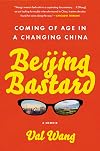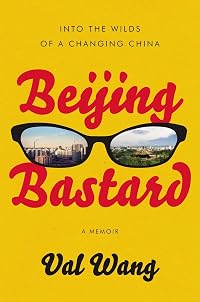
Beijing Bastard: Into the Wilds of a Changing China
by Val Wang
On This Page
Description
"A humorous and moving coming-of-age story that brings a unique, not-quite-outsider's perspective to China's shift from ancient empire to modern superpower. Raised in a strict Chinese-American household in the suburbs, Val Wang dutifully got good grades, took piano lessons, and performed in a Chinese dance troupe--until she shaved her head and became a leftist, the stuff of many teenage rebellions. But Val's true mutiny was when she moved to China, the land her parents had fled before the show more Communist takeover in 1949. Val arrives in Beijing in 1998 expecting to find freedom but instead lives in the old city with her traditional relatives, who wake her at dawn with the sound of a state-run television program playing next to her cot, make a running joke of how much she eats, and monitor her every move. But outside, she soon discovers a city rebelling against its roots just as she is, struggling too to find a new, modern identity. Rickshaws make way for taxicabs, skyscrapers replace hutong courtyard houses, and Beijing prepares to make its debut on the world stage with the 2008 Olympics. And in the gritty outskirts of the city where she moves, a thriving avant-garde subculture is making art out of the chaos. Val plunges into the city's dizzying culture and nightlife and begins shooting a documentary, about a Peking Opera family who is witnessing the death of their traditional art. Brilliantly observed and winningly told, Beijing Bastard is a compelling story of a young woman finding her place in the world and of China, as its ancient past gives way to a dazzling but uncertain future"-- show lessTags
Recommendations


Member Recommendations
Member Reviews
I must admit I struggled to finish this. The story, about the author moving to China after college in 1998 and staying for four or five years, seemed overlong and failed to attract my interest. As a character in the book observed, Val seemed to just drift into China and drift through her journalism career. Throughout the book she has this dream of becoming a documentary filmmaker, a dream that never came to fruition, as she just gave up on the idea when she came across a problem.
You might say that both Val and Beijing -- which was undergoing a massive urban development project towards the end of the book -- were both experiencing growing pains. But not every coming of age story needs to be written, and I think unless you're super show more obsessed with China and Beijing in particular, this book just doesn't have a lot to offer. show less
You might say that both Val and Beijing -- which was undergoing a massive urban development project towards the end of the book -- were both experiencing growing pains. But not every coming of age story needs to be written, and I think unless you're super show more obsessed with China and Beijing in particular, this book just doesn't have a lot to offer. show less
 This review was written for LibraryThing Early Reviewers.
I have to admit, I love the idea of finding yourself by going back to the place that your parents fled. While that may not have been the actual reason for Wang to go back to China, it certainly seemed to be what she got out of it. I listened to the audiobook, read by Emily Woo Zeller, who's voice was familiar from when I listened to The Girl Who Wrote Loneliness last year.
There's actually a lot to love in this book. As with Najla Said in Looking for Palestine, Wang grows up stuck between the culture she is growing up in and the culture her parents are pushing upon her. She is dragged to Chinese school, told what Chinese do, and doesn't seem to ever quite feel Chinese. She's Chinese-American, which seems to become an ever greater show more distinction as other try to force her identity onto her rather than let her identify herself.
I've been through a little of that too as people have tried to tell me just how Hispanic I am and what I should or shouldn't do on account of it. I've tried to gently remind them that there is this whole other half of me and that perhaps Hispanics are more nuanced they are giving themselves credit for (the person, not all Hispanics because this only seems to happen with people who think we should all be some monolithic group that all dance perfectly, among other things). Nevertheless, I have never gone back to Cuba, where my mother is from, but I would only hope for a similar kind of experience.
While in China, for reasons that are more a gut feeling than rational, Wang realizes quite a bit about her family, where they came from, what they ran from, and why they are the way they are. She seems to get there just in time as China begins to capitalize and modernize. While the exact China of her parents' past was already gone, trampled under 50 years of communist regime, she gets to look in and see a part of what made their culture and lifestyle so different from life in the US and a little of why they worked so hard to preserve it.
My favorite part about stories like this, that start in the US and involve traveling to parental homes abroad, is that it tends to have the same feel of a hero's journey into an unknown world in science fiction or fantasy. The lone hero embarks upon an adventure of discovery into a culture that is new to their lived experience, maybe they've learned something about them, maybe not. Either way, the lived experience is entirely different and the awkward moments of figuring out what's normal and who's taking advantage of you and what isn't normal is all fun to read about.
I loved the way her views on her parents and China and Chinese culture and different kinds of attachments evolve throughout the book. At my age now, and reading through books like this, I have to wonder if we all cringe at the thought of what our 20 year old selves thought and did and thought our lives were going to be like. Big ideas and no idea how to get there.
For me, the most poignant moment can be summed up in a line she quotes from an interview:
His history, after all, is mine too.
I suppose that's true for us all. Our parents are a part of our history, and what they went through is a part of how they raised us. show less
There's actually a lot to love in this book. As with Najla Said in Looking for Palestine, Wang grows up stuck between the culture she is growing up in and the culture her parents are pushing upon her. She is dragged to Chinese school, told what Chinese do, and doesn't seem to ever quite feel Chinese. She's Chinese-American, which seems to become an ever greater show more distinction as other try to force her identity onto her rather than let her identify herself.
I've been through a little of that too as people have tried to tell me just how Hispanic I am and what I should or shouldn't do on account of it. I've tried to gently remind them that there is this whole other half of me and that perhaps Hispanics are more nuanced they are giving themselves credit for (the person, not all Hispanics because this only seems to happen with people who think we should all be some monolithic group that all dance perfectly, among other things). Nevertheless, I have never gone back to Cuba, where my mother is from, but I would only hope for a similar kind of experience.
While in China, for reasons that are more a gut feeling than rational, Wang realizes quite a bit about her family, where they came from, what they ran from, and why they are the way they are. She seems to get there just in time as China begins to capitalize and modernize. While the exact China of her parents' past was already gone, trampled under 50 years of communist regime, she gets to look in and see a part of what made their culture and lifestyle so different from life in the US and a little of why they worked so hard to preserve it.
My favorite part about stories like this, that start in the US and involve traveling to parental homes abroad, is that it tends to have the same feel of a hero's journey into an unknown world in science fiction or fantasy. The lone hero embarks upon an adventure of discovery into a culture that is new to their lived experience, maybe they've learned something about them, maybe not. Either way, the lived experience is entirely different and the awkward moments of figuring out what's normal and who's taking advantage of you and what isn't normal is all fun to read about.
I loved the way her views on her parents and China and Chinese culture and different kinds of attachments evolve throughout the book. At my age now, and reading through books like this, I have to wonder if we all cringe at the thought of what our 20 year old selves thought and did and thought our lives were going to be like. Big ideas and no idea how to get there.
For me, the most poignant moment can be summed up in a line she quotes from an interview:
His history, after all, is mine too.
I suppose that's true for us all. Our parents are a part of our history, and what they went through is a part of how they raised us. show less
Beijing Bastard is a memoir of a young woman who searches for her identity by moving to the homeland of her parents - China. As she makes her way and works odd jobs related to the film and print industry, Val meets different individuals and families and shares their personalities and lifestyles which characterize Beijing and the challenges they face as the city changes. The book also explores the author's relationship and understanding of her family, consisting of relatives in Beijing and her parents and grandparents who immigrated to the United States. Although the stories do not always flow together, the general idea for the book is interesting and gives you a window onto the world of some of the people who were living in in Beijing show more as it prepared to host the Olympic Games. show less
This review was written for LibraryThing Early Reviewers.This memoir was an interesting description of life in China seen through the eyes of the daughter of Chinese immigrants to the US, living and working in Beijing. The writer has a flare for describing what she sees in a manner so that you can see it too. The people she interacts with, both family members and people she meets, are also similarly real to the reader. There is an element of coming-of-age to the account as the author describes her life as it is happening and also as she looks back on that time period.
This review was written for LibraryThing Early Reviewers.In Beijing Bastard Val Wang has attempted to write an account of her search for family and self. I have no doubt her time spent in this ancient city provided much opportunity for both, but this book is uneven at best. What you get is surface, of a city in transition and of Wang herself. Strangely enough, she does better with the city. With herself, she never quite gets beyond the ex-pat, rather shallow and slightly whiny “American girl rebelling against her parents” impression. There was so much fodder for depth in this book, Grandfather Zhang and the Peking Opera, Bomu and Bobo, but not only did the author not take advantage of it, she did not show much empathy. I wish she’d go back and try again.
This review was written for LibraryThing Early Reviewers.For most of the book, Beijing Bastards feels like it's trying very, very hard to get to a point, when I'm not entirely sure there is one. But that's ok; I enjoyed the ride, even if there was no destination.
I liked it. Despite repetitive focus on the author trying to figure herself out, it's really more of an exploration of her experience in China. Her ultimate goal is to film a documentary in China, and the book was written in that same spirit.
It's very much what I expected - maybe a little less humor, but that's a good thing. Sometimes the people she meets come off as caricatures, but sometimes they're surprisingly real. I'm reminded of that time we all have late in our teenage years when we realize our parents (and all adults, and show more other people, too) have entire lives outside of what we know of them. That goes both for the author's family and for the people she meets along the way.
Favorites:The littlest side characters are somehow the most engaging.
Least favorites: It's a little self-indulgent, but it's aware of its self-indulgence at least.
Writing style: Fun, lots of detail and flair, a typical "memoir" voice. Who couldn't love phrases like "having robbed me of my ancestral rent-controlled birthright" ?! And OH BOY the metaphors and similes. There's at least one every two or three sentences. That usually drives me nuts, but while I was certainly aware of it, it wasn't annoying.
Recommendation: For fans of quirky memoirs, readers looking for a quick beach read that isn't romance, and anyone interested in a Chinese-American point of view.
Feels: Introspective and colorful. show less
I liked it. Despite repetitive focus on the author trying to figure herself out, it's really more of an exploration of her experience in China. Her ultimate goal is to film a documentary in China, and the book was written in that same spirit.
It's very much what I expected - maybe a little less humor, but that's a good thing. Sometimes the people she meets come off as caricatures, but sometimes they're surprisingly real. I'm reminded of that time we all have late in our teenage years when we realize our parents (and all adults, and show more other people, too) have entire lives outside of what we know of them. That goes both for the author's family and for the people she meets along the way.
Favorites:The littlest side characters are somehow the most engaging.
Least favorites: It's a little self-indulgent, but it's aware of its self-indulgence at least.
Writing style: Fun, lots of detail and flair, a typical "memoir" voice. Who couldn't love phrases like "having robbed me of my ancestral rent-controlled birthright" ?! And OH BOY the metaphors and similes. There's at least one every two or three sentences. That usually drives me nuts, but while I was certainly aware of it, it wasn't annoying.
Recommendation: For fans of quirky memoirs, readers looking for a quick beach read that isn't romance, and anyone interested in a Chinese-American point of view.
Feels: Introspective and colorful. show less
This review was written for LibraryThing Early Reviewers.I really enjoyed this book. It's your typical coming-of-age type story that most people have probably lived and relate to in some form or another---surely we have all experienced the feeling of being suffocated under your family's hopes for you, and that urge to stretch your wings and fly independently, to see the world, to have an adventure. I went to Europe. Ms. Wang went to China.
There isn't much too the story itself. It's the people in the stories that make this book so endearing. From the haircutting troops to the family of Opera performers to the bohemian expat community, the characters are intriguing and interesting, comical and at times caricature-ish. All are easily likable and all have interesting things to add to the book, show more and make it unique.
Ms. Wang may not have finished her documentary she hoped to film, but she did write a great book. She paints such a loving portrait of a changing China and it's people that a film would be almost superfluous. This book really won't help you better understand China. But it will give you a glimpse into Chinese culture and the gritty reality of Beijing, introduce you to some great characters, and give you a sense of empathy for these people caught in the wind between old and new. show less
There isn't much too the story itself. It's the people in the stories that make this book so endearing. From the haircutting troops to the family of Opera performers to the bohemian expat community, the characters are intriguing and interesting, comical and at times caricature-ish. All are easily likable and all have interesting things to add to the book, show more and make it unique.
Ms. Wang may not have finished her documentary she hoped to film, but she did write a great book. She paints such a loving portrait of a changing China and it's people that a film would be almost superfluous. This book really won't help you better understand China. But it will give you a glimpse into Chinese culture and the gritty reality of Beijing, introduce you to some great characters, and give you a sense of empathy for these people caught in the wind between old and new. show less
This review was written for LibraryThing Early Reviewers.Members
- Recently Added By
Author Information
1 Work 63 Members
Awards and Honors
Common Knowledge
- Important places
- Beijing, China
Classifications
- Genres
- Nonfiction, Biography & Memoir, General Nonfiction, History
- DDC/MDS
- 305.48 — Society, government, & culture Social sciences, sociology & anthropology Social group - Age, Gender, Ethnicity Women Specific groups of women
- LCC
- E184 .C5 .W357 — History of the United States United States Elements in the population Afro-Americans
- BISAC
Statistics
- Members
- 63
- Popularity
- 494,334
- Reviews
- 23
- Rating
- (2.94)
- Languages
- English
- Media
- Paper, Audiobook, Ebook
- ISBNs
- 7
- ASINs
- 1