On This Page
Description
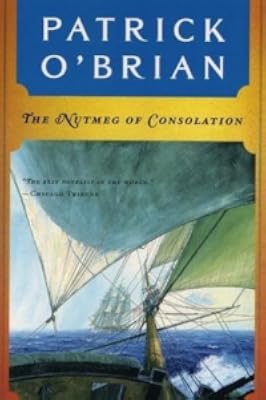
When last seen, Jack and Stephen had been shipwrecked on a desert island in the glittering South China Sea. The Nutmeg of Consolation opens as the castaways fashion a makeshift vessel from the wreckage, only to have it destroyed in a fiery attack by Malay pirates. Only the wondrous ingenuity of Stephen, along with the unexpected appearance of one of Jack's oldest allies, leads them to escape-and to dubious safety in a penal colony at New South Wales.Tags
Recommendations










Member Reviews
Aubrey and Maturin are at it again! Sailing the high seas, fighting the French (and miscellaneous jerks), saving children, finding rare creatures, curing ailments, and generally being surrogate parents to a slightly disreputable family of sailors. Their domesticity repeatedly verges upon the romantic in this instalment: Stephen is struck by the blueness of Jack’s eyes; Jack is jealous of Martin for taking up Stephen’s time. ‘The Nutmeg of Consolation’ proved to be another wonderful tale of their adventures, spent entirely abroad and mostly at sea. Killick can as usual be relied upon to provide great amusement, while violence ashore and at sea creates tension. O’Brian is such a reliably excellent writer. This is the fourteenth show more book in the series - I am so flighty a reader that the last sequence I got so far with was probably the Animorphs, back in my teens. I usually lose interest after perhaps three books, but could hardly do so with such lovable characters and beautifully rendered historical settings. The plots, honestly, are of much less interest to me, although they are very well crafted. My favourite moments are generally those that show the characters at quiet times, rather than during chases and battles. A few particularly pleasing lines of dialogue follow:
Other highlights include:the coca-leaf-addled rats, very moving scenes at the end when Padeen is recovered, Stephen’s belief that coffee is as good as opium, Jack and Stephen’s musical game that Killick objects to, the deliberate messing-up of the Nutmeg for stealth purposes, the crew thwarting the dissection of their deceased shipmate, a fricassee, Jack nearly falling into the sea because the quarter-galley has been shot off by cannon fire, the frequent repetition of Stephen’s ‘curtailed’ comment, a discussion of sloops, several awkward dinner parties, Jack’s care for his illegitimate son, complaints that the Surprise stinks, Pullings reminding Stephen to put on his trousers, reminiscing, Jemmy Ducks the excellent babysitter, Jack foolishly double-dosing himself with laxatives, the fascinations of boomerangs, and Stephen surviving the venom of a platypus. And that is an abbreviated list! I laughed a number of times while reading this book on the train. There is nothing like an Aubrey and Maturin novel for good cheer. show less
”My dear Maturin, how very happy I am to see you! We had given you up for lost. I trust you are well?”
“Perfectly well, I thank you, Governor; only a little ruffled,” said Stephen, whose face was indeed somewhat less sallow than usual. “The sergeant offered me fourpence to go away.”
[...]
“Lord, Raffles,” cried his wife, coming in, “What is that very ill smell? Has something died behind the wainscot?”
“My dear,” said the Governor, “It is this new plant, which is to be named after Dr Maturin.”
[...]
“It would I am sure be indiscreet to ask why you were turned before the mast,” said the Dutch lady most at home in English.
“Well, ma’am,” said Jack with an engaging leer, “it was partly due to my devotion to the sex, but even more because I stole the captain’s tripe.”
“Sex?” cried the Dutch ladies, “Tripe?” They whispered among themselves, blushed, looked very grave, and fell silent.
[...]
“You are luckier than I am in that way. They do not look upon you with any respect. That is to say, not with any undue respect. I mean they have an amazing respect for you, of course; but they do not look upon you as a superior being.”
“Do they not? They certainly looked upon me as a very disagreeable one this afternoon. I was cursed sullen, snappish and dogged with them all.”
“You astonish me. Had something put you out?”
“I had set aside a corpse for opening, an interesting case of the marthambles; I was going to ask your good word as duty bound, but before I could do so some criminal or at least some busy hand had sewn it up and placed it among those you buried.”
“What a ghoul you are, Stephen, upon my word.”
[...]
Killick came in and stood breathing heavily in the doorway and looking disagreeable. They took no notice, intent upon their letters; he came forward to the table and moved some knives and forks, quite unnecessarily, and with unnecessary noise.
“Get out, Killick,” said Jack, without looking round.
“Killick, you break in upon my thoughts,” said Stephen.
“Which I only came to say that the cook has burnt the soup, the Doctor ain’t shaved yet, and your honour has spilt ink on your breeches, your only decent breeches.”
“God’s blood - hell and death, so I have,” cried Jack.
[...]
“You may recall that last time we had the happiness of walking in the Brazilian rainforest I was bitten by an owl-faced night ape.”
“Certainly I do. How you bled!”
“This time I was bitten by a tapir, and bled even more.”
“A tapir, for all love?”
Other highlights include:
This is so much more eventful than The Thirteen Gun Salute, much more action-filled and much more dramatic. To some extent, that's a disappointment because there's so much less time for the kind of small moments of character interplay that O' Brian does so well. On the other hand, it made for an incredibly engaging and satisfying novel which I finished very, very quickly, building smoothly to a great cliffhanger of an ending.
I was delighted to see Padeen return, especially after a novel which was scattered throughout with some less than complimentary remarks about Ireland from a couple of the minor characters. I'm always delighted, too, with just how well O' Brian manages to take the rhythms and speech-patterns of Irish and translate show more them into English for those parts where Padeen is speaking to Stephen; especially since, as far as I know, O' Brian didn't have any Irish himself.
As ever, I'm looking forward to the next volume; especially if it finally lets us meet Baby Maturin. I am so full of glee at the idea of Stephen being a dad show less
I was delighted to see Padeen return, especially after a novel which was scattered throughout with some less than complimentary remarks about Ireland from a couple of the minor characters. I'm always delighted, too, with just how well O' Brian manages to take the rhythms and speech-patterns of Irish and translate show more them into English for those parts where Padeen is speaking to Stephen; especially since, as far as I know, O' Brian didn't have any Irish himself.
As ever, I'm looking forward to the next volume; especially if it finally lets us meet Baby Maturin. I am so full of glee at the idea of Stephen being a dad show less
Book 14 in the Aubrey-Maturin series sees the characters dealing with the aftermath of a shipwreck, fighting the French, visiting a rather horrific Australian penal colony, and, in Stephen's case, hunting for platypuses and receiving various significant bits of news from home.
I think this is one of my favorites of the series. It does perhaps lack for laugh-out-loud funny moments, even if it is occasionally, amusing, but it's got everything else, and it's just entirely engaging, start to finish, with none of those moments where things get so thoroughly nautical that my eyes start to glaze a bit. I'm very pleased to still be enjoying this series, so many books in.
I think this is one of my favorites of the series. It does perhaps lack for laugh-out-loud funny moments, even if it is occasionally, amusing, but it's got everything else, and it's just entirely engaging, start to finish, with none of those moments where things get so thoroughly nautical that my eyes start to glaze a bit. I'm very pleased to still be enjoying this series, so many books in.
Another romp through the southern oceans for Aubrey and Maturin: escape from a desolate island, a complicated plan to overtake a French frigate, rendezvous with old friends, and then a visit to Botany Bay (where Maturin has an unexpected run-in with a much-sought Australian critter). The description of penal-colony Australia is well drawn, and O'Brian's witty humor and good storytelling are as present here as in the other volumes.
The Nutmeg of Consolation, Patrick O’Brian’s fourteenth book in his Aubrey-Maturin series, picks up shortly after the events of The Thirteen Gun Salute, with Captain Jack Aubrey and the crew of the Diane shipwrecked and building a cutter out of the remains of their former ship. They come under attack from local pirates and fend them off, though at great cost to their supplies. Fortunately, a Chinese trading vessel arrives and Dr. Stephen Maturin is able to negotiate their passage to Batavia. There, Governor Raffles provides Aubrey a raised Dutch ship, which he rechristens Nutmeg of Consolation after one of the royal titles of the Sultan of Pulo Prabang. Jack takes the ship to engage the French ship, Cornélie, which he believes will show more water at Nil Desperandum. He engages her and leads her a chase, being saved from disaster at the last minute through the arrival of Thomas Pullings in the Surprise along with the Triton. They win the day and send the Nutmeg back to Batavia.
Aubrey, Stephen, and others transfer back to the Surprise and continue on to New South Wales. They find conditions in the penal colony shocking and the general corruption daunting. Having run out of his coca leaves, Stephen finds himself on-edge and ends up in a duel with Captain Lowe, who insulted the Irish to no end. Fortunately, Stephen wins and receives happy news. He visits Padeen Colman, who had been transported following earlier events resulting from his addiction to laudanum. Stephen plans to help Padeen escape, but Aubrey warns him against it due to the delicate position in which the Surprise finds itself vis-à-vis local politics. Stephen travels to the arranged meeting place in order to view duck-billed platypuses, successfully capturing one, only to be poisoned by its spurs. When the Surprise arrives, Padeen is brought aboard with the shore party, where Stephen recovers.
At one point, Stephen, Mr. Martin, and Paulton discuss novels, allowing O’Brian to describe his philosophy for endings. Through Stephen, he writes, “There is another Frenchman whose name escapes me but who is even more to the point: La bêtise c’est de vouloir conclure. The conventional ending, with virture rewarded and loose ends tied up is often sadly chilling; and its platitude and falsity tend to infect what has gone before, however excellent. Many books would be far better without their last chapter: or at least with no more than a brief, cool, unemotional statement of the outcome” (pg. 242). This perfectly captures many of O’Brian’s endings.
Like the previous sevel novels, The Nutmeg of Consolation exists outside the normal flow of time – this novel being the eighth of twelve to exist in what O’Brian described as an extended 1812, with these dozen books taking place between the beginning of June 1813 and November 1813. Those looking for a perfect chronology are advised to simply enjoy the story and the way in which O’Brian perfectly recreates the world of the Napoleonic Wars, using Aubrey and Stephen’s activities to comment on the rapid changes occurring in this era and the passage of time in the series’ internal chronology. This Folio Society edition reprints the original text with insets containing historical portraits and sketches to illustrate some of the scenes. show less
Aubrey, Stephen, and others transfer back to the Surprise and continue on to New South Wales. They find conditions in the penal colony shocking and the general corruption daunting. Having run out of his coca leaves, Stephen finds himself on-edge and ends up in a duel with Captain Lowe, who insulted the Irish to no end. Fortunately, Stephen wins and receives happy news. He visits Padeen Colman, who had been transported following earlier events resulting from his addiction to laudanum. Stephen plans to help Padeen escape, but Aubrey warns him against it due to the delicate position in which the Surprise finds itself vis-à-vis local politics. Stephen travels to the arranged meeting place in order to view duck-billed platypuses, successfully capturing one, only to be poisoned by its spurs. When the Surprise arrives, Padeen is brought aboard with the shore party, where Stephen recovers.
At one point, Stephen, Mr. Martin, and Paulton discuss novels, allowing O’Brian to describe his philosophy for endings. Through Stephen, he writes, “There is another Frenchman whose name escapes me but who is even more to the point: La bêtise c’est de vouloir conclure. The conventional ending, with virture rewarded and loose ends tied up is often sadly chilling; and its platitude and falsity tend to infect what has gone before, however excellent. Many books would be far better without their last chapter: or at least with no more than a brief, cool, unemotional statement of the outcome” (pg. 242). This perfectly captures many of O’Brian’s endings.
Like the previous sevel novels, The Nutmeg of Consolation exists outside the normal flow of time – this novel being the eighth of twelve to exist in what O’Brian described as an extended 1812, with these dozen books taking place between the beginning of June 1813 and November 1813. Those looking for a perfect chronology are advised to simply enjoy the story and the way in which O’Brian perfectly recreates the world of the Napoleonic Wars, using Aubrey and Stephen’s activities to comment on the rapid changes occurring in this era and the passage of time in the series’ internal chronology. This Folio Society edition reprints the original text with insets containing historical portraits and sketches to illustrate some of the scenes. show less
Things that stood out for me in this novel included the descriptions of life in Botany Bay (penal colony in Australia) and the matter-of-factness of being shipwrecked. I have a romantic view of Australia - but Mr. O'Brian paints a dismal view of conditions there for prisoners. And it always amazes me that a shipwreck doesn't seem to phase Jack and his crew. They are always confident that things will work out. Mr O'Brian continues to amuse (but you have to read carefully to catch some of the jokes)!
Wonderfully fluent writing, as always.
But for the first time – having now reached the fourteenth book of the series, and I ration my reading to prolong the pleasure – I had a slight feeling of déjà vu (déjà lu ?).
But for the first time – having now reached the fourteenth book of the series, and I ration my reading to prolong the pleasure – I had a slight feeling of déjà vu (déjà lu ?).
Members
- Recently Added By
Lists

Folio Society
831 works; 48 members

Top Five Books of 2020
982 works; 350 members

Books Read in 2018
4,360 works; 110 members
Author Information

154+ Works 77,054 Members
Patrick O'Brian is the author of twenty volumes in the highly respected Aubrey/Maturin series of novels. (Publisher Provided) Patrick O'Brien was born in Ireland in 1914. His education included the Sorbonne. O'Brian has produced a variety of works, including biographies of Picasso and Sir Joseph Banks and translations of the novels and memoirs of show more Simone de Beauvoir, but he is best known for the creation of an unlikely pair of Napoleonic War-era heroes in the Aubrey-Maturin Series. British naval officer Jack Aubrey and Irish scholar and physician Stephen Maturin have been featured in more than a novels published in Great Britain (five of which have also appeared in America). He died on January 2, 2000. (Bowker Author Biography) show less
Some Editions
Series

Belongs to Publisher Series
Work Relationships
Is contained in
Common Knowledge
- Original publication date
- 1991
- People/Characters
- Jack Aubrey; Stephen Maturin; Barrett Bonden; Preserved Killick; Tom Pullings; Nathaniel Martin (show all 17); Dick Richardson; Jean-Pierre Dumesnil; William Reade; Padeen Colman; Joe Plaice; Awkward Davies; Emily Sweeting; Sarah Sweeting; West; Davidge; William Oakes
- Important places
- Australia; Indian Ocean; New South Wales, Australia; Jakarta, Indonesia (Batavia); Sydney, New South Wales, Australia
- Important events
- Age of Sail
- Epigraph
- [None]
- Dedication
- MARIAE SACRUM
- First words
- Any author whose tales are situated in the early nineteenth century and whose people are for the most part sailors must depend for a great deal of his factual information and for much of his sense of the time on the memoirs a... (show all)nd letters of seamen, on Admiralty and navy oard records, on naval historians and of course on the invaluable publications of the Navy Records Society.
Author's note.
A hundred and fifty-seven castaways on a desert island in the South China Sea, the survivors of the wreck of HMS Diane, which had struck against an uncharted rock and had there een shattered by a great typhoon some day... (show all)s later: a hundred and fifty-seven, but as they sat there round the edge of a flat bare piece of ground between high-water mark and the beginning of the forest they sounded like the full complement of a ship of the line, for this was Sunday afternoon, and the starboard watch, headed by Captain Aubrey, was engaged in a cricket-match against the Marines, under their commanding officer, Mr Welby.
Chapter one.
The period which Patrick O'Brian has made his own, the Great Wars against France, is at once the least and the best known part of all British naval history.
The naval world of Jack Aubrey, by N.A.M. Rodger. - Quotations
- 'Many books would be far better without their last chapter: or at least with no more than a brief, cool, unemotional statement of the outcome.' [Stephen to Poulton, 242]
- Last words
- (Click to show. Warning: May contain spoilers.)'Jack, I cannot tell you how ardently, how very ardently, I look forward to going home.'
- Publisher's editor
- Lawrence, Starling
- Blurbers
- Judd, Alan; Byatt, A. S.; Snow, Richard
- Original language
- English
Classifications
Statistics
- Members
- 2,631
- Popularity
- 7,191
- Reviews
- 22
- Rating
- (4.16)
- Languages
- 5 — English, French, German, Italian, Spanish
- Media
- Paper, Audiobook, Ebook
- ISBNs
- 53
- UPCs
- 1
- ASINs
- 21