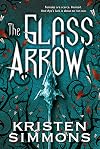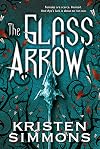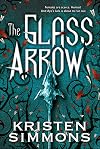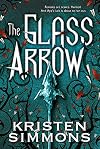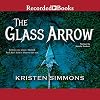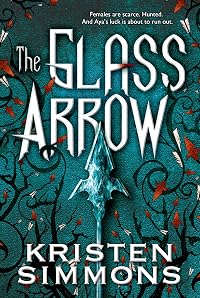
The Glass Arrow
by Kristen Simmons
On This Page
Description
Stolen from her home, and being groomed for auction, Aya is desperate to escape her fate and return to her family, but her only allies are a loyal wolf she's raised from a pup and a strange mute boy who may be her best hope for freedom ... if she can truly trust him.Tags
Recommendations

Member Recommendations
Member Reviews
Meet The Handmaid's Tale's Younger YA Cousin
(Full disclosure: I received a free copy of this book for review from the publisher. Trigger warning for rape - including allusions to rape, at least one rape attempt, medical rape, and general rape culture - human trafficking, slavery, and violence.)
"My ma taught me one thing from the beginning: My body is mine. My own. No one else's. Just because someone thinks they have rights to it, doesn't make it true. I thought I understood that before, but here, in this place, it's become more clear than ever how right she was. My flesh and blood - it's the only thing I own, and I'll defend it until I can't fight anymore."
"Behind us are two or three dozen country people from the outlying towns. With show more them are cages of chicken and goats, sheep, even cattle. That's where we fit on market day. Between the executions and the livestock sales."
Fifteen-year-old Aiyana (Aya to her family; Clover to her captors) is a rarity - a free woman living in the forests of Isor. Along with her mostly-adopted family - her cousin Salma; fellow refugee Metea; and Metea's children, Bian, Tam, and Nina - Aya hunts and gathers the food she needs, prays to Mother Hawk for guidance, and just generally goes about her business, all while evading detection by the feared Trackers.
In the nearby city of Glasscaster, women are items to be bought and sold. Property. Slaves. Young women may be purchased for sex (read: rape) or for breeding, only to be foisted off on pimps in the Black Lanes after they're all "used up." Along with "First Rounders" (read: virgins), "wild girls" are among the most valuable of them all - not only do Magnates take especial pleasure in breaking these formerly free women down, but their time outside of the city and its attendant pollution has blessed them with superior fertility. Lucky them.
Though hardly charmed, Aya is happy - that is, until the fateful day when young Bian leads the Trackers right to their camp. Aya is caught - crippled by an electric wire and then trapped in a Tracker's net, like so much wild game - and taken to the Garden for grooming and eventual sale. Through a calculated campaign of sabotage, Aya manages to avoid the first few monthly auctions - yet she's unable to escape punishment in solitary. Not that she'd want to, mind you: that barren patch of land behind the Garden is her only escape. It's where she befriends Brax, a wolf puppy trapped in the city's sewers - and Kiran, a mute Driver boy who works at the stables across the way. Can these unlikely allies help Aya escape Glasscaster and reunite her with her lost family?
There are so many things I loved about The Glass Arrow - too many to list, I'm afraid. While I spotted a few of the plot developments coming from a mountaintop away (Brax; Kyna), many of the twists proved unexpected (Daphne, on both counts; Varick; Salma). The ending is hopeful, yet understated enough to maintain believability; Aya's victory is mostly a personal one. (Then again, you know what they say about the personal being political.) Simmons's writing is both engaging and entertaining; she suffuses the book with a healthy dose of feminist sensibility, yet the action moves along at such a steady clip that it never feels like a political treatise.
What initially drew me to The Glass Arrow was its comparison to The Handmaid's Tale. Margaret Atwood is one of my all-time favorites (if I were building a dream team of writers, say for a flash fic contest, she'd be my first-round pick) and The Handmaid's Tale is at the top of my list (in terms of Atwood's work, it's second only to the MaddAddam trilogy). So I both gravitate towards books deemed Atwoodian, while simultaneously side-eyeing them with skepticism (there's only one Margaret Atwood, okay).
But the comparison here isn't that far off; The Glass Arrow is similar to The Handmaid's Tale, in both content and quality. It's kind of like The Handmaid's Tale's younger YA cousin, once or twice removed. (It has a bit of a fantasy vibe, even though it's completely lacking in supernatural elements; I credit this chiefly to Aya's rustic forest lifestyle.)
One of the most striking similarities for me is the idea of suicide as the last/best/only means of escape. Straw Hair's gruesome yet calculated suicide brought to mind Offred's contemplation of suicide - and the many subtle indicators that her handlers have planned for just that: "I know why there is no glass, in front of the watercolor picture of blue irises, and why the window opens only partly and why the glass in it is shatter-proof. It isn't running away they're afraid of. We wouldn't get far. It's those other escapes, the ones you can open in yourself, given a cutting edge."
Likewise, Aya's "purity test" is reminiscent of Offred's monthly OBGYN exams. While rape is a pervasive element of the story - including allusions to rape, at least one rape attempt, medical rape, child rape, and rape culture in general - Simmons thankfully steers clear of especially graphic depictions of rape. The most horrific scene for me is the purity test that Aya is subjected to prior to purchase. Drugged so that she's paralyzed but fully conscious - aware of what's going on, yet unable to resist in any way - Aya undergoes a gynecological exam in front of a small audience of hostile men. To me, this is far worse than any threats doled out by Greer. Again, it's not terribly graphic, but it made me physically ill just the same.
Just as with the handmaids - who assume the name of the man they "serve," e.g., Offred, Ofglen - in Isor, women are renamed once they enter the Garden (or a similar grooming facility); in this case, after flowers and plants. While not quite as disorienting as the system in The Handmaid's Tale - where names change regularly and quite literally advertise one's property status - this still serves as a rather potent way of stripping women of their power, their voice, their very identity. Who are we if we're not allowed to be ourselves? What do we have if not our names?
Of course, there are some notable differences. Whereas the subjugation of women in The Handmaid's Tale has a strong religious basis, the Magnates and Merchants of Glasscaster seem almost lacking in religion; they are secular, if not atheist. (This stands in sharp contrast to Aya's strongly held, earth-based (ecofeminist?) religious values.) Depending on the conditions in the city - are there enough fertile women to keep the population stable? - the city men seem mostly content to leave the townie and forest women alone. Certainly, they aren't storming across Isor, demanding that everyone adopt their way of thinking/living or else perish, as happens in the Republic of Gilead.
Additionally, while the division of women into different classes - broodmares, sex workers, domestic help - is roughly mirrored in The Glass Arrow, there seems to be more permeability between the borders. Sex (rape) with handmaids serves a strictly procreative purpose (a tenant emphasized by their unassuming, even purposefully dowdy appearance); husbands aren't supposed to enjoy it. In contrast, women in Isor are ranked not just by fertility, but appearance as well. Literally ranked, by scores displayed on a giant screen behind the auction block. Sex for recreational purposes is not frowned upon in Isor, even if it's with a fertile female.
The endings also bear some similarities, although if memory serves, The Handmaid's Tale strikes a much more melancholy chord.
While I love the world that Simmons has created - or rather, the heroine who challenges it - well, here's the part where I nitpick.
I wish we could have seen more interaction between Aya and Amir. The Mayor purchases Aya as a "pet" for his young son; she escapes not a day later. At first I'd hoped that we'd see Aya try to influence the boy's mindset and upbringing, à la Dana and Rufus in Octavia Butler's Kindred (not that it did Dana and her ancestors much good, but still). Probably the plot couldn't have veered remotely in that direction, given Aya's total lack of power and privilege; Dana at least was able to wield Rufus's very survival as a form of protection. Even so, it would have been interesting to see her try.
And Brax. Oh, Brax. You are the true glass arrow in this tale.
Last but not least, diversity. We only have three obvious POC in the entire story: Amir, whose mother was a WOC, making him biracial; Jasmine, a dark-skinned woman who appears in a single scene, only to be punished for breaking the purity rule; and Buttercup, a dark-haired girl who according to Aya has "slanted eyes" (a cringe-worthy term, but maybe not out of place given the context; i.e., it's unlikely that Aya's ever seen an Asian person before). It's possible that Aya is a WOC - with brown eyes and long black hair "in twists like sheep" - but it's never clarified outright, at least that I recall.
It's strongly implied that Daphne is attracted to women; she and Buttercup perform lesbianism for an audience of prospective male buyers, yet when Daphne tries to "practice" in private, Buttercup shoots her down - a rejection which really seems to sting. I would have loved to have seen this explored further.
As far as contemporary novels go, it's not bad, but I think it could be better.
The Glass Arrow : Read it if you heart The Handmaid's Tale; you like fast-paced action-adventure stories featuring strong female protagonists with an underlying sociopolitical message; you loathe love triangles, but not necessarily romance; or creepy/infuriating dystopias are your jam.
http://www.easyvegan.info/2015/04/08/the-glass-arrow-by-kristen-simmons/ show less
(Full disclosure: I received a free copy of this book for review from the publisher. Trigger warning for rape - including allusions to rape, at least one rape attempt, medical rape, and general rape culture - human trafficking, slavery, and violence.)
"My ma taught me one thing from the beginning: My body is mine. My own. No one else's. Just because someone thinks they have rights to it, doesn't make it true. I thought I understood that before, but here, in this place, it's become more clear than ever how right she was. My flesh and blood - it's the only thing I own, and I'll defend it until I can't fight anymore."
"Behind us are two or three dozen country people from the outlying towns. With show more them are cages of chicken and goats, sheep, even cattle. That's where we fit on market day. Between the executions and the livestock sales."
Fifteen-year-old Aiyana (Aya to her family; Clover to her captors) is a rarity - a free woman living in the forests of Isor. Along with her mostly-adopted family - her cousin Salma; fellow refugee Metea; and Metea's children, Bian, Tam, and Nina - Aya hunts and gathers the food she needs, prays to Mother Hawk for guidance, and just generally goes about her business, all while evading detection by the feared Trackers.
In the nearby city of Glasscaster, women are items to be bought and sold. Property. Slaves. Young women may be purchased for sex (read: rape) or for breeding, only to be foisted off on pimps in the Black Lanes after they're all "used up." Along with "First Rounders" (read: virgins), "wild girls" are among the most valuable of them all - not only do Magnates take especial pleasure in breaking these formerly free women down, but their time outside of the city and its attendant pollution has blessed them with superior fertility. Lucky them.
Though hardly charmed, Aya is happy - that is, until the fateful day when young Bian leads the Trackers right to their camp. Aya is caught - crippled by an electric wire and then trapped in a Tracker's net, like so much wild game - and taken to the Garden for grooming and eventual sale. Through a calculated campaign of sabotage, Aya manages to avoid the first few monthly auctions - yet she's unable to escape punishment in solitary. Not that she'd want to, mind you: that barren patch of land behind the Garden is her only escape. It's where she befriends Brax, a wolf puppy trapped in the city's sewers - and Kiran, a mute Driver boy who works at the stables across the way. Can these unlikely allies help Aya escape Glasscaster and reunite her with her lost family?
There are so many things I loved about The Glass Arrow - too many to list, I'm afraid. While I spotted a few of the plot developments coming from a mountaintop away (Brax; Kyna), many of the twists proved unexpected (Daphne, on both counts; Varick; Salma). The ending is hopeful, yet understated enough to maintain believability; Aya's victory is mostly a personal one. (Then again, you know what they say about the personal being political.) Simmons's writing is both engaging and entertaining; she suffuses the book with a healthy dose of feminist sensibility, yet the action moves along at such a steady clip that it never feels like a political treatise.
What initially drew me to The Glass Arrow was its comparison to The Handmaid's Tale. Margaret Atwood is one of my all-time favorites (if I were building a dream team of writers, say for a flash fic contest, she'd be my first-round pick) and The Handmaid's Tale is at the top of my list (in terms of Atwood's work, it's second only to the MaddAddam trilogy). So I both gravitate towards books deemed Atwoodian, while simultaneously side-eyeing them with skepticism (there's only one Margaret Atwood, okay).
But the comparison here isn't that far off; The Glass Arrow is similar to The Handmaid's Tale, in both content and quality. It's kind of like The Handmaid's Tale's younger YA cousin, once or twice removed. (It has a bit of a fantasy vibe, even though it's completely lacking in supernatural elements; I credit this chiefly to Aya's rustic forest lifestyle.)
One of the most striking similarities for me is the idea of suicide as the last/best/only means of escape. Straw Hair's gruesome yet calculated suicide brought to mind Offred's contemplation of suicide - and the many subtle indicators that her handlers have planned for just that: "I know why there is no glass, in front of the watercolor picture of blue irises, and why the window opens only partly and why the glass in it is shatter-proof. It isn't running away they're afraid of. We wouldn't get far. It's those other escapes, the ones you can open in yourself, given a cutting edge."
Likewise, Aya's "purity test" is reminiscent of Offred's monthly OBGYN exams. While rape is a pervasive element of the story - including allusions to rape, at least one rape attempt, medical rape, child rape, and rape culture in general - Simmons thankfully steers clear of especially graphic depictions of rape. The most horrific scene for me is the purity test that Aya is subjected to prior to purchase. Drugged so that she's paralyzed but fully conscious - aware of what's going on, yet unable to resist in any way - Aya undergoes a gynecological exam in front of a small audience of hostile men. To me, this is far worse than any threats doled out by Greer. Again, it's not terribly graphic, but it made me physically ill just the same.
Just as with the handmaids - who assume the name of the man they "serve," e.g., Offred, Ofglen - in Isor, women are renamed once they enter the Garden (or a similar grooming facility); in this case, after flowers and plants. While not quite as disorienting as the system in The Handmaid's Tale - where names change regularly and quite literally advertise one's property status - this still serves as a rather potent way of stripping women of their power, their voice, their very identity. Who are we if we're not allowed to be ourselves? What do we have if not our names?
Of course, there are some notable differences. Whereas the subjugation of women in The Handmaid's Tale has a strong religious basis, the Magnates and Merchants of Glasscaster seem almost lacking in religion; they are secular, if not atheist. (This stands in sharp contrast to Aya's strongly held, earth-based (ecofeminist?) religious values.) Depending on the conditions in the city - are there enough fertile women to keep the population stable? - the city men seem mostly content to leave the townie and forest women alone. Certainly, they aren't storming across Isor, demanding that everyone adopt their way of thinking/living or else perish, as happens in the Republic of Gilead.
Additionally, while the division of women into different classes - broodmares, sex workers, domestic help - is roughly mirrored in The Glass Arrow, there seems to be more permeability between the borders. Sex (rape) with handmaids serves a strictly procreative purpose (a tenant emphasized by their unassuming, even purposefully dowdy appearance); husbands aren't supposed to enjoy it. In contrast, women in Isor are ranked not just by fertility, but appearance as well. Literally ranked, by scores displayed on a giant screen behind the auction block. Sex for recreational purposes is not frowned upon in Isor, even if it's with a fertile female.
The endings also bear some similarities, although if memory serves, The Handmaid's Tale strikes a much more melancholy chord.
While I love the world that Simmons has created - or rather, the heroine who challenges it - well, here's the part where I nitpick.
I wish we could have seen more interaction between Aya and Amir. The Mayor purchases Aya as a "pet" for his young son; she escapes not a day later. At first I'd hoped that we'd see Aya try to influence the boy's mindset and upbringing, à la Dana and Rufus in Octavia Butler's Kindred (not that it did Dana and her ancestors much good, but still). Probably the plot couldn't have veered remotely in that direction, given Aya's total lack of power and privilege; Dana at least was able to wield Rufus's very survival as a form of protection. Even so, it would have been interesting to see her try.
And Brax. Oh, Brax. You are the true glass arrow in this tale.
Last but not least, diversity. We only have three obvious POC in the entire story: Amir, whose mother was a WOC, making him biracial; Jasmine, a dark-skinned woman who appears in a single scene, only to be punished for breaking the purity rule; and Buttercup, a dark-haired girl who according to Aya has "slanted eyes" (a cringe-worthy term, but maybe not out of place given the context; i.e., it's unlikely that Aya's ever seen an Asian person before). It's possible that Aya is a WOC - with brown eyes and long black hair "in twists like sheep" - but it's never clarified outright, at least that I recall.
It's strongly implied that Daphne is attracted to women; she and Buttercup perform lesbianism for an audience of prospective male buyers, yet when Daphne tries to "practice" in private, Buttercup shoots her down - a rejection which really seems to sting. I would have loved to have seen this explored further.
As far as contemporary novels go, it's not bad, but I think it could be better.
The Glass Arrow : Read it if you heart The Handmaid's Tale; you like fast-paced action-adventure stories featuring strong female protagonists with an underlying sociopolitical message; you loathe love triangles, but not necessarily romance; or creepy/infuriating dystopias are your jam.
http://www.easyvegan.info/2015/04/08/the-glass-arrow-by-kristen-simmons/ show less
In the first few chapters I wasn't sure I'd be able to finish The Glass Arrow. There's only so much institutionalized misogyny I can take and this book takes it to the extreme, where women are just objects to be raped, used as broodmares, and essentially sold and used again and again until death. Thankfully, these aspects of the world are touched on, but not experienced by the novel's protagonist, Aya. I found it fairly stomach-churning at the beginning but the book is quite a lot more than that so I'm glad I continued.
The description of the book is a bare bones telling of the first chapter's background. Half of the book is spent with Aya in The Garden, a place where girls are primped and prepped to be sold to rich and cruel men as objects to be used. Aya, free of the social conditioning that makes this fate seem pleasing to her fellow teenage girls, is sickened and constantly attempts to escape.
Her attempts to escape auction and get back to the makeshift family left behind by her capture leave her often in outdoor solitary confinement, where she befriends a Driver from a nearby stables, a silent young man she names Kiran. The romance is chaste, at best, and there are far more important aspects to the relationship between Aya and Kiran that make it an enjoyable relationship.
I've never read anything by Kristen Simmons before so I was pleasantly surprised by her prose. She's created a frustrating, yet interesting world and by having it filtered through the outsider eyes of Aya, we're only given slices but also the impression that we're seeing the world as it really is.
Aya is bright and clever and so determined. She's the sort of character you hope you'll be when stuck in a bad situation. And the story stays on her and her struggle. It doesn't become about saving the downtrodden people from the totalitarian government (as much as you occasionally want it to); the story is much smaller in scope. With the sheer number of dystopian YA novels where a teenager accidentally stumbles into a key role in the revolution, it's refreshing to read about an individual struggle to survive.
Despite a slow start where I wasn't sure I'd be able to continue, I truly enjoyed The Glass Arrow. Heavy on the characterization and narrative, light on the romance - just the way I like it.8.3/10 show less
In a world where females are scarce and are hunted, then bought and sold at market for their breeding rights, 15-year old Aya has learned how to hide. With a ragtag bunch of other women and girls, she has successfullyshow more
avoided capture and eked out a nomadic but free existence in the mountains. But when Aya’s luck runs out and she’s caught by a group of businessmen on a hunting expedition, fighting to survive takes on a whole new meaning.
The description of the book is a bare bones telling of the first chapter's background. Half of the book is spent with Aya in The Garden, a place where girls are primped and prepped to be sold to rich and cruel men as objects to be used. Aya, free of the social conditioning that makes this fate seem pleasing to her fellow teenage girls, is sickened and constantly attempts to escape.
Her attempts to escape auction and get back to the makeshift family left behind by her capture leave her often in outdoor solitary confinement, where she befriends a Driver from a nearby stables, a silent young man she names Kiran. The romance is chaste, at best, and there are far more important aspects to the relationship between Aya and Kiran that make it an enjoyable relationship.
I've never read anything by Kristen Simmons before so I was pleasantly surprised by her prose. She's created a frustrating, yet interesting world and by having it filtered through the outsider eyes of Aya, we're only given slices but also the impression that we're seeing the world as it really is.
Aya is bright and clever and so determined. She's the sort of character you hope you'll be when stuck in a bad situation. And the story stays on her and her struggle. It doesn't become about saving the downtrodden people from the totalitarian government (as much as you occasionally want it to); the story is much smaller in scope. With the sheer number of dystopian YA novels where a teenager accidentally stumbles into a key role in the revolution, it's refreshing to read about an individual struggle to survive.
Despite a slow start where I wasn't sure I'd be able to continue, I truly enjoyed The Glass Arrow. Heavy on the characterization and narrative, light on the romance - just the way I like it.8.3/10 show less
DNF at around 54%.
I got about halfway through this book before I finally just couldn't take it anymore and abandoned it. The opening scene was great-- it was a fast-paced action sequence when we see the heroine being hunted down like prey. It made me excited for the rest of the book. Too bad though, the rest of the story (at least up to the 54% mark that I read up to) was molasses-slow with little character development, a boring storyline, clichéd mean girl characters, a dull love interest, and only the bare bones of building a believable setting.
The main character lacks depth, all we really know about her is that she was hiding in the forest with her family until he was captured, she's physically fit, and she really really wants to show more break out of the prison she's in. While in The Garden, where she's being held to wait to be auctioned off to the highest bidder, she spends her time plotting her escape and attempting various breakouts. Unfortunately, we don't actually get to see her breakouts as most of the story revolves around her in solitary confinement where she mostly just watches others and hangs out with a wolf and a mute boy.
And how does it make any sense that solitary confinement is outdoors with her chained to a stick in the ground? Like, wouldn't it be easier to put her in a tiny room with no windows to keep track of her and actually punish her? Clearly the author did this for the convenience of her plot, otherwise how would the girl meet her love interest and wolf friend?
Oh yes, she somehow manages to make friends with a random wolf. I don't understand what the author was trying to do here, maybe to show that the main character is different from the other girls because she's from the wild, but the addition of the wolf seemed like such an arbitrary decision, done to add some points for coolness or something. And then there's the love interest. He is a non-speaking character, and all he really does is sit and listen to the main character ramble, so I didn't get a real sense of who he was either. This made it difficult to get invested in the story since I really didn't care what happened to the characters.
The worldbuilding was totally lacking as well. There was no sense of history or setting. Did this take place in our world or an alternate universe? We aren't really told a real reason for why women are property either, and the whole idea of it seemed to be done for shock value or because the author wanted to write a (terribly heavy handed) feminist story or something. It also doesn't make sense that men were deemed superior so female babies in the city were killed, yet they had to go out into the forest to capture "wild" women and sell girls to the highest bidder for breeding purposes.
Really, this whole book was absolutely nonsensical and even if the second half gets really good, I don't really think it's worth getting through such a lacklustre first half for it. show less
I got about halfway through this book before I finally just couldn't take it anymore and abandoned it. The opening scene was great-- it was a fast-paced action sequence when we see the heroine being hunted down like prey. It made me excited for the rest of the book. Too bad though, the rest of the story (at least up to the 54% mark that I read up to) was molasses-slow with little character development, a boring storyline, clichéd mean girl characters, a dull love interest, and only the bare bones of building a believable setting.
The main character lacks depth, all we really know about her is that she was hiding in the forest with her family until he was captured, she's physically fit, and she really really wants to show more break out of the prison she's in. While in The Garden, where she's being held to wait to be auctioned off to the highest bidder, she spends her time plotting her escape and attempting various breakouts. Unfortunately, we don't actually get to see her breakouts as most of the story revolves around her in solitary confinement where she mostly just watches others and hangs out with a wolf and a mute boy.
And how does it make any sense that solitary confinement is outdoors with her chained to a stick in the ground? Like, wouldn't it be easier to put her in a tiny room with no windows to keep track of her and actually punish her? Clearly the author did this for the convenience of her plot, otherwise how would the girl meet her love interest and wolf friend?
Oh yes, she somehow manages to make friends with a random wolf. I don't understand what the author was trying to do here, maybe to show that the main character is different from the other girls because she's from the wild, but the addition of the wolf seemed like such an arbitrary decision, done to add some points for coolness or something. And then there's the love interest. He is a non-speaking character, and all he really does is sit and listen to the main character ramble, so I didn't get a real sense of who he was either. This made it difficult to get invested in the story since I really didn't care what happened to the characters.
The worldbuilding was totally lacking as well. There was no sense of history or setting. Did this take place in our world or an alternate universe? We aren't really told a real reason for why women are property either, and the whole idea of it seemed to be done for shock value or because the author wanted to write a (terribly heavy handed) feminist story or something. It also doesn't make sense that men were deemed superior so female babies in the city were killed, yet they had to go out into the forest to capture "wild" women and sell girls to the highest bidder for breeding purposes.
Really, this whole book was absolutely nonsensical and even if the second half gets really good, I don't really think it's worth getting through such a lacklustre first half for it. show less
Originally seen on
Emily Reads Everything
I’ve been a huge fan of dystopian books since reading 1984 in Jr. High. I don’t want to date myself but this was long before dystopian novels became as popular as they are today. Back then my favorites were the classics; 1984 by George Orwell, Fahrenheit 451 by Ray Bradbury, Harrison Bergeron by Kurt Vonnegut and The Handmaid’s Tale by Margaret Atwood. If you are a fan of dystopians and you haven’t heard of or read these, you should right away. I could definitely see The Glass Arrow in this list in 5 or 10 years because its themes and writing are just as compelling.
I think the reason that some dystopians are so fascinating is because they play into our deeper fears about the current show more day’s political and social climate. A good dystopian novel can make you imagine a future, not that far away, where the novel is actually true. The Glass Arrow is no different. Aya lives in the mountains, following a strict set of rules her mother taught her to keep her safe. However, when the trackers come, it isn’t enough. She’s captured and taken to a town far away. Her name is changed and she is forcibly groomed to prepare her for the auction that will seal her fate.
This book was tense! There were so many times that I had to take a break and put this one down before I could continue. I wanted to read it, I had to know what was going to happen to Aya, but at the same time I couldn’t stand the stress and worry that she might not be OK. It was so emotionally draining, it had me on the edge of my seat and kept me there the whole time. There was one point where I had to put it down to go to work and I cursed myself all day for starting it when I couldn’t finish it.
I absolutely loved this book. There’s the term “Book Hangover” for a book that you just can’t seem to get over when you are done with it. These are the kind of books that I like best. The ones that I can’t seem to get over. The Glass Arrow is definitely one of those for me. I finished it weeks ago and it look me longer than it should have to get around to reviewing it because I was still processing it in my mind. I want to know more about the culture and the history. I would love a novella from the view of the Drivers! I thought that they were fascinating. I know this book is supposed to be a stand alone, but I’m so hopeful that maybe there will be more! show less
Emily Reads Everything
I’ve been a huge fan of dystopian books since reading 1984 in Jr. High. I don’t want to date myself but this was long before dystopian novels became as popular as they are today. Back then my favorites were the classics; 1984 by George Orwell, Fahrenheit 451 by Ray Bradbury, Harrison Bergeron by Kurt Vonnegut and The Handmaid’s Tale by Margaret Atwood. If you are a fan of dystopians and you haven’t heard of or read these, you should right away. I could definitely see The Glass Arrow in this list in 5 or 10 years because its themes and writing are just as compelling.
I think the reason that some dystopians are so fascinating is because they play into our deeper fears about the current show more day’s political and social climate. A good dystopian novel can make you imagine a future, not that far away, where the novel is actually true. The Glass Arrow is no different. Aya lives in the mountains, following a strict set of rules her mother taught her to keep her safe. However, when the trackers come, it isn’t enough. She’s captured and taken to a town far away. Her name is changed and she is forcibly groomed to prepare her for the auction that will seal her fate.
This book was tense! There were so many times that I had to take a break and put this one down before I could continue. I wanted to read it, I had to know what was going to happen to Aya, but at the same time I couldn’t stand the stress and worry that she might not be OK. It was so emotionally draining, it had me on the edge of my seat and kept me there the whole time. There was one point where I had to put it down to go to work and I cursed myself all day for starting it when I couldn’t finish it.
I absolutely loved this book. There’s the term “Book Hangover” for a book that you just can’t seem to get over when you are done with it. These are the kind of books that I like best. The ones that I can’t seem to get over. The Glass Arrow is definitely one of those for me. I finished it weeks ago and it look me longer than it should have to get around to reviewing it because I was still processing it in my mind. I want to know more about the culture and the history. I would love a novella from the view of the Drivers! I thought that they were fascinating. I know this book is supposed to be a stand alone, but I’m so hopeful that maybe there will be more! show less
The Glass Arrow is heralded as something akin to a young adult take on Atwood's The Handmaid's Tale, which I'll admit both intrigued and made me a bit wary, as those are rather illustrious shoes to fill. Particularly with the barrage of young adult dystopian literature currently flooding the market, few seem to live up to expectations, causing skepticism. However, forever the literary optimist, I chose to give Kristen Simmons' latest a fair chance. The Glass Arrow follows fifteen year old Aya, a rebel living in a small mountain camp with her family outside of the city. Hunted by militants and bounty hunters, women of her age are in particularly high demand, sought for breeding and auctions for the wealthy within the city's walls. In a show more world plagued by infertility, eligible women are rounded up and sold to the highest bidder, those from beyond the boundaries being an especially hot commodity. Aya's harrowing journey as a captive at a holding facility leads through her often violent encounters with the other females being groomed for market, her valiant attempts to sabotage the monthly auctions, and her time spent in solitary as punishment where she befriends a stray wolf and a mysterious mute male who seems hellbent on helping her escape. While the fierce protagonist and gripping story are undeniably a huge draw, what is most satisfying about this book may actually be what it lacks. There is no ridiculous love triangle or zealous romance developed in three pages, no young teenager somehow capable of singlehandedly toppling an entire corrupt system, and no canned plans for an unnecessary trilogy. While the pacing is slow early in the book and Simmons' feminist angle can be heavy-handed (lacking the subtlety and starkness of Atwood's dystopian classic), the mature subject matter is handled with grace while the worldbuilding is impeccable. With its riveting storytelling and unique features, The Glass Arrow is a standout. show less
4.5 Stars
A YA/NA survival love story that has a dystopian backdrop. However, the plot and storyline focus on the survival, escape, and sacrifices of the MCs, not on overcoming the societal beliefs and customs. Think a story within a story, like looking up at the night sky and only clearly seeing one or two stars. It's refreshing. This book is a character-driven, stand-alone novel that develops bit by bit, but keeps the reader interested. One character embodies resilience, another tolerance, and a third personifies the ability to change, but each character illustrates sacrifice in some form. The account is dark and gritty, but ends with a beautiful idea. I loved it. For YA fans.
LT Early Reviewers
A YA/NA survival love story that has a dystopian backdrop. However, the plot and storyline focus on the survival, escape, and sacrifices of the MCs, not on overcoming the societal beliefs and customs. Think a story within a story, like looking up at the night sky and only clearly seeing one or two stars. It's refreshing. This book is a character-driven, stand-alone novel that develops bit by bit, but keeps the reader interested. One character embodies resilience, another tolerance, and a third personifies the ability to change, but each character illustrates sacrifice in some form. The account is dark and gritty, but ends with a beautiful idea. I loved it. For YA fans.
LT Early Reviewers
 This review was written for LibraryThing Early Reviewers.
Make sure to check out http://betterbooks.tumblr.com/ for more reviews and book related posts!
“I'd rather be a wolf than a girl any day.”
Set in a world where women are property bought and sold for breeding, our protagonist is ripped from freedom and tossed into the world she's tried so hard to avoid. The novel touches on themes of family, sacrifice, friendship and bravery.
Above all this novel shines with it's world building. Every detail is thought out and it seems almost a shame that the world is locked into a single novel. Magnates, Pips, Watchers, Virulents, the book introduces a whole new societal structure and manages to explain it well enough that I never felt confused and managed to easily submerge myself in this fictional show more world.
There are quite a few well written female characters, though it is a shame that "strong female character" has again been confused for a girl who fights furiously and viciously. There's nothing wrong with this sort of girl, but every softer, more traditionally feminine female is sort of looked down on. This can be put on the protagonists view of strength as it's from her perspective but it's a shame to see girls who are raped or who want to dream of something different tossed aside like they're worthless.
It was an impressive novel. It lost a few chances to make more powerful statements on rape and sort of fell into the "hide your gays" trope with a few scenes that seemed to hint something but were never fully tied up. Nevertheless it was a breath of fresh air in the genre. Romance was not shoved needlessly into the spotlight (here's looking at you Divergent), there is a strong focus on family love instead of romantic love, and all in all it's a fast paced novel that feels tight and well-tied up in the end. show less
“I'd rather be a wolf than a girl any day.”
Set in a world where women are property bought and sold for breeding, our protagonist is ripped from freedom and tossed into the world she's tried so hard to avoid. The novel touches on themes of family, sacrifice, friendship and bravery.
Above all this novel shines with it's world building. Every detail is thought out and it seems almost a shame that the world is locked into a single novel. Magnates, Pips, Watchers, Virulents, the book introduces a whole new societal structure and manages to explain it well enough that I never felt confused and managed to easily submerge myself in this fictional show more world.
There are quite a few well written female characters, though it is a shame that "strong female character" has again been confused for a girl who fights furiously and viciously. There's nothing wrong with this sort of girl, but every softer, more traditionally feminine female is sort of looked down on. This can be put on the protagonists view of strength as it's from her perspective but it's a shame to see girls who are raped or who want to dream of something different tossed aside like they're worthless.
It was an impressive novel. It lost a few chances to make more powerful statements on rape and sort of fell into the "hide your gays" trope with a few scenes that seemed to hint something but were never fully tied up. Nevertheless it was a breath of fresh air in the genre. Romance was not shoved needlessly into the spotlight (here's looking at you Divergent), there is a strong focus on family love instead of romantic love, and all in all it's a fast paced novel that feels tight and well-tied up in the end. show less
Members
- Recently Added By
Lists

mom
729 works; 1 member
Author Information

18 Works 2,584 Members
Kristen Simmons received a B.A. in psychology and a master's degree in social work from the University of Nevada. She is an advocate for mental health and an author. Her books include Article 5, Breaking Point, Three, and The Glass Arrow. (Bowker Author Biography)
Some Editions
Awards and Honors
Notable Lists
Common Knowledge
- Original publication date
- 2015-02-10
- People/Characters
- Aya "Clover"; Kiran; Daphne; Lorcan
- Important places
- Glasscaster
- Dedication
- To Melissa Frain, for many reasons, but mostly for making me better
- First words
- RUN. My breath is sharp as a dagger, stabbing through my throat.
- Last words
- (Click to show. Warning: May contain spoilers.)I think I'll let him talk a little longer.
- Blurbers
- Amy Christine Parker; Ellen Oh; Katie McGarry
Classifications
Statistics
- Members
- 388
- Popularity
- 80,579
- Reviews
- 25
- Rating
- (3.44)
- Languages
- English
- Media
- Paper, Audiobook, Ebook
- ISBNs
- 12
- ASINs
- 2