On This Page
Description
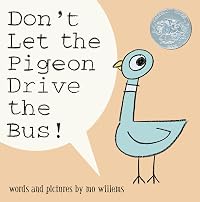
When a bus driver takes a break from his route, a very unlikely volunteer springs up to take his place -- a pigeon! But you've never met one like this before.Tags
Recommendations




Member Recommendations
Member Reviews
Originally published in 2003, and awarded a Caldecott Honor in 2004, Don't Let the Pigeon Drive the Bus has become a modern-day children's classic, capturing, with its perfect blend of cartoon-like illustrations and simple text, the experiences of toddlers everywhere. Opening as a bus-driver temporarily leaves his vehicle in the keeping of the reader, the book follows its eponymous pullastrine hero as he uses every wheedling argument he can think of to get permission to drive the bus. Although unsuccessful, he is unquashed, and the book ends as his attention is drawn to another vehicle...
A book that never fails to win a chuckle from this reader, Don't Let the Pigeon Drive the Bus is a title that I have enjoyed, and that I have show more recommended wholeheartedly in my capacity as a bookseller since it first was published. I was very fortunate to attend a talk given by Mo Willems two years ago, when living in Dublin, and found him as amusing in person as he is in print. He has an ear for the speech patterns of younger children, capturing in his pigeon character their stubborn fixation on what they want, and their mounting frustration when denied. I think it is that sense of recognition that makes the pigeon books so appealing to toddlers, who get to see a little bit of themselves reflected back at them through the main character. Recommended to anyone looking for entertaining and humorous tales for younger children. show less
A book that never fails to win a chuckle from this reader, Don't Let the Pigeon Drive the Bus is a title that I have enjoyed, and that I have show more recommended wholeheartedly in my capacity as a bookseller since it first was published. I was very fortunate to attend a talk given by Mo Willems two years ago, when living in Dublin, and found him as amusing in person as he is in print. He has an ear for the speech patterns of younger children, capturing in his pigeon character their stubborn fixation on what they want, and their mounting frustration when denied. I think it is that sense of recognition that makes the pigeon books so appealing to toddlers, who get to see a little bit of themselves reflected back at them through the main character. Recommended to anyone looking for entertaining and humorous tales for younger children. show less
This charming picture book allows for interaction between the text and the reader/audience. It begins with the bus driver popping off for a break and asking the reader/audience to make sure the pigeon doesn't drive the bus. What follows is the pigeon asking, begging, pleading, whining, etc. to be allowed to drive the bus. Although not written in the text, the obvious response from the reader/audience is always a resounding "No!". In the end the bus driver comes back and a dejected-looking pigeon watches him drive away. But never fear - the final image is of the pigeon dreaming of driving a big rig!
Summary: When a bus driver takes a break from his route, a very unlikely volunteer springs up to take his place - a pigeon! But you've never met one like this before.
Personal Response: I love this book! I can’t read it without laughing out loud. This pigeon is hilarious! Mo Williems has created a book that is interactive and engaging to even very young readers. My children have loved this book at every age level.
Curriculum Connections: This book is a great example to students of how words can convey meaning simply by how they’re written. As the pigeon gets angry, the type of the words change. This book must be read along with the pictures showing children how words and pictures are interconnected.
Personal Response: I love this book! I can’t read it without laughing out loud. This pigeon is hilarious! Mo Williems has created a book that is interactive and engaging to even very young readers. My children have loved this book at every age level.
Curriculum Connections: This book is a great example to students of how words can convey meaning simply by how they’re written. As the pigeon gets angry, the type of the words change. This book must be read along with the pictures showing children how words and pictures are interconnected.
Don’t Let the Pigeon Drive the Bus! is a funny and clever book that I really enjoyed. The way the pigeon begs, pleads, and throws a tantrum feels so much like how kids act when they really want something, which makes it both relatable and entertaining. I like how the story invites the reader to be part of the decision, saying “no” to the pigeon and keeping control of the bus. It’s simple, but it teaches boundaries in a playful way, and the humor makes it memorable.
Mo Willems' DON"T LET THE PIGEON DRIVE THE BUS is a great interactive story that will get kids laughing and wanting to join in on the fun. The story is about a pigeon who really wants to drive the bus. But at the beginning of the book, the reader is instructed by the bus driver NOT to let the pigeon drive the bus. The pages are filled with hilarious illustrations and pleas from the pigeon, begging the reader to let him drive the bus. Of course, the reader is supposed to say no every time - although some of the pigeon's arguments are pretty convincing and almost had me saying yes! The illustrations are simple sketches yet they are able to show a lot of emotion and character. I thoroughly enjoyed reading this book and would love to use it show more as a read-aloud in the classroom. Afterwards, I could have the students write their own alternative endings to the story if the pigeon had been allowed to drive the bus. show less
Love this book about a super pushy pigeon who's absolutely DYING to drive a bus! Basically, the bus driver steps away for a minute and is like "hey, whatever you do, don't let this pigeon drive my bus" and that's when the chaos begins. The pigeon starts begging and pleading like a kid who really really wants candy at the grocery store, pulling out every trick from "I'll be your best friend!" to full-on meltdowns(again just like a child). The whole thing is drawn in super simple illustrations but the way this pigeon's expressions and body language work is so funny. Reminds me of my own kids!
In Don’t Let the Pigeon Drive the Bus! by Mo Willems, the central theme of persuasion and self-regulation is effectively conveyed through direct address and interactive storytelling. The pigeon serves as a dynamic protagonist whose persistent attempts to convince the reader to let him drive the bus highlight the concept of rhetorical appeal, particularly through humor, exaggeration, and emotional manipulation. His character development is subtle yet meaningful, as he cycles through a range of emotions—from confidence to frustration—demonstrating how individuals react when faced with boundaries.
Willems’ use of dialogue and minimalist text emphasizes characterization, allowing the pigeon’s personality to drive the narrative. The show more simplicity of the language contrasts with the complexity of the pigeon’s persuasive strategies, making it an excellent example of how literary techniques can function effectively in children’s literature. Additionally, the pigeon can be interpreted as a symbol of impulsivity, representing the internal struggles young readers may face when learning to accept limits.
The illustrations play a critical role in meaning-making, as the pigeon’s exaggerated facial expressions and body language enhance the emotional tone and humor of the story. As a picture book, it adheres to genre conventions such as repetition and reader interaction while also breaking the fourth wall to engage the audience directly.
This book is highly relevant for children, as it introduces important lessons about boundaries, decision-making, and self-control in an engaging and memorable way. As a future educator, I appreciate how this text can be used to support social-emotional learning while also encouraging student participation and critical thinking. show less
Willems’ use of dialogue and minimalist text emphasizes characterization, allowing the pigeon’s personality to drive the narrative. The show more simplicity of the language contrasts with the complexity of the pigeon’s persuasive strategies, making it an excellent example of how literary techniques can function effectively in children’s literature. Additionally, the pigeon can be interpreted as a symbol of impulsivity, representing the internal struggles young readers may face when learning to accept limits.
The illustrations play a critical role in meaning-making, as the pigeon’s exaggerated facial expressions and body language enhance the emotional tone and humor of the story. As a picture book, it adheres to genre conventions such as repetition and reader interaction while also breaking the fourth wall to engage the audience directly.
This book is highly relevant for children, as it introduces important lessons about boundaries, decision-making, and self-control in an engaging and memorable way. As a future educator, I appreciate how this text can be used to support social-emotional learning while also encouraging student participation and critical thinking. show less
Members
- Recently Added By
Lists

Best children's picture books
377 works; 85 members

Top-Rated Children's Books
87 works; 16 members

1001 Children's Books You Must Read Before You Grow Up
774 works; 101 members

Caldecott Honor Books
296 works; 22 members

Favorite Animal Fiction
359 works; 156 members

Storytime
145 works; 2 members

UNLV 2017 - Ladd's Class
2 works; 1 member

75 Books for Literacy Block: Fall 2016
75 works; 2 members

Puffin Books 70th anniversary handbook recommendations
537 works; 10 members

2000s (the decade, not the century)
184 works; 11 members

Books Read in 2023
5,638 works; 147 members

Early Picture Books
467 works; 9 members

Favorite Picture and Board Books
480 works; 1 member

Books With Complete Sentence Titles
501 works; 17 members
Author Information

148+ Works 140,196 Members
Mo Willems was born on February 11, 1968. After graduating from New York University's Tisch School for the Arts, he spent a year traveling around the world drawing a cartoon every day, which were published in the book You Can Never Find a Rickshaw When it Monsoons. For nine seasons, he worked as a writer and animator for PBS' Sesame Street, where show more he received 6 Emmy Awards for his writing. During this time, he also served as a weekly commentator for BBC Radio and created two animated series, Nickelodeon's The Off-Beats and Cartoon Network's Sheep in the Big City. While working as head writer for Cartoon Network's Codename: Kids Next Door, he began writing and drawing books for children. He received three Caldecott Honor Awards for Don't Let the Pigeon Drive the Bus! in 2004; Knuffle Bunny: A Cautionary Tale in 2005; and Knuffle Bunny Too: A Case of Mistaken Identity in 2008. He also created the Elephant and Piggie series for Easy Readers, which were awarded the Theodor Seuss Geisel Medal in 2008 and 2009. His drawings, wire sculptures, and ceramics have been exhibited in numerous galleries and museums across the nation. Occasionally he serves as the Radio Cartoonist for NPR's All Things Considered. He voices and produces animated cartoons based on his books with Weston Woods studios. The animated Knuffle Bunny was awarded Best Film during the New York International Children's Film Festival in 2008 and received the Andrew Carnegie Medal in 2007. His title Happy Pig Day made Publisher's Weekly Best Seller List for 2011. In 2012 his title Goldilocks and The Three Dinosaurs made The New York Times Best Seller List. In 2013 his titles: That is Not a Good Idea!, Let's Go for a Drive! and I'm a Frog! made the New York Times Best Seller List. In 2014 The Pigeons Need a Bath! and Waiting Is Not Easy! made the New York Times Best Seller List. (Bowker Author Biography) show less
Awards and Honors
Awards
Distinctions
Notable Lists
Series

Work Relationships
Common Knowledge
- Canonical title
- Don't Let the Pigeon Drive the Bus!
- Original title
- Don't Let the Pigeon Drive the Bus!
- Alternate titles
- Do not let the pigeon drive the bus!
- Original publication date
- 2003
- People/Characters
- The Pigeon (1); The Bus Driver
- Dedication
- For Cheryl
- First words
- Hi! I'm the bus driver.
- Last words
- (Click to show. Warning: May contain spoilers.)Hey...
- Original language
- English
Classifications
Statistics
- Members
- 12,623
- Popularity
- 659
- Reviews
- 543
- Rating
- (4.37)
- Languages
- 6 — English, French, Portuguese, Spanish, Vietnamese, Chinese, traditional
- Media
- Paper, Audiobook, Ebook
- ISBNs
- 70
- UPCs
- 4
- ASINs
- 11