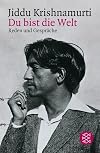
You Are the World: An Authentic Report of Talks and Discussions in American Universities
by J. Krishnamurti
On This Page
Tags
Recommendations

















Member Reviews
Update: Full-length mp3 files of most of the original talks are available for download here:
http://krishnamurti.progressiveradionetwork.org/
Krishnamurti toured college campuses in the US during the winter of 1968- 1969. This book is a collection of twelve campus sessions, and together create an unusually clear picture of Krishnamurti's approach to life. Each talk focused on a different question, and the twelve fit together surprisingly well.
Talk 1: 10/18/68 Brandeis University
"Is it possible to live in this world non-violently, in freedom?"
Talk 2: 10/21/68 Brandeis University
"Can the mind be free of fear?" "What is fear?"
Talk 3: 10/22/68 Brandeis University
"What is meditation?" What is virtue?"
Talk 4: 2/3/69 Berkeley
"What is the show more problem when we observe the world around us and in us?"
"The problem of living in this world."
Talk 5: 2/4/69 Berkeley
"What is relationship?" "What can one person do to bring about a change?"
Talk 6: 2/5/69 Berkeley
"We would like to talk about death, life, and love."
Talk 7: 2/6/69 Berkeley
"What is the state of the mind which can see what truth is?"
Talk 8: 2/11/69 Stanford
"Is it at all possiible for human beings to change?"
Talk 9: 2/12/69 Stanford
"Can one end strife and live completely at peace?"
"Whether it is possible to uncondition the mind?"
Talk 10: 2/13/69 Stanford
"Why do we not change?"
"What is love and what is death?"
Talk 11: 2/14/69 Stanford
"Consider the question of passion and beauty."
"If you will discard authority completely ... then you will also discard all systems and mere repetition of words."
"There is no method for meditation."
Talk 12: 2/19/69 Santa Cruz
"What is going to become of us all?"
"Are we going to make something entirely different of our life?"
Krishanmurti's last talk at Stanford (Talk 11) especially seemed to encapsule his entire teaching. This book is a great entrance into Krishnamurti's world. show less
http://krishnamurti.progressiveradionetwork.org/
Krishnamurti toured college campuses in the US during the winter of 1968- 1969. This book is a collection of twelve campus sessions, and together create an unusually clear picture of Krishnamurti's approach to life. Each talk focused on a different question, and the twelve fit together surprisingly well.
Talk 1: 10/18/68 Brandeis University
"Is it possible to live in this world non-violently, in freedom?"
Talk 2: 10/21/68 Brandeis University
"Can the mind be free of fear?" "What is fear?"
Talk 3: 10/22/68 Brandeis University
"What is meditation?" What is virtue?"
Talk 4: 2/3/69 Berkeley
"What is the show more problem when we observe the world around us and in us?"
"The problem of living in this world."
Talk 5: 2/4/69 Berkeley
"What is relationship?" "What can one person do to bring about a change?"
Talk 6: 2/5/69 Berkeley
"We would like to talk about death, life, and love."
Talk 7: 2/6/69 Berkeley
"What is the state of the mind which can see what truth is?"
Talk 8: 2/11/69 Stanford
"Is it at all possiible for human beings to change?"
Talk 9: 2/12/69 Stanford
"Can one end strife and live completely at peace?"
"Whether it is possible to uncondition the mind?"
Talk 10: 2/13/69 Stanford
"Why do we not change?"
"What is love and what is death?"
Talk 11: 2/14/69 Stanford
"Consider the question of passion and beauty."
"If you will discard authority completely ... then you will also discard all systems and mere repetition of words."
"There is no method for meditation."
Talk 12: 2/19/69 Santa Cruz
"What is going to become of us all?"
"Are we going to make something entirely different of our life?"
Krishanmurti's last talk at Stanford (Talk 11) especially seemed to encapsule his entire teaching. This book is a great entrance into Krishnamurti's world. show less
http://btripp-books.livejournal.com/1197.html
YOU ARE THE WORLD
J.Krishnamurti
There is a strange malaise amongst the student population
of the worid and, at this critical moment,when the campus
has virtually become a battlefield, the words of J.Krishnamurti
direct each person to become his own teacher as well as disciple.
.
For over four decades, Krishnamurti has spoken to people in
all parts of the world. He does not represent any 'school' of
thought, either of the East or of the West. He is only concerned
with facts not with ideas, theories and beliefs. As far back as
1930, George Bernard Shaw was proclaiming him as "the
world's greatest teacher", while in-the present day Aldous
Huxley, in his recently published Letters, ikens a Talk by
Krishnamurti to "a discourse of the Buddha"
I am not your show more teacher - you are not my disciples. There is no
authority, no guru who is going to lead you by the hand to God
or enlightenment. You yourself are both the teacher and the
disciple."
Not a guru, but rather a signpost for the journey each of us has
to make for himself, Krishnamurti asks us to use his words as
a mirror to look at ourselves as we actually are, and to see the
totality of existence. To look în such a manner, the mind must
be completely free not bound by authority of any kind.
This freedom, however, can easily be misunderstood:it does
not mean leading an undisciplined, self indulgent kind of
life, doing as one pleases. The violent protest of the activist
group, intent on changing socrety is meahingless to
Krishnamurti who pöints out that Tthe Only Revolution
(incidentally the title of one o bis most recenr publications)
is a total revolution in the psiche isef, wheri the mind
being can undergo a complete transf oimatien
When asked: "Where did you leatn al that you.know?" he
empties itself of the known It is only then that the human
replies, When you see the truth of arything, what is there to
know?
it is the essential simplicity of direct perception which for
most people will undoubtedly prove to be the stumbling
block. show less
J.Krishnamurti
There is a strange malaise amongst the student population
of the worid and, at this critical moment,when the campus
has virtually become a battlefield, the words of J.Krishnamurti
direct each person to become his own teacher as well as disciple.
.
For over four decades, Krishnamurti has spoken to people in
all parts of the world. He does not represent any 'school' of
thought, either of the East or of the West. He is only concerned
with facts not with ideas, theories and beliefs. As far back as
1930, George Bernard Shaw was proclaiming him as "the
world's greatest teacher", while in-the present day Aldous
Huxley, in his recently published Letters, ikens a Talk by
Krishnamurti to "a discourse of the Buddha"
I am not your show more teacher - you are not my disciples. There is no
authority, no guru who is going to lead you by the hand to God
or enlightenment. You yourself are both the teacher and the
disciple."
Not a guru, but rather a signpost for the journey each of us has
to make for himself, Krishnamurti asks us to use his words as
a mirror to look at ourselves as we actually are, and to see the
totality of existence. To look în such a manner, the mind must
be completely free not bound by authority of any kind.
This freedom, however, can easily be misunderstood:it does
not mean leading an undisciplined, self indulgent kind of
life, doing as one pleases. The violent protest of the activist
group, intent on changing socrety is meahingless to
Krishnamurti who pöints out that Tthe Only Revolution
(incidentally the title of one o bis most recenr publications)
is a total revolution in the psiche isef, wheri the mind
being can undergo a complete transf oimatien
When asked: "Where did you leatn al that you.know?" he
empties itself of the known It is only then that the human
replies, When you see the truth of arything, what is there to
know?
it is the essential simplicity of direct perception which for
most people will undoubtedly prove to be the stumbling
block. show less
Aug 24, 2018Spanish
USTED ES EL MUNDO
„El pensamiento sustenta y nutre tanto al temor
como al placer. Lo que queremos es el placer
continuo, màs y más placer..., y si lo observamos
bien, toda la moralidad social -que es realmente
inmoral- se basa en el placer y el temor, en la
recompensa y el castigo.
El cultivar diversas formas de lo que debería ser
que son llamadas virtud, practicándolas día tras dia
hasta que se vuelven mecánicas, no tiene ningún
sentido. La virtud, ciertamente, es algo de instante
en instante, como la belleza, como el amor, no algo
que uno ha acumulado y desde lo cual actúa.
«El pensamiento engendra el temor, pero el
pensamiento no puede terminar con el temor,
iqué harán entonces?"
„El pensamiento sustenta y nutre tanto al temor
como al placer. Lo que queremos es el placer
continuo, màs y más placer..., y si lo observamos
bien, toda la moralidad social -que es realmente
inmoral- se basa en el placer y el temor, en la
recompensa y el castigo.
El cultivar diversas formas de lo que debería ser
que son llamadas virtud, practicándolas día tras dia
hasta que se vuelven mecánicas, no tiene ningún
sentido. La virtud, ciertamente, es algo de instante
en instante, como la belleza, como el amor, no algo
que uno ha acumulado y desde lo cual actúa.
«El pensamiento engendra el temor, pero el
pensamiento no puede terminar con el temor,
iqué harán entonces?"
Jan 27, 2020Spanish
Ratings
Members
- Recently Added By
Author Information

785+ Works 10,801 Members
Jiddu Krishnamurti was born on May 11, 1895 in Madanapalle, India. As children, he and his brother were adopted by Dr. Annie Besant, then president of the Theosophical Society. She and others proclaimed that Krishnamurti was to be a world teacher whose coming the Theosophists had predicted. To prepare the world for this coming, a world-wide show more organization called the Order of the Star in the East was formed and Krishnamurti was made its head. In 1929, he renounced the role that he was expected to play, dissolved the Order, and returned all the money and property that had been donated for this work. From then until his death, he traveled the world speaking to large audiences and to individuals about the need for a radical change in mankind. He belonged to no religious organization, sect or country, nor did he subscribe to any school of political or ideological thought. On the contrary, he maintained that these are the factors that divide human beings and bring about conflict and war, and that we are all human beings first. He was a philosopher whose teachings of more than 20,000,000 words are published in more than 75 books, 700 audiocassettes, and 1200 videocassettes. He died of pancreatic cancer on February 17, 1986 at the age of 90. (Bowker Author Biography) show less
Classifications
Statistics
- Members
- 158
- Popularity
- 207,748
- Reviews
- 4
- Rating
- (3.90)
- Languages
- 5 — Dutch, English, German, Japanese, Spanish
- Media
- Paper
- ISBNs
- 10
- ASINs
- 4