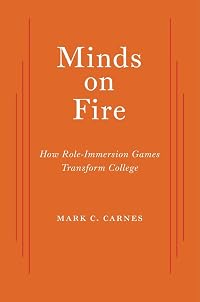
Minds on Fire: How Role-Immersion Games Transform College
by Mark C. Carnes
On This Page
Description
Why are so many students intellectually disengaged? Faculty, administrators, and tuition-paying parents have been asking this question for nearly two centuries. And the answer is always more or less the same: students are so deeply absorbed in competitive social play (fraternities, sports, beer pong, World of Warcraft, social media) that they neglect academics. In Minds on Fire, Carnes shows how role-immersion games channel students' competitive (and sometimes mischievous) impulses into show more transformative learning experiences. His discussion is based on interviews with scores of students and faculty who have used a pedagogy called Reacting to the Past, which features month-long games set during the French revolution, Galileo's trial, the partition of India, and dozens of other epochal moments in disciplines ranging from art history to the sciences. These games have spread to over three hundred campuses around the world, where many of their benefits defy expectations. Students think more critically by internalizing alternative selves, and they understand the past better by filtering it through their present. Fierce competition between opposing sides leads to strong community bonds among teammates and develops speaking, writing, leadership, and problem-solving skills. Minds on Fire is a provocative critique of educational reformers who deplored role-playing pedagogies, from Plato to Dewey to Erikson. Carnes also makes an impassioned appeal for pedagogical innovation. At a time when cost-cutting legislators and trustees are increasingly drawn to online learning, Carnes focuses on how bricks-and-mortar institutions of higher education can set young minds on fire. show lessTags
Recommendations



Member Reviews
College is broken, and anyone with an ounce of insight knows it. I know it, as someone who attended two rather elite institutions, and who's attended and taught at a much more mundane one that nevertheless brags about its 'innovation'. Students are disengaged in their classes, with attitudes ranging from bored to outright rebellion. Despite decades of work on student support and learning, the state of higher education remains dismal. I doubt students remember much of anything from beyond the end of the semester. This status quo would be, well, accepted as much as we've accepted everything else in higher education, except that these days college is ruinously expensive, online courses are lurking to demolish the already precarious show more structure of academic labor, and as a society we're counting on college graduates to solve so many looming social and technological problems.
Carnes thinks he has discovered the solution, in his Reacting to the Past series of games. Reacting to the Past replaces several weeks of traditional curriculum activities (lectures, papers, etc), with an interactive simulation where students take on the roles of key figures around major historical events (The Trial of Socrates, The French Revolution, and many more), break into factions, and try and persuade the other students to favor their cause, with a little help from the dice as arbiters of uncertainty. In character speeches, debates, and papers drive the class, with students driven to research above and beyond their packets by the desire to impress their class.
When it works, it works astoundingly well. Anecdotes from students describe an almost obsessive level of engagement with the class, life-changing experiences that taught them about empathy, leadership, and resilience, and improvements in critical thinking, teamwork and subject expertise. Carnes also has a strong synthesis of the history and psychology of the failure of college, dating back the 1880s Ivy League, and the way in which his theory of "subversive play" describes why students drop out.
However, there's markedly little systemic research on the Reacting to the Past curriculum (just Stroesser et al 2009), and this book sometimes takes on overly defensive, hard-sell attitude. Fair, since it's wildly different than what colleges have been doing, but this may turn off some people.
My more substantial criticism comes from the serious direction of tabletop roleplaying game theory. While I haven't had a chance to delve deeply into a Reacting to the Past unit, from what I understand, it's a cross between a GURPS source-book and a history course reader. I'm a strong proponent that System Matters in tabletop games, and there have been a lot of impressive work done since the mid-90s on system design, particularly lighter systems for narrative play. The second, related criticism, is that I play a lot of RPGs, I consider myself pretty good as a GM, and I've seen a lot of games utterly fall apart. With the much bigger and messier historical simulations of Reacting to the Past, I'm sure there's a lot more places for things to get derailed, and I hope Carnes is engaged with the messy details of the simulation in his guidebooks for teachers.
That aside, this is a serious criticism of college as practiced today, a strong theory as how to improve it, and an extremely impressive collection of anecdotes. In a worst case scenario of just 1% of Reacting to the Past students having the kinds of experiences that Carnes describes, implementing this curriculum is the only ethically sound choice for educators. show less
Carnes thinks he has discovered the solution, in his Reacting to the Past series of games. Reacting to the Past replaces several weeks of traditional curriculum activities (lectures, papers, etc), with an interactive simulation where students take on the roles of key figures around major historical events (The Trial of Socrates, The French Revolution, and many more), break into factions, and try and persuade the other students to favor their cause, with a little help from the dice as arbiters of uncertainty. In character speeches, debates, and papers drive the class, with students driven to research above and beyond their packets by the desire to impress their class.
When it works, it works astoundingly well. Anecdotes from students describe an almost obsessive level of engagement with the class, life-changing experiences that taught them about empathy, leadership, and resilience, and improvements in critical thinking, teamwork and subject expertise. Carnes also has a strong synthesis of the history and psychology of the failure of college, dating back the 1880s Ivy League, and the way in which his theory of "subversive play" describes why students drop out.
However, there's markedly little systemic research on the Reacting to the Past curriculum (just Stroesser et al 2009), and this book sometimes takes on overly defensive, hard-sell attitude. Fair, since it's wildly different than what colleges have been doing, but this may turn off some people.
My more substantial criticism comes from the serious direction of tabletop roleplaying game theory. While I haven't had a chance to delve deeply into a Reacting to the Past unit, from what I understand, it's a cross between a GURPS source-book and a history course reader. I'm a strong proponent that System Matters in tabletop games, and there have been a lot of impressive work done since the mid-90s on system design, particularly lighter systems for narrative play. The second, related criticism, is that I play a lot of RPGs, I consider myself pretty good as a GM, and I've seen a lot of games utterly fall apart. With the much bigger and messier historical simulations of Reacting to the Past, I'm sure there's a lot more places for things to get derailed, and I hope Carnes is engaged with the messy details of the simulation in his guidebooks for teachers.
That aside, this is a serious criticism of college as practiced today, a strong theory as how to improve it, and an extremely impressive collection of anecdotes. In a worst case scenario of just 1% of Reacting to the Past students having the kinds of experiences that Carnes describes, implementing this curriculum is the only ethically sound choice for educators. show less
The volume is an interesting look at Reacting role-play. According the author the classes work extremely well and since I hope try to try it I'd like to think my experience will be the same.
Ratings
Members
- Recently Added By
Lists

Books for Educators
164 works; 6 members
Author Information

29+ Works 1,344 Members
Mark C. Carnes is Ann Whitney Olin Professor of History at Barnard College
Classifications
- Genres
- Nonfiction, Technology, History
- DDC/MDS
- 371.33 — Society, government, & culture Education Schools and their activities; special education Methods of instruction and study Teaching aids, equipment, materials
- LCC
- LB2395.7 .C38 — Education Theory and practice of education Theory and practice of education Higher education
- BISAC
Statistics
- Members
- 55
- Popularity
- 556,089
- Reviews
- 2
- Rating
- (3.50)
- Languages
- English
- Media
- Paper, Ebook
- ISBNs
- 4
- ASINs
- 1