On This Page
Description
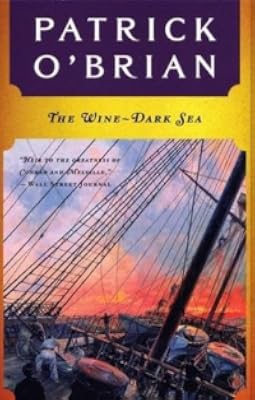
Captain Jack Aubrey and Stephen Maturin set sail aboard the Diane for the South China Sea, shepherding a diplomatic mission to prevent links between Bonaparte and the Malay princes. If their mission fails, English merchant shipping in the area will be threatened. At the barbaric court of Pulo Prabang, the stage is set for a duel of intelligence agents, pitting the savage cunning of Stephen Maturin against the French envoys-who are already entrenched in the Sultan's favor.Tags
Recommendations














Member Reviews
Every now and then it comes round, like the call of the wild blue yonder or the yearning for the unknown - a fancy to take a voyage on the seas of a Patrick O'Brian book. I don't always recognise it and give in to it, more fool me, but thanfully this time I had it by the beam and she filled out the mizzen topmast staysail sweet as kiss your hand, laying us by the lee and poking someone or other in the eye.
The previous Aubrey/Maturin adventure was merely a shaking-out voyage to test the waters for the mission of The Thirteen Gun Salute. Restored to the lists, setting out on a secret mission in Aubrey's favourite ship with a hand-picked crew, the machinations of the intriguing intelligence service oblige them to switch berths. A voyage show more to Malay ensues, setting out to thwart the French and snatch a treaty from the jaws of defeat. There are comings and goings - an unfamiliar crew, an envoy who may turn out to be troublesome, a pair of familiar traitors and opportunities for observing some of the wonders of the natural world. History may plough on, the oceans may storm and toss or go calm, the vagaries of the service may make unreasonable demands, but O'Brian's novels have the vigour, life, discipline, voice and authority of a naval man o'war in full sail. show less
The previous Aubrey/Maturin adventure was merely a shaking-out voyage to test the waters for the mission of The Thirteen Gun Salute. Restored to the lists, setting out on a secret mission in Aubrey's favourite ship with a hand-picked crew, the machinations of the intriguing intelligence service oblige them to switch berths. A voyage show more to Malay ensues, setting out to thwart the French and snatch a treaty from the jaws of defeat. There are comings and goings - an unfamiliar crew, an envoy who may turn out to be troublesome, a pair of familiar traitors and opportunities for observing some of the wonders of the natural world. History may plough on, the oceans may storm and toss or go calm, the vagaries of the service may make unreasonable demands, but O'Brian's novels have the vigour, life, discipline, voice and authority of a naval man o'war in full sail. show less
Book 13 in Patrick O'Brian's Aubrey-Maturin series sends our nautical protagonists on an important diplomatic mission to Malaysia, which plays out with a lot of (honestly sometimes rather disturbing) tricks and shenanigans. Also, Stephen gets to see lots of cool wildlife.
I honestly don't know why I enjoy this series as much as I do. Even in installments like this, where there's not actually much in the way of confusing naval battles, I still spend a surprising amount of time not feeling entirely sure what's going on, as the historical terminology and references go rushing right over my head. And O'Brian, I swear, has no remotest acquaintance with the concept of pacing.
But he does have a very good sense of character, which is shown off show more to good effect here in the character of Fox, the envoy slowly being crushed under the increasing weight of his own inflated ego. He also has an impressive ability to make you feel like you're personally standing there on the deck of a ship next to Captain Aubrey. And he does a nicely realistic depiction of exactly how quickly fortunes can change at sea. show less
I honestly don't know why I enjoy this series as much as I do. Even in installments like this, where there's not actually much in the way of confusing naval battles, I still spend a surprising amount of time not feeling entirely sure what's going on, as the historical terminology and references go rushing right over my head. And O'Brian, I swear, has no remotest acquaintance with the concept of pacing.
But he does have a very good sense of character, which is shown off show more to good effect here in the character of Fox, the envoy slowly being crushed under the increasing weight of his own inflated ego. He also has an impressive ability to make you feel like you're personally standing there on the deck of a ship next to Captain Aubrey. And he does a nicely realistic depiction of exactly how quickly fortunes can change at sea. show less
The thirteenth instalment of the Aubrey and Maturin chronicles is as delightful and compelling as the rest of this matchless series. The pair are sent on an urgent global mission, introduced to annoying new people and charming new animals, menaced by forces meteorological and human, yet their steadfast friendship remains the heart and soul of the narrative. There is so much to appreciate in O’Brian’s elegant, witty, and endlessly humane writing. At the start, he sets the scene for the reader who read the last in the series a while back, while subtly introducing the plot. The customary verbal misunderstandings, punctured pomposities, and personal eccentricities are all present and correct, yet O’Brian makes them fresh and show more delightful every time. Reading an Aubrey/Maturin novel always makes me laugh, hold my breath at moments of tension, and quite forget that I’m not sailing the high seas in the early 19th century. One of my favourite exchanges sums up the central relationship very well:
Of especial note: Jack mishearing the name ‘Fuggers’, complaints about bankers, Stephen replacing his laudanum habit with chewing coca leaves, Jack’s snoring, the Lisbon pilot’s sales pitch, Killick’s perpetually grumpy remarks, Jack and Stephen choosing taffeta together for their wives, spleens, the low-ceilinged cutter captained by one of the tallest officers in the Navy, Jack’s uniform being too big, the voluble patient that tired Stephen, young Philip’s attempt at running away to sea, Jack carefully editing his adventures so that Sophie doesn’t worry, the unfortunate cuttlefish, plagiarism amongst the youths, a troop of grampuses, Stephen prescribing placebos, the arrival in Java, the three officials whose company is a trial, cannon fireworks, Stephen’s magical field trip up the steps, an encounter with rhinos, spy machinations, the purser warning Stephen about the brothel, Jack’s amusement at Stephen staying in a brothel, Fox’s failed babysitting, Stephen wearing scarlet doctoral robes, Jack’s remarks upon Ganymede, the importance of coffee, Stephen being mistaken for an orang-utan, Jack and Stephen always missing one another whenever seperated for a very short time, “What a rattle you are, to be sure”, Stephen hating to be woken up early, the villain of the piece being dissected, Jack and Stephen ducking out of an unseemly dinner party, the mizzen topgallant staysail that Stephen likens to a tablecloth, Jack calling Stephen “Dr Humorous Droll”, the boat’s crew responding to Stephen’s clueless remark about it, the royal salute, a sudden very dramatic storm, “What was that?” “A landslide, my dear”, and the dramatic conclusion: marooned!
To come up with that list I paged through the whole book and kept being drawn back into it - the mark of truly great writing. show less
Quite early in the morning Captain Aubrey stood tall and shadowy by Stephen’s cot. “Are you awake?” he asked in a soft voice.
“I am not,” said Stephen.
“We are going ashore in the new pinnace, and I thought you might like to come too. There may be a whole colony of nondescript boobies.”
“So there may - how truly kind - I shall be with you in a minute.”
Of especial note:
To come up with that list I paged through the whole book and kept being drawn back into it - the mark of truly great writing. show less
At some point O'Brian decided this series would go on indefinitely. The structure of some of the books then became odd. There are some that don't end - they just stop. There's an obvious on-going, unresolved plot but - tough luck - you're gonna hafta wait for the next volume to get a resolution. This is one of them. It ends with a cliff-hanger (which some don't) and for some reason it's easier to handle then when a book just stops apparently arbitrarily.
So, thirteen books in and it's getting harder to find non-repetitive things for Aubrey and Maturin to do with each volume, yet O'Brian pulls it off again! Making Maturin not just a physician but an intelligence officer was a stroke of genius in this regard. It offers a much greater range show more of possible and plausible adventures than regular Royal Navy work could...and so we are off to the Pacific on a diplomatic mission with clandestine additional motivations. The best, most delightful part of this volume is an almost complete aside from the main plot, however: Maturin indulges his interest in natural history by visiting a volcanic island where Orangutans abound.
Back to the cliff-hanger. I have not had so urgent a desire to read the next in this series since probably somewhere in the first five volumes. I think I overdosed for a while and I also think the quality varies somewhat between volumes in this series, but this one is the best since the tenth, at least. show less
So, thirteen books in and it's getting harder to find non-repetitive things for Aubrey and Maturin to do with each volume, yet O'Brian pulls it off again! Making Maturin not just a physician but an intelligence officer was a stroke of genius in this regard. It offers a much greater range show more of possible and plausible adventures than regular Royal Navy work could...and so we are off to the Pacific on a diplomatic mission with clandestine additional motivations. The best, most delightful part of this volume is an almost complete aside from the main plot, however: Maturin indulges his interest in natural history by visiting a volcanic island where Orangutans abound.
Back to the cliff-hanger. I have not had so urgent a desire to read the next in this series since probably somewhere in the first five volumes. I think I overdosed for a while and I also think the quality varies somewhat between volumes in this series, but this one is the best since the tenth, at least. show less
Now that Aubrey is restored to the King's Navy once more, he's off on another mission, this time to Malaysia. His particular friend, Dr.Stephen Maturin, is along to spy on the French's forces in Malaysia. The diplomatic mission goes well, not least because Maturin disgraces and then kills the leading French diplomats. (This plot line is one of those masterful strokes that O'Brian is so excellent at. For the first half of the book, Maturin and Fox often practice their long distance shooting as part of a friendly competition. Later, Maturin befriends an anatomist and has amusingly detached conversations with him. Maturin stays in a brothel and watches the French. All of these minor little background moments come together in one stunning show more scene, when Maturin turns up on the anatomist's doorstop with an unnamed body with a precise bullet hole, and they dispassionately dissect it. It's stunning and cold.) On the way home, the ship is wrecked on uncharted reefs, and the crew is stranded on a small island.
O'Brian has a talent for the long game, giving little clues and hints that slowly build to a crescendo. He's unafraid of making his characters unlikable, or absurd, which in turn makes them actually far more interesting. show less
O'Brian has a talent for the long game, giving little clues and hints that slowly build to a crescendo. He's unafraid of making his characters unlikable, or absurd, which in turn makes them actually far more interesting. show less
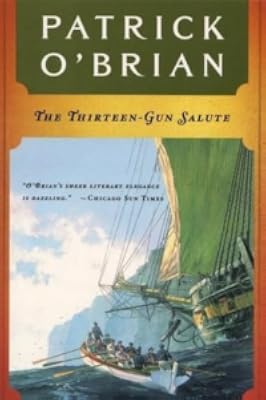
The Thirteen Gun Salute, Patrick O’Brian’s thirteenth book in his Aubrey-Maturin series, picks up shortly after the events of The Letter of Marque, with Captain Jack Aubrey taking the private ship Surprise on a mission to South America in order to foil French interests in the Spanish colonies. Due to the routing of their intelligence service, however, the admiralty must find a way to make the mission more innocuous by sending Jack on a diplomatic mission to to the Indies prior to a roundabout trip back to England by way of South America. As part of this, following Jack’s success in the prior two books, the admiralty restores him to the naval lists and puts him in command of the Diane, which he captured during the events of The show more Letter of Marque. Stephen accompanies him and they plan to rendezvous with Surprise in the South China Sea once their diplomatic mission is complete.
The novel’s title comes from the practice of saluting envoys with thirteen guns (pg. 93) and the particular envoy in question, Edward Fox, works to persuade the Sultan of Pulo Prabang to become an English ally in order to secure the trade of the East Indies Company. Much of the story focuses on Fox’s self-importance, which slowly grows into insufferableness over the course of the story and upsets naval decorum. Upon reaching their destination, O’Brian demonstrates how distance delays bad news, with characters hearing rumors about a run on the market back home (pg. 155). Meanwhile, Dr. Steven Maturin spends his time with naturalist Cornelius van Buren, who offers intelligence to benefit the English efforts. Through Steven, O’Brian explores more of the culture of the island, its politics and entertainment, as well as a remote Buddhist temple where Steven has the joy to see many rare animals in their natural habitat.
In a fun example of misremembered history that lends further verisimilitude to his characters, O’Brian portrays Jack attempting to teach the midshipmen history, specifically about the American Revolution. Jack asks, “Do you know how it began,” leading to the following exchange:
“‘Yes, sir. It was about tea, which they did not choose to pay duty on. They called out No reproduction without copulation and tossed it into Boston harbour.’
“Jack frowned, considered, and said, ‘Well, in any event they accomplished little or nothing at sea, that bout’” (pg. 147).
Recalling events from Master and Commander, Jack runs into the nephew of the French officer that captured the crew of the Sophie in that first novel. As neither are in a position to fight the other, they exchange pleasantries and, learning of the French hardship and inability to purchase stores or make speedy repairs, Jack repays the kindness he received while a prisoner of war by easing the Frenchman’s want for food, thus demonstrating the gentlemanly nature of war in this time (pgs. 228-229). In what may be an act of foreshadowing, the Sultan of Pulo Prabang counts among his titles “the Nutmeg of Consolation” (pg. 182), which is the title of the following book. Like a few others in the series, this story ends on something of a cliffhanger, though readers will enjoy the characters despite the lack of battles in this particular novel.
Like the previous six novels, The Thirteen Gun Salute exists outside the normal flow of time – this novel being the seventh of twelve to exist in what O’Brian described as an extended 1812, with these dozen books taking place between the beginning of June 1813 and November 1813. The specific reference to Jack taking command of Diane on the “fifteenth day of May in the fifty-third year of His Majesty’s reign” (pg. 107) may, perhaps, situate this book in 1814. Those looking for a perfect chronology are advised to simply enjoy the story and the way in which O’Brian perfectly recreates the world of the Napoleonic Wars, using Aubrey and Stephen’s activities to comment on the rapid changes occurring in this era and the passage of time in the series’ internal chronology. This Folio Society edition reprints the original text with insets containing historical portraits and sketches to illustrate some of the scenes. show less
The novel’s title comes from the practice of saluting envoys with thirteen guns (pg. 93) and the particular envoy in question, Edward Fox, works to persuade the Sultan of Pulo Prabang to become an English ally in order to secure the trade of the East Indies Company. Much of the story focuses on Fox’s self-importance, which slowly grows into insufferableness over the course of the story and upsets naval decorum. Upon reaching their destination, O’Brian demonstrates how distance delays bad news, with characters hearing rumors about a run on the market back home (pg. 155). Meanwhile, Dr. Steven Maturin spends his time with naturalist Cornelius van Buren, who offers intelligence to benefit the English efforts. Through Steven, O’Brian explores more of the culture of the island, its politics and entertainment, as well as a remote Buddhist temple where Steven has the joy to see many rare animals in their natural habitat.
In a fun example of misremembered history that lends further verisimilitude to his characters, O’Brian portrays Jack attempting to teach the midshipmen history, specifically about the American Revolution. Jack asks, “Do you know how it began,” leading to the following exchange:
“‘Yes, sir. It was about tea, which they did not choose to pay duty on. They called out No reproduction without copulation and tossed it into Boston harbour.’
“Jack frowned, considered, and said, ‘Well, in any event they accomplished little or nothing at sea, that bout’” (pg. 147).
Recalling events from Master and Commander, Jack runs into the nephew of the French officer that captured the crew of the Sophie in that first novel. As neither are in a position to fight the other, they exchange pleasantries and, learning of the French hardship and inability to purchase stores or make speedy repairs, Jack repays the kindness he received while a prisoner of war by easing the Frenchman’s want for food, thus demonstrating the gentlemanly nature of war in this time (pgs. 228-229). In what may be an act of foreshadowing, the Sultan of Pulo Prabang counts among his titles “the Nutmeg of Consolation” (pg. 182), which is the title of the following book. Like a few others in the series, this story ends on something of a cliffhanger, though readers will enjoy the characters despite the lack of battles in this particular novel.
Like the previous six novels, The Thirteen Gun Salute exists outside the normal flow of time – this novel being the seventh of twelve to exist in what O’Brian described as an extended 1812, with these dozen books taking place between the beginning of June 1813 and November 1813. The specific reference to Jack taking command of Diane on the “fifteenth day of May in the fifty-third year of His Majesty’s reign” (pg. 107) may, perhaps, situate this book in 1814. Those looking for a perfect chronology are advised to simply enjoy the story and the way in which O’Brian perfectly recreates the world of the Napoleonic Wars, using Aubrey and Stephen’s activities to comment on the rapid changes occurring in this era and the passage of time in the series’ internal chronology. This Folio Society edition reprints the original text with insets containing historical portraits and sketches to illustrate some of the scenes. show less
There was slighly less historical detail or sense of place in this installment; Pulo Prabang never really came alive for me as a unique, distinct country. The exception to this was, of course, Stephen's trek to the temple deep in the jungle, and the time he spent with the orang-utans up there: definitely one of the most memorable and evocative moments in the series so far.
Apart from that minor quibble, though, this was as superb as I've come to expect from O'Brian, full of humour and intelligence. The characters were as brilliantly drawn as ever; both throughout the book as a whole, and in those small scenes like Stephen helping van Buren to dissect the bodies of Ledward and Wray (that especially I found utterly chilling. oh Stephen). show more The minor characters were as neatly drawn as always: though I confess I found myself a little uncertain about Fox, who seemed very unbalanced.
The ending was one of the most dramatic in the series, and not the fate I expected for the Diane so soon after her introduction. I have the feeling that despite my best intentions to make the series last, I will be dragging out The Nutmeg of Consolation as soon as I get home this evening to see how it resolves: especially given the fact that I desperately want to know whether or not Stephen is right as to the sex of the baby. *g* show less
Apart from that minor quibble, though, this was as superb as I've come to expect from O'Brian, full of humour and intelligence. The characters were as brilliantly drawn as ever; both throughout the book as a whole, and in those small scenes like Stephen helping van Buren to dissect the bodies of Ledward and Wray (that especially I found utterly chilling. oh Stephen). show more The minor characters were as neatly drawn as always: though I confess I found myself a little uncertain about Fox, who seemed very unbalanced.
The ending was one of the most dramatic in the series, and not the fate I expected for the Diane so soon after her introduction. I have the feeling that despite my best intentions to make the series last, I will be dragging out The Nutmeg of Consolation as soon as I get home this evening to see how it resolves: especially given the fact that I desperately want to know whether or not Stephen is right as to the sex of the baby. *g* show less
Members
- Recently Added By
Lists

Folio Society
831 works; 53 members

Huxley's Reading Log 2018
37 works; 1 member

Books Read in 2018
4,360 works; 110 members
Author Information

154+ Works 76,965 Members
Patrick O'Brian is the author of twenty volumes in the highly respected Aubrey/Maturin series of novels. (Publisher Provided) Patrick O'Brien was born in Ireland in 1914. His education included the Sorbonne. O'Brian has produced a variety of works, including biographies of Picasso and Sir Joseph Banks and translations of the novels and memoirs of show more Simone de Beauvoir, but he is best known for the creation of an unlikely pair of Napoleonic War-era heroes in the Aubrey-Maturin Series. British naval officer Jack Aubrey and Irish scholar and physician Stephen Maturin have been featured in more than a novels published in Great Britain (five of which have also appeared in America). He died on January 2, 2000. (Bowker Author Biography) show less
Some Editions
Series

Work Relationships
Is contained in
Common Knowledge
- Original publication date
- 1989
- People/Characters
- Jack Aubrey; Stephen Maturin; Diana Villiers; Sophie Aubrey; Sir Joseph Blaine; Barrett Bonden (show all 14); Preserved Killick; Tom Pullings; Nathaniel Martin; Andrew Wray; Edward Ledward; Dick Richardson; William Reade; Jean-Pierre Dumesnil
- Important places
- Indonesia; South China Sea; Malaysia; Inaccessible Island; St Helena; Ascension Island (show all 9); Tristan da Cunha; Jakarta, Indonesia (Batavia); London, England, UK
- Dedication
- To Richard Ollard
- First words
- In spite of the hurry, many wives and many sweethearts had come to see the ship off, and those members of her company who were not taken up with sailing her on her difficult course close-hauled to the brisk south-east breeze,... (show all) watched the white flutter of their handkerchiefs far across the water until Black Point hid them entirely, shut them right out.
- Last words
- (Click to show. Warning: May contain spoilers.)'Then, shipmates,' said Jack, smiling at his people, 'let us build one as quick as we can.'
- Publisher's editor
- Lawrence, Starling
Classifications
Statistics
- Members
- 2,642
- Popularity
- 7,092
- Reviews
- 31
- Rating
- (4.19)
- Languages
- 6 — Czech, English, French, German, Italian, Spanish
- Media
- Paper, Audiobook, Ebook
- ISBNs
- 56
- UPCs
- 1
- ASINs
- 20