On This Page
Description
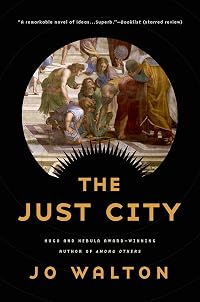
Created as an experiment by the time-traveling goddess Pallas Athene, the Just City is a planned community, populated by over ten thousand children and a few hundred adult teachers from all eras of history, along with some handy robots from the far human future - all set down together on a Mediterranean island in the distant past. The student Simmea, born an Egyptian farmer's daughter sometime between 500 and 1000 A.D, is a brilliant child, eager for knowledge, ready to strive to be her best show more self. The teacher Maia was once Ethel, a young Victorian lady of much learning and few prospects, who prayed to Pallas Athene in an unguarded moment during a trip to Rome - and, in an instant, found herself in the Just City with grey-eyed Athene standing unmistakably before her. Meanwhile, Apollo - stunned by the realization that there are things mortals understand better than he does - has arranged to live a human life, and has come to the City as one of the children. He knows his true identity, and conceals it from his peers. For this lifetime, he is prone to all the troubles of being human. Then, a few years in, Sokrates arrives - the same Sokrates recorded by Plato himself - to ask all the troublesome questions you would expect. show lessTags
Recommendations




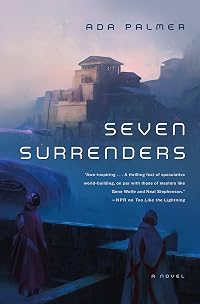
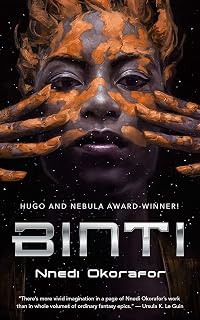


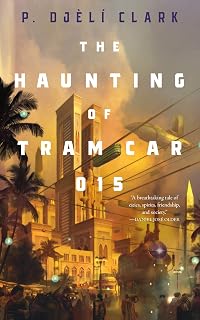
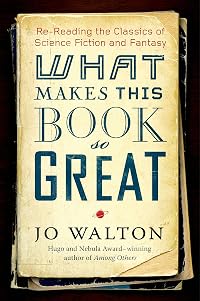


Member Recommendations
by anonymous user
by Cecrow
Member Reviews
Technically, this is a DNF book. I did a lot of skimming after 150 pages, hoping to find the plums in the pudding. Since I didn't read it, word for word from start to finish, I probably shouldn't give it a star rating -- but it's to balance the universe that I do so. Jo Walton might appreciate the irony of that.
This is my first Jo Walton book, and it might be my last. It's hard to make those kinds of definitive statements in literature, and in philosophy, which Jo Walton might also appreciate.
I was on fire to read this book because I was hungry for a dalliance with mythology and it's been so looooooong since I read a good book about the Olympians, et al. Spun into the pudding was a promise of re-visiting Plato's Republic. Speaking quite show more literally, I thought, "What a fantastic premise!" This will be fun. This will be thought-provoking. This will be challenging and exhilarating. As one public figure who has made his presence known all-too-well lately would say, .... "WRONG!"
This was dull. And plodding. And un-original.
I don't understand why her words weighed so heavily on me but I barely had the volition to turn the page. Maybe it was because I was being handed bromides and clichés faster than I could read them; maybe because banalities masqueraded as (philosophical) buzzwords and pretended to offer restorative treatment for spiritual ailment, -- the equivalent of giving Alka-Seltzer to cure pancreatic cancer. This was Philosophy-Lite, with 75% reduced sodium, and gluten-free.
I suppose this is why I don't read many Fantasy, or SciFi or hybrids-of-the-two that are out there. They just don't make sense. So many authors think they can slap any-old dystopian (in this case utopian ha ha!) societies and add a slapdash of hot sauce to it all to spice it up and you have a gourmet meal. Once again, "WRONG!"
Plato deserves much better than this.
My mind deserves much better than this. So does yours. show less
This is my first Jo Walton book, and it might be my last. It's hard to make those kinds of definitive statements in literature, and in philosophy, which Jo Walton might also appreciate.
I was on fire to read this book because I was hungry for a dalliance with mythology and it's been so looooooong since I read a good book about the Olympians, et al. Spun into the pudding was a promise of re-visiting Plato's Republic. Speaking quite show more literally, I thought, "What a fantastic premise!" This will be fun. This will be thought-provoking. This will be challenging and exhilarating. As one public figure who has made his presence known all-too-well lately would say, .... "WRONG!"
This was dull. And plodding. And un-original.
I don't understand why her words weighed so heavily on me but I barely had the volition to turn the page. Maybe it was because I was being handed bromides and clichés faster than I could read them; maybe because banalities masqueraded as (philosophical) buzzwords and pretended to offer restorative treatment for spiritual ailment, -- the equivalent of giving Alka-Seltzer to cure pancreatic cancer. This was Philosophy-Lite, with 75% reduced sodium, and gluten-free.
I suppose this is why I don't read many Fantasy, or SciFi or hybrids-of-the-two that are out there. They just don't make sense. So many authors think they can slap any-old dystopian (in this case utopian ha ha!) societies and add a slapdash of hot sauce to it all to spice it up and you have a gourmet meal. Once again, "WRONG!"
Plato deserves much better than this.
My mind deserves much better than this. So does yours. show less
I want to knock a star off for being yet another damn trilogy, but I knew that going in so that'd make me a bit of a hypocrite, wouldn't it?
Then again, the novel (or third thereof) is all about getting yourself into things you should see coming, and the setup is so brilliant (and a neat jab in the ribs to too many YA 'verses to boot). The Greek gods are bored and puzzled by mankind (that's always a good start), so they kidnap a few hundred Platonian philosophers from all eras, plonk them down on an antique Greek island along with 10,000 likewise kidnapped children, and tell them "There. Now build Plato's Republic for real, in detail. Go on, teach the kids about beauty and justice, divide them into factions according to their worth, get show more them breeding without that pesky emotional bond, all that stuff."
Fun fact: Plato, for all his influence on Western so-called civilization, was kind of a fascist asshole, and the Republic may or may not be about as practical as actually locking a cat in a box with some radioactive material. So The Just City comes to be largely about the difference between idealism and pragmatism, theory and practice, freedom and society, all the while gleefully picking apart the old (and I do mean old) divide-the-kids-into-houses-and-put-them-in-love-triangles plot with an only slightly poisoned pen.
No, The Just City isn't perfect. But that's kind of the point, isn't it? show less
Then again, the novel (or third thereof) is all about getting yourself into things you should see coming, and the setup is so brilliant (and a neat jab in the ribs to too many YA 'verses to boot). The Greek gods are bored and puzzled by mankind (that's always a good start), so they kidnap a few hundred Platonian philosophers from all eras, plonk them down on an antique Greek island along with 10,000 likewise kidnapped children, and tell them "There. Now build Plato's Republic for real, in detail. Go on, teach the kids about beauty and justice, divide them into factions according to their worth, get show more them breeding without that pesky emotional bond, all that stuff."
Fun fact: Plato, for all his influence on Western so-called civilization, was kind of a fascist asshole, and the Republic may or may not be about as practical as actually locking a cat in a box with some radioactive material. So The Just City comes to be largely about the difference between idealism and pragmatism, theory and practice, freedom and society, all the while gleefully picking apart the old (and I do mean old) divide-the-kids-into-houses-and-put-them-in-love-triangles plot with an only slightly poisoned pen.
No, The Just City isn't perfect. But that's kind of the point, isn't it? show less
This is the first book of a three-part whole (The Philosopher Kings and Necessity being the other two).
Athene decides to set up an actual attempt to build Plato's Republic during the Bronze Age, pulling in philosophers/classicists from throughout history as masters to start it up and populating it with ten-year-olds purchased over several hundred years of time travel from slave markets. Socrates gets pulled in five years after the foundation and the sorts of effects ensue that you might expect. (There was a reason the Athenians voted to get rid of him, and that was in a city where most people ignored him as much as they could. In a city of committed Platonists, though, this is not going to be the reaction...) Just to complicate matters, show more Apollo has also decided to become incarnate as one of the children in the city, and provides one of the viewpoints; interestingly, as this works out, the behavioural traits that Jo has handed her incarnate Apollo make him come across as resembling the high-functioning Autism spectrum.
This is at least as good as one might expect from Walton, given her current track record, and arguably her best work yet. The thematic elements that undergird it mesh effortlessly with the characterization and plot elements, and they are among the themes which are absolutely central not only to Plato but to a long succession of philosophers after him: justice/righteousness (both are translations of dikaiosyne), the good life, the nature of learning (via instruction and via experience (vide the Meno, not referenced directly in the work)), the nature of freedom. And there are hints of other themes which are promised to surface later (Necessity being an obvious one).
It's pretty well inevitable that any modern examination of the Republic as a realized city will focus on its failure modes. It stood at the font of the literary/philosophical stream that eventually gave us the Utopia (pretty well literally: More's Utopia is mainly the Republic with the numbers filed off, as are Swift's Houyhnhnms), but it's also very close to the modern dystopia by way of Bentham's panopticon.
Jo's take on it -- allowing the dynamics which break it down to operate effectively enough, early enough, to make it not become a simple dystopia is a welcome approach.
If the two following volumes keep to the same level, this will be a major work. show less
Athene decides to set up an actual attempt to build Plato's Republic during the Bronze Age, pulling in philosophers/classicists from throughout history as masters to start it up and populating it with ten-year-olds purchased over several hundred years of time travel from slave markets. Socrates gets pulled in five years after the foundation and the sorts of effects ensue that you might expect. (There was a reason the Athenians voted to get rid of him, and that was in a city where most people ignored him as much as they could. In a city of committed Platonists, though, this is not going to be the reaction...) Just to complicate matters, show more Apollo has also decided to become incarnate as one of the children in the city, and provides one of the viewpoints; interestingly, as this works out, the behavioural traits that Jo has handed her incarnate Apollo make him come across as resembling the high-functioning Autism spectrum.
This is at least as good as one might expect from Walton, given her current track record, and arguably her best work yet. The thematic elements that undergird it mesh effortlessly with the characterization and plot elements, and they are among the themes which are absolutely central not only to Plato but to a long succession of philosophers after him: justice/righteousness (both are translations of dikaiosyne), the good life, the nature of learning (via instruction and via experience (vide the Meno, not referenced directly in the work)), the nature of freedom. And there are hints of other themes which are promised to surface later (Necessity being an obvious one).
It's pretty well inevitable that any modern examination of the Republic as a realized city will focus on its failure modes. It stood at the font of the literary/philosophical stream that eventually gave us the Utopia (pretty well literally: More's Utopia is mainly the Republic with the numbers filed off, as are Swift's Houyhnhnms), but it's also very close to the modern dystopia by way of Bentham's panopticon.
Jo's take on it -- allowing the dynamics which break it down to operate effectively enough, early enough, to make it not become a simple dystopia is a welcome approach.
If the two following volumes keep to the same level, this will be a major work. show less
I would've given another half star, if not for the abrupt ending, and the lack of real resolution in this series opener.
That said, this is one of those "you can't make that work!" type books. It assumes the Greek gods exist, just as claimed, not aliens acting as gods, capable of turning people into trees, or whatever, petty and powerful. Athena decides to see if Plato's Just City from the New Republic could actually work, so she finds a safe place and time to run the experiment in a way that no trace will be left in history. Athena brings three population to an island that will eventually be destroyed by volcano. There are several hundred "masters" who, at some point in several thousand years of Earth's history, studied the New show more Republic, and prayed to Athena to see it. There are 10,000 children (nominally of age 10) bought on the slave markets over several decades and taken, whether they wished it or not, to the island to start life over with a clean slate. And there are several hundred non-humanoid robot workers to build and maintain the infrastructure.
The story is told by a representative of two of the populations, plus a god: one of the female masters, from Victorian times, one of the female slave children, and Apollo, who has incarnated into mortal human form, to learn about "volition and equal significance."
Walton does at least two astonishing balancing acts here. First, there are pages and pages of Socratic dialogues. This is an island where intellect and discussion dominate almost all decision making. Endless dialog is a recipe for disaster (see John Wright's Golden Age trilogy), but here, the discussion is rich and thoughtful. Like the songs in the best musicals, the discussions advance the plot in a natural way, while deepening the subtexts, not flogging a dead horse.
The second balancing act is in dealing with the consequences of Plato's rules for the Just City and the actions taken to bring it into existence. For example, is buying 10,000 slave children a case of rescue? Or creating a market for more enslavement? The tensions between this and many other aspects of the experiment are never ignored nor trivially resolved.
Highly recommended, even if I hated the way it suddenly jerked to a stop. show less
That said, this is one of those "you can't make that work!" type books. It assumes the Greek gods exist, just as claimed, not aliens acting as gods, capable of turning people into trees, or whatever, petty and powerful. Athena decides to see if Plato's Just City from the New Republic could actually work, so she finds a safe place and time to run the experiment in a way that no trace will be left in history. Athena brings three population to an island that will eventually be destroyed by volcano. There are several hundred "masters" who, at some point in several thousand years of Earth's history, studied the New show more Republic, and prayed to Athena to see it. There are 10,000 children (nominally of age 10) bought on the slave markets over several decades and taken, whether they wished it or not, to the island to start life over with a clean slate. And there are several hundred non-humanoid robot workers to build and maintain the infrastructure.
The story is told by a representative of two of the populations, plus a god: one of the female masters, from Victorian times, one of the female slave children, and Apollo, who has incarnated into mortal human form, to learn about "volition and equal significance."
Walton does at least two astonishing balancing acts here. First, there are pages and pages of Socratic dialogues. This is an island where intellect and discussion dominate almost all decision making. Endless dialog is a recipe for disaster (see John Wright's Golden Age trilogy), but here, the discussion is rich and thoughtful. Like the songs in the best musicals, the discussions advance the plot in a natural way, while deepening the subtexts, not flogging a dead horse.
The second balancing act is in dealing with the consequences of Plato's rules for the Just City and the actions taken to bring it into existence. For example, is buying 10,000 slave children a case of rescue? Or creating a market for more enslavement? The tensions between this and many other aspects of the experiment are never ignored nor trivially resolved.
Highly recommended, even if I hated the way it suddenly jerked to a stop. show less
Plato's Republic is one of the most-debated thought experiments of all time, but I'd always seen the critiques/reflections/responses to Plato's speculations on civic virtue in serious academic writing, so it was very refreshing to see someone think about the Republic in narrative form, and as a fantasy novel no less. What would actually living in the ideal city look like? How would you set it up, keep it running, deal with challenges? Karl Popper spent the whole Volume 1 of The Open Society criticizing the Republic as a totalitarian nightmare state (the classes of citizens, the abhorrence of trade, the idea that as long as the rulers are smart and virtuous enough nothing can go wrong), but in Walton's hands, for many of the characters show more it's much freer than the societies they came from, a practical lesson in applied ethics and the relativity of idealism that couldn't be obtained any other way. Once Walton has set up the premise - Athena has gathered thousands of people from across time in a recreation of Plato's Republic in part to teach Apollo, fresh off of Daphne's escape from his advances via transformation into a laurel tree, important insights about morality and mortality - the characters, including Socrates, have to work within the structures they've chosen and been chosen for to build the lives they want. Utopian societies have a long and honorable place in fiction, such as Francis Spufford's superb evocation of the Soviet 60s in Red Plenty, but it was very satisfying to see the Just City, the ancestor of them all, treated according to its own premises, and as one character says, "Nobody reads Plato and agrees with everything. But nobody reads any of the dialogues without wanting to be there joining in." show less
The Just City is an experiment, Pallas Athene's experiment. An island city, structured in accordance with Plato's Republic. The masters are adults who have all wished to be a part of such a society, plucked from different eras. The children are Greek-speaking ten year olds who have be "rescued" from slavery. The slaves are robots from our future, whose intelligence becomes a matter of debate.
The story unfolds from the perspective of Apollo, who has (temporarily) set aside his powers in order to experience life as a mortal in order to learn about volition and equal significance, and who arrives on the island as one of the children; Maia, one of the masters, who was originally a clergyman's daughter from Victorian England; and Simmea, a show more girl from a farming village near Alexandria.
I really liked the characters and was engrossed in the story because I wanted to know what happened to them, but certainly this is a story where you have be interested in the concept. It is a bit like Walton's My Real Children in that respect - the what if? is absolutely central.
It's obvious from the beginning that the city is not going to be perfect. We didn't have the least idea in the world what we were letting ourselves in for, Apollo says at the beginning - and the question is not Will anything go wrong? but rather, How much will go wrong?
This feels rather appropriate in a novel featuring Greek gods.
The Just City is fascinating, thought-provoking and at times very unsettling. It is an unusual - but successful - blend of history, and myth, and science-fiction. It's about authority, and conformity, and philosophy, and society - particularly the role of women in society - but it is also about the individuals who make up that society.
I found the ending somewhat unsatisfying, but the story isn't over - there are sequels. show less
The story unfolds from the perspective of Apollo, who has (temporarily) set aside his powers in order to experience life as a mortal in order to learn about volition and equal significance, and who arrives on the island as one of the children; Maia, one of the masters, who was originally a clergyman's daughter from Victorian England; and Simmea, a show more girl from a farming village near Alexandria.
I really liked the characters and was engrossed in the story because I wanted to know what happened to them, but certainly this is a story where you have be interested in the concept. It is a bit like Walton's My Real Children in that respect - the what if? is absolutely central.
It's obvious from the beginning that the city is not going to be perfect. We didn't have the least idea in the world what we were letting ourselves in for, Apollo says at the beginning - and the question is not Will anything go wrong? but rather, How much will go wrong?
This feels rather appropriate in a novel featuring Greek gods.
The Just City is fascinating, thought-provoking and at times very unsettling. It is an unusual - but successful - blend of history, and myth, and science-fiction. It's about authority, and conformity, and philosophy, and society - particularly the role of women in society - but it is also about the individuals who make up that society.
I found the ending somewhat unsatisfying, but the story isn't over - there are sequels. show less
Full Review can be found at TenaciousReader: http://www.tenaciousreader.com/2015/01/10/the-just-city-by-jo-walton/
A very thought provoking and insightful book that makes you question the way things are in the world, as well as how they could be (and if that “other way” would really be better or worse).
The Just City is an experiment carried out with by a Goddess. Her goal was to create perfectly balanced society where its citizens are judged solely on their own merits and abilities. There is to be no preferential treatment, people there should want to be their best selves and strive to do right by the city. If everyone lives by this code, then the city should thrive.
Since the masters had all prayed to Athena specifically to join this show more city, there was not an equal representation of people through out all of time. And there was a greater percentage of men from periods of time where women held less status. And not much representation from the modern age, as Athena is not generally a goddess of choice any more. It is interesting to watch the women masters in this and how they handle being given such responsibility and being valued for their intellect and desire to learn, something rarely seen in their prior lives. But also having to deal with some of the male masters from a much older time period that were not quite as open to equality of the genders. This makes for an interesting dynamic.
Sokrates makes an appearance, though years after the children have been brought there. He is not quite a master, but is definitely not a child. But the questions and insights he brings to the City, while may seem almost silly at times, are absolutely critical.
The book also examines the nature of thinking beings and question what constitutes a person. There are issues of choice. And with a society of so much structure, you can’t help but notice there are some fundamental choices that are taken away. Can a society be “just” when it’s citizen’s lack the freedom to choose? Just a small sampling of the philosophical questions you can’t help but examine while reading.
This was my first book by Jo Walton, but it certainly won’t be my last. This was a very powerful and addictive book. Usually books that I have a hard time putting down are often faster paced, but while this was not “action-packed”, it was fully absorbing. Highly recommend. show less
A very thought provoking and insightful book that makes you question the way things are in the world, as well as how they could be (and if that “other way” would really be better or worse).
The Just City is an experiment carried out with by a Goddess. Her goal was to create perfectly balanced society where its citizens are judged solely on their own merits and abilities. There is to be no preferential treatment, people there should want to be their best selves and strive to do right by the city. If everyone lives by this code, then the city should thrive.
Since the masters had all prayed to Athena specifically to join this show more city, there was not an equal representation of people through out all of time. And there was a greater percentage of men from periods of time where women held less status. And not much representation from the modern age, as Athena is not generally a goddess of choice any more. It is interesting to watch the women masters in this and how they handle being given such responsibility and being valued for their intellect and desire to learn, something rarely seen in their prior lives. But also having to deal with some of the male masters from a much older time period that were not quite as open to equality of the genders. This makes for an interesting dynamic.
Sokrates makes an appearance, though years after the children have been brought there. He is not quite a master, but is definitely not a child. But the questions and insights he brings to the City, while may seem almost silly at times, are absolutely critical.
The book also examines the nature of thinking beings and question what constitutes a person. There are issues of choice. And with a society of so much structure, you can’t help but notice there are some fundamental choices that are taken away. Can a society be “just” when it’s citizen’s lack the freedom to choose? Just a small sampling of the philosophical questions you can’t help but examine while reading.
This was my first book by Jo Walton, but it certainly won’t be my last. This was a very powerful and addictive book. Usually books that I have a hard time putting down are often faster paced, but while this was not “action-packed”, it was fully absorbing. Highly recommend. show less
Members
- Recently Added By
Published Reviews
ThingScore 88
The Just City is a glorious example of one of the primary purposes of speculative fiction: serving as a map to the potentials and miseries of a possible world. But it is also a map that should be scrawled with the words, “here be dragons.”
added by bluejo
Brilliant, compelling, and frankly unputdownable, this will do what your Intro to Philosophy courses probably couldn't: make you want to read The Republic.
added by bluejo
Lists

2016 Hugo Eligible Novels
90 works; 32 members

Best Time Travel Novels
165 works; 125 members

NPR Summer 2021: 50 Favorite Sci-Fi And Fantasy Books Of The Past Decade
50 works; 8 members

Top Five Books of 2020
982 works; 348 members

Top Five Books of 2015
811 works; 241 members

Speculative Fiction to Read
706 works; 31 members

once upon a time ~ ancient world
46 works; 7 members

Shannon's Read-Alikes List
71 works; 8 members

CBC's Great Canadian Reading List
149 works; 5 members
Author Information

61+ Works 14,691 Members

Jo Walton is a LibraryThing Author, an author who lists their personal library on LibraryThing.
Some Editions
Awards and Honors
Awards
Distinctions
Notable Lists
Series

Work Relationships
Is contained in
Was inspired by
Common Knowledge
- Canonical title
- The Just City
- Original publication date
- 2015-01
- People/Characters
- Apollo; Pallas Athena; Sokrates; Simmea; Maia; Benjamin Jowett (Adeimantus) (show all 17); Ellen Francis Mason (Aristomache); Titus Pomponius Atticus; Marsilio Ficino; Giovanni Pico della Mirandola (Ikaros); Crito; Lucrezia Borgia; Boethius (Anicius Manlius Torquatus Severinus, ca. 480-ca. 524); Plotinus; Marcus Tullius Cicero; Crocus; Sixty-One
- Epigraph
- Wherever you go, there are plenty of places where you will find a welcome; and if you choose to go to Thessaly, I have friends there who will make much of you and give you complete protection, so that no one in Thessaly can i... (show all)nterfere with you.
—Plato, Crito
The triremes which defended Greece at Salamis defended Mars too.
—Ada Palmer, Dogs of Peace
Yes, I know, Plato; but if you always take the steps in threes, one day you will miss a cracked one.
—Mary Renault, The Last of the Wine
If you could take that first step
You could dance with Artemis
Beside Apollo Eleven.
—Jo Walton, "Submersible Moonphase" - Dedication
- This is for Ada, who took me to Bernini's Apollo.
- First words
- She turned into a tree. It was a Mystery. It must have been. Nothing else made sense, because I didn't understand it.
- Last words
- (Click to show. Warning: May contain spoilers.)Not even Necessity knows all ends. Know yourself.
- Publisher's editor
- Nielsen Hayden, Patrick
- Blurbers
- Palwick, Susan
- Original language
- English
- Canonical DDC/MDS
- 823.914
- Canonical LCC
- PR6073.A448
Classifications
Statistics
- Members
- 1,171
- Popularity
- 21,425
- Reviews
- 82
- Rating
- (3.80)
- Languages
- English, Spanish
- Media
- Paper, Audiobook, Ebook
- ISBNs
- 9
- ASINs
- 4