On This Page
Description
Four years after she set sail from England, leaving everything she most loved behind, Maisie Dobbs at last returns, only to find herself in a dangerous place . . .In Jacqueline Winspear's powerful story of political intrigue and personal tragedy, a brutal murder in the British garrison town of Gibraltar leads Maisie into a web of lies, deceit, and peril.
Spring 1937. In the four years since she left England, Maisie Dobbs has experienced love, contentment, stability—and the deepest tragedy show more a woman can endure. Now, all she wants is the peace she believes she might find by returning to India. But her sojourn in the hills of Darjeeling is cut short when her stepmother summons her home to England; her aging father Frankie Dobbs is not getting any younger.
But on a ship bound for England, Maisie realizes she isn't ready to return. Against the wishes of the captain who warns her, "You will be alone in a most dangerous place," she disembarks in Gibraltar. Though she is on her own, Maisie is far from alone: the British garrison town is teeming with refugees fleeing a brutal civil war across the border in Spain.
Yet the danger is very real. Days after Maisie's arrival, a photographer and member of Gibraltar's Sephardic Jewish community, Sebastian Babayoff, is murdered, and Maisie becomes entangled in the case, drawing the attention of the British Secret Service. Under the suspicious eye of a British agent, Maisie is pulled deeper into political intrigue on "the Rock"—arguably Britain's most important strategic territory—and renews an uneasy acquaintance in the process. At a crossroads between her past and her future, Maisie must choose a direction, knowing that England is, for her, an equally dangerous place, but in quite a different way.
. show less
Tags
Recommendations











Member Reviews
This is one of my favorite Maisie Dobbs books, because it deals with loss and grief in a very real way. The book opens with a series of letters that catch the reader up on some painful events that have occurred since the last book ended. Although somewhat recovered now, Maisie is not ready to return to England and debarks ship in Gibraltar. Stumbling upon an unresolved murder, Maisie uses work to try and grope her way back into life. Soon she is embroiled in a case involving Sephardic Jews, spies, arms smuggling, and the murky motivations of nations involved in the Spanish Civil War.
For those who are fans of WWI and WWII fiction, you can’t go wrong with Jacqueline Winspear’s Maisie Dobbs series. This is not fiction for the faint of heart. This is fiction where you get a real glimpse of life in the dangerous times. We find Maisie in Gibraltar in 1937 right during the Spanish Civil War. Maisie is grieving after the horrendous loss of her husband James and their unborn daughter. She’s been travelling and not really keeping her family up to date on the state of her mental health. She discovers the dead body of a local photographer who was killed on a dark Gibraltar pathway. Trying to discover what happened to Sebastian Babayoff sets Maisie on a game of cat and mouse where the stakes are high. This book is a show more crossroads in Maisie Dobbs’ life, and she can either follow the trail or give in to despair and grief and walk away. Despite pressure from her friends and family, Maisie decides to follow the trail of the dead photographer, thus putting herself into danger and darkness again. This series is one of my top historical fiction series. Seeing the state of the world from Maisie’s eyes truly takes the.blinders off, and brings war and all its desolation to the forefront. I could never figure out why authors sugar-coat, tamp down the desolation and romanticize war. Here we see it at its worst. And Maisie at her best—doing her bit to ease the suffering. show less
Maisie Dobbs finds herself in Gibraltar, licking her wounds after recent tragedy. Literally stumbling over a dead body, she suspects the police explanation of the murder is lacking. Not specifically hired by anyone and thus not an 'official' case, Maisie still feels the circumstances require her intervention. Her investigation takes her into Spain at the height of hostilities in that benighted Civil War -- most definitely a 'dangerous place.' However, the title may also refer to Maisie's inner turmoil as she deals with her personal demons. Readers familiar with the first ten books of this series know Maisie has much practice in dealing with inner demons.
Now, for a rant and why I doubt I'll read any further in this series (WARNING show more Spoliers abound!): Writers of series such of this have a certain compact of fidelity with their readers. Loyal followers have invested time, expense and emotion in the story and characters. In the lead up to this latest installment, we have suffered mightily with Miss Dobbs. We have watched the ever kind, handsome and patient James plight his troth over several books. When last we left Maisie, she has finally promised a 'yes' or 'no' answer to his proposal. So, what happens? Within the space of a few short pages related in cursory fashion, we are propelled forward four years, only to learn of their blissful wedding, happy marriage and blessed hopes as expected parents. Husband and child are summarily killed by plane and miscarriage. By page 18 or so we are washed upon the shores of Gibraltar.
What? We don't get to experience the answer to the proposal? The wedding? Some of their happiness? The answer to several books gone by of how she'll handle her work and marriage? Talk about a betrayal of those who have stuck around this long! And now we get more inner angst and navel gazing? Talk about pulling the rug out! I understand killing off major characters. Had we been there for the promised pay off, perhaps we could join more fully in her incredible grief.
On top of which, Maisie has become hideously self indulgent, selfish and petulant. She escapes off the grid, avoiding all contact with her elderly infirm father, whom she hasn't seen since her marriage -- and is clearly worried about her. She refuses to go to England, thus denying her dead husband's parents the chance to even hold a Memorial service as they await her return. They can't have the service without the daughter-in-law widow. And Maisie knows they can't but still doesn't go back. Who does this? And it gets fixed by blithe little letters with no return address assuming their understanding?
I am thoroughly tired of Miss Dobbs and I suspect Ms. Winspear must be as well to have had such an abrupt off-screen deus ex machina veering of plot. I give this two stars -- one for the author writing it and one for me for reading it. show less
Now, for a rant and why I doubt I'll read any further in this series (WARNING show more Spoliers abound!):
What? We don't get to experience the answer to the proposal? The wedding? Some of their happiness? The answer to several books gone by of how she'll handle her work and marriage? Talk about a betrayal of those who have stuck around this long! And now we get more inner angst and navel gazing? Talk about pulling the rug out! I understand killing off major characters. Had we been there for the promised pay off, perhaps we could join more fully in her incredible grief.
On top of which, Maisie has become hideously self indulgent, selfish and petulant. She escapes off the grid, avoiding all contact with her elderly infirm father, whom she hasn't seen since her marriage -- and is clearly worried about her. She refuses to go to England, thus denying her dead husband's parents the chance to even hold a Memorial service as they await her return. They can't have the service without the daughter-in-law widow. And Maisie knows they can't but still doesn't go back. Who does this? And it gets fixed by blithe little letters with no return address assuming their understanding?
I am thoroughly tired of Miss Dobbs and I suspect Ms. Winspear must be as well to have had such an abrupt off-screen deus ex machina veering of plot. I give this two stars -- one for the author writing it and one for me for reading it. show less
Maisie isn't the only person at a crossroads. As concerns this series, I am, too. Longtime fans will probably be as stunned as I over the first few pages of A Dangerous Place. In a series of letters, Winspear deals with four momentous years in Maisie's life with what can only be described as brisk efficiency. I can understand her desire not to bog down the narrative, but since Maisie is already constantly harking back to time spent with her mentor or her service in World War I or her college days or what her best friend would say to her, what's a little more time spent on telling readers about those four years?
Winspear does her usual marvelous job in giving readers a real feel for the setting. With the Spanish Civil War raging just over show more the border, with the build-up to World War II, Gibraltar's strategic position makes it extremely valuable to many countries, and it seems that they all have representatives in place, lurking around the corners of buildings and following Maisie wherever she goes.
The author has also created a strong secondary cast-- Salazar the café owner, Mrs. Bishop the owner of the guesthouse, and the dead man's sister among them. The more the story unfolds, the more it seems that no one is whom they first appear to be, and with the number of people spying on others it's a miracle they don't start tripping over each other. This is a presentiment of another problem I'm beginning to have with a series I've loved since its inception.
The closer to World War II the series becomes, the more the storylines are delving into the shadowy world of spies and double-dealing. I've never cared for spy novels, so I'm definitely not enjoying this foray into that world. But as a character told Maisie in a previous book, once those spy organizations get their hooks into you, they don't let you go. I really don't want to see Maisie go down that road.
Although the mystery is rather slow to unfold, it does pick up speed and becomes quite intriguing. I enjoyed watching Maisie solve a complex case, just as I enjoyed the author's depiction of Gibraltar at this very tumultuous time. I'm deeply invested in Winspear's character. Maisie's story has grown from being a rags-to-riches tale to something deeper and much more meaningful. But for the past few books, Maisie has seemed to take two steps back to every three steps forward. Her experiences during World War I have left an indelible mark upon her of which she seems unwilling or unable to let go. With her constant musing on the past, I just can't quite see her as a successful spy in the next calamitous war to come. I am at a crossroads, and I am actually wondering if I'll be continuing with this series-- something that would have been completely unthinkable in the past. show less
Winspear does her usual marvelous job in giving readers a real feel for the setting. With the Spanish Civil War raging just over show more the border, with the build-up to World War II, Gibraltar's strategic position makes it extremely valuable to many countries, and it seems that they all have representatives in place, lurking around the corners of buildings and following Maisie wherever she goes.
The author has also created a strong secondary cast-- Salazar the café owner, Mrs. Bishop the owner of the guesthouse, and the dead man's sister among them. The more the story unfolds, the more it seems that no one is whom they first appear to be, and with the number of people spying on others it's a miracle they don't start tripping over each other. This is a presentiment of another problem I'm beginning to have with a series I've loved since its inception.
The closer to World War II the series becomes, the more the storylines are delving into the shadowy world of spies and double-dealing. I've never cared for spy novels, so I'm definitely not enjoying this foray into that world. But as a character told Maisie in a previous book, once those spy organizations get their hooks into you, they don't let you go. I really don't want to see Maisie go down that road.
Although the mystery is rather slow to unfold, it does pick up speed and becomes quite intriguing. I enjoyed watching Maisie solve a complex case, just as I enjoyed the author's depiction of Gibraltar at this very tumultuous time. I'm deeply invested in Winspear's character. Maisie's story has grown from being a rags-to-riches tale to something deeper and much more meaningful. But for the past few books, Maisie has seemed to take two steps back to every three steps forward. Her experiences during World War I have left an indelible mark upon her of which she seems unwilling or unable to let go. With her constant musing on the past, I just can't quite see her as a successful spy in the next calamitous war to come. I am at a crossroads, and I am actually wondering if I'll be continuing with this series-- something that would have been completely unthinkable in the past. show less
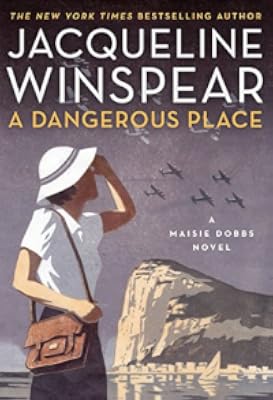
Having followed Jacqueline Winspear from the start of the Maisie Dobbs series, I was not surprised to find that the words of the title "a dangerous place" can take on diverse meanings. Maisie is indeed in a dangerous place and not only physically. Her decision to travel before giving her lover James the answer to his proposal is in tune with her personality, integrity, honesty and cautiousness about how she will live her life. And the cautiousness definitely comes into play here and battles it out with her personal integrity. The cover illustration also defines the specific place of Gibraltar and a specific incident totally horrendous in its implementation- Guernica. In all of the Maisie Dobbs books, the author places her character in show more real time; and Maisie always seems to be the very center of a tornado which is twirling her round and round until she finally lands and can be quit of the velocity. I found myself learning more about the Spanish Civil War and the positions that countries would and did take in the years to come.
It all starts as Maisie stumbles, literally, across a dead man during one of her evening walks. And because she is Maisie Dobbs, the fact that she reports this to the local police doesn't leave her satisfied. Into the whirlwind she goes, insisting, persistently. Not to everyone's liking as usual. I very much approve of the ending, feeling that this is entirely in character for Maisie Dobbs.
I have noted that several other reviewers caution first-time readers of the Maisie Dobbs series not to begin with this book. Agree. The Maisie Dobbs series has to begin at the very beginning, with Book 1. show less
It all starts as Maisie stumbles, literally, across a dead man during one of her evening walks. And because she is Maisie Dobbs, the fact that she reports this to the local police doesn't leave her satisfied. Into the whirlwind she goes, insisting, persistently. Not to everyone's liking as usual. I very much approve of the ending, feeling that this is entirely in character for Maisie Dobbs.
I have noted that several other reviewers caution first-time readers of the Maisie Dobbs series not to begin with this book. Agree. The Maisie Dobbs series has to begin at the very beginning, with Book 1. show less
I had heard about the "surprise" beginning of this book a long time before reading it. So I was prepared for it at least. Many others have spoken about all the problems with this approach, and I agree wholeheartedly and it felt like a dreadful cop out. Putting characters thru Hell is part of what makes for good story-telling, but most readers are going to expect those tragedies to be shown and not told and for them to be either backstory at the beginning of the series or to have the opportunity to experience them with the character so we feel her emotions. Maisie comes across as someone grieving horribly, but over something which is only abstractly horrify to the reader, not visceral.Such a lost opportunity!
That issue aside, the show more mystery, which has no importance beyond the personal grief of the family (which Maisie is extending by insisting on pushing her investigation), is poorly developed and revealed and is muddled with so many smaller intrigues that it almost gets lost in the shuffle multiple times.
Seemingly it's all only presented to show Maisie trying (and mostly failing for much of the book) to put together the pieces of her broken life. What she needs - and should know she needs - is someone to talk to. Or has her psychological training completely been forgotten??? Instead she gets herself involved in war and conflict, spycraft and nursing, and muddling through completely alone, and this is somehow healing to her? Not terribly believable. This is pathology not independence. And seems like a perfect setup for repressing pain and ending up in terrible shape down the road when she can no longer keep her demons at bay. (Potentially interesting in future books, certainly, but horribly boring in this book.) The unemotional, casual, and blasé acceptances (presented as flat statements often when looking in the mirror) of the recent deaths of husband and baby and her new status as widow in the last third of the book and are almost offensive in their numbness, as is her "brushes" with morphine and tobacco use without falling into addiction.
Now I'm thinking that the earlier books must have been much worse than I'd originally noticed. :( Another series to strike off the to-read shelf. show less
That issue aside, the show more mystery, which has no importance beyond the personal grief of the family (which Maisie is extending by insisting on pushing her investigation), is poorly developed and revealed and is muddled with so many smaller intrigues that it almost gets lost in the shuffle multiple times.
Seemingly it's all only presented to show Maisie trying (and mostly failing for much of the book) to put together the pieces of her broken life. What she needs - and should know she needs - is someone to talk to. Or has her psychological training completely been forgotten??? Instead she gets herself involved in war and conflict, spycraft and nursing, and muddling through completely alone, and this is somehow healing to her? Not terribly believable. This is pathology not independence. And seems like a perfect setup for repressing pain and ending up in terrible shape down the road when she can no longer keep her demons at bay. (Potentially interesting in future books, certainly, but horribly boring in this book.) The unemotional, casual, and blasé acceptances (presented as flat statements often when looking in the mirror) of the recent deaths of husband and baby and her new status as widow in the last third of the book and are almost offensive in their numbness, as is her "brushes" with morphine and tobacco use without falling into addiction.
Now I'm thinking that the earlier books must have been much worse than I'd originally noticed. :( Another series to strike off the to-read shelf. show less
After the 10th installment I thought we would get a very detailed account of Maisie's travels in India and how she achieved (if she did achieve it) the insights she was looking for. Instead we skip ahead 4 years to 1937 and get only a brief few pages about what happened during that time. Suffice it to say Maisie suffered more personal tragedy, and sadly, James was not her happily ever after. I'm kind of glad about that since Winspear had written that entire subplot into a corner there was really no other way out of except to resolve it in a rather heavy-handed manner. The series could not continue into WW2 with Maisie as Lady Compton. Instead she washes ashore in Gibraltar, on her way back to London. There she (of course) stumbles upon show more a dead body and a mystery to solve. As hinted in earlier stories, it looks like intelligence and undercover work is in Maisie's future. The Gibraltar/Spanish Civil War setting was really interesting. Winspear is no John LeCarre, but I enjoyed this transitional installment of the series. show less
Members
- Recently Added By
Lists

Books Read in 2016
4,666 works; 199 members

Global Reads: Books Set in Western Europe
186 works; 10 members
Author Information

33+ Works 32,560 Members
Jacqueline Winspear was born in the county of Kent, England. She was educated at the University of London's Institute of Education. After graduation, she worked in academic publishing, in higher education, and in marketing communications in the UK. In 1990, she emigrated to the United States. She was working in business and as a show more personal/professional coach when she decided to try writing. Her first novel, Maisie Dobbs, won the Agatha Award for Best First novel, the Macavity Award for Best First Novel, and the Alex Award. She is the author of the Maisie Dobbs Mystery series. She has also won the Agatha Award for Best Novel, the inaugural Sue Feder/Macavity Award for Best Historical Mystery, and the Bruce Alexander Award for Best Historical Mystery. Her title, A Dangerous Place, made The New York Times High Profile titles list. Journey to Munich, a book in the Maisie Dobbs Series, made the New York Times bestseller list in 2016. (Bowker Author Biography) show less
Some Editions
Series

Common Knowledge
- Canonical title
- A Dangerous Place
- Original publication date
- 2015-03-17
- People/Characters
- Maisie Dobbs; Sebastian Babayoff; Arturo Kenyon; Miriam Babayoff; Robert MacFarlane; Antonio Vallejo (show all 9); Rosanna Grillo; Mrs. Bishop; Thomas Wright
- Important places
- Gibraltar; Spain
- Important events
- Spanish Civil War
- Epigraph
- The world is a dangerous place to live; not because of the people who are evil, but because of the people who don't do anything about it.
--Albert Einstein
The world is getting to be such a dangerous place, a man is lucky to get out of it alive.
--W. C. Fields - Dedication
- To Kas Salazar
Dear friend, this one's for you. - First words
- Arturo Kenyon stood in the shadows of a white-washed building opposite a small guesthouse known locally as Mrs. Bishop's, though it had no sign to advertise the fact.
- Last words
- (Click to show. Warning: May contain spoilers.)"Hope."
Classifications
Statistics
- Members
- 1,197
- Popularity
- 20,897
- Reviews
- 73
- Rating
- (3.71)
- Languages
- English
- Media
- Paper, Audiobook, Ebook
- ISBNs
- 21
- ASINs
- 5