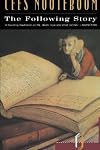
The Following Story
by Cees Nooteboom
On This Page
Description
Herman Mussert went to bed last night in Amsterdam and wakes in Lisbon in a hotel room where he slept with another man’s wife more than twenty years ago. Winner of the European Literary Prize for Best Novel, and a New York Times Notable Book of the Year. Translated by Ina Rilke. A Helen and Kurt Wolff BookTags
Recommendations


Member Reviews
Hermann Mussert wakes up in a hotel room in Lisbon that he visited twenty years previous, despite having gone to sleep in his room in Amsterdam the night before. Clearly all is not as it seems, which prompts the question what is as it seems. And the answer to that traces the course of a life, which Mussert pursues in hopes of recalling himself to himself. Most recently he has been a writer of travel books under the name ‘Dr Strabo’. But before that he had been a teacher of Latin and Greek in a high school in Holland. None of which explains how it is he has woken up in Lisbon. But Mussert knows enough to know it probably has something to do with love.
Thereafter he intersperses recollections of Lisbon with his time teaching and of the show more woman with whom he fell in love. It is a complicated tale of love and revenge made more so by the fact that Maria Zienstra, his lover, is a biology teacher at the school and her temperament — rational and exacting — couldn’t be more different from his own. There is also the unfortunate fact that she only agrees to a liaison with him to spite her husband, who is having an affair with one of the students at the school. In the second half of the book it becomes more probable that Mussert is in a kind of limbo which he imagines as a voyage on a ship from Portugal to Brazil. The culmination of the journey will lead to his transfiguration. But for that to occur, he will have to be able to tell his story to its end.
For a slim volume, this is intensely rich writing. It is soaked in classical allusions and direct reference and quotation (for which translations are provided). Nooteboom handles the depth with surety and lightness. Mussert’s teaching methods are mesmerizing and the way in which they contrast with those of the biology teacher are stark. But it is the enigmatic figure of the brilliant young female student, Lisa d’India, that sets the action alight. Muse or siren? Or innocent? It is marvellous writing that positively demands rereading.
Highly recommended. show less
Thereafter he intersperses recollections of Lisbon with his time teaching and of the show more woman with whom he fell in love. It is a complicated tale of love and revenge made more so by the fact that Maria Zienstra, his lover, is a biology teacher at the school and her temperament — rational and exacting — couldn’t be more different from his own. There is also the unfortunate fact that she only agrees to a liaison with him to spite her husband, who is having an affair with one of the students at the school. In the second half of the book it becomes more probable that Mussert is in a kind of limbo which he imagines as a voyage on a ship from Portugal to Brazil. The culmination of the journey will lead to his transfiguration. But for that to occur, he will have to be able to tell his story to its end.
For a slim volume, this is intensely rich writing. It is soaked in classical allusions and direct reference and quotation (for which translations are provided). Nooteboom handles the depth with surety and lightness. Mussert’s teaching methods are mesmerizing and the way in which they contrast with those of the biology teacher are stark. But it is the enigmatic figure of the brilliant young female student, Lisa d’India, that sets the action alight. Muse or siren? Or innocent? It is marvellous writing that positively demands rereading.
Highly recommended. show less
Former classics teacher Herman Mussert ("Sokrates" to his students and colleagues) wakes up in a familiar Lisbon hotel room, a room he had stayed in in the course of an extramarital affair some twenty years earlier. Which is fine, except that he's sure he went to sleep the evening before in his own apartment in Amsterdam.
It soon becomes clear that this trip — if it is a trip — has nothing to do with Mussert's current job as a hack writer of guidebooks to foreign places for ignorant Dutch tourists (obviously Nooteboom making gentle fun of his own work as a travel writer) and everything to do with that long-ago affair with biology teacher Maria, which in turn was connected to an affair between Maria's partner Arendt and Mussert's show more star pupil Lisa. But we have to work our way through quite a lot of Ovid, Plato, Horace, planetary science and entomology — as well as a few passing references to Pessoa — before we can start to get a clear picture of what's going on. It's all quite elegant, but Nooteboom works far more slowly and methodically than I would have thought possible in the space of a 96-page novella, so there are moments towards the middle of the book when you've seen where it's going and you feel you ought to start screaming "just get on with it!". I suppose it would be good training for reading Hermann Broch... show less
It soon becomes clear that this trip — if it is a trip — has nothing to do with Mussert's current job as a hack writer of guidebooks to foreign places for ignorant Dutch tourists (obviously Nooteboom making gentle fun of his own work as a travel writer) and everything to do with that long-ago affair with biology teacher Maria, which in turn was connected to an affair between Maria's partner Arendt and Mussert's show more star pupil Lisa. But we have to work our way through quite a lot of Ovid, Plato, Horace, planetary science and entomology — as well as a few passing references to Pessoa — before we can start to get a clear picture of what's going on. It's all quite elegant, but Nooteboom works far more slowly and methodically than I would have thought possible in the space of a 96-page novella, so there are moments towards the middle of the book when you've seen where it's going and you feel you ought to start screaming "just get on with it!". I suppose it would be good training for reading Hermann Broch... show less
Anybody reading these words probably knows the Dutch poet and novelist Cees Nooteboom is one of the finest literary writers living in the world today. In the spirit of freshness, I would like to make several observations about this very short novel and the author in light of what 19th century German philosopher, Arthur Schopenhauer, has to say about aesthetics and the art of the novel.
In the very first line of this short novel, Herman Mussert, the narrator and main character, tells us, "I have never had an exaggerated interest in my own person, but unfortunately that did not imply I could stop thinking about myself at will, from one moment to the next." Indeed, Mussert is not interested in himself as a flesh-and-blood man of action; show more quite the opposite, he surrounds himself with books and reads all the time.
Within the first few pages, it becomes clear Mussert's world is the world of words. We read: "Words of polished marble drive out the most evil fumes." And to have such polish, Musset's words can't be the modern words ordinary people use in day-to-day conversation; rather, he goes on to tell us, "Our modern languages are altogether too wordy, look at any bilingual edition: on the left the spare, measured Latin phrases, the sculptured lines, on the right the full page, the traffic jam, the jumble of words, blathering chaos."
Let's pause and reflect on how such a life relates to Schopenhauer's aesthetics. For Schopenhauer, aesthetic experience happens when we rise above our preoccupation with our own will, our own individual survival, and, using art as a medium, observe the material, mundane world from a conceptual distance. For example: instead of participating in an actual love affair, we go to an art museum and stand before a painting of two people in love and behold the ideas (love, passion, yearning, attraction) the artist is portraying, and thus, as objective observers, we develop a clear, painless understanding of the dynamics of human emotion.
Of course, such objective observation is precisely what Herman Mussert experiences with his immersion in Ovid, Tacitus, Cicero and other ancient writers. At one point he reflects: "Whenever (I take off my glasses) I feel like a tortoise without a shell. That is to say, in the intimate proximity of the female body I am the most defenseless of creatures. Which explains why I kept largely aloof from those activities which everyone is always going on about and which, to me, have more to do with the animal kingdom than with human beings who concern themselves with less tangible aspects of existence."
However, Mussert tells us he lost his objectivity once when he was thirty years old in Lisbon. "Now for once I belonged to the ranks of ordinary people, the mortals, the rest, because I was in love with Maria Zeinstra." A married woman driven to avenge her husband's infidelity, Maria pulls Herman down from his aesthetic crow's nest and thrusts him into the nitty-gritty of a passionate affair. "And so now I was in love, and thus a member of the same weak, glutinous fraternity of one-track-minded automatons which I have always claimed to despise." Schopenhauer would nod his head, understanding how the raw forces of the universe are too powerful for us to escape completely; aesthetic distance happens at points in our lives, it is not a permanent state.
And Mussert's passionate affair has dire consequences. He relays how on one sunny afternoon he was dragged out to the playground by Maria's enraged husband and became a public spectacle, beaten up and humiliated in plain sight of everyone - students, teachers, administrators. For a man who lives his life at an aesthetic distance, a distance he creates through his books and ancient literature, this is a complete role reversal. For once Mussert is the actor on life's stage and all those ordinary mortals he despises get to be the spectators. Is it any wonder years later he wakes up in Lisbon having gone to bed the night before in Amsterdam? Such an experience would certainly make a deep impression on a sensitive man of letters predisposed to live his life in solitude, reading, surrounded by his books.
According to Schopenhauer, drama, being a superb reflection of human existence, can show life unfolding in three ways: 1) what is merely interesting, 2) what is sentimental, and 3) what is tragic. Specifically on the tragic, Schopenhauer's words are: "At the highest and hardest stage the tragic is aimed at: grievous suffering, the misery of existence is brought before us, and the final outcome is here the vanity of all human striving." Cess Nooteboom echoes Schopenhauer's tragic sense when he has Mussert reflect on a photograph taken by the Voyager at six billion kilometers away from the earth, "That sort of thing does not impress me. My tiny lifespan, the utter insignificance of my existence, they are no more microscopic for being viewed from such a distance."
Respecting the writing of novels, here is a Schopenhauer quote: "A novel will be the higher and nobler the more inner and less outer life it depicts . . . The art lies in setting the inner life into the most violent motion with the smallest possible expenditure of outer life; for it is the inner life which is the real object of our interest - The task of the novelist is not to narrate great events but to make small ones interesting." The Following Story is a tour de force of the inner life. And Mr. Nooteboom makes the small events in Mussert's life not only interesting for the reader but deeply probing and profound.
*The above Schopenhauer quotes are from `Arthur Schopenhauer -- Essays and Aphorisms' published by Penguin Books and translated by R.J. Hollingdale. show less
What I was thinking that afternoon wasn’t the point. The point was that here was a man consoling his friends whereas he was the one who deserved consolation, and that it was possible for a man to devote the final hours of his life to intellectual exercise, not to the formulation of arguments per se, but to the volley of ideas, options, inklings, contradictions, to the arches spanning the distance from one mind to another in that confined space, to the astounding potential of the human intellect for self-reflection, for reversal of opinion, for weaving webs of questions and then securing them in the void where certainty can deny itself.
Nooteboom’s figurative treatment of a man in a dialectical tussle with his own soul, inspired by show more Plato’s great themes of the real and the unreal, the sensual and the intellectual. Herman Mussert is a teacher, steeped in mythology and classical allusions, and ill-at-ease with the quotidian. He carries the nickname ‘Socrates,’ though more for his rough appearance than his mind. The body, the mind. He wonders why white animals all have different names. He is suspicious of sentimentality, but cries watching a film of a spacecraft leaving Earth’s orbit. Another film: the sexton beetle copulates in a moat scraped into the ground around the corpse of a rat. 'There is no I, just a cluster of composite, endlessly altering circumstances and functions.' The memory of a long-ago love affair sends his soul to Lisbon, then on to a phantasmal Ship of Fools heading up the Amazon, under every star, from which no one may disembark before telling their story. show less
Nooteboom’s figurative treatment of a man in a dialectical tussle with his own soul, inspired by show more Plato’s great themes of the real and the unreal, the sensual and the intellectual. Herman Mussert is a teacher, steeped in mythology and classical allusions, and ill-at-ease with the quotidian. He carries the nickname ‘Socrates,’ though more for his rough appearance than his mind. The body, the mind. He wonders why white animals all have different names. He is suspicious of sentimentality, but cries watching a film of a spacecraft leaving Earth’s orbit. Another film: the sexton beetle copulates in a moat scraped into the ground around the corpse of a rat. 'There is no I, just a cluster of composite, endlessly altering circumstances and functions.' The memory of a long-ago love affair sends his soul to Lisbon, then on to a phantasmal Ship of Fools heading up the Amazon, under every star, from which no one may disembark before telling their story. show less
Herman Mussert, the cold, arrogant writer of a popular series of Dutch travel books, wakes up one morning not in Amsterdam, but in Lisbon. He can't remember how he got there, or why his pockets are full of Portuguese money and why the hotel staff seems unfazed by his presence. This is not his first time in Lisbon though, as many years before he had a brief affair here with a married colleague who had refused to become emotionally attached.
Trying to find his way home, Mussert boards a ferry, along with a handful of others, and thinks back to the days when he was a teacher of Greek and Latin. These, along with Ovid and Socrates, have been his only loves and he often fantasizes about being among the Gods.
Only 115 pages, but this book is show more challenging . It dips in and out of surrealism, with Mussert going from the teacher of his beloved Greek myths to becoming lost in his powerful fantasies, from recalling his mistakes to taking the eerie ferry ride that never seems to end. show less
Trying to find his way home, Mussert boards a ferry, along with a handful of others, and thinks back to the days when he was a teacher of Greek and Latin. These, along with Ovid and Socrates, have been his only loves and he often fantasizes about being among the Gods.
Only 115 pages, but this book is show more challenging . It dips in and out of surrealism, with Mussert going from the teacher of his beloved Greek myths to becoming lost in his powerful fantasies, from recalling his mistakes to taking the eerie ferry ride that never seems to end. show less
4.5? The first half ( 2/3?) of this amazing novel was 5 stars, but I have this thing against the narrative device used in the last third that detracted slightly–I won't say what it is. In the first half as you drift around in the experience that can't be real, but is what it is, and get to know our noble narrator I was spellbound. As you get to learn of his past and the key events at the core of his life you meet some amazing characters and get to experience stunning language that captures so much so beautifully. His sassy lover I both loved and abhorred, and found very amusing. I look forward to reading it again in a few years, if I don't wake up somewhere else, hmm, where would it be? The Fairmont Pallister in Canada perhaps...?
The show more introduction by David Mitchell is excellent - but as always, read it after, not before, form your own impressions first. show less
The show more introduction by David Mitchell is excellent - but as always, read it after, not before, form your own impressions first. show less
Anybody reading these words probably knows the Dutch poet and novelist Cees Nooteboom is one of the finest literary writers living in the world today. In the spirit of freshness, I would like to make several observations about this very short novel and the author in light of what nineteenth century German philosopher Arthur Schopenhauer has to say about aesthetics and the art of the novel.
In the very first line, Herman Mussert, the narrator and main character, tells us, "I have never had an exaggerated interest in my own person, but unfortunately that did not imply I could stop thinking about myself at will, from one moment to the next." Indeed, Mussert is not interested in himself as a flesh-and-blood man of action; quite the opposite, show more he surrounds himself with books and reads all the time.
Within the first few pages, it becomes clear Mussert's world is the world of words. We read: "Words of polished marble drive out the most evil fumes." And to have such polish, Musset's words can't be the modern words ordinary people use in day-to-day conversation; rather, he goes on to tell us, "Our modern languages are altogether too wordy, look at any bilingual edition: on the left the spare, measured Latin phrases, the sculptured lines, on the right the full page, the traffic jam, the jumble of words, blathering chaos."
Let's pause and reflect on how such a life relates to Schopenhauer's aesthetics. For Schopenhauer, aesthetic experience happens when we rise above our preoccupation with our own will, our own individual survival, and, using art as a medium, observe the material, mundane world from a conceptual distance. For example: instead of participating in an actual love affair, we go to an art museum and stand before a painting of two people in love and behold the ideas (love, passion, yearning, attraction) the artist is portraying, and thus, as objective observers, we develop a clear, painless understanding of the dynamics of human emotion.
Of course, such objective observation is precisely what Herman Mussert experiences with his immersion in Ovid, Tacitus, Cicero and other ancient writers. At one point he reflects: "Whenever (I take off my glasses) I feel like a tortoise without a shell. That is to say, in the intimate proximity of the female body I am the most defenseless of creatures. Which explains why I kept largely aloof from those activities which everyone is always going on about and which, to me, have more to do with the animal kingdom than with human beings who concern themselves with less tangible aspects of existence."
However, Mussert tells us he lost his objectivity once when he was thirty years old in Lisbon. "Now for once I belonged to the ranks of ordinary people, the mortals, the rest, because I was in love with Maria Zeinstra." A married woman driven to avenge her husband's infidelity, Maria pulls Herman down from his aesthetic crow's nest and thrusts him into the nitty-gritty of a passionate affair. "And so now I was in love, and thus a member of the same weak, glutinous fraternity of one-track-minded automatons which I have always claimed to despise." Schopenhauer would nod his head, understanding how the raw forces of the universe are too powerful for us to escape completely; aesthetic distance happens at points in our lives, it is not a permanent state.
And Mussert's passionate affair has dire consequences. He relays how on one sunny afternoon he was dragged out to the playground by Maria's enraged husband and became a public spectacle, beaten up and humiliated in plain sight of everyone - students, teachers, administrators. For a man who lives his life at an aesthetic distance, a distance he creates through his books and ancient literature, this is a complete role reversal. For once Mussert is the actor on life's stage and all those ordinary mortals he despises get to be the spectators. Is it any wonder years later he wakes up in Lisbon having gone to bed the night before in Amsterdam? Such an experience would certainly make a deep impression on a sensitive man of letters predisposed to live his life in solitude, reading, surrounded by his books.
According to Schopenhauer, drama, being a superb reflection of human existence, can show life unfolding in three ways: 1) what is merely interesting, 2) what is sentimental, and 3) what is tragic. Specifically on the tragic, Schopenhauer's words are: "At the highest and hardest stage the tragic is aimed at: grievous suffering, the misery of existence is brought before us, and the final outcome is here the vanity of all human striving." Cess Nooteboom echoes Schopenhauer's tragic sense when he has Mussert reflect on a photograph taken by the Voyager at six billion kilometers away from the earth, "That sort of thing does not impress me. My tiny lifespan, the utter insignificance of my existence, they are no more microscopic for being viewed from such a distance."
Respecting the writing of novels, here is a Schopenhauer quote: "A novel will be the higher and nobler the more inner and less outer life it depicts . . . The art lies in setting the inner life into the most violent motion with the smallest possible expenditure of outer life; for it is the inner life which is the real object of our interest - The task of the novelist is not to narrate great events but to make small ones interesting." The Following Story is a tour de force of the inner life. And Mr. Nooteboom makes the small events in Mussert's life not only interesting for the reader but deeply probing and profound.
*The above Schopenhauer quotes are from `Arthur Schopenhauer -- Essays and Aphorisms' published by Penguin Books and translated by R.J. Hollingdale. show less
Members
- Recently Added By
Lists

Short and Sweet
243 works; 23 members

International IMPAC Dublin Literary Award
179 works; 6 members

BBC World Book Club
261 works; 5 members
Author Information

193+ Works 7,595 Members
Some Editions
Awards and Honors
Awards
Notable Lists
Series
Belongs to Publisher Series
Work Relationships
Is contained in
Has as a student's study guide
Common Knowledge
- Canonical title*
- Het volgende verhaal
- Original title
- Het volgende verhaal
- Alternate titles
- The Following Story (English) (English)
- Original publication date
- 1991 (Dutch) (Dutch); 1993 (English) (English)
- People/Characters
- Lisa D'India; Herman Mussert; Arend
- Important places
- Lisbon, Portugal
- First words
- I have never had an exaggerated interest in my own person, but unfortunately that did not imply I could stop thinking about myself at will, from one moment to the next.
- Last words*
- (Click to show. Warning: May contain spoilers.)En toen vertelde ik haar, toe vertelde ik jou HET VOLGENDE VERHAAL.
- Original language*
- Nederlands
*Some information comes from Common Knowledge in other languages. Click "Edit" for more information.
Classifications
- Genres
- General Fiction, Fiction and Literature
- DDC/MDS
- 839.31364 — Literature & rhetoric German & related literatures Other Germanic literatures Netherlandish literatures Dutch Dutch fiction 20th Century 1945-1999
- LCC
- PT5881.24 .O55 .V6513 — Language and Literature German, Dutch and Scandinavian literatures Dutch literature Individual authors or works 1961-2000
- BISAC
Statistics
- Members
- 940
- Popularity
- 28,172
- Reviews
- 24
- Rating
- (3.59)
- Languages
- 18 — Catalan, Danish, Dutch, English, Estonian, Finnish, French, German, Icelandic, Italian, Norwegian (Bokmål), Portuguese, Romanian, Russian, Croatian, Spanish, Swedish, Turkish
- Media
- Paper, Ebook
- ISBNs
- 48
- ASINs
- 5