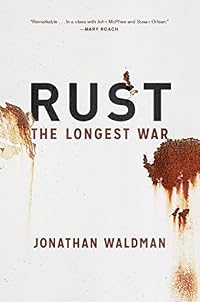
Rust: The Longest War
by Jonathan Waldman
On This Page
Description
An environmental journalist traces the historical war against rust, revealing how rust-related damage costs more than all other natural disasters combined and how it is combated by industrial workers, the government, universities, and everyday people.Tags
Recommendations







































Member Reviews
Rust: The Longest War
Ok, with a title like this you expect it to be a bit quirky. And you expect the readership to also be a bit quirky.....and I suppose I fit that description. But is this a book about rust or is it a collection of biographies. It’s really both and the author has rather cleverly woven a fascinating story around some players in the field of corrosion.....Maybe he gets a bit waylaid wandering around the derelict Bethlehem steel works with the rust photographer and maybe we learn just a bit too much about the pipeline-maintenance guy’s hobby of aquarium fish. But, overall, I think it works. He had me hooked for the duration ...even if I found myself skimming a lot of the purely descriptive stuff. (Though he does write show more well).
I was hoping that I might have learned a bit more about the chemistry of rust and corrosion and the chemistry of rust preventers and inhibitors....but maybe that would have made it much too technical for the general reader.
I guess I was aware of the fact, but he brings it home extremely well ,when he points out that as soon as we build something it starts to rust of corrode....And there is a huge cost to the nation when delivering something fast is given much greater priority than making something that is going to last. I remember coming face to face with rust with my first cars in the 1960’s....the tell-tale signs around the bottom of the doors and when you looked underneath at the chassis, one found profound rust. Hard to believe that simply by paying attention to the problem, improved design and treating the metal in the first place could bring about such a radical change. I recall that I had significant rust in a new Toyota Crown within two years in 1976.
But the message comes through loud and clear that corrosion is a massive financial problem for our military and for our infrastructure ..especially railroads and bridges.. But I wonder whether a book one third the size ...without all the biographical stuff could have done the same job in conveying information. Did I really need to know that a lot of the guys in the corrosion industry sported moustaches? (Though it was kind of a running gag and he played it well). I’ve included a number of extracts below ...mainly for my own purposes in trying to remember the main points of the book). Overall, I enjoyed the book. Learned some new stuff...and I’m a bit wary of canned food now. Five stars from me.
Introduction: The Pervasive Menace
About one brand of American car, they used to say this: “On a quiet night you can hear a Ford rust.”....In Ohio, since rust used to lighten automobiles by about ten pounds every year, that was half an ounce of metallic music to your ears nightly. (That’s a scary thought)....Few automobile companies have steered clear of corrosion. Hyundai, Nissan, Jeep, Toyota, GM, Isuzu, Suzuki, Mercedes, Fiat, Peugeot, Lexus, and Cadillac have all recalled automobiles because of rust.....More than once, Firestone has recalled millions of steel-belted radials on account of rust.
In postwar suburbia, state departments of transportation resorted to salt (sodium chloride or calcium chloride) like addicts, doubling their use on highways every five years until 1970. By then, the country used about ten million tons of salt a year. It’s fluctuated mildly since. Salt is bad news because chlorine is as reactive as oxygen, and more persistent.[The chlorine in the salt] has much to do with the deficient condition of the country’s bridges......Airports rely on de-icing alternatives like acetates, formates, and urea. The most common, calcium magnesium acetate, is one-fifth as corrosive as salt on steel and one-tenth as corrosive on aluminum. (But more expensive0.
Oil rig designers put one extra inch of steel on the bottom of offshore oil platforms, calling it a “corrosion allowance.”.....To protect water mains, tap water contains a corrosion inhibitor. Where I live, twenty-five miles east of the continental divide in Colorado, it’s lime (calcium hydroxide), though other municipalities use sodium hydroxide or phosphates.
As water flows from the Rockies to the Mississippi, and gets successively treated by more municipalities, it grows laden with calcium and magnesium, becoming what most people call hard. It’s corrosion is a major concern where their servers are stored. To inhibit rust in server rooms, companies use dehumidifiers and gas filters that remove ozone, hydrogen fluoride, hydrogen sulfide, chlorine, sulfur dioxide, and ammonia to minute (less than a few parts per billion).......Lloyd’s, wouldn’t insure oceangoing metal ships for more than two decades after such things began moving cargo......There’s even rust in outer space, on account of atomic (rather than molecular) oxygen—.....Rust is costlier than all other natural disasters combined, amounting to 3 percent of GDP, or $ 437 billion annually, more than the GDP of Sweden. That averages out to about $ 1500 per person every year......John Scully, the editor of the journal Corrosion, told me corrosion gets no respect. “It’s like saying you work in mould or something,” he said.
Golf clubs in San Diego still rust, as do ships at the naval base there. Jets in Tucson, Arizona, still rust, as do hammers in Oymyakon, Siberia, but five hundred times slower than they do at Punta Galeta, Panama......Some fifteen thousand Americans are working in corrosion.....Very few of them think of themselves as rust people. They work in “integrity management,” or as coatings specialists, or as engineers or chemists......Most corrosion engineers are men. In my rough estimation, something like two thirds of these rust guys are mustachioed......Only one, an advisor to many federal science agencies named Alan Moghissi, saw rust as an opportunity. He imagined it could become as big as the environmental movement of the 1970s.....Because corrosion is exothermic, the skin of a corroding Ford becomes hotter than the metal underlying it, and this thermal gradient generates local stress called electrostriction. Technically, with the right tools, you really could hear it.
1. A High-Maintenance Lady.....The statue of Liberty. They went to the Bartholdi museum, in Colmar, France, to see notes, papers, models, and a journal from 1885. They found no drawings,....Elsewhere, they found Eiffel’s sketches, and nine handwritten pages from November 12, 1881.....The frame’s design—an iron skeleton riveted to the copper skin—was ingenious, and risky, and Bartholdi had known it......Eiffel’s design was risky because the two metals couldn’t actually touch each other. Dissimilar metals, in contact, would corrode......In the case of the Statue of Liberty, the voltage was only about a quarter of a volt—not enough to illuminate even the smallest lightbulb—but persistent, far more so than any battery......Eiffel was aware of the risk, and planned to manage it by separating the iron from the copper with shellac-impregnated asbestos.
Scientific American saw it differently, and within a month of the statue’s completion, warned, “There are five dangers to be feared, namely, earthquake, wind, lightning, galvanic action, and man.”.....[Over the years] all of that paint was almost as thick as the copper, and unfortunately, had trapped water between the iron frame and the copper skin—exactly what Eiffel and Bartholdi had wanted to avoid.....The statue had become an enormous battery.
Everywhere engineers had looked, in every part of the statue, they found corrosion, or a contributor to it.....The asbestos insulator—which actually wicked water, exacerbating the damage—had long since disintegrated......There was, according to the report, “definite risk of structural failure”
Ultimately, Iacocca’s campaign raised $ 277 million ($ 1.4 billion in today’s dollars) and threw it at a three-hundred-foot-tall metal object on an island on the windy, rainy, salty, humid Atlantic Coast.....Men in white suits spent two weeks removing the paint by freezing it off with liquid nitrogen. Once frozen, it flaked off in sheets.
Baboian (who had run Texas Instruments’s corrosion laboratory) also studied the interaction between the copper and the iron frame. The statue, he determined, “was an ideal configuration for galvanic corrosion.” On account of the copper, the iron was corroding one hundred times faster than it would by itself......Had the statue been built only a decade later, steel, rather than wrought iron, would have been used, and the story would be different.
So Baboian and others set about determining what type of metal to replace the iron with.
Stainless steel it was.....Repairing the statue’s frame proved the most challenging task yet.
The whole thing was replaced, piece by piece.......Once bent to the proper shape, it was quenched in water, sandblasted, labelled, wrapped up, and sent to Manhattan, where it was treated with nitric acid to re-create the outer, corrosion-resistant, patina-like layer of the metal.....To cap it all off, when the scaffolding was removed, and the Statue of Liberty revealed in all her glory for the first time in two and a half years, a black scar on her face drew attention. It was a streak caused by the baking soda, and only time would turn it green, but a rumour formed that the mark was from workers, who, rather than climb down the scaffolding and use the bathrooms on the ground, had urinated on her face.
No other rust battle in America has been fought so visibly, contentiously, or been celebrated so grandly.....So many visitors flocked to the statue, and were forced to stand in such long lines, that a riot almost ensued.
2. Spoiled Iron
Two thousand years ago, during the Blue Nile campaign, a Roman army general. complained about corrosion in his giant catapults.....He wrote, “that the arbalests are causing more casualties in our own army than to the enemy.”
By his own intelligible standard, Boyle [the Chemist] failed.....His twenty experiments were not for naught, though. He found that salt, by itself, didn’t corrode lead nearly as fast as saltwater did. By pouring saltwater, lemon juice, vinegar (which had “edges like blades of swords”), urine, turpentine, lye, and various acids onto lead, iron, mercury, copper, antimony, and tin, he showed that all metals were vulnerable. Silver, for example, fell victim to nitric acid. Even gold corroded when subjected to a mixture of nitric and hydrochloric acids called aqua regia.....Today we know that only a handful of rare metals don’t corrode: tantalum, niobium, iridium, and osmium.
(This also explains why oxygen did not accumulate in the atmosphere for billions of years, until rocks on the surface had reached their fill). ....Around 1800 heat was understood as a weightless fluid called caloric. An experimentalist at heart, Davy didn’t like either theory. In 1806, after more experiments with batteries, he coined the term electrochemistry. The next year, he discovered sodium and potassium, new metals of the reactive variety. Colleagues compared him to Boyle, and the government saw him as society’s saviour.....But not until the first half of the twentieth century did corrosion theory take shape.....It started with Swiss chemist Julius Tafel, who in 1905 related current and voltage to the rate of a chemical reaction.....Various chemists in 1923, came up with the notion that chemical bonding resulted from the pairing up of acids and bases, which, depending on how you looked at it, either donated/ received protons, or donated/ received electrons. Three years later, Linus Pauling and Robert Mulliken—both future Nobel Prize winners—began quantifying the tendencies of elements to attract electrons, a property called electronegativity.
Oxygen, is the second most electronegative element—and this explains why life relies on it. For transporting energy, it is the best thing going.
In sort of a mirror of electronegativity, metals can be ranked in nobility. Noble metals don’t give up their electrons, no matter how electronegative the other elements may be. The nobility of a metal is measured in volts, from 1.18 (platinum) to-1.6 (magnesium). A quarter-volt difference is enough to compel an electron to migrate. There’s a quarter volt between lead and titanium, and there’s a quarter volt between tin and silver. The quarter volt between iron and copper is what saved the copper on the bottom of the HMS Comet, and what saved the Statue of Liberty’s skin at the expense of its frame.
In 1938 Carl Wagner and Wilhelm Traud said that the sum of the charges lost and gained in a corrosion reaction was zero, and that each metal would corrode at a new rate. It became known as the mixed-potential theory of galvanic corrosion....By then chemists also recognized that most of one volt was enough to compel electrons to stay put. In other words, if a pipeline operator pushed 0.85 volts into his buried pipeline, he could convince the electrons in the steel not to be lured elsewhere.
The third arm of defence, far blunter, precedes them both. It’s paint.......And electroplating with a metal more durable than zinc—cadmium, chromium, nickel, or gold—is sort of the rich-man’s galvanizing.
3. Knives That Won’t Cut
Harry Brearley was born on February 18, 1871, and grew up poor, in a small, cramped house on Marcus Street, in Ramsden’s Yard, on a hill in Sheffield. The city was the world capital of steelmaking; by 1850 Sheffield steelmakers produced half of all the steel in Europe, and 90 percent of the steel in England...He was then hired as a bottle washer by James Taylor, the chief chemist in a laboratory of the same steelmakers. Harry was only twelve; he would become Taylor’s protégé. Taylor started his training by teaching Harry arithmetic (Harry had to buy the book himself) and then, a couple of years later, algebra (Taylor bought him the book, a gift Harry brought home to show off, and never forgot). Taylor bought Harry a set of drawing instruments too.....Under Taylor, Harry learned to join wood, paint, solder, plumb, blow glass, bind books, and work with metal.....Steel business was good, and in September 1903, Brearley’s old employer, Thomas Firth & Sons, bought a steelmaking plant in Riga—Russia’s second largest port, on the Baltic Sea—in order to produce steel for the massive Russian market.....Together Brearley and Moorwood travelled there in January 1904, in the dead of winter...Whilst there he invented a system of ceramic cones rto measure funace temperatures.....He sent the formulas for the sentinel pyrometers back home, and Amalgams Co. sold thousands.....By now, his adult persona had emerged: he was deliberate and devoted; confident but not dictatorial, and definitely not greedy.
The revolution [in Russia] came in 1905.....Brearley took his spot as general manager and kept it for three years.....When Brearley returned to England in 1907, he was offered a position running the Brown-Firth Research Laboratories,.Yet Brearley was troubled by new changes in steelmaking. Science was replacing art. ...Theory was gaining traction over experience, and Brearley began to wax nostalgic for the old days,....Until then, the only method of making steel was crude, slow, and expensive.....It took three tons of coke to make one ton of steel. Steel made this way was called blister steel.....The vanishing began in 1855, with the invention of the Bessemer process. By injecting cold air into a chamber of molten iron—a chamber that looked like a big black egg, or maybe a huge grenade—steelmakers were able to burn off carbon and most other contaminants in a white-hot reaction. Then they added some carbon, and voilà: they’d done in twenty minutes what had once taken a week, using one-sixth of the fuel......Three-quarters of the steel made on England’s northeast coast in 1883 was made via the Bessemer process; by 1907, the Basic process [which precipitated the phosphorus from the iron ore] had almost replaced it. In 1916 more than half the specialty steel in the United States was made via electric furnaces; the next year it was 66 percent; by 1930, more than 99.5 percent of the steel in the United States was made in electric furnaces.....Brearley would soon be a dinosaur. But, as a quasi-free-agent analyst at Firth’s, his knowledge surpassed that of many other analysts....In May 1912 Brearley travelled 130 miles south, to the Royal Small Arms Factory in Enfield to study the erosion of rifle barrels. He examined the problem and dis experiments....The second cast (number 1008), on August 20, turned out better. It was 12.8 percent chromium, 0.24 percent carbon, 0.44 percent manganese, and 0.2 percent silicon. He made a three-inch square ingot and then rolled it into a one-and-a-half-inch-diameter bar....It wouldn’t etch, or, rather, it etched very very slowly. It reacted to vinegar and lemon juice the same way. He compared a polished sample of carbon steel to a polished sample of the chromium steel, and was amazed to find after twelve days that while the former had rusted, the latter remained shiny and bright.
He suggested that the metal might be advantageously used in cutlery, which, at the time, was made of carbon steel or sterling silver. He didn’t let it go. By the end of 1913, he couldn’t stop talking about the utility of the new metal for cutlery.....A few months later, a report came back: the steel wouldn’t forge, grind, harden, or polish—and wouldn’t stay sharp. It was useless for cutlery. Ibberson wrote back: “In our opinion this steel is unsuited for Cutlery steel.” The cutlers called him “the inventor of knives that won’t cut.”....It’s difficult to imagine now, but rustless steel must have seemed an oxymoron of the highest order,
On October 2, 1914, Brearley wrote another report for his bosses, when he realized that this new stainless steel could be useful in spindles, pistons, plungers, and valves—in addition to cutlery. If anything, it was this tenacity—this quasi-insanity—that set him apart from earlier discoverers.....In 1914, the company produced 50 tons of the steel; over the next two years, Firth’s produced 1,000 tons more....Firth’s omitted Brearley’s name. Firth advertised itself as the discoverer, inventor, and originator of stainless steel, in ads, posters, and labels on bars of steel.
Harry Brearley didn’t know it then, but the stuff he cast from the electric furnace at Firth’s on August 20, 1913, was nothing new. At least ten others had created it, or something like it, before; at least half a dozen had described it; and one guy even explained it, and explained it well. Others had patented it, and commercialized it. Before Brearley got around to it, at least two dozen scientists in England, France, Germany, Poland, Sweden, and the United States were studying alloys of steel by varying the amounts of chromium, nickel, and carbon in it. Faraday had tried as much nearly a century earlier. It’s not like Brearley was exploring unknown territory. That he is credited with discovering stainless steel is due mostly to luck; that he is credited with fathering it is due mostly to his resolve.
In 1908, Bertha Krupp, the wealthy daughter of the owner of the Krupp Works, commissioned a 154-foot-long steel-hulled schooner: an elegant hull, painted white, made of chromium-nickel steel....An English crew raced the boat to victory at the 1908 Kaiser’s Cup at Cowes,
Finally, ten years after he [Robert Hadfield made [manganese steel] , it was found ideal for railroad tracks. It lasted almost fifty times longer than carbon steel, and became the standard for heavy duty rails.....A month after Brearley resigned, news of his stainless steel reached America. On January 31, 1915, the New York Times announced the discovery:.....Here’s another reason why Brearley is credited as the discoverer of stainless steel: Reporters at the New York Times weren’t reading the metallurgical trade magazines. They didn’t know about Monnartz and Strauss......The first American ingot of Brearley’s stainless steel was cast thirty-one days later and sent directly to a knife maker.......Brearley applied for a patent on March 29, 1915. He was denied, because stainless steel was being made in England by at least seven companies. He reapplied, specifying it as a “new and useful improvement in cutlery” for metal with 9 percent to 16 percent chromium, and less than 0.7 percent carbon.
Brearley was granted patent number 1,197,256 on September 5, 1916.
Later the council had awarded the Bessemer Gold Medal—the highest award of the Iron and Steel Institute—to Brearley, “who, if not actually born in a steelworks, was cradled there.”
4. Coating the Can
The beverages inside exploding bottles run the gamut. You name it, it’s exploded: soda, beer, champagne, Perrier, grenadine,milk. Bottles have exploded in bars and restaurants, hardware stores, drug stores, and liquor stores. At least 130 such cases have gone to trial. One plaintiff asserted that there were at minimum 10,000 exploding bottle episodes annually in the carbonated beverage industry.
[But can wer not immune to exploding]. Other exploding can incidents never made it to court but did make their way into the record books....As a result, new cans made by the world’s largest can manufacturer contain an “anti-missiling” feature. It keeps the panel from blowing out and getting you in the eye. Manufacturing strong, healthy aluminum cans, in fact, is so challenging, and requires such a vast amount of study, design, and precise machining, that many consider cans the most engineered products in the world. This notion—that the ubiquitous aluminum can, which seems anything but amazing, is in fact incredible—was the first thing I learned at Can School.....The Ball Corporation has been running Can School annually for twenty-five years; not quite a thousand people in the beverage industry have graduated. To say the company is qualified to teach the course is a gross understatement. The people of the world go through 180 billion aluminum beverage cans a year. That’s four six-packs for every person on the planet. The United States and Canada gobble up more than half of them—100 billion a year—and Ball makes a third of these.
It also operates fourteen steel food can factories in the United States and one in Canada.
Since 1994, when Ball first made $ 1 billion worth of cans, its compound annual growth rate has exceeded 12 percent.
Consider a can of Coke. It’s a corrosion nightmare. Phosphoric acid gives it a pH of 2.75, salts and dyes render it still more aggressive, and the concoction exists under ninety pounds per square inch of pressure, trying to force its way out of a layer of aluminum a few thousandths of an inch thick. It sits there for weeks, months, years, often in a humid fridge, or dank pantry, or hot trunk, or stagnant warehouse.
All that protects the meager aluminum is an invisible plastic shield. Industry insiders call it an internal coating, or IC, and it’s the product of a phenomenal amount of work....Until the 1990s, he [Ed Laperle, a corrosion engineer] would tell customers, “Okay, send me some, I’ll put it in a can, on a shelf, for six months and see what happens.” Cases just sat there.
Then Ball figured out how to do the corrosion test in about four hours. They call it a pitting scan......Over four hours, the potentiometer spits out a graph of current versus time. It looks like a pyramid. The peak represents the pitting potential, or PP, of the liquid.
By plugging the pitting potential and some other measurements (salt, copper, chloride, dye, dissolved oxygen, pH) into a carefully guarded equation, Laperle’s team can determine the corrosivity of the product......Beer, for example, isn’t very corrosive, so coatings on beer cans are extremely thin, and weigh in the neighborhood of 90 milligrams......and salty, or “isotonic,” drinks, such as V8, demand greater corrosion protection, and hence thicker coatings of up to 225 milligrams......This much is clear: the higher the pitting potential of a beverage (anywhere from 100 to 500 millivolts), the fewer cans will fail. This much is also clear: sodium benzoate is bad. Copper is bad. Sugar is good. It absorbs carbon dioxide, decreasing the pressure within a can, and it also inhibits other corrosion reactions....Citric acid and phosphoric acid are equally bad.
Ball doesn’t manufacture cans by the billions until after the beverage and the coating and the interaction between the two have been examined. After the company’s engineers examine package-product interaction chemically, they double-check with their tongues.
As I sniffed, Laperle said there was no such thing as a container that doesn’t change the flavour of the product. Cans, plastic, even glass, he said, had an effect.....Laperle said that flavour testers at Ball learn to detects parts per million, then parts per billion, and eventually, parts per trillion. He figured that if his flavour testers couldn’t taste something, nobody could.
The one exception may be cats. On account of felines’ extreme organoleptic capacities, wet cat food is packaged in cans with “particularly low levels of taint.”
Beer, Laperle explained, is actually so mild that the can does not require a coating. He called beer a “nice oxygen scavenger,” describing how proteins in beer consume dissolved oxygen, keep it from accessing and corroding the aluminium. It’s the same for orange juice.
In fact, the only reason beer cans have a coating at all is so that the carbon dioxide doesn’t escape at once. The coating smooths out the surface of the metal, so that the gas has no microbumps from which to propagate,
If you stacked up all of the aluminium beverage cans produced in a year, the stack would be 13.5 million miles long.
As each can dropped, it was loaded onto an indexed wheel,..the can spun rapidly at 2,200 revolutions per minute....At the first position, a high-pressure injector sprayed liquid epoxy down into the can. At the second, another injector sprayed the liquid epoxy at a slight angle, toward the top of the wall.....A conveyer belt whisked them away to another oven, which cured the epoxy by heating it up to 390 degrees, gradually, for two minutes.....Five digital black-and-white cameras examined the coating inside every can, with a strobe....A computer assessed the gray scale of every can—at two thousand cans per minute—to determine if the coating was sufficient, which is to say perfect.....Another test employed a light sensor to test for holes in every can. The tiniest pinhole could spell disaster: a leaker or an exploder.
The world’s first cans, developed by an Englishman in 1810, owed their corrosion resistance to a layer of tin.....Like modern epoxy coatings, enamels separated the package from the product. Can makers had learned the hard way that a plain tin-lined can was fine for pastas, peaches, pears, and pineapples, but would bleach strawberries, cherries, and beets so thoroughly that customers wouldn’t return to buy more.
Bohart’s C enamel (as opposed to the standard R enamel) worked because the zinc oxide reacted with the hydrogen sulphide before it had a chance to react with the can. C enamel allowed can makers to put all kinds of heretofore forbidden—that is, corrosive—products in cans. Can making companies quickly figured out how to put ham, dog food, and orange juice in cans. Aggressive foods, such as sauerkraut, pickles, and jalapenos, would eventually demand even thicker coatings.
Tin-coated steel cans turned beer cloudy, and ruined its taste. Iron was even worse: just one part per million of iron in beer ruined its flavour......He [canner] must deal with the headspace: the 5 millilitre air bubble at the top. He doesn’t want oxygen in there....Bob deals with this threat by flooding the headspace with carbon dioxide or nitrogen before seaming the can shut....The simplest mistake the filler at a beverage manufacturer can make is one of overcompensation. A filler may crank up the nitrogen or carbon dioxide and overpressurize his cans.
Copper [is a problem] and can also come from the water supply, the water that is added to soda syrup......Two out of three leaking product complaints now come from warehouse problems. This is the dreaded outside-in corrosion......Most consumer complaints were coming from supermarkets. Next in line was vending machines. He wondered: how can the claims be so high? It turned out they’d find a leaker, wipe the others off, and put them back. “They were spreading a cancer,” Scheuerman said.....“Give or take two or three millionths of an inch, and this can won’t open. [Said Elmer, the Assistant Manager]....Cans, he explained, are manufactured with much tighter tolerances than aerospace parts—ends particularly. Many in the industry like to say, he told me, “The can is just a pedestal on which the crown sits.” Marvel of marvels: not perfect-tasting beer but the top of the can.....Leave a can sideways for six months, and it’ll leak....Ball now makes cans accurate to 50 millionths of an inch, and aims for errors to be so rare that they are six standard deviations from the mean.
Can School wasn’t for journalists;.......no journalist had ever attended. That it wouldn’t be fair to those in the industry. It wouldn’t be fair to the industry, I came to conclude, because the internal coatings used to prevent aluminium cans from rusting from the inside out and adulterating their products are as secret and controversial as fracking fluid.....Often the formula is unpatented and therefore preserved as a trade secret.....The cross-linking agent of choice for the most tenacious epoxy coating is bisphenol-A, or BPA. BPA is the primary ingredient in such coatings because it makes the plastic plastic.....Coatings for tomatoes must be stain resistant, those for fish must resist sulphur, and those for fruits and pickles must resist acids. There’s one coating for tomatoes, one for beans, one for potatoes, and another for corn, peas, fish, and shrimp. Chocolate, especially sensitive to adulteration, requires its own coating. Those for meats must contain a lubricious wax, called a meat release agent, so that the meat slides right out.....The top of the list belongs to rhubarb. It, alone among foods, requires three layers of lacquer, and even with that much protection, rhubarb still boasts a shorter shelf-life than its peers. [I assume that this is because of the oxalic acid content of Rhubarb......it’s used for polishing marble floors].
All told, there are over fifteen thousand coatings.....Endocrine disruptors, including molecules that mimic the hormone estrogen—called estrogenic chemicals, or xenoestrogens—get jammed in the cells so that the real molecules can’t get in there and do what they should.....In a landmark 1993 study, biologists Theo Colborn and Frederick vom Saal described the range of this “endocrine disruption,” a term coined only two years earlier.
BPA’s role as an endocrine disruptor wasn’t recognized until 1998........Forty percent of her control mice—the ostensibly normal, healthy ones—were producing abnormal eggs.....Something was leaching into the mice’s feeding tubes and interfering with the mice. The something was BPA, an artificial estrogen.......A 2011 paper titled “Most Plastic Products Release Estrogenic Chemicals,” published by the National Institutes of Health’s National Institute of Environmental Health Sciences, sums up the current understanding.
They report that manufacturing processes—such as pasteurization—convert non-estrogenic chemicals into estrogenic chemicals, and they note that sunlight, microwave radiation, and machine dish washing accelerate the leaching of estrogenic chemicaIs......It turns out that exposure to BPA may be comparable to exposure to DDT.......Hunt, Colborn, vom Saal, and many other researchers around the world have found that BPA can cause early puberty, obesity, and miscarriages, lower sperm counts, and increase rates of cancers of the breast, prostate, ovaries, and testicles......BPA has been shown to cause normal breast cells to act like cancer cells......Hence, perhaps, the retraction of my invitation.
A good coating is hard to find, and as much effort goes into creating and applying one as goes into any other aspect of manufacturing cans.....Making an epoxy coating starts with a petroleum refiner like ExxonMobil, which produces huge quantities of benzene. Dow Chemical Company or Momentive Specialty Chemicals converts the benzene to bisphenol-A, and combines it, about 4: 1, with epichlorohydrin. Dow calls this stuff D.E.R. 331, or Dow Epoxy Resin 331, and Momentive calls it Epon 829.....Next, a chemical company such as Cytec Industries or Sartomer or Rahn buys the epoxy resin, adds 5 percent acrylate to make an acrylated epoxy called something like Genomer 2255, and sells it to one of the big coatings companies. To render the coating just right for Bob’s Energy Drink, the major coatings companies then add small amounts of pigments, surfactants, adhesion promoters, corrosion inhibitors, light stabilizers, toners, extenders, thixotropic agents, dispersing agents, wetting agents, dyes, and catalysts—I heard Mary Chopyak say that she spent two years working on BPA-free coatings. I heard Dan Vorlage, Ball’s head of innovation, describe being stymied by his work on BPA-free coatings. Then, at eleven thirty, Paul DiLucchio, Ball’s training and development manager, tapped my shoulder and whispered that someone wanted to see me in the hallway...[The Director of Corporate relations tried to eject him from the Can School].
The Can Manufacturers Institute is, not surprisingly, addicted to discussing the benefits of aluminium.....When BPA concerns are raised, they cite studies they maintain confirm that BPA levels in cans are safe.....The North American Metal Packaging Alliance similarly dismisses the importance of BPA.....NAMPA’s chairman, John Rost, has called coatings critical and safe,...Rost, a trained chemist, is also a lobbyist. BPA coatings, he has said, provide superior performance, without even a “marginal health risk,” and have been reviewed by health agencies. That, and there’s no readily available alternative...The American Chemistry Council, too, seeks to allay worries over BPA....Ball employees haven’t developed a coherent strategy. Some attempt a mild deception, by calling the epoxies “organic coatings.” Of course, aldrin and dioxin are organic, too—and toxic in minute quantities.....Can makers argue that modern society offers plenty of exposure to BPA outside of cans, and that it’s been deemed safe; that the quantity of BPA in each can is minuscule; that even less migrates into beverages; that the quantity detected in humans is even smaller (“ extremely small”); and that, regardless, any absorbed BPA gets expelled daily in urine....Finally, they say that major regulatory bodies in Japan, Australia, New Zealand, Canada, and the United States agree that current levels of BPA exposure are safe,
“Agree” and “safe,” though, are at odds with the opinion of the US Health and Human Services Department.....Frederick vom Saal, who has been studying hormones as long as Scheuerman has been studying cans, has found that BPA is as potent as DES, able to act far below the FDA’s threshold, below 1 part per trillion (ppt).....In 2004 the CDC found that of 2,517 people six years and older, 93 percent of them had BPA in their urine....Canada added BPA to the list of toxic chemicals under the Canadian Environmental Protection Act. France voted to continue with a ban on BPA-based polycarbonate bottles. Denmark voted to continue with a ban on BPA in food packaging meant for children under age three. Japan has nearly eliminated BPA can coatings.
When Rachel Carson wrote Silent Spring, she noted that one out of four Americans would get cancer in their lifetimes. Now the rate is almost twice that....Patrick Rose, a lawyer who sued Ball unsuccessfully in a 1999 exploding can case, is more concerned about BPA than explosions. “I won’t drink out of a can,” he told me. “I won’t let them near my kid. I’m kinda surprised this hasn’t trickled down into the popular culture.” He said he thinks the huge increase in breast cancer incidences is related to BPA. “We’re ruining women’s health,” he said, “and it’s totally preventable.”...Jamil Baghdachi, the can coatings consultant who runs the Coatings Research Institute, is similarly fearful. “It scares the hell out of me,” he said.
He calls cans “suspicious” and doesn’t buy canned food...Frederick vom Saal, the respected biologist, also won’t buy canned foods or beverages, and won’t allow polycarbonate plastics in his home......When he studied a dose of BPA 25,000 times lower than anybody had studied, in 1996, and found developmental harm, Dow suggested that he not publish his results.
He said that toxicologists are off by anywhere from one to eight orders of magnitude. For regulatory agencies, he reserves greater criticism, calling them “locked into procedures decades out of date,” unable to acknowledge, let alone perform, modern science.
“This is the highest volume endocrine-disrupting chemical in commerce,” he told Kolbert.
Mike Adams, the FDA chemist, is not reluctant at all to drink out of cans.....He said, “we are one hundred percent sure that this is not gonna be a problem.” Of BPA concerns, he called it “paranoia.” He told me that the testing labs are “really, really pushing levels of analytical capabilities.”....Ball employees are not hypocrites: they eat and drink out of their cans....They refuse to admit that BPA-free cans would be an improvement. Oddly enough, Ball’s already done it. The company makes BPA-free cans for a small Michigan company called Eden Foods......America produces millions of gallons of BPA a year, for profits exceeding $ 6 billion. Few elected officials are going to stick their necks between that and the American Chemistry Council,
5. Indiana Jane
The rustiest place in America is not open to the public.....The place is the Bethlehem Steel Works, in Bethlehem, Pennsylvania. Once the world’s second largest steel producer, it has been rusting since the middle of the Civil War, when iron was first made there....One woman is exceptionally familiar with the place. Her name is Alyssha Eve Csük. (Her last name rhymes with book.) The granddaughter of a steelworker, she is a photographer. She photographs rust. She is, as far as I know, the only person who makes a living finding beauty in rust.......“While many may look at these sites as brownfields littered with abandoned buildings and humps of rusting metal,” she explained later, “I find in contrast an emerald city of jewels amidst a dark and mysterious place.”
6. The Ambassador
In 1998, at the request of the Department of Transportation, the National Association of Corrosion Engineers began estimating the cost of corrosion. By the summer of 2001, NACE figured that the military cost alone amounted to $ 20 billion.....Finally, in 2005, Dunmire got a budget, albeit not from Congress. Mr. Wynne allocated $ 27 million to Dunmire, and he used part of it to detail the actual costs of corrosion. He funded studies that broke up the research into chunks. Dunmire recalls that Robert Mason, the assistant deputy undersecretary of defence for maintenance policy, programs, and resources, didn’t think such an assessment was possible, or that the resulting numbers would be meaningful, but it was, and they were, with a methodical process.
In 2006 Dunmire’s office declared that corrosion was responsible for $ 2 billion worth of annual damage to the 446,000 ground vehicles belonging to the army, and $ 2.4 billion in annual damage to the 256 ships belonging to the navy.....Engineers in Dunmire’s office cite competing incentives as a cause of much of their rust troubles. Program managers in charge of new weapons systems get graded on performance, schedule, and cost. If one oversees the building of a $ 500 million missile that can fly to Mars by 2015, he’s evaluated on the millions spent, the missile, and the date of completion. If the missile rusts to hell in 2016, that’s not his problem.....“By the time the maintenance bill comes through,” they figure, “I’ll be gone.” It’s not hard to race rust and win. Officers get their stars, and assets get treated like orphans......“The annual cost of corrosion to the United States amounts to three-point-one percent of our gross domestic product. In the year 2011, that came to something like four hundred and eighty billion dollars a year—
The first time I met Dunmire, at a navy corrosion conference in Norfolk, Virginia, called Mega Rust, he told me about wanting to change American military and civil culture. This was in 2009. “Manufacturers want stuff to break,” he said. “They design stuff to break. At the navy, we don’t want stuff to break. So we’re looking at corrosion from two different lenses.”
He said, “I’ll pay for it, but I don’t wanna pay for it over and over and over again. Gimme the good stuff the first time. Make sure it works, and make sure it lasts.” He told me about developing a national anticorrosion culture, focusing on prevention, and training more engineers and scientists.....“We gotta go from find and fix to predict and manage. Otherwise it’s twenty billion dollars, and that makes me upset.”
Congress had recently approved expanding the fleet to 313 ships, but McCoy saw that aim as unfeasible. “It’s great to buy new ships,” he said, “but we can’t buy our way to three thirteen. We gotta keep three-quarters of that with our old ships.” His great fear was that corrosion would bring the US Navy’s fleet down to 200 ships,
During the next year, Cook produced a few short video podcasts for Dunmire’s office. Dunmire, as the head of the office, was the talent. He dived into the role like it was his first day on a ship. In one video, he pops up on screen, wincing quizzically, as if giving the camera a hard time. He dances, sort of. In another, five versions of Dunmire, all dressed differently, are sitting in a room, watching a sixth Dunmire talk about corrosion on a screen.
Dunmire has a reputation for being crazy, scattered, and bumbling.......It’s a worrisome, piercing posture with a hint of the lunacy you see in the homeless or deranged. Had he been playing charades, I’d have guessed that he was conducting an orchestra, or doing a hippie dance in San Francisco’s Golden Gate Park. The museum staff, meanwhile, beheld Dunmire with feet planted firmly, steadily, hands clasped or in pockets, their upper bodies immobile. Only their necks moved slightly, as did their facial features.
That’s the other thing people invariably cite in Dunmire: passion. Talking to him is sometimes like getting berated by a coach—he’s always fired up.
of Dunmire, he said, “Dan is a visionary. He’s the opposite of me.” He added, “Dan’s really good at starting stuff. I’m here to institutionalize it, get it done. If the office goes away, it’ll be like we were never here. So that’s why I’m excited about policies.”
The men who comprise Dunmire’s core team are nothing like him. Each is an opposite: quiet, linear, calm, composed, less obsessed, closer to “normal,” technically proficient.
At Corrosion Forum XXXI, attendees called Dunmire eccentric, unconventional, and non-Pentagony, but they also called him charismatic, guileless, spellbinding, effective, and great. One person put it succinctly: “All of us worked in corrosion forever, and we never got anywhere. Then Dan came along. He’s funny, he’s got energy. He’s colourful.”
What he didn’t mention is that from 2005 to 2013, of the 236 weapons projects that Dunmire’s office has thrown $ 165 million at, roughly a third of them have been in pursuit of the perfect paint. The Corrosion Prevention Office has funded the development of coatings for aircraft, decks, fire systems, jet fuel tanks, water tanks, air-conditioning coils, pump impellers, vehicle underbodies, bilges, magnesium parts, and cold environments. They’re single coats or multiple coats, primers or topcoats, designed to cure quickly or at high temperatures or low temperatures, for spraying or rolling or powder coating or depositing by laser. Some are magnesium rich, or zinc rich, or vinyl based, or epoxy based, or nickel titanium based, or specifically chrome free. Some are fluorescent, stealth, sticky, thick, long-lasting, flexible, fire-resistant, chip-resistant, thermally insulating, or nonskid. The office has put more than $ 3 million toward paints that are self-priming, self-inspecting, self-cleaning, or self-healing. The office has also spent just under $ 1 million developing peel-and-stick patches for the marine corps, so that soldiers can quickly repair said coatings in the field.
All the fancy paints in the world don’t do any good if the painter doesn’t know what he’s doing, though. One could be forgiven for assuming that paint is a simple business and that minimal education is sufficient for its application—but neither is the case. At shipyards and hangars, fewer than half of the military’s painters possess high school diplomas. Many can’t add or multiply. When mixing paint, they use a ladle of this and a ladle of that, to avoid math. Assigning junior members to painting has virtually ensured poor results. Failing to mandate rigid specifications for the military’s vast painting jobs has guaranteed them.
All military weapon requests for proposals (RFPs) now stipulate corrosion prevention and control assessments. Dunmire’s office established guidelines for companies submitting new products to the military; in the twenty-first century, companies must address corrosion before proceeding. Dunmire has called this “getting corrosion policy weaved into the fabric of the DOD.”
When the Potomac Institute for Policy Studies asked Dunmire to join its peer review board, it performed a background check with current and former officials and servicemen. “We want you to know, you are not very well liked,” someone told Dunmire. “But you’re respected because you get things done.”
7. Where the Streets Are Paved with Zinc
I met with Phil Rahrig, the executive director of the American Galvanizers Association.
Rahrig, of middle age and middle size, with a decent-sized neck, spent years working for U.S. Steel, and believes fiercely not just in steel, or American steel, but in American steel coated in zinc....“We use forty percent as much galvanized steel as Europe. They have a much higher sense of preservation than we do......In its battle against paint, and its armies built by paint giants PPG Industries and Valspar, the AGA has produced a fact sheet called “Hot-Dip Galvanized Steel Vs. Paint.” It’s arranged like a rundown of two candidates from opposing political parties.
Galvanized coatings are thick, hard and resistant to scratching, and bonded to steel with ten times more force than paint. Galvanized coatings can handle higher temperatures and last seventy-five years; paint, only fifteen.....According to NACE, which published the analysis, the overall cost of building and maintaining a galvanized structure is anywhere from one-half to one-third that of building and maintaining a painted one.....According to a contemporaneous Welsh bishop, Richard Weston of Llandaff, the process wasn’t so tricky at all. Weston of Llandaff described galvanizing iron saucepans thus: “The vessels are first made very bright of salammoniac and afterward dipped into an iron pot full of melted zinc.” That’s pretty much still the procedure.
In the middle of the rust belt, Ohio seems to have gotten the AGA’s message. It has over 1,600 galvanized bridges, more than any other state. Chicago just built 8. Renovating the Tappan Zee Bridge, New York turned to galvanizing, and saved $ 3 million. Pittsburgh, on the other hand, learned the hard way that concrete was no rival. Long objects can be dipped sequentially ..first one end , then dipping in the other end. Galvanizers call this progressive dipping. The dip is into molten, 840-degree zinc, four times as thick as maple syrup. Before dipping a pipe or tube or anything hollow, a galvanizer will blow holes in the object, to let air and water vent out, and molten zinc in and then out. Using a magnetic thickness gauge, an inspector can assure himself, once the beam or pipe has cooled, that the entire thing has been coated.....Coated is a funny word, because, really, the two metals are metallurgically bonded. If, using an electron microscope, you examine the thin layer of zinc on the surface of the steel beam, you’ll see four distinct layers. From the steel up, they are known as gamma, delta, zeta, and eta. The first three layers—respectively, 75 percent zinc, 90 percent zinc, and 95 percent zinc—are harder than steel itself.....While a galvanized steel beam cools over days, reactions slowly convert the zinc to zinc carbonate. To guys like Irving, this is primo stuff, worth waiting for. It’s worth waiting for because it bonds very well with paint, and a beam that has been galvanized and painted—what’s known as duplex—benefits from something of a synergistic effect. An engineer using duplex-treated steel can plan on about twice the life expectancy he’d otherwise expect,
8. Ten Thousand Mustachioed Men.....About half of all corrosion engineers work in oil and gas...Non-biostable implants corrode and present as arthritis. The latest stents, used to keep narrow arteries open, are made of nickel alloys, platinum chromium alloys, and cobalt chromium alloys, and some made of niobium are in development....Some 93 percent of corrosion engineers are men. There’s no official data on what fraction of them have mustaches, but my estimate is high. The field is full of stable old-timers: 40 percent have been working in corrosion for twenty or more years,....Surprisingly, they are not especially educated: fewer than one in three have a bachelor’s degree. One in ten have a master’s degree; one in sixteen have a PhD. The Accreditation Board for Engineering and Technology (ABET) does not recognize corrosion engineers as professional engineers, mechanical, civil, electrical, or otherwise.....Education notwithstanding, the average annual salary of a corrosion engineer is just shy of $ 100,000. This is significantly better than the averages for architects and engineers, as the Department of Labor sees it.....Ten corrosion engineers are named Rusty. Rusty Strong, of noncancelable auto insurance, believes he has the best name in the industry. “You know Catch-22,” he said. “I’m like Major Major Major.” Rusty made a conscious decision to put his nickname on his business card when he joined NACE. It got him onto the board.
9. Pigging the Pipe......Three hundred miles into the Arctic, at the northern terminus of the Trans-Alaska Pipeline System (TAPS), a forty-one-year-old engineer named Bhaskar Neogi hummed Beethoven. He was sitting in the Maintenance Tech Office of Pump Station 1, thinking about rust.....From Prudhoe Bay to Prince William Sound, TAPS stretches eight hundred miles, which leaves Neogi accountable for one of the heaviest metal things in the Western Hemisphere, through which the vast majority of Alaska’s economy flows....He was about to launch a $ 2 million rust-detecting robot through the pipeline, and he was worried about the robot’s ability to perform, let alone survive, the long journey.....The robot was a “smart pig,” sixteen feet long and more than ten thousand pounds, and suggestive of a giant centipede......They checked 112 magnetic sensors mounted in between 112 pairs of magnetized brushes. These sensors would detect the magnetic field induced in the pipe as the pig, propelled by the flow of oil, travelled through it. Given any kind of anomaly in the half-inch steel—a pit, a ding, a thin spot—the field would change, and the sensors would capture this and record it on a hard drive. Inch by inch, the sensors would capture this information; Neogi hoped they would capture all seven billion square inches of the pipe. That’s 1,200 acres.....Even the most advanced pig can’t perform its inspection if the wall of the pipe is covered in wax. Wax accumulates when the oil cools below 75 degrees, and long, slack sections, where the pig can barrel down mountain passes at high speed, manifest themselves when there’s not much oil flowing through the pipe......They checked the hard drive in the rear of the pig, and they repositioned one of the pig’s two transmitters, which would make tracking it during its eighteen-day journey possible.....They planned to launch the tool at seven in the morning, exactly twelve hours behind a red urethane pig of lesser intelligence. That pig, like a giant squeegee, was scraping the line clean.
Neogi had kept track of how much wax these pigs had pushed out in Valdez, and graphed it. From 1,200 pounds, the mass had dropped to 400. The line was as clean as it was going to get, primed for inspection. It was ready for the smart pig.
Up the flow went, to 600,000, 700,000, 800,000 barrels per day, and still the pig didn’t budge. It didn’t budge until propelled by 865 pounds per square inch of crude, flowing at a rate of 840,000 barrels per day—more than half again the typical flow of oil in the pipeline. It finally took off at a quarter after seven, bound to see what rust had done to the biggest, baddest oil pipeline in the world. As the pig headed south into the barren, wintry immensity of Alaska’s North Slope, it sounded like a train. All Neogi said was “All right.”
The estimates all couch what nobody wants to say: the pipeline, once the largest privately funded project in America, and one of its greatest engineering achievements, is now an elderly patient in intensive care....Reluctantly, out of alternatives, they settled on a pipeline. A steel tube winding across Alaska was ten times the rust risk of a giant copper lady standing in New York Harbor, and they knew it.....But what really keeps Alyeskans up is corrosion. It’s the number one threat to the integrity of the Trans-Alaska Pipeline, enough to make engineers in the last frontier dream of Bakersfield.....On account of that threat, the pipeline was outfitted with the greatest corrosion-protection features of the era. Its principal protection was its coating: paint. As a backup, a zinc strap the size of a wrist (a giant anode) was buried under the pipe. Though TAPS was, boldly, called rustproof, the defence proved insufficient. Like all coatings, the one on TAPS proved vulnerable—Thanks largely to smart pigs, TAPS hasn’t suffered a corrosion-induced leak since it began operating in 1977....Early smart pigs weren’t so bright or amenable, and since 1998, smart pigs have been stymied by wax....To keep it clean, Alyeska sends cleaning pigs south weekly. Before the last smart pig run, Alyeska sent a janitorial pig south every four days for a month. When these pigs pop out in Valdez, they usually push out ten or twenty barrels of wax.
Alyeska assigns each significant threat a PYTD: a Potential Years to Dig. The severest corrosion threats earn a 0 and get dealt with immediately. The mildest get 8s, or 15s, or even 29s. In this manner, even though Alyeska may address a dozen repairs a year, a backlog accrues. Examining the backlog, it is easy to be alarmed by not-infrequent reports of pits half the thickness of the pipeline.....The major challenge in pig design lay in data storage. When British Gas, in the early 1970s, tested the MFL pigs on the market, it concluded that none was good enough and began developing its own. Storing the data, someone at British Gas said, was like “reading the Bible every six seconds.”
The second problem with early smart pigs was battery power. One had only enough juice to run for twenty hours.....An ultrasonic smart pig—which measured the thickness of pipe walls by listening to echoes—wasn’t patented until 1971.....The hitch was getting them to work on dirty, rough pipes at twenty miles per hour......Still, the pig would be further calibrated. Alyeska has 150 intentional defects in its pipe at various pump stations. Once the pig emerged in Valdez with all of its data, analysts would use these to fine-tune the pig’s defect-sensing algorithm.....In pipelines around the world, pigs get jammed in offtakes, wedged in valves that aren’t entirely open, stalled at branches or wyes, constricted by debris, stuck nose down, trapped in reducers, pinned in too-tight bends, or—as on TAPS—sucked into
drain lines......More than a couple of pigs have created their own exits at the end of the ride.
A foam pig projected out of its receiver has cracked a brick wall thirty yards away. Another has cleared eight hundred yards.......Since 1984, Alyeska has put a transmitter on every pig inserted in the line and done everything it can to keep every one from getting stuck....I once asked Neogi what he would do if he won the lottery. He said he’d quit work and just take classes forever. Evolution. Linguistics. Astrophysics. Bioengineering. Oceanography. Ichthyology.
After 2006, when BP spilled five thousand barrels of oil at Prudhoe Bay, a lot of people tried to hire Neogi, whose colleagues invariably describe him as “super intelligent” or a “genius.” BP tried to get him as an integrity engineer. Conoco-Phillips tried to hire him, too...Reflecting on that year, Neogi said, “What makes someone successful is how they react to failures.” He tries to study failures because he sees them as the best way to learn. {Neogi loves his aquarium}.....Sensors in his tank monitor pH, oxygen level, specific gravity, ozone, dissolved oxygen, total dissolved solids, temperature. Other sensors measure power draw, humidity, lighting, and leaks. From his phone, Neogi can monitor and control his fish tank. He can adjust the lights. If the power goes out, a backup battery will take over, and he’ll get an email.
Alyeska had wrapped the pipe in tape because the coating was imperfect and because the federal government told the company it could improvise......“they Band-Aided it. I think they did what they thought would work, but I don’t think they put a lot of thought into it. The whole concept of taking a failing coating and wrapping it with something else is kind of mind boggling today.”.....It took ten minutes for the mediator to make a decision: the state could sue. The mediator declared that to better oversee the pipeline, the various state and federal regulators would combine forces in one Joint Pipeline Office. And the mediator instructed
Alyeska to hire CC Technologies for the next two years as technical experts. The corrosion guys went out and got drunk at the Dancing Crab.
“The public has low tolerance for pipeline failures,” Neogi said later. He pointed out that over a hundred people a day die in car accidents—few ever making national news—but when one person dies in a pipeline accident, we get hearings in Washington.....A leak is easily a billion dollars.” Actually, a leak could be five times that. “If I fail, the company’s looking at over a billion dollars in problems: image, cleanup costs, respect in Alaska.”....As the flow of oil through TAPS decreases, pigging will become drastically more difficult. Below 400,000 barrels per day, it will become impossible....By 2015, the small percentage of water entrained in the oil will drop out and begin flowing in a separate layer on the bottom of the line. Collecting at a dozen low spots, it could freeze. In so doing, it could disable check valves or halt pigs......North Slope crude gels at 15 degrees. It gets so thick that pumps can’t push it. It becomes thixotropic, like quicksand. For whatever reason—a power outage, say—if the oil sits in the line too long, at the wrong time of year, the threat of the big Popsicle looms. In January 2011, the oil cooled to 25 degrees. The threat is critical. Alyeska’s former president told Congress that at the flow rate expected in 2015, nine winter days of shutdown could spell the ultimate end of the pipeline. If the oil gels, there will be no recovering from it.
It’s because of this conundrum that drilling in the Beaufort and Chukchi Seas is of such importance to Alaska, Alyeska, and Alaskans. Those rigs will tie into the Alaska pipeline, feed it their oil.
He restarted. “I would like to have had more oil in the pipe. Quantifying wax is very difficult. There’s no pure science that says this is it.”....Then he said something surprising: “Even in engineering, there’s things that are half magic, half repeatable.”....“That’s the beauty of sports,” he said. “You have a definite start time and a definite end time, and the real winner is clear. Pipe inspection doesn’t work like that.”
10. Between Snake Oil and Rolexes:.....John Carmona, the proprietor of the Rust Store,
now sells more than 250 rust products, tailored to tools, cars, boats, and so forth. He employs six staff, including his wife. The demand for rust products, he recently told me, is way steadier than the demand for football-themed products, which he also sells...Some rust products have been modified or removed entirely from the shelves—dusty or otherwise—by the US Federal Trade Commission. Regarding two motor-oil additives, the FTC told the products’ makers to stop falsely claiming that the additives reduced corrosion in engines. The most famous case involved a $ 600 cathodic protection system for cars, sold by David McCready, of Pennsylvania.....At Texas Instruments, Bob Baboian began investigating, running a couple of experiments......“It didn’t work,” he recalled. “It was really a scam. An absolute scam. Just awful.” The voltage in Rust Evader’s anodes was so low that they protected only a couple of inches of steel rather than the whole car.....McCready sent a letter to the president of Texas Instruments, alleging that Baboian didn’t know what he was talking about. Texas Instruments stood behind Baboian.....When I finally tracked down McCready,
he called me back. “This is a painful part of my life,” he said. “It’s just like heartburn. I’m not interested in revisiting it. It’s distasteful. There’s a lot more than just the FTC and Rust Evader.”....Rust Evader is not dead, though. In Indonesia, it lives on under the name Neo Rust Evader. It comes with an eight-year guarantee. On a priceless company YouTube video that takes misrepresentation to the next level, the product is hailed as “US Technology.” When I told Baboian about Neo Rust Evader, he said, “Now they can get away with it because cars are corrosion resistant.....He had just got an email from a lady who had a rust stain on a pink shirt—her favorite shirt. She reluctantly tried it, and a week later we got show less
Ok, with a title like this you expect it to be a bit quirky. And you expect the readership to also be a bit quirky.....and I suppose I fit that description. But is this a book about rust or is it a collection of biographies. It’s really both and the author has rather cleverly woven a fascinating story around some players in the field of corrosion.....Maybe he gets a bit waylaid wandering around the derelict Bethlehem steel works with the rust photographer and maybe we learn just a bit too much about the pipeline-maintenance guy’s hobby of aquarium fish. But, overall, I think it works. He had me hooked for the duration ...even if I found myself skimming a lot of the purely descriptive stuff. (Though he does write show more well).
I was hoping that I might have learned a bit more about the chemistry of rust and corrosion and the chemistry of rust preventers and inhibitors....but maybe that would have made it much too technical for the general reader.
I guess I was aware of the fact, but he brings it home extremely well ,when he points out that as soon as we build something it starts to rust of corrode....And there is a huge cost to the nation when delivering something fast is given much greater priority than making something that is going to last. I remember coming face to face with rust with my first cars in the 1960’s....the tell-tale signs around the bottom of the doors and when you looked underneath at the chassis, one found profound rust. Hard to believe that simply by paying attention to the problem, improved design and treating the metal in the first place could bring about such a radical change. I recall that I had significant rust in a new Toyota Crown within two years in 1976.
But the message comes through loud and clear that corrosion is a massive financial problem for our military and for our infrastructure ..especially railroads and bridges.. But I wonder whether a book one third the size ...without all the biographical stuff could have done the same job in conveying information. Did I really need to know that a lot of the guys in the corrosion industry sported moustaches? (Though it was kind of a running gag and he played it well). I’ve included a number of extracts below ...mainly for my own purposes in trying to remember the main points of the book). Overall, I enjoyed the book. Learned some new stuff...and I’m a bit wary of canned food now. Five stars from me.
Introduction: The Pervasive Menace
About one brand of American car, they used to say this: “On a quiet night you can hear a Ford rust.”....In Ohio, since rust used to lighten automobiles by about ten pounds every year, that was half an ounce of metallic music to your ears nightly. (That’s a scary thought)....Few automobile companies have steered clear of corrosion. Hyundai, Nissan, Jeep, Toyota, GM, Isuzu, Suzuki, Mercedes, Fiat, Peugeot, Lexus, and Cadillac have all recalled automobiles because of rust.....More than once, Firestone has recalled millions of steel-belted radials on account of rust.
In postwar suburbia, state departments of transportation resorted to salt (sodium chloride or calcium chloride) like addicts, doubling their use on highways every five years until 1970. By then, the country used about ten million tons of salt a year. It’s fluctuated mildly since. Salt is bad news because chlorine is as reactive as oxygen, and more persistent.[The chlorine in the salt] has much to do with the deficient condition of the country’s bridges......Airports rely on de-icing alternatives like acetates, formates, and urea. The most common, calcium magnesium acetate, is one-fifth as corrosive as salt on steel and one-tenth as corrosive on aluminum. (But more expensive0.
Oil rig designers put one extra inch of steel on the bottom of offshore oil platforms, calling it a “corrosion allowance.”.....To protect water mains, tap water contains a corrosion inhibitor. Where I live, twenty-five miles east of the continental divide in Colorado, it’s lime (calcium hydroxide), though other municipalities use sodium hydroxide or phosphates.
As water flows from the Rockies to the Mississippi, and gets successively treated by more municipalities, it grows laden with calcium and magnesium, becoming what most people call hard. It’s corrosion is a major concern where their servers are stored. To inhibit rust in server rooms, companies use dehumidifiers and gas filters that remove ozone, hydrogen fluoride, hydrogen sulfide, chlorine, sulfur dioxide, and ammonia to minute (less than a few parts per billion).......Lloyd’s, wouldn’t insure oceangoing metal ships for more than two decades after such things began moving cargo......There’s even rust in outer space, on account of atomic (rather than molecular) oxygen—.....Rust is costlier than all other natural disasters combined, amounting to 3 percent of GDP, or $ 437 billion annually, more than the GDP of Sweden. That averages out to about $ 1500 per person every year......John Scully, the editor of the journal Corrosion, told me corrosion gets no respect. “It’s like saying you work in mould or something,” he said.
Golf clubs in San Diego still rust, as do ships at the naval base there. Jets in Tucson, Arizona, still rust, as do hammers in Oymyakon, Siberia, but five hundred times slower than they do at Punta Galeta, Panama......Some fifteen thousand Americans are working in corrosion.....Very few of them think of themselves as rust people. They work in “integrity management,” or as coatings specialists, or as engineers or chemists......Most corrosion engineers are men. In my rough estimation, something like two thirds of these rust guys are mustachioed......Only one, an advisor to many federal science agencies named Alan Moghissi, saw rust as an opportunity. He imagined it could become as big as the environmental movement of the 1970s.....Because corrosion is exothermic, the skin of a corroding Ford becomes hotter than the metal underlying it, and this thermal gradient generates local stress called electrostriction. Technically, with the right tools, you really could hear it.
1. A High-Maintenance Lady.....The statue of Liberty. They went to the Bartholdi museum, in Colmar, France, to see notes, papers, models, and a journal from 1885. They found no drawings,....Elsewhere, they found Eiffel’s sketches, and nine handwritten pages from November 12, 1881.....The frame’s design—an iron skeleton riveted to the copper skin—was ingenious, and risky, and Bartholdi had known it......Eiffel’s design was risky because the two metals couldn’t actually touch each other. Dissimilar metals, in contact, would corrode......In the case of the Statue of Liberty, the voltage was only about a quarter of a volt—not enough to illuminate even the smallest lightbulb—but persistent, far more so than any battery......Eiffel was aware of the risk, and planned to manage it by separating the iron from the copper with shellac-impregnated asbestos.
Scientific American saw it differently, and within a month of the statue’s completion, warned, “There are five dangers to be feared, namely, earthquake, wind, lightning, galvanic action, and man.”.....[Over the years] all of that paint was almost as thick as the copper, and unfortunately, had trapped water between the iron frame and the copper skin—exactly what Eiffel and Bartholdi had wanted to avoid.....The statue had become an enormous battery.
Everywhere engineers had looked, in every part of the statue, they found corrosion, or a contributor to it.....The asbestos insulator—which actually wicked water, exacerbating the damage—had long since disintegrated......There was, according to the report, “definite risk of structural failure”
Ultimately, Iacocca’s campaign raised $ 277 million ($ 1.4 billion in today’s dollars) and threw it at a three-hundred-foot-tall metal object on an island on the windy, rainy, salty, humid Atlantic Coast.....Men in white suits spent two weeks removing the paint by freezing it off with liquid nitrogen. Once frozen, it flaked off in sheets.
Baboian (who had run Texas Instruments’s corrosion laboratory) also studied the interaction between the copper and the iron frame. The statue, he determined, “was an ideal configuration for galvanic corrosion.” On account of the copper, the iron was corroding one hundred times faster than it would by itself......Had the statue been built only a decade later, steel, rather than wrought iron, would have been used, and the story would be different.
So Baboian and others set about determining what type of metal to replace the iron with.
Stainless steel it was.....Repairing the statue’s frame proved the most challenging task yet.
The whole thing was replaced, piece by piece.......Once bent to the proper shape, it was quenched in water, sandblasted, labelled, wrapped up, and sent to Manhattan, where it was treated with nitric acid to re-create the outer, corrosion-resistant, patina-like layer of the metal.....To cap it all off, when the scaffolding was removed, and the Statue of Liberty revealed in all her glory for the first time in two and a half years, a black scar on her face drew attention. It was a streak caused by the baking soda, and only time would turn it green, but a rumour formed that the mark was from workers, who, rather than climb down the scaffolding and use the bathrooms on the ground, had urinated on her face.
No other rust battle in America has been fought so visibly, contentiously, or been celebrated so grandly.....So many visitors flocked to the statue, and were forced to stand in such long lines, that a riot almost ensued.
2. Spoiled Iron
Two thousand years ago, during the Blue Nile campaign, a Roman army general. complained about corrosion in his giant catapults.....He wrote, “that the arbalests are causing more casualties in our own army than to the enemy.”
By his own intelligible standard, Boyle [the Chemist] failed.....His twenty experiments were not for naught, though. He found that salt, by itself, didn’t corrode lead nearly as fast as saltwater did. By pouring saltwater, lemon juice, vinegar (which had “edges like blades of swords”), urine, turpentine, lye, and various acids onto lead, iron, mercury, copper, antimony, and tin, he showed that all metals were vulnerable. Silver, for example, fell victim to nitric acid. Even gold corroded when subjected to a mixture of nitric and hydrochloric acids called aqua regia.....Today we know that only a handful of rare metals don’t corrode: tantalum, niobium, iridium, and osmium.
(This also explains why oxygen did not accumulate in the atmosphere for billions of years, until rocks on the surface had reached their fill). ....Around 1800 heat was understood as a weightless fluid called caloric. An experimentalist at heart, Davy didn’t like either theory. In 1806, after more experiments with batteries, he coined the term electrochemistry. The next year, he discovered sodium and potassium, new metals of the reactive variety. Colleagues compared him to Boyle, and the government saw him as society’s saviour.....But not until the first half of the twentieth century did corrosion theory take shape.....It started with Swiss chemist Julius Tafel, who in 1905 related current and voltage to the rate of a chemical reaction.....Various chemists in 1923, came up with the notion that chemical bonding resulted from the pairing up of acids and bases, which, depending on how you looked at it, either donated/ received protons, or donated/ received electrons. Three years later, Linus Pauling and Robert Mulliken—both future Nobel Prize winners—began quantifying the tendencies of elements to attract electrons, a property called electronegativity.
Oxygen, is the second most electronegative element—and this explains why life relies on it. For transporting energy, it is the best thing going.
In sort of a mirror of electronegativity, metals can be ranked in nobility. Noble metals don’t give up their electrons, no matter how electronegative the other elements may be. The nobility of a metal is measured in volts, from 1.18 (platinum) to-1.6 (magnesium). A quarter-volt difference is enough to compel an electron to migrate. There’s a quarter volt between lead and titanium, and there’s a quarter volt between tin and silver. The quarter volt between iron and copper is what saved the copper on the bottom of the HMS Comet, and what saved the Statue of Liberty’s skin at the expense of its frame.
In 1938 Carl Wagner and Wilhelm Traud said that the sum of the charges lost and gained in a corrosion reaction was zero, and that each metal would corrode at a new rate. It became known as the mixed-potential theory of galvanic corrosion....By then chemists also recognized that most of one volt was enough to compel electrons to stay put. In other words, if a pipeline operator pushed 0.85 volts into his buried pipeline, he could convince the electrons in the steel not to be lured elsewhere.
The third arm of defence, far blunter, precedes them both. It’s paint.......And electroplating with a metal more durable than zinc—cadmium, chromium, nickel, or gold—is sort of the rich-man’s galvanizing.
3. Knives That Won’t Cut
Harry Brearley was born on February 18, 1871, and grew up poor, in a small, cramped house on Marcus Street, in Ramsden’s Yard, on a hill in Sheffield. The city was the world capital of steelmaking; by 1850 Sheffield steelmakers produced half of all the steel in Europe, and 90 percent of the steel in England...He was then hired as a bottle washer by James Taylor, the chief chemist in a laboratory of the same steelmakers. Harry was only twelve; he would become Taylor’s protégé. Taylor started his training by teaching Harry arithmetic (Harry had to buy the book himself) and then, a couple of years later, algebra (Taylor bought him the book, a gift Harry brought home to show off, and never forgot). Taylor bought Harry a set of drawing instruments too.....Under Taylor, Harry learned to join wood, paint, solder, plumb, blow glass, bind books, and work with metal.....Steel business was good, and in September 1903, Brearley’s old employer, Thomas Firth & Sons, bought a steelmaking plant in Riga—Russia’s second largest port, on the Baltic Sea—in order to produce steel for the massive Russian market.....Together Brearley and Moorwood travelled there in January 1904, in the dead of winter...Whilst there he invented a system of ceramic cones rto measure funace temperatures.....He sent the formulas for the sentinel pyrometers back home, and Amalgams Co. sold thousands.....By now, his adult persona had emerged: he was deliberate and devoted; confident but not dictatorial, and definitely not greedy.
The revolution [in Russia] came in 1905.....Brearley took his spot as general manager and kept it for three years.....When Brearley returned to England in 1907, he was offered a position running the Brown-Firth Research Laboratories,.Yet Brearley was troubled by new changes in steelmaking. Science was replacing art. ...Theory was gaining traction over experience, and Brearley began to wax nostalgic for the old days,....Until then, the only method of making steel was crude, slow, and expensive.....It took three tons of coke to make one ton of steel. Steel made this way was called blister steel.....The vanishing began in 1855, with the invention of the Bessemer process. By injecting cold air into a chamber of molten iron—a chamber that looked like a big black egg, or maybe a huge grenade—steelmakers were able to burn off carbon and most other contaminants in a white-hot reaction. Then they added some carbon, and voilà: they’d done in twenty minutes what had once taken a week, using one-sixth of the fuel......Three-quarters of the steel made on England’s northeast coast in 1883 was made via the Bessemer process; by 1907, the Basic process [which precipitated the phosphorus from the iron ore] had almost replaced it. In 1916 more than half the specialty steel in the United States was made via electric furnaces; the next year it was 66 percent; by 1930, more than 99.5 percent of the steel in the United States was made in electric furnaces.....Brearley would soon be a dinosaur. But, as a quasi-free-agent analyst at Firth’s, his knowledge surpassed that of many other analysts....In May 1912 Brearley travelled 130 miles south, to the Royal Small Arms Factory in Enfield to study the erosion of rifle barrels. He examined the problem and dis experiments....The second cast (number 1008), on August 20, turned out better. It was 12.8 percent chromium, 0.24 percent carbon, 0.44 percent manganese, and 0.2 percent silicon. He made a three-inch square ingot and then rolled it into a one-and-a-half-inch-diameter bar....It wouldn’t etch, or, rather, it etched very very slowly. It reacted to vinegar and lemon juice the same way. He compared a polished sample of carbon steel to a polished sample of the chromium steel, and was amazed to find after twelve days that while the former had rusted, the latter remained shiny and bright.
He suggested that the metal might be advantageously used in cutlery, which, at the time, was made of carbon steel or sterling silver. He didn’t let it go. By the end of 1913, he couldn’t stop talking about the utility of the new metal for cutlery.....A few months later, a report came back: the steel wouldn’t forge, grind, harden, or polish—and wouldn’t stay sharp. It was useless for cutlery. Ibberson wrote back: “In our opinion this steel is unsuited for Cutlery steel.” The cutlers called him “the inventor of knives that won’t cut.”....It’s difficult to imagine now, but rustless steel must have seemed an oxymoron of the highest order,
On October 2, 1914, Brearley wrote another report for his bosses, when he realized that this new stainless steel could be useful in spindles, pistons, plungers, and valves—in addition to cutlery. If anything, it was this tenacity—this quasi-insanity—that set him apart from earlier discoverers.....In 1914, the company produced 50 tons of the steel; over the next two years, Firth’s produced 1,000 tons more....Firth’s omitted Brearley’s name. Firth advertised itself as the discoverer, inventor, and originator of stainless steel, in ads, posters, and labels on bars of steel.
Harry Brearley didn’t know it then, but the stuff he cast from the electric furnace at Firth’s on August 20, 1913, was nothing new. At least ten others had created it, or something like it, before; at least half a dozen had described it; and one guy even explained it, and explained it well. Others had patented it, and commercialized it. Before Brearley got around to it, at least two dozen scientists in England, France, Germany, Poland, Sweden, and the United States were studying alloys of steel by varying the amounts of chromium, nickel, and carbon in it. Faraday had tried as much nearly a century earlier. It’s not like Brearley was exploring unknown territory. That he is credited with discovering stainless steel is due mostly to luck; that he is credited with fathering it is due mostly to his resolve.
In 1908, Bertha Krupp, the wealthy daughter of the owner of the Krupp Works, commissioned a 154-foot-long steel-hulled schooner: an elegant hull, painted white, made of chromium-nickel steel....An English crew raced the boat to victory at the 1908 Kaiser’s Cup at Cowes,
Finally, ten years after he [Robert Hadfield made [manganese steel] , it was found ideal for railroad tracks. It lasted almost fifty times longer than carbon steel, and became the standard for heavy duty rails.....A month after Brearley resigned, news of his stainless steel reached America. On January 31, 1915, the New York Times announced the discovery:.....Here’s another reason why Brearley is credited as the discoverer of stainless steel: Reporters at the New York Times weren’t reading the metallurgical trade magazines. They didn’t know about Monnartz and Strauss......The first American ingot of Brearley’s stainless steel was cast thirty-one days later and sent directly to a knife maker.......Brearley applied for a patent on March 29, 1915. He was denied, because stainless steel was being made in England by at least seven companies. He reapplied, specifying it as a “new and useful improvement in cutlery” for metal with 9 percent to 16 percent chromium, and less than 0.7 percent carbon.
Brearley was granted patent number 1,197,256 on September 5, 1916.
Later the council had awarded the Bessemer Gold Medal—the highest award of the Iron and Steel Institute—to Brearley, “who, if not actually born in a steelworks, was cradled there.”
4. Coating the Can
The beverages inside exploding bottles run the gamut. You name it, it’s exploded: soda, beer, champagne, Perrier, grenadine,milk. Bottles have exploded in bars and restaurants, hardware stores, drug stores, and liquor stores. At least 130 such cases have gone to trial. One plaintiff asserted that there were at minimum 10,000 exploding bottle episodes annually in the carbonated beverage industry.
[But can wer not immune to exploding]. Other exploding can incidents never made it to court but did make their way into the record books....As a result, new cans made by the world’s largest can manufacturer contain an “anti-missiling” feature. It keeps the panel from blowing out and getting you in the eye. Manufacturing strong, healthy aluminum cans, in fact, is so challenging, and requires such a vast amount of study, design, and precise machining, that many consider cans the most engineered products in the world. This notion—that the ubiquitous aluminum can, which seems anything but amazing, is in fact incredible—was the first thing I learned at Can School.....The Ball Corporation has been running Can School annually for twenty-five years; not quite a thousand people in the beverage industry have graduated. To say the company is qualified to teach the course is a gross understatement. The people of the world go through 180 billion aluminum beverage cans a year. That’s four six-packs for every person on the planet. The United States and Canada gobble up more than half of them—100 billion a year—and Ball makes a third of these.
It also operates fourteen steel food can factories in the United States and one in Canada.
Since 1994, when Ball first made $ 1 billion worth of cans, its compound annual growth rate has exceeded 12 percent.
Consider a can of Coke. It’s a corrosion nightmare. Phosphoric acid gives it a pH of 2.75, salts and dyes render it still more aggressive, and the concoction exists under ninety pounds per square inch of pressure, trying to force its way out of a layer of aluminum a few thousandths of an inch thick. It sits there for weeks, months, years, often in a humid fridge, or dank pantry, or hot trunk, or stagnant warehouse.
All that protects the meager aluminum is an invisible plastic shield. Industry insiders call it an internal coating, or IC, and it’s the product of a phenomenal amount of work....Until the 1990s, he [Ed Laperle, a corrosion engineer] would tell customers, “Okay, send me some, I’ll put it in a can, on a shelf, for six months and see what happens.” Cases just sat there.
Then Ball figured out how to do the corrosion test in about four hours. They call it a pitting scan......Over four hours, the potentiometer spits out a graph of current versus time. It looks like a pyramid. The peak represents the pitting potential, or PP, of the liquid.
By plugging the pitting potential and some other measurements (salt, copper, chloride, dye, dissolved oxygen, pH) into a carefully guarded equation, Laperle’s team can determine the corrosivity of the product......Beer, for example, isn’t very corrosive, so coatings on beer cans are extremely thin, and weigh in the neighborhood of 90 milligrams......and salty, or “isotonic,” drinks, such as V8, demand greater corrosion protection, and hence thicker coatings of up to 225 milligrams......This much is clear: the higher the pitting potential of a beverage (anywhere from 100 to 500 millivolts), the fewer cans will fail. This much is also clear: sodium benzoate is bad. Copper is bad. Sugar is good. It absorbs carbon dioxide, decreasing the pressure within a can, and it also inhibits other corrosion reactions....Citric acid and phosphoric acid are equally bad.
Ball doesn’t manufacture cans by the billions until after the beverage and the coating and the interaction between the two have been examined. After the company’s engineers examine package-product interaction chemically, they double-check with their tongues.
As I sniffed, Laperle said there was no such thing as a container that doesn’t change the flavour of the product. Cans, plastic, even glass, he said, had an effect.....Laperle said that flavour testers at Ball learn to detects parts per million, then parts per billion, and eventually, parts per trillion. He figured that if his flavour testers couldn’t taste something, nobody could.
The one exception may be cats. On account of felines’ extreme organoleptic capacities, wet cat food is packaged in cans with “particularly low levels of taint.”
Beer, Laperle explained, is actually so mild that the can does not require a coating. He called beer a “nice oxygen scavenger,” describing how proteins in beer consume dissolved oxygen, keep it from accessing and corroding the aluminium. It’s the same for orange juice.
In fact, the only reason beer cans have a coating at all is so that the carbon dioxide doesn’t escape at once. The coating smooths out the surface of the metal, so that the gas has no microbumps from which to propagate,
If you stacked up all of the aluminium beverage cans produced in a year, the stack would be 13.5 million miles long.
As each can dropped, it was loaded onto an indexed wheel,..the can spun rapidly at 2,200 revolutions per minute....At the first position, a high-pressure injector sprayed liquid epoxy down into the can. At the second, another injector sprayed the liquid epoxy at a slight angle, toward the top of the wall.....A conveyer belt whisked them away to another oven, which cured the epoxy by heating it up to 390 degrees, gradually, for two minutes.....Five digital black-and-white cameras examined the coating inside every can, with a strobe....A computer assessed the gray scale of every can—at two thousand cans per minute—to determine if the coating was sufficient, which is to say perfect.....Another test employed a light sensor to test for holes in every can. The tiniest pinhole could spell disaster: a leaker or an exploder.
The world’s first cans, developed by an Englishman in 1810, owed their corrosion resistance to a layer of tin.....Like modern epoxy coatings, enamels separated the package from the product. Can makers had learned the hard way that a plain tin-lined can was fine for pastas, peaches, pears, and pineapples, but would bleach strawberries, cherries, and beets so thoroughly that customers wouldn’t return to buy more.
Bohart’s C enamel (as opposed to the standard R enamel) worked because the zinc oxide reacted with the hydrogen sulphide before it had a chance to react with the can. C enamel allowed can makers to put all kinds of heretofore forbidden—that is, corrosive—products in cans. Can making companies quickly figured out how to put ham, dog food, and orange juice in cans. Aggressive foods, such as sauerkraut, pickles, and jalapenos, would eventually demand even thicker coatings.
Tin-coated steel cans turned beer cloudy, and ruined its taste. Iron was even worse: just one part per million of iron in beer ruined its flavour......He [canner] must deal with the headspace: the 5 millilitre air bubble at the top. He doesn’t want oxygen in there....Bob deals with this threat by flooding the headspace with carbon dioxide or nitrogen before seaming the can shut....The simplest mistake the filler at a beverage manufacturer can make is one of overcompensation. A filler may crank up the nitrogen or carbon dioxide and overpressurize his cans.
Copper [is a problem] and can also come from the water supply, the water that is added to soda syrup......Two out of three leaking product complaints now come from warehouse problems. This is the dreaded outside-in corrosion......Most consumer complaints were coming from supermarkets. Next in line was vending machines. He wondered: how can the claims be so high? It turned out they’d find a leaker, wipe the others off, and put them back. “They were spreading a cancer,” Scheuerman said.....“Give or take two or three millionths of an inch, and this can won’t open. [Said Elmer, the Assistant Manager]....Cans, he explained, are manufactured with much tighter tolerances than aerospace parts—ends particularly. Many in the industry like to say, he told me, “The can is just a pedestal on which the crown sits.” Marvel of marvels: not perfect-tasting beer but the top of the can.....Leave a can sideways for six months, and it’ll leak....Ball now makes cans accurate to 50 millionths of an inch, and aims for errors to be so rare that they are six standard deviations from the mean.
Can School wasn’t for journalists;.......no journalist had ever attended. That it wouldn’t be fair to those in the industry. It wouldn’t be fair to the industry, I came to conclude, because the internal coatings used to prevent aluminium cans from rusting from the inside out and adulterating their products are as secret and controversial as fracking fluid.....Often the formula is unpatented and therefore preserved as a trade secret.....The cross-linking agent of choice for the most tenacious epoxy coating is bisphenol-A, or BPA. BPA is the primary ingredient in such coatings because it makes the plastic plastic.....Coatings for tomatoes must be stain resistant, those for fish must resist sulphur, and those for fruits and pickles must resist acids. There’s one coating for tomatoes, one for beans, one for potatoes, and another for corn, peas, fish, and shrimp. Chocolate, especially sensitive to adulteration, requires its own coating. Those for meats must contain a lubricious wax, called a meat release agent, so that the meat slides right out.....The top of the list belongs to rhubarb. It, alone among foods, requires three layers of lacquer, and even with that much protection, rhubarb still boasts a shorter shelf-life than its peers. [I assume that this is because of the oxalic acid content of Rhubarb......it’s used for polishing marble floors].
All told, there are over fifteen thousand coatings.....Endocrine disruptors, including molecules that mimic the hormone estrogen—called estrogenic chemicals, or xenoestrogens—get jammed in the cells so that the real molecules can’t get in there and do what they should.....In a landmark 1993 study, biologists Theo Colborn and Frederick vom Saal described the range of this “endocrine disruption,” a term coined only two years earlier.
BPA’s role as an endocrine disruptor wasn’t recognized until 1998........Forty percent of her control mice—the ostensibly normal, healthy ones—were producing abnormal eggs.....Something was leaching into the mice’s feeding tubes and interfering with the mice. The something was BPA, an artificial estrogen.......A 2011 paper titled “Most Plastic Products Release Estrogenic Chemicals,” published by the National Institutes of Health’s National Institute of Environmental Health Sciences, sums up the current understanding.
They report that manufacturing processes—such as pasteurization—convert non-estrogenic chemicals into estrogenic chemicals, and they note that sunlight, microwave radiation, and machine dish washing accelerate the leaching of estrogenic chemicaIs......It turns out that exposure to BPA may be comparable to exposure to DDT.......Hunt, Colborn, vom Saal, and many other researchers around the world have found that BPA can cause early puberty, obesity, and miscarriages, lower sperm counts, and increase rates of cancers of the breast, prostate, ovaries, and testicles......BPA has been shown to cause normal breast cells to act like cancer cells......Hence, perhaps, the retraction of my invitation.
A good coating is hard to find, and as much effort goes into creating and applying one as goes into any other aspect of manufacturing cans.....Making an epoxy coating starts with a petroleum refiner like ExxonMobil, which produces huge quantities of benzene. Dow Chemical Company or Momentive Specialty Chemicals converts the benzene to bisphenol-A, and combines it, about 4: 1, with epichlorohydrin. Dow calls this stuff D.E.R. 331, or Dow Epoxy Resin 331, and Momentive calls it Epon 829.....Next, a chemical company such as Cytec Industries or Sartomer or Rahn buys the epoxy resin, adds 5 percent acrylate to make an acrylated epoxy called something like Genomer 2255, and sells it to one of the big coatings companies. To render the coating just right for Bob’s Energy Drink, the major coatings companies then add small amounts of pigments, surfactants, adhesion promoters, corrosion inhibitors, light stabilizers, toners, extenders, thixotropic agents, dispersing agents, wetting agents, dyes, and catalysts—I heard Mary Chopyak say that she spent two years working on BPA-free coatings. I heard Dan Vorlage, Ball’s head of innovation, describe being stymied by his work on BPA-free coatings. Then, at eleven thirty, Paul DiLucchio, Ball’s training and development manager, tapped my shoulder and whispered that someone wanted to see me in the hallway...[The Director of Corporate relations tried to eject him from the Can School].
The Can Manufacturers Institute is, not surprisingly, addicted to discussing the benefits of aluminium.....When BPA concerns are raised, they cite studies they maintain confirm that BPA levels in cans are safe.....The North American Metal Packaging Alliance similarly dismisses the importance of BPA.....NAMPA’s chairman, John Rost, has called coatings critical and safe,...Rost, a trained chemist, is also a lobbyist. BPA coatings, he has said, provide superior performance, without even a “marginal health risk,” and have been reviewed by health agencies. That, and there’s no readily available alternative...The American Chemistry Council, too, seeks to allay worries over BPA....Ball employees haven’t developed a coherent strategy. Some attempt a mild deception, by calling the epoxies “organic coatings.” Of course, aldrin and dioxin are organic, too—and toxic in minute quantities.....Can makers argue that modern society offers plenty of exposure to BPA outside of cans, and that it’s been deemed safe; that the quantity of BPA in each can is minuscule; that even less migrates into beverages; that the quantity detected in humans is even smaller (“ extremely small”); and that, regardless, any absorbed BPA gets expelled daily in urine....Finally, they say that major regulatory bodies in Japan, Australia, New Zealand, Canada, and the United States agree that current levels of BPA exposure are safe,
“Agree” and “safe,” though, are at odds with the opinion of the US Health and Human Services Department.....Frederick vom Saal, who has been studying hormones as long as Scheuerman has been studying cans, has found that BPA is as potent as DES, able to act far below the FDA’s threshold, below 1 part per trillion (ppt).....In 2004 the CDC found that of 2,517 people six years and older, 93 percent of them had BPA in their urine....Canada added BPA to the list of toxic chemicals under the Canadian Environmental Protection Act. France voted to continue with a ban on BPA-based polycarbonate bottles. Denmark voted to continue with a ban on BPA in food packaging meant for children under age three. Japan has nearly eliminated BPA can coatings.
When Rachel Carson wrote Silent Spring, she noted that one out of four Americans would get cancer in their lifetimes. Now the rate is almost twice that....Patrick Rose, a lawyer who sued Ball unsuccessfully in a 1999 exploding can case, is more concerned about BPA than explosions. “I won’t drink out of a can,” he told me. “I won’t let them near my kid. I’m kinda surprised this hasn’t trickled down into the popular culture.” He said he thinks the huge increase in breast cancer incidences is related to BPA. “We’re ruining women’s health,” he said, “and it’s totally preventable.”...Jamil Baghdachi, the can coatings consultant who runs the Coatings Research Institute, is similarly fearful. “It scares the hell out of me,” he said.
He calls cans “suspicious” and doesn’t buy canned food...Frederick vom Saal, the respected biologist, also won’t buy canned foods or beverages, and won’t allow polycarbonate plastics in his home......When he studied a dose of BPA 25,000 times lower than anybody had studied, in 1996, and found developmental harm, Dow suggested that he not publish his results.
He said that toxicologists are off by anywhere from one to eight orders of magnitude. For regulatory agencies, he reserves greater criticism, calling them “locked into procedures decades out of date,” unable to acknowledge, let alone perform, modern science.
“This is the highest volume endocrine-disrupting chemical in commerce,” he told Kolbert.
Mike Adams, the FDA chemist, is not reluctant at all to drink out of cans.....He said, “we are one hundred percent sure that this is not gonna be a problem.” Of BPA concerns, he called it “paranoia.” He told me that the testing labs are “really, really pushing levels of analytical capabilities.”....Ball employees are not hypocrites: they eat and drink out of their cans....They refuse to admit that BPA-free cans would be an improvement. Oddly enough, Ball’s already done it. The company makes BPA-free cans for a small Michigan company called Eden Foods......America produces millions of gallons of BPA a year, for profits exceeding $ 6 billion. Few elected officials are going to stick their necks between that and the American Chemistry Council,
5. Indiana Jane
The rustiest place in America is not open to the public.....The place is the Bethlehem Steel Works, in Bethlehem, Pennsylvania. Once the world’s second largest steel producer, it has been rusting since the middle of the Civil War, when iron was first made there....One woman is exceptionally familiar with the place. Her name is Alyssha Eve Csük. (Her last name rhymes with book.) The granddaughter of a steelworker, she is a photographer. She photographs rust. She is, as far as I know, the only person who makes a living finding beauty in rust.......“While many may look at these sites as brownfields littered with abandoned buildings and humps of rusting metal,” she explained later, “I find in contrast an emerald city of jewels amidst a dark and mysterious place.”
6. The Ambassador
In 1998, at the request of the Department of Transportation, the National Association of Corrosion Engineers began estimating the cost of corrosion. By the summer of 2001, NACE figured that the military cost alone amounted to $ 20 billion.....Finally, in 2005, Dunmire got a budget, albeit not from Congress. Mr. Wynne allocated $ 27 million to Dunmire, and he used part of it to detail the actual costs of corrosion. He funded studies that broke up the research into chunks. Dunmire recalls that Robert Mason, the assistant deputy undersecretary of defence for maintenance policy, programs, and resources, didn’t think such an assessment was possible, or that the resulting numbers would be meaningful, but it was, and they were, with a methodical process.
In 2006 Dunmire’s office declared that corrosion was responsible for $ 2 billion worth of annual damage to the 446,000 ground vehicles belonging to the army, and $ 2.4 billion in annual damage to the 256 ships belonging to the navy.....Engineers in Dunmire’s office cite competing incentives as a cause of much of their rust troubles. Program managers in charge of new weapons systems get graded on performance, schedule, and cost. If one oversees the building of a $ 500 million missile that can fly to Mars by 2015, he’s evaluated on the millions spent, the missile, and the date of completion. If the missile rusts to hell in 2016, that’s not his problem.....“By the time the maintenance bill comes through,” they figure, “I’ll be gone.” It’s not hard to race rust and win. Officers get their stars, and assets get treated like orphans......“The annual cost of corrosion to the United States amounts to three-point-one percent of our gross domestic product. In the year 2011, that came to something like four hundred and eighty billion dollars a year—
The first time I met Dunmire, at a navy corrosion conference in Norfolk, Virginia, called Mega Rust, he told me about wanting to change American military and civil culture. This was in 2009. “Manufacturers want stuff to break,” he said. “They design stuff to break. At the navy, we don’t want stuff to break. So we’re looking at corrosion from two different lenses.”
He said, “I’ll pay for it, but I don’t wanna pay for it over and over and over again. Gimme the good stuff the first time. Make sure it works, and make sure it lasts.” He told me about developing a national anticorrosion culture, focusing on prevention, and training more engineers and scientists.....“We gotta go from find and fix to predict and manage. Otherwise it’s twenty billion dollars, and that makes me upset.”
Congress had recently approved expanding the fleet to 313 ships, but McCoy saw that aim as unfeasible. “It’s great to buy new ships,” he said, “but we can’t buy our way to three thirteen. We gotta keep three-quarters of that with our old ships.” His great fear was that corrosion would bring the US Navy’s fleet down to 200 ships,
During the next year, Cook produced a few short video podcasts for Dunmire’s office. Dunmire, as the head of the office, was the talent. He dived into the role like it was his first day on a ship. In one video, he pops up on screen, wincing quizzically, as if giving the camera a hard time. He dances, sort of. In another, five versions of Dunmire, all dressed differently, are sitting in a room, watching a sixth Dunmire talk about corrosion on a screen.
Dunmire has a reputation for being crazy, scattered, and bumbling.......It’s a worrisome, piercing posture with a hint of the lunacy you see in the homeless or deranged. Had he been playing charades, I’d have guessed that he was conducting an orchestra, or doing a hippie dance in San Francisco’s Golden Gate Park. The museum staff, meanwhile, beheld Dunmire with feet planted firmly, steadily, hands clasped or in pockets, their upper bodies immobile. Only their necks moved slightly, as did their facial features.
That’s the other thing people invariably cite in Dunmire: passion. Talking to him is sometimes like getting berated by a coach—he’s always fired up.
of Dunmire, he said, “Dan is a visionary. He’s the opposite of me.” He added, “Dan’s really good at starting stuff. I’m here to institutionalize it, get it done. If the office goes away, it’ll be like we were never here. So that’s why I’m excited about policies.”
The men who comprise Dunmire’s core team are nothing like him. Each is an opposite: quiet, linear, calm, composed, less obsessed, closer to “normal,” technically proficient.
At Corrosion Forum XXXI, attendees called Dunmire eccentric, unconventional, and non-Pentagony, but they also called him charismatic, guileless, spellbinding, effective, and great. One person put it succinctly: “All of us worked in corrosion forever, and we never got anywhere. Then Dan came along. He’s funny, he’s got energy. He’s colourful.”
What he didn’t mention is that from 2005 to 2013, of the 236 weapons projects that Dunmire’s office has thrown $ 165 million at, roughly a third of them have been in pursuit of the perfect paint. The Corrosion Prevention Office has funded the development of coatings for aircraft, decks, fire systems, jet fuel tanks, water tanks, air-conditioning coils, pump impellers, vehicle underbodies, bilges, magnesium parts, and cold environments. They’re single coats or multiple coats, primers or topcoats, designed to cure quickly or at high temperatures or low temperatures, for spraying or rolling or powder coating or depositing by laser. Some are magnesium rich, or zinc rich, or vinyl based, or epoxy based, or nickel titanium based, or specifically chrome free. Some are fluorescent, stealth, sticky, thick, long-lasting, flexible, fire-resistant, chip-resistant, thermally insulating, or nonskid. The office has put more than $ 3 million toward paints that are self-priming, self-inspecting, self-cleaning, or self-healing. The office has also spent just under $ 1 million developing peel-and-stick patches for the marine corps, so that soldiers can quickly repair said coatings in the field.
All the fancy paints in the world don’t do any good if the painter doesn’t know what he’s doing, though. One could be forgiven for assuming that paint is a simple business and that minimal education is sufficient for its application—but neither is the case. At shipyards and hangars, fewer than half of the military’s painters possess high school diplomas. Many can’t add or multiply. When mixing paint, they use a ladle of this and a ladle of that, to avoid math. Assigning junior members to painting has virtually ensured poor results. Failing to mandate rigid specifications for the military’s vast painting jobs has guaranteed them.
All military weapon requests for proposals (RFPs) now stipulate corrosion prevention and control assessments. Dunmire’s office established guidelines for companies submitting new products to the military; in the twenty-first century, companies must address corrosion before proceeding. Dunmire has called this “getting corrosion policy weaved into the fabric of the DOD.”
When the Potomac Institute for Policy Studies asked Dunmire to join its peer review board, it performed a background check with current and former officials and servicemen. “We want you to know, you are not very well liked,” someone told Dunmire. “But you’re respected because you get things done.”
7. Where the Streets Are Paved with Zinc
I met with Phil Rahrig, the executive director of the American Galvanizers Association.
Rahrig, of middle age and middle size, with a decent-sized neck, spent years working for U.S. Steel, and believes fiercely not just in steel, or American steel, but in American steel coated in zinc....“We use forty percent as much galvanized steel as Europe. They have a much higher sense of preservation than we do......In its battle against paint, and its armies built by paint giants PPG Industries and Valspar, the AGA has produced a fact sheet called “Hot-Dip Galvanized Steel Vs. Paint.” It’s arranged like a rundown of two candidates from opposing political parties.
Galvanized coatings are thick, hard and resistant to scratching, and bonded to steel with ten times more force than paint. Galvanized coatings can handle higher temperatures and last seventy-five years; paint, only fifteen.....According to NACE, which published the analysis, the overall cost of building and maintaining a galvanized structure is anywhere from one-half to one-third that of building and maintaining a painted one.....According to a contemporaneous Welsh bishop, Richard Weston of Llandaff, the process wasn’t so tricky at all. Weston of Llandaff described galvanizing iron saucepans thus: “The vessels are first made very bright of salammoniac and afterward dipped into an iron pot full of melted zinc.” That’s pretty much still the procedure.
In the middle of the rust belt, Ohio seems to have gotten the AGA’s message. It has over 1,600 galvanized bridges, more than any other state. Chicago just built 8. Renovating the Tappan Zee Bridge, New York turned to galvanizing, and saved $ 3 million. Pittsburgh, on the other hand, learned the hard way that concrete was no rival. Long objects can be dipped sequentially ..first one end , then dipping in the other end. Galvanizers call this progressive dipping. The dip is into molten, 840-degree zinc, four times as thick as maple syrup. Before dipping a pipe or tube or anything hollow, a galvanizer will blow holes in the object, to let air and water vent out, and molten zinc in and then out. Using a magnetic thickness gauge, an inspector can assure himself, once the beam or pipe has cooled, that the entire thing has been coated.....Coated is a funny word, because, really, the two metals are metallurgically bonded. If, using an electron microscope, you examine the thin layer of zinc on the surface of the steel beam, you’ll see four distinct layers. From the steel up, they are known as gamma, delta, zeta, and eta. The first three layers—respectively, 75 percent zinc, 90 percent zinc, and 95 percent zinc—are harder than steel itself.....While a galvanized steel beam cools over days, reactions slowly convert the zinc to zinc carbonate. To guys like Irving, this is primo stuff, worth waiting for. It’s worth waiting for because it bonds very well with paint, and a beam that has been galvanized and painted—what’s known as duplex—benefits from something of a synergistic effect. An engineer using duplex-treated steel can plan on about twice the life expectancy he’d otherwise expect,
8. Ten Thousand Mustachioed Men.....About half of all corrosion engineers work in oil and gas...Non-biostable implants corrode and present as arthritis. The latest stents, used to keep narrow arteries open, are made of nickel alloys, platinum chromium alloys, and cobalt chromium alloys, and some made of niobium are in development....Some 93 percent of corrosion engineers are men. There’s no official data on what fraction of them have mustaches, but my estimate is high. The field is full of stable old-timers: 40 percent have been working in corrosion for twenty or more years,....Surprisingly, they are not especially educated: fewer than one in three have a bachelor’s degree. One in ten have a master’s degree; one in sixteen have a PhD. The Accreditation Board for Engineering and Technology (ABET) does not recognize corrosion engineers as professional engineers, mechanical, civil, electrical, or otherwise.....Education notwithstanding, the average annual salary of a corrosion engineer is just shy of $ 100,000. This is significantly better than the averages for architects and engineers, as the Department of Labor sees it.....Ten corrosion engineers are named Rusty. Rusty Strong, of noncancelable auto insurance, believes he has the best name in the industry. “You know Catch-22,” he said. “I’m like Major Major Major.” Rusty made a conscious decision to put his nickname on his business card when he joined NACE. It got him onto the board.
9. Pigging the Pipe......Three hundred miles into the Arctic, at the northern terminus of the Trans-Alaska Pipeline System (TAPS), a forty-one-year-old engineer named Bhaskar Neogi hummed Beethoven. He was sitting in the Maintenance Tech Office of Pump Station 1, thinking about rust.....From Prudhoe Bay to Prince William Sound, TAPS stretches eight hundred miles, which leaves Neogi accountable for one of the heaviest metal things in the Western Hemisphere, through which the vast majority of Alaska’s economy flows....He was about to launch a $ 2 million rust-detecting robot through the pipeline, and he was worried about the robot’s ability to perform, let alone survive, the long journey.....The robot was a “smart pig,” sixteen feet long and more than ten thousand pounds, and suggestive of a giant centipede......They checked 112 magnetic sensors mounted in between 112 pairs of magnetized brushes. These sensors would detect the magnetic field induced in the pipe as the pig, propelled by the flow of oil, travelled through it. Given any kind of anomaly in the half-inch steel—a pit, a ding, a thin spot—the field would change, and the sensors would capture this and record it on a hard drive. Inch by inch, the sensors would capture this information; Neogi hoped they would capture all seven billion square inches of the pipe. That’s 1,200 acres.....Even the most advanced pig can’t perform its inspection if the wall of the pipe is covered in wax. Wax accumulates when the oil cools below 75 degrees, and long, slack sections, where the pig can barrel down mountain passes at high speed, manifest themselves when there’s not much oil flowing through the pipe......They checked the hard drive in the rear of the pig, and they repositioned one of the pig’s two transmitters, which would make tracking it during its eighteen-day journey possible.....They planned to launch the tool at seven in the morning, exactly twelve hours behind a red urethane pig of lesser intelligence. That pig, like a giant squeegee, was scraping the line clean.
Neogi had kept track of how much wax these pigs had pushed out in Valdez, and graphed it. From 1,200 pounds, the mass had dropped to 400. The line was as clean as it was going to get, primed for inspection. It was ready for the smart pig.
Up the flow went, to 600,000, 700,000, 800,000 barrels per day, and still the pig didn’t budge. It didn’t budge until propelled by 865 pounds per square inch of crude, flowing at a rate of 840,000 barrels per day—more than half again the typical flow of oil in the pipeline. It finally took off at a quarter after seven, bound to see what rust had done to the biggest, baddest oil pipeline in the world. As the pig headed south into the barren, wintry immensity of Alaska’s North Slope, it sounded like a train. All Neogi said was “All right.”
The estimates all couch what nobody wants to say: the pipeline, once the largest privately funded project in America, and one of its greatest engineering achievements, is now an elderly patient in intensive care....Reluctantly, out of alternatives, they settled on a pipeline. A steel tube winding across Alaska was ten times the rust risk of a giant copper lady standing in New York Harbor, and they knew it.....But what really keeps Alyeskans up is corrosion. It’s the number one threat to the integrity of the Trans-Alaska Pipeline, enough to make engineers in the last frontier dream of Bakersfield.....On account of that threat, the pipeline was outfitted with the greatest corrosion-protection features of the era. Its principal protection was its coating: paint. As a backup, a zinc strap the size of a wrist (a giant anode) was buried under the pipe. Though TAPS was, boldly, called rustproof, the defence proved insufficient. Like all coatings, the one on TAPS proved vulnerable—Thanks largely to smart pigs, TAPS hasn’t suffered a corrosion-induced leak since it began operating in 1977....Early smart pigs weren’t so bright or amenable, and since 1998, smart pigs have been stymied by wax....To keep it clean, Alyeska sends cleaning pigs south weekly. Before the last smart pig run, Alyeska sent a janitorial pig south every four days for a month. When these pigs pop out in Valdez, they usually push out ten or twenty barrels of wax.
Alyeska assigns each significant threat a PYTD: a Potential Years to Dig. The severest corrosion threats earn a 0 and get dealt with immediately. The mildest get 8s, or 15s, or even 29s. In this manner, even though Alyeska may address a dozen repairs a year, a backlog accrues. Examining the backlog, it is easy to be alarmed by not-infrequent reports of pits half the thickness of the pipeline.....The major challenge in pig design lay in data storage. When British Gas, in the early 1970s, tested the MFL pigs on the market, it concluded that none was good enough and began developing its own. Storing the data, someone at British Gas said, was like “reading the Bible every six seconds.”
The second problem with early smart pigs was battery power. One had only enough juice to run for twenty hours.....An ultrasonic smart pig—which measured the thickness of pipe walls by listening to echoes—wasn’t patented until 1971.....The hitch was getting them to work on dirty, rough pipes at twenty miles per hour......Still, the pig would be further calibrated. Alyeska has 150 intentional defects in its pipe at various pump stations. Once the pig emerged in Valdez with all of its data, analysts would use these to fine-tune the pig’s defect-sensing algorithm.....In pipelines around the world, pigs get jammed in offtakes, wedged in valves that aren’t entirely open, stalled at branches or wyes, constricted by debris, stuck nose down, trapped in reducers, pinned in too-tight bends, or—as on TAPS—sucked into
drain lines......More than a couple of pigs have created their own exits at the end of the ride.
A foam pig projected out of its receiver has cracked a brick wall thirty yards away. Another has cleared eight hundred yards.......Since 1984, Alyeska has put a transmitter on every pig inserted in the line and done everything it can to keep every one from getting stuck....I once asked Neogi what he would do if he won the lottery. He said he’d quit work and just take classes forever. Evolution. Linguistics. Astrophysics. Bioengineering. Oceanography. Ichthyology.
After 2006, when BP spilled five thousand barrels of oil at Prudhoe Bay, a lot of people tried to hire Neogi, whose colleagues invariably describe him as “super intelligent” or a “genius.” BP tried to get him as an integrity engineer. Conoco-Phillips tried to hire him, too...Reflecting on that year, Neogi said, “What makes someone successful is how they react to failures.” He tries to study failures because he sees them as the best way to learn. {Neogi loves his aquarium}.....Sensors in his tank monitor pH, oxygen level, specific gravity, ozone, dissolved oxygen, total dissolved solids, temperature. Other sensors measure power draw, humidity, lighting, and leaks. From his phone, Neogi can monitor and control his fish tank. He can adjust the lights. If the power goes out, a backup battery will take over, and he’ll get an email.
Alyeska had wrapped the pipe in tape because the coating was imperfect and because the federal government told the company it could improvise......“they Band-Aided it. I think they did what they thought would work, but I don’t think they put a lot of thought into it. The whole concept of taking a failing coating and wrapping it with something else is kind of mind boggling today.”.....It took ten minutes for the mediator to make a decision: the state could sue. The mediator declared that to better oversee the pipeline, the various state and federal regulators would combine forces in one Joint Pipeline Office. And the mediator instructed
Alyeska to hire CC Technologies for the next two years as technical experts. The corrosion guys went out and got drunk at the Dancing Crab.
“The public has low tolerance for pipeline failures,” Neogi said later. He pointed out that over a hundred people a day die in car accidents—few ever making national news—but when one person dies in a pipeline accident, we get hearings in Washington.....A leak is easily a billion dollars.” Actually, a leak could be five times that. “If I fail, the company’s looking at over a billion dollars in problems: image, cleanup costs, respect in Alaska.”....As the flow of oil through TAPS decreases, pigging will become drastically more difficult. Below 400,000 barrels per day, it will become impossible....By 2015, the small percentage of water entrained in the oil will drop out and begin flowing in a separate layer on the bottom of the line. Collecting at a dozen low spots, it could freeze. In so doing, it could disable check valves or halt pigs......North Slope crude gels at 15 degrees. It gets so thick that pumps can’t push it. It becomes thixotropic, like quicksand. For whatever reason—a power outage, say—if the oil sits in the line too long, at the wrong time of year, the threat of the big Popsicle looms. In January 2011, the oil cooled to 25 degrees. The threat is critical. Alyeska’s former president told Congress that at the flow rate expected in 2015, nine winter days of shutdown could spell the ultimate end of the pipeline. If the oil gels, there will be no recovering from it.
It’s because of this conundrum that drilling in the Beaufort and Chukchi Seas is of such importance to Alaska, Alyeska, and Alaskans. Those rigs will tie into the Alaska pipeline, feed it their oil.
He restarted. “I would like to have had more oil in the pipe. Quantifying wax is very difficult. There’s no pure science that says this is it.”....Then he said something surprising: “Even in engineering, there’s things that are half magic, half repeatable.”....“That’s the beauty of sports,” he said. “You have a definite start time and a definite end time, and the real winner is clear. Pipe inspection doesn’t work like that.”
10. Between Snake Oil and Rolexes:.....John Carmona, the proprietor of the Rust Store,
now sells more than 250 rust products, tailored to tools, cars, boats, and so forth. He employs six staff, including his wife. The demand for rust products, he recently told me, is way steadier than the demand for football-themed products, which he also sells...Some rust products have been modified or removed entirely from the shelves—dusty or otherwise—by the US Federal Trade Commission. Regarding two motor-oil additives, the FTC told the products’ makers to stop falsely claiming that the additives reduced corrosion in engines. The most famous case involved a $ 600 cathodic protection system for cars, sold by David McCready, of Pennsylvania.....At Texas Instruments, Bob Baboian began investigating, running a couple of experiments......“It didn’t work,” he recalled. “It was really a scam. An absolute scam. Just awful.” The voltage in Rust Evader’s anodes was so low that they protected only a couple of inches of steel rather than the whole car.....McCready sent a letter to the president of Texas Instruments, alleging that Baboian didn’t know what he was talking about. Texas Instruments stood behind Baboian.....When I finally tracked down McCready,
he called me back. “This is a painful part of my life,” he said. “It’s just like heartburn. I’m not interested in revisiting it. It’s distasteful. There’s a lot more than just the FTC and Rust Evader.”....Rust Evader is not dead, though. In Indonesia, it lives on under the name Neo Rust Evader. It comes with an eight-year guarantee. On a priceless company YouTube video that takes misrepresentation to the next level, the product is hailed as “US Technology.” When I told Baboian about Neo Rust Evader, he said, “Now they can get away with it because cars are corrosion resistant.....He had just got an email from a lady who had a rust stain on a pink shirt—her favorite shirt. She reluctantly tried it, and a week later we got show less
It is infrastructure week, my dudes, and the state of America's infrastructure is... well, perennially a D from the American Society of Civil Engineers. Rust isn't exactly the sexist topic. Waldman does his best to jazz it up by finding the human interest stories behind corrosion.
Rust abstract by photographer Alyssha Eve Csuk, who is the subject of one chapter
The story opens with the Statue of Liberty, which was revealed to be literally rusting to bits after a pair of Leftist protestors climbed it in the early 1980s. The book lurches around various topics, but finds its form at the end in a detailed study of Dan Dunmire, a Pentagon official and Star Trek fanatic who became Director of Corrosion Policy and Oversight, and along with show more trying to eliminate the $30 billion in defense related losses due to corrosion, got LeVar Burton to narrate a series of videos on corrosion to raise awareness about this pervasive menace. A long chapter on using a high-tech sensor laden pig to inspect the Trans-Alaska Pipeline is a delicious exploration of technical excellence under harsh conditions.
The individual stories are interesting, but shy away from the hard technical issues that Waldman discusses, but doesn't have the scholarly chops to full explore (no hostility intended, he's a fine journalist, but not a technical or policy expert). While rust is omnipresent and costs billions of dollars, the practical fight against rust falls into gaps in procurement and maintenance, and particularly in scientific and engineering training. Most engineers will receive a single lecture on corrosion in their education.
Mastering corrosion means a better world, full of things which work better with less human attention, and which also fade away gracefully once we're done with them, rather than scattering litter across the Earth. show less
Rust abstract by photographer Alyssha Eve Csuk, who is the subject of one chapter
The story opens with the Statue of Liberty, which was revealed to be literally rusting to bits after a pair of Leftist protestors climbed it in the early 1980s. The book lurches around various topics, but finds its form at the end in a detailed study of Dan Dunmire, a Pentagon official and Star Trek fanatic who became Director of Corrosion Policy and Oversight, and along with show more trying to eliminate the $30 billion in defense related losses due to corrosion, got LeVar Burton to narrate a series of videos on corrosion to raise awareness about this pervasive menace. A long chapter on using a high-tech sensor laden pig to inspect the Trans-Alaska Pipeline is a delicious exploration of technical excellence under harsh conditions.
The individual stories are interesting, but shy away from the hard technical issues that Waldman discusses, but doesn't have the scholarly chops to full explore (no hostility intended, he's a fine journalist, but not a technical or policy expert). While rust is omnipresent and costs billions of dollars, the practical fight against rust falls into gaps in procurement and maintenance, and particularly in scientific and engineering training. Most engineers will receive a single lecture on corrosion in their education.
Mastering corrosion means a better world, full of things which work better with less human attention, and which also fade away gracefully once we're done with them, rather than scattering litter across the Earth. show less
A reasonably riveting read. It ambles leisurely and changes focus from history to science onto art and engineering and it serves the subject matter well. Previous interest in rust not a prerequisite to enjoying this book.
Rust is, nominally, a book about corrosion. As an engineer, I enjoy reading about the scientific things that people deal with every day but usually pass along unnoticed. Rust is one of those things.
I thought that the book started out really strong, discussing the issues specific to the Statue of Liberty and its rehabilitation in the early-mid 1980s. From the choice of materials to how it was painted, every decision in its design and rehab made a big impact on its stability over time. I found the entire chapter to be captivating and I had a hard time putting the book down. It set the stage for what I was hoping would be a really interesting book.
After that, however, I thought that the book really dragged and never really got around to show more the more technical discussions hinted at in the first chapter. A lot of time was spent discussing individuals. A photographer who took many pictures of the Bethlehem Steel buildings, a DOD bureaucrat who is in charge of managing corrosion projects, an Alaska pipeline integrity manager. The latter chapters in Rust spent endless ink talking about individuals and how much facial hair they did or didn't have. One chapter, instead of discussing details of corrosion issues specific to the military, gave me a blow-by-blow of every word and expression and sigh of LeVar Burton.
Also, there were some things in this book that gave off the odor of insufficient research. The number of Star Trek series that the author mentioned didn't include The Animated Series. (You can't pretend to nerd out about Star Trek if you're not actually a Star Trek nerd.) He referred to Rochester Polytechnic Institute, which isn't actually a university.
Overall, I'd rate this book adequate. It definitely had more potential than execution, but I can't say I felt like I wasted the time I spent reading it. show less
I thought that the book started out really strong, discussing the issues specific to the Statue of Liberty and its rehabilitation in the early-mid 1980s. From the choice of materials to how it was painted, every decision in its design and rehab made a big impact on its stability over time. I found the entire chapter to be captivating and I had a hard time putting the book down. It set the stage for what I was hoping would be a really interesting book.
After that, however, I thought that the book really dragged and never really got around to show more the more technical discussions hinted at in the first chapter. A lot of time was spent discussing individuals. A photographer who took many pictures of the Bethlehem Steel buildings, a DOD bureaucrat who is in charge of managing corrosion projects, an Alaska pipeline integrity manager. The latter chapters in Rust spent endless ink talking about individuals and how much facial hair they did or didn't have. One chapter, instead of discussing details of corrosion issues specific to the military, gave me a blow-by-blow of every word and expression and sigh of LeVar Burton.
Also, there were some things in this book that gave off the odor of insufficient research. The number of Star Trek series that the author mentioned didn't include The Animated Series. (You can't pretend to nerd out about Star Trek if you're not actually a Star Trek nerd.) He referred to Rochester Polytechnic Institute, which isn't actually a university.
Overall, I'd rate this book adequate. It definitely had more potential than execution, but I can't say I felt like I wasted the time I spent reading it. show less
Very interesting. For the most part, a breezy overview of rust and why we should care. The Alaskan pipeline chapters were the most in depth and made me think a lot more about Alaska and how dependent the entire state is on oil. Funny here and there and interesting throughout
Pretty interesting book on the titular topic. It was eye opening how much rust and corrosion effects society, in a sneaky, under the radar way. The chapter on soda cans was fascinating. Environmental issues were not touched on at all which I felt was a missed opportunity. There is some science, but for the most part the author writes as a layman, and even displays a droll sense of humor, which was fun, Worthwhile read.
What could have been a really interesting look at the engineering challenges posed by rust is mostly wasted by enormous focus on the people involved in the fight against rust, who seem committed and good at their jobs but really not meriting that kind of attention, which one of them even says to Waldman. He should have listened.
Members
- Recently Added By
Lists

Simon & Schuster
136 works; 4 members
Author Information

2 Works 326 Members
Jonathan Waldman studied writing at Dartmouth and Boston University's Knight Center for Science journalism and worked in print, radio, and TV before landing in books. His first book, Rust: The Longest War, was a finalist for the Los Angeles Times Book Prize and winner of a Colorado Book Award. He has been a Ted Scripps Fellow and an Alicia show more Patterson Fellow. His writing has otherwise appeared in the New York Times and McSweeney's. show less
Awards and Honors
Common Knowledge
- Original title
- Rust
- Original publication date
- 2015
- Epigraph
- Only entropy comes easy.
- Anton Chekhov - Dedication
- For Mom and Dad, and whoever bought that stupid sailboat.
- First words
- They say a lot of things about boats.
Rust has knocked down bridges, killing dozens. - Last words
- (Click to show. Warning: May contain spoilers.)Finally, unlike so many bleak environmental stories of the moral and practical variety, we may see results long before we degrade and die.
(Click to show. Warning: May contain spoilers.)(Epilogue) But I'm alive. I am alive! - Publisher's editor
- Greene, Nick; Ferrari-Adler, Jofie
- Blurbers
- Roach, Mary; Crawford, Matthew B.; Blum, Deborah
- Original language
- English US
Classifications
- Genres
- Science & Nature, Nonfiction, General Nonfiction, History, Technology
- DDC/MDS
- 620.1 — Technology Engineering Engineering and allied operations Engineering Mechanics and Materials Science
- LCC
- TA418.74 .W35 — Technology Engineering Civil engineering (General). Engineering (General). Civil engineering (General) Materials of engineering and construction.
- BISAC
Statistics
- Members
- 309
- Popularity
- 102,953
- Reviews
- 14
- Rating
- (3.67)
- Languages
- English
- Media
- Paper, Audiobook, Ebook
- ISBNs
- 9
- ASINs
- 4