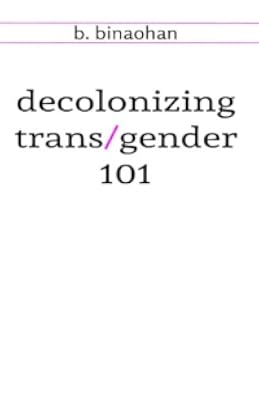
decolonizing trans/gender 101
by b. binaohan
On This Page
Description
tired of reading yet another trans/gender 101 entirely centered around white people and their normative narratives? tired of feeling like you must be _this_ tall to be trans enough to belong in the community ? tired of feeling like the white trans community is erasing your experiences? having gender feels but not understanding how they fit into the current white hegemonic discourse on gender? decolonizing trans/gender 101 is a short, accessible (and non-academic) critique of many of the show more fundamental concepts in white trans/gender theory and discourse. written for the indigenous and/or person of colour trying to understand how their gender is/has been impacted by whiteness and colonialism. show lessTags
Recommendations




Member Reviews
one of the first things mentioned in this book is that formal white english grammar rules are not going to be of any concern, and yet the only reviews on GR are people complaining about the grammar and how unreadible it is, which is funny because i understood every word, but i am used to reading works on blogs by [QT]PoC ppl and i'm used to studying and participating w/ languages with differeent grammar rules than european languages (for whatever "reasons" they proport to be imposed). I was less confused reading this than reading a pile of deleuzian plateaus crammed into a 400 pg, grammatically perfec, tome.
one of the important feeling underlying streams of this book is that the parameters of gender politics are in fact coming from a show more white, mostly top-down hegemony, & in many ways dehistorcizing Idigenous and/or People of Color's gender complexity and continuing the colonial project that hinges on things like binary gender reference points, visibility-consumption continuum, and the current boxed view of socialization (the author argues there is only one socialization: colonial misogyny).
a lotta rage i resonated with was coming through which i'm still prossessing, esp since the author is a transpin@y bakla and i'm trans filipin@ & white, but i'm coming from a place of diasporic dehistorization, so a lot of the beliefs grounded in white supremacy are ones i grew up [en]acting-with (that reminds me that if you're really triggered and frustrated reading this book, check yrself and see if it's out of a place of your internal structures, that are grounded in white-colonialism, being challenged -- if your sure it's not then maybe you're a transman geetting offended by the seeming transference of the critique of Teich's priviledge onto all (well especially white) transmen. that's something that i felt weird about beccause i've heard and felt transmen friend's legitimate pain and i don't want anyone to feel invalid, while i do agree with the author's sentiment that there's nothing like transmisogyny).
i guess i'd advocate this for any belief, especially when they're being passionately expressed: what are the assumptions and other beliefs it is/they are coming from, and where are those assumptions and other beliefs coming from, who are they benefiting, and why does it feel so important to you? keep going with it if you have the energy, then maybe reread this book. show less
one of the important feeling underlying streams of this book is that the parameters of gender politics are in fact coming from a show more white, mostly top-down hegemony, & in many ways dehistorcizing Idigenous and/or People of Color's gender complexity and continuing the colonial project that hinges on things like binary gender reference points, visibility-consumption continuum, and the current boxed view of socialization (the author argues there is only one socialization: colonial misogyny).
a lotta rage i resonated with was coming through which i'm still prossessing, esp since the author is a transpin@y bakla and i'm trans filipin@ & white, but i'm coming from a place of diasporic dehistorization, so a lot of the beliefs grounded in white supremacy are ones i grew up [en]acting-with (that reminds me that if you're really triggered and frustrated reading this book, check yrself and see if it's out of a place of your internal structures, that are grounded in white-colonialism, being challenged -- if your sure it's not then maybe you're a transman geetting offended by the seeming transference of the critique of Teich's priviledge onto all (well especially white) transmen. that's something that i felt weird about beccause i've heard and felt transmen friend's legitimate pain and i don't want anyone to feel invalid, while i do agree with the author's sentiment that there's nothing like transmisogyny).
i guess i'd advocate this for any belief, especially when they're being passionately expressed: what are the assumptions and other beliefs it is/they are coming from, and where are those assumptions and other beliefs coming from, who are they benefiting, and why does it feel so important to you? keep going with it if you have the energy, then maybe reread this book. show less
I'm too white to properly review this book. If you want to know what this book is about or what someone thought about it, find another reviewer please. I found this book easy to read, passionate and informative, liberating and concerning, and in my experience totally correct. I'm going to read this again and highlight passages to read when I'm feeling down.
2014. This book is about decolonizing your mindset so you don't impose colonial notions of race and gender (and grammar) on others or yourself. It's super useful and a quick read. Recommend.
Ratings
Members
- Recently Added By
Lists

Trans Lit
36 works; 1 member
Author Information
2 Works 91 Members
Classifications
- Genres
- Sexuality and Gender Studies, Nonfiction, LGBTQ+, General Nonfiction, Philosophy
- DDC/MDS
- 306.768 — Society, government, & culture Social sciences, sociology & anthropology Social Behavior - Dating, Marriage, Divorce Sexual relations Sexual orientation, transgender identity, intersexuality Transgender identity and intersexuality
- LCC
- HQ77.9 .B535 — Social sciences The family. Marriage, Women and Sexuality The Family. Marriage. Women Sexual life Transexualism
- BISAC
Statistics
- Members
- 88
- Popularity
- 363,955
- Reviews
- 3
- Rating
- (4.50)
- Languages
- English
- Media
- Paper, Ebook
- ISBNs
- 2
- ASINs
- 1