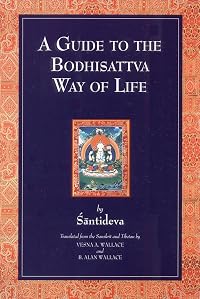
A Guide to the Bodhisattva Way of Life
by Shantideva
On This Page
Description
Written in India in the early eighth century CE, Santideva's Bodhicaryavatara takes as its subject the profound desire to become a Buddha and save all beings from suffering. The person who enacts such a desire is a Bodhisattva. Santideva not only sets out what the Bodhisattva must do and become; he also invokes the intense feelings of aspiration which underlie such a commitment, using language which has inspired Buddhists in their religious lives from his time to the present. Important as a show more manual of training among Mahayana Buddhists, especially in the Tibetan Buddhist tradition, The Bodhicaryavatara continues to be used as a basis for teaching by modern Buddhist teachers. His Holiness the Dalai Lama frequently cites passages as his highest inspiration. In this recording, William Hope first of all reads the work in its entirety so that the listener can gain an overall perspective and emotional engagement with the text and then embarks on the 'study' section, where the translators introduce each chapter, making crucial helpful points. Translated with introductions and notes by Kate Crosby and Andrew Skilton. With a general introduction by Paul Williams. show lessTags
Recommendations












Member Reviews
A great collection of aphorism, but also a sophisticated philosophical consideration of two major problems for salvific religions: if I'm concerned with my own salvation, should I care about other people, and why? The obvious answer, of course, is that your treatment of other people is intimately related to your own salvation, but that's much harder to justify than you might think. Santideva was a monk, writing to other monks, and prone to answering questions like how will all this meditation really help other people though? by saying things like "The perfection is the mental attitude itself." Because you kind of have to say that if you're going to defend withdrawal from the world, and you kind of have to withdraw from the world if show more you're going to live a life of purity, which is the only way to save yourself... right?
Well, what follows the above quote (5.10) is a pretty good try to get out of that logic.
The other problem concerns the value we place of this world. In Santideva's understanding of Buddhist cosmology, nothing exists, everything is illusion, and this causes some pretty obvious problems: why should I bother trying to avoid rebirth, if it's all just illusion anyway? Isn't the process of trying to avoid rebirth just as illusory as the pleasure we take from a nice meal? Book 9 tries to answer such questions, not very well in my eyes, but with a great deal of thought. And this is, again, applicable to all salvific religions: how do you balance the desire for a better state of existence with the needs of the present state? This is connected to the first problem, of course.
The Oxford World's Classics translation is a good one, scholarly but not obtrusive. The notes are helpful, while, of course, avoiding much discussion of the tremendous cosmology needed to justify the idea of rebirth. There's a lot of suffering and hell in this book, and the editors take the easy "oh, it's just in your mind" way out, which means they don't have to tell us anything about the various levels of hell and so on. That's okay, you can't annotate everything. I just want to know more about the levels. show less
Well, what follows the above quote (5.10) is a pretty good try to get out of that logic.
The other problem concerns the value we place of this world. In Santideva's understanding of Buddhist cosmology, nothing exists, everything is illusion, and this causes some pretty obvious problems: why should I bother trying to avoid rebirth, if it's all just illusion anyway? Isn't the process of trying to avoid rebirth just as illusory as the pleasure we take from a nice meal? Book 9 tries to answer such questions, not very well in my eyes, but with a great deal of thought. And this is, again, applicable to all salvific religions: how do you balance the desire for a better state of existence with the needs of the present state? This is connected to the first problem, of course.
The Oxford World's Classics translation is a good one, scholarly but not obtrusive. The notes are helpful, while, of course, avoiding much discussion of the tremendous cosmology needed to justify the idea of rebirth. There's a lot of suffering and hell in this book, and the editors take the easy "oh, it's just in your mind" way out, which means they don't have to tell us anything about the various levels of hell and so on. That's okay, you can't annotate everything. I just want to know more about the levels. show less
In the whole of the Tibetan Buddhist tradition, there is no single treatise more deeply revered or widely practiced than A Guide to the Bodhisattva Way of Life. Composed in the eighth century by the Indian Bodhisattva Santideva, it became an instant classic in the curricula of the Buddhist monastic universities of India, and its renown has grown ever since. Santideva presents methods to harmonize one's life with the Bodhisattva ideal and inspires the reader to cultivate the perfections of the Bodhisattva: generosity, ethics, patience, zeal, meditative concentration, and wisdom.
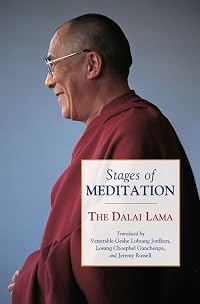
I plan to reread this often--I read it twice during His Holiness the Dalai Lama's week-long teachings from it. As in my review for His Holiness's "Stages of Meditation," I suppose I might appreciate this text more for the explanations His Holiness offered during those teachings, but this book is, so far, the other of those two most profound and instructive guides to formal meditation I've read so far. The translators claim they have lost some of the beauty of Shantideva's poetry, and I don't doubt it, but their presentation is excellent, especially in the way they handled the distinctions between the Sanskrit and the Tibetan versions of the text. A profound, beautiful book,and an excellent guide for anyone's life, Buddhist or non-Buddhist.
I read through this more quickly than I should have. I think it's a book that I'll have to read through a few times and after studying other material to really understand it well.
One of the great classics of Mahayana Buddhism, The Way of the Bodhisattva ( Bodhicharyavatara) is a guide to cultivating the mind of enlightenment, and to generating the qualities of love, compassion, generosity, and patience. Presented in the form of a personal meditation in verse, it outlines the path of the bodhisattvas--those beings who renounce the peace of an individual salvation and vow to work for the deliverance of all beings, and to attain enlightenment for their sake. The text is beloved by Buddhists of all traditions.
Originally written in India in Sanskrit, the text first appeared in Tibetan translation in the eighth century. The fact that it has been expounded, studied, and practiced in Tibet in an unbroken tradition lends show more the Tibetan version of the Bodhicharyavatara a particular authority. The present version has therefore been translated from the Tibetan, following a commentary by the Nyingma master Kunzang Pelden, renowned for its thoroughness, clarity, and accessibility. show less
Originally written in India in Sanskrit, the text first appeared in Tibetan translation in the eighth century. The fact that it has been expounded, studied, and practiced in Tibet in an unbroken tradition lends show more the Tibetan version of the Bodhicharyavatara a particular authority. The present version has therefore been translated from the Tibetan, following a commentary by the Nyingma master Kunzang Pelden, renowned for its thoroughness, clarity, and accessibility. show less
A very readable translation of the eighth-century Indian text usually known in English as "A Guide to the Bodhisattva's Way of Life." It's often seen as one of the greatest Mahayana texts, and is best known for its emphasis on altruism, compassion and seeking awakening for the sake of all. Includes a 35-page introduction by the respected scholar Paul Williams.
Very readable translation of this classic text; extensive notes.
Members
- Recently Added By
Author Information

48+ Works 1,879 Members
Some Editions
Series
Belongs to Publisher Series
Common Knowledge
- Canonical title*
- Bodhicaryavatara. Una guida al sentiero buddhista del risveglio
- Original title
- Bodhisattvacaryāvatāra; Byang.chub.sems.dpaiʹ.spyod.pa.la.jug.pa; Bodhicaryāvatāra
*Some information comes from Common Knowledge in other languages. Click "Edit" for more information.
Classifications
Statistics
- Members
- 1,672
- Popularity
- 13,372
- Reviews
- 19
- Rating
- (4.32)
- Languages
- 11 — Dutch, English, Estonian, Finnish, French, German, Italian, Sanskrit, Spanish, Swedish, Tibetan
- Media
- Paper, Audiobook, Ebook
- ISBNs
- 39
- ASINs
- 17