On This Page
Description
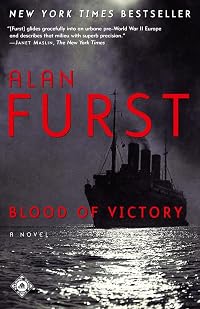
NEW YORK TIMES BESTSELLER • “(Furst) glides gracefully into an urbane pre–World War II Europe and describes that milieu with superb precision.” —Janet Maslin, The New York Times In the autumn of 1940, Russian émigré journalist I. A. Serebin is recruited in Istanbul by an agent of the British secret services for a clandestine operation to stop German importation of Romanian oil—a last desperate attempt to block Hitler’s conquest of Europe. Serebin’s race against time begins show more in Bucharest and leads him to Paris, the Black Sea, Beirut, and, finally, Belgrade; his task is to attack the oil barges that fuel German tanks and airplanes. Blood of Victory is a novel with the heart-pounding suspense, extraordinary historical accuracy, and narrative immediacy we have come to expect from Alan Furst. Praise for Blood of Victory “Densely atmospheric and genuinely romantic, the novel is most reminiscent of the Hollywood films of the forties, when moral choices were rendered not in black-and-white but in smoky shades of gray.”—The New Yorker “Furst’s achievement is a moral one, producing a powerful testament to fiction’s ability to re-create the experience of others, and why it is so deeply important to do so.” —Neil Gordon, The New York Times Book Review “Richly atmospheric and satisfying.” —Deirdre Donahue, USA Today. show lessTags
Recommendations


























Member Reviews
Alan Furst is a great writer when it comes to espionage, spies, and supplying some realism to the plot. His characters are well developed and some are not predictable. He creates mystery characters in his stories and you keep reading to see who comes out on top.
The reader is first introduced to a Paris-based Russian emigrant writer, IA. Serebin who has fled Stalin’s Russia and is living in a Nazis subjugated Paris. We encounter IA. Serebin boarding a boat from Romania to Turkey and find that travel is essential for countries occupants even in dictatorship and easy passage is possible if the right papers have been obtained. This is an intellectual novel giving the reader a world of smart, reflective people living lives as refugees and show more activists. IA. Serebin is no friend of the Germans and is approached by a Hungarian spy, Count Polyani asking for help so Serebin agrees to participate in a mission that the British have already tried and failed. Serebin finds himself facing his fifth war, but this time he is in exile, a man without a country, and there is no army to join.
Most of the story is based in Romanian during a time of great civil uneasiness as the anti-Semitic nationalist Iron Guard seeks to take control of the country which means it places Serebin in the thick of the Romanian civil war and in the middle of the oil fields. Serebin is also convinced to help the British attempt to block the Danube River, preventing the Germans access to the Romanian oil that is the key to their remaining both militarily and industrially functional. Their plan is to disrupt the flow of the oil from the fields in Romania to Germany by sinking a group of barges at a shallow point in the Danube River to sabotage any operations the Germans might have planned.
As the battle goes on to put a stop to the Germans oil supply through spy haunts of the Balkans to a whorehouse in Izmir than on to the river docks of Belgrade to the foggy banks of the Danube River. The reader may have questions from both sides of the conspiracy, I know I did. Furst doesn’t make some of the espionage clear enough to follow but if you have read some of his other books you will learn to read between the lines. He is a great writer but his work is somewhat complex. show less
The reader is first introduced to a Paris-based Russian emigrant writer, IA. Serebin who has fled Stalin’s Russia and is living in a Nazis subjugated Paris. We encounter IA. Serebin boarding a boat from Romania to Turkey and find that travel is essential for countries occupants even in dictatorship and easy passage is possible if the right papers have been obtained. This is an intellectual novel giving the reader a world of smart, reflective people living lives as refugees and show more activists. IA. Serebin is no friend of the Germans and is approached by a Hungarian spy, Count Polyani asking for help so Serebin agrees to participate in a mission that the British have already tried and failed. Serebin finds himself facing his fifth war, but this time he is in exile, a man without a country, and there is no army to join.
Most of the story is based in Romanian during a time of great civil uneasiness as the anti-Semitic nationalist Iron Guard seeks to take control of the country which means it places Serebin in the thick of the Romanian civil war and in the middle of the oil fields. Serebin is also convinced to help the British attempt to block the Danube River, preventing the Germans access to the Romanian oil that is the key to their remaining both militarily and industrially functional. Their plan is to disrupt the flow of the oil from the fields in Romania to Germany by sinking a group of barges at a shallow point in the Danube River to sabotage any operations the Germans might have planned.
As the battle goes on to put a stop to the Germans oil supply through spy haunts of the Balkans to a whorehouse in Izmir than on to the river docks of Belgrade to the foggy banks of the Danube River. The reader may have questions from both sides of the conspiracy, I know I did. Furst doesn’t make some of the espionage clear enough to follow but if you have read some of his other books you will learn to read between the lines. He is a great writer but his work is somewhat complex. show less
What a GREAT book!!! I very highly recommend it -- but not to someone looking for a quick read, a happy ending or warm fuzzies. This is a very dark story of espionage. It is one of the most literate novels I've read in a very long time.
Set before WWII becomes World War, just prior to Hitler's invasion of the Soviet Union, the story focuses on a plot by a varied group of committed anti-fascists to disrupt the flow of "the blood of victory", oil. The Germans depend on the flow of Romanian oil up the Danube to lubricate their war machine. The disruption of this flow has been tried several times, but has always failed and the Germans are always on the lookout for trouble. Serebin, an itinerant Russian poet living in Vichy France, becomes show more involved with this group, and the story is really his story. The strings are pulled by people in power, some of whom have questionable motives and loyalties, and some of whom feel no qualms about betraying others for their own reasons. Furthermore, Furst describes how money and power are really at the root of war -- and how solutions for ending war have a price.
The characters are very true to life; the writing is outstanding, and the suspense nearly killed me. I rate it very highly and can't wait for another book by this author. show less
Set before WWII becomes World War, just prior to Hitler's invasion of the Soviet Union, the story focuses on a plot by a varied group of committed anti-fascists to disrupt the flow of "the blood of victory", oil. The Germans depend on the flow of Romanian oil up the Danube to lubricate their war machine. The disruption of this flow has been tried several times, but has always failed and the Germans are always on the lookout for trouble. Serebin, an itinerant Russian poet living in Vichy France, becomes show more involved with this group, and the story is really his story. The strings are pulled by people in power, some of whom have questionable motives and loyalties, and some of whom feel no qualms about betraying others for their own reasons. Furthermore, Furst describes how money and power are really at the root of war -- and how solutions for ending war have a price.
The characters are very true to life; the writing is outstanding, and the suspense nearly killed me. I rate it very highly and can't wait for another book by this author. show less
This novel by Furst follows his "Kingdom of Shadows," a book I very much enjoyed. It jumps ahead from the last novel to November 24, 1940 and it is primarily set in the countries that border the Black Sea. The Germans have already taken Paris and this book is much more overtly a spy thriller than the last. New set of primary characters, all interesting, and for me a somewhat surprising appearance of a character from the prior novel that we thought was possibly dead. We learn there was much more to him then previously thought. The story revolves in various ways around a somewhat renowned but minor Russian writer from Odessa, I. A. Serabin, an émigré living initially in Paris and other places and how he is drawn into the war. After an show more incident he realizes he must make a decision to either fight or flee and he chooses to aid the British in an undercover role through a surprising contact.
The objective here is to stop the flow of the "Blood of Victory," which is oil and specifically Roumanian oil to Germany. Although this was an interesting read dripping with atmosphere set in some far off and unusual places, it didn't really pull me in quite like "Kingdom of Shadows" did. Still, this was a very suspenseful book, with some exciting heart racing scenes. I'll certainly be reading more from Furst. show less
The objective here is to stop the flow of the "Blood of Victory," which is oil and specifically Roumanian oil to Germany. Although this was an interesting read dripping with atmosphere set in some far off and unusual places, it didn't really pull me in quite like "Kingdom of Shadows" did. Still, this was a very suspenseful book, with some exciting heart racing scenes. I'll certainly be reading more from Furst. show less
Read during Spring 2005
This was reccomended as 'LeCarre like' but really wasn't. However, it was a very enjoyable and hard to put down WWII thriller with interesting characters and settings. My biggest problem was the minor charcaters, introduced in a few sentences and then picked up again 30 pages later. I was glad to be able to flip back and forth and jog my memory. It doesn't have the muddy moral ground of LeCarre, nor the subtleness, but it beats most other spy novels I've tried.
This was reccomended as 'LeCarre like' but really wasn't. However, it was a very enjoyable and hard to put down WWII thriller with interesting characters and settings. My biggest problem was the minor charcaters, introduced in a few sentences and then picked up again 30 pages later. I was glad to be able to flip back and forth and jog my memory. It doesn't have the muddy moral ground of LeCarre, nor the subtleness, but it beats most other spy novels I've tried.
More than anything else Alan Furst recreates the atmosphere of the early days of World War II espionage. I.A. Serebin inhabits the urbane world of Russian emigres in the Europe of 1940-1941, mainly in Paris, but also in Roumania. Serebin is recruited into what seems to be the British secret service and seeks to interrupt the flow of Roumanian oil to the Nazi war machine. The whole operation reeks of amateurism - appropriate enough at that stage of the war - brainy, careful, daring, but amateur. With one exception, none of the players know completely what they are part of - which also leaves the reader at times groping for the story line. Still Furst's prose forms the characters into full-dimensional beings from Bogart's Casablanca or show more Graham Greene's Human Factor.
Highly recommended for readers with an interest in espionage or WW II. show less
Highly recommended for readers with an interest in espionage or WW II. show less
Serebin, former officer in the Red Army who has fled Stalins persecution and ended up in Paris, heading an émigre organisation, decides to become an agent for the Allied forces in WWII.
His assignment is to help stop the oil of Roumania from reaching its German destinations.
Finely drawn environments with ambience, short staccato sentences, a compact story taking place in old time Europeans capitals.
His assignment is to help stop the oil of Roumania from reaching its German destinations.
Finely drawn environments with ambience, short staccato sentences, a compact story taking place in old time Europeans capitals.
The Furst novels are wonderful evocations of Europe, and particular cities, so well done that you feel you are in the cities with the characters. Stories about spying and espionage
Members
- Recently Added By
Lists

Books Read in 2023
5,547 works; 145 members
Author Information

26+ Works 16,463 Members
Furst received a B.A. from Oberlin College in 1962 and an M.A. from Penn State in 1967. Before becoming a full-time novelist, Furst worked in advertising and wrote magazine articles, most notably for Esquire, and as a columnist for the International Herald Tribune His early novels (1976-1983) achieved limited success. However, the 1988 publication show more of Night Soldiers inspired by a 1984 trip to Eastern Europe on assignment for Esquire revitalized his career. It was the first of his highly original novels about espionage in Europe before and during the Second World War. Born in New York on February 20, 1941, he lived for long periods in France, especially Paris where he was awarded a Fulbright teaching fellowship. In 2011, the Tulsa Library Trust in Tulsa, Oklahoma selected Furst to receive its Helmerich Award, a literary prize given annually to honor a distinguished author's body of work He also made The New York Times Best Seller List in 2012 with his title The Mission to Paris and Midnight in Europe in 2014. Furst again made the New York Times Bestseller in 2016 with his novel a Hero of France. (Publisher Provided) Alan Furst is an American author of spy novels. He was born in New York City on February 20, 1941, and was raised on the Upper West Side of Manhattan. Furst received a B.A. from Oberlin College in 1962 and an M.A. from Penn State in 1967. His novels are set just prior to and during the Second World War. Titles include: Night Soldiers, Kingdom of Shadows (which won the 2001 Hammett Prize), Blood of Victory, Spies of the Balkans and Mission to Paris. In 2011, the Tulsa Library Trust in Tulsa, Oklahoma, selected Furst to receive its Helmerich Award, a literary prize given annually to honor a distinguished author's body of work. Furst made The New York Times Best Seller List in 2012 with his title The Mission to Paris and Midnight in Europe in 2014. Furst again made the New York Times Bestseller in 2016 with his novel A Hero of France. (Bowker Author Biography) show less

Alan Furst is a LibraryThing Author, an author who lists their personal library on LibraryThing.
Some Editions
Awards and Honors
Distinctions
Series

Common Knowledge
- Canonical title
- Blood of Victory
- Original title
- Blood of Victory
- Original publication date
- 2002
- People/Characters
- I.A. Serebin; Count Janos Polanyi; S. Kolb; Marie-Galante Labonniere; Serge Kubalsky; Ivan Kostyka
- Important places
- Romania; Istanbul, Turkey
- Important events
- World War II
- Blurbers
- Maslin, Janet; Gordon, Neil; Donahue, Deirdre; Allis, Sam
Classifications
- Genres
- Fiction and Literature, General Fiction, Historical Fiction, Mystery
- DDC/MDS
- 813.54 — Literature & rhetoric American literature in English American fiction in English 1900-1999 1945-1999
- LCC
- PS3556 .U76 .B57 — Language and Literature American literature American literature Individual authors 1961-
- BISAC
Statistics
- Members
- 1,038
- Popularity
- 24,796
- Reviews
- 14
- Rating
- (3.81)
- Languages
- 5 — Dutch, English, French, German, Spanish
- Media
- Paper, Audiobook, Ebook
- ISBNs
- 29
- UPCs
- 1
- ASINs
- 6