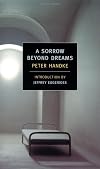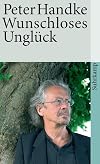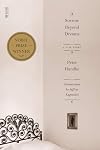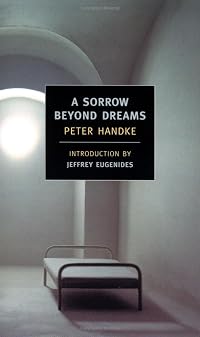
A Sorrow Beyond Dreams
by Peter Handke
On This Page
Description
"My mother has been dead for almost seven weeks: I had better go to work before the need to write about her, which I felt so strongly at her funeral, dies away and I fall back into the dull speechlessness with which I reacted to the news of her suicide." So begins Peter Handke's extraordinary confrontation with his mother's death. In a painful and courageous attempt to deal with the almost intolerable horror of her suicide, he sets out to piece together the facts of her life, as he perceives show more them. What emerges is a loving portrait of inconsolable grief, a woman whose lively spirit has been crushed not once but over and over again by the miseries of her place and time. Yet well into middle age, living in the Austrian village of her birth, she still remains haunted by her dreams. show lessTags
Recommendations
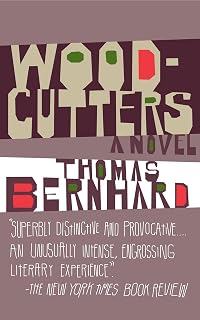

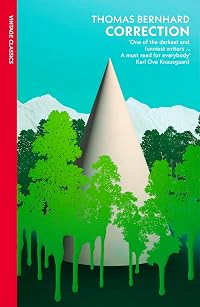
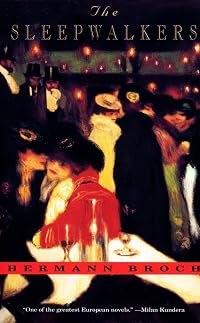
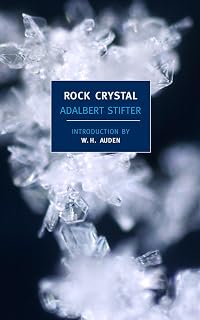



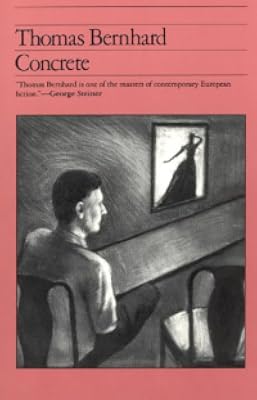


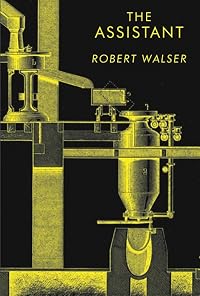
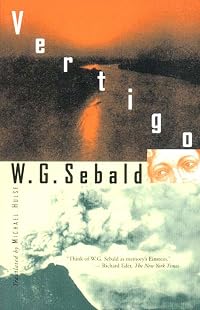

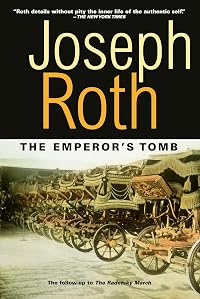


Member Recommendations
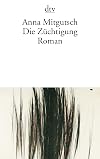
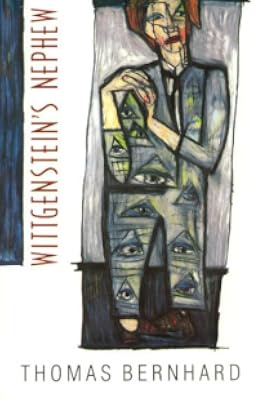
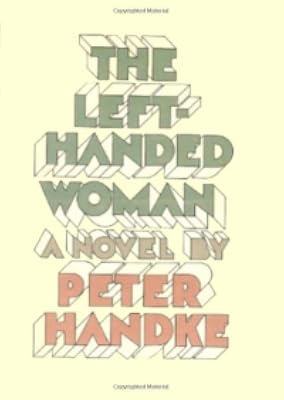
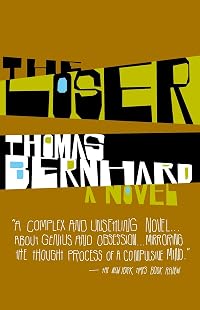
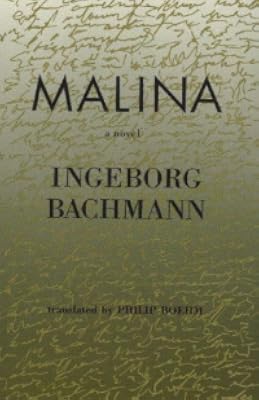
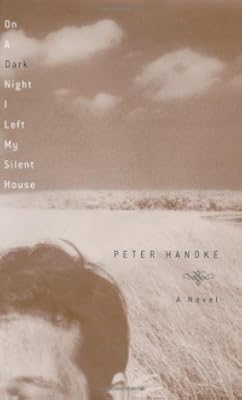
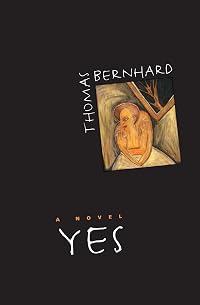
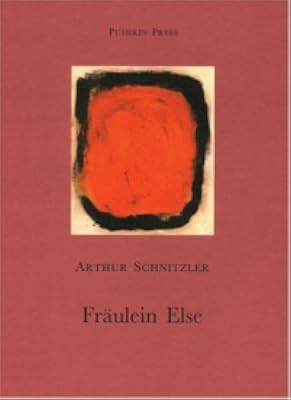
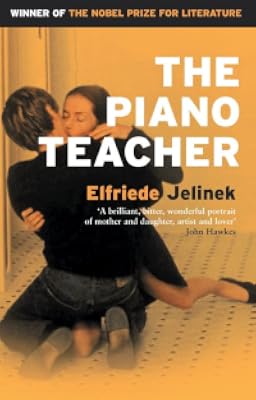
verenka Both books by contemporary Austrian authors deal with difficult mother-daughter relationships.
Member Reviews
A Sorrow Beyond Dreams is a memoir that Peter Handke wrote following his mother's suicide in 1971. It is a brief gut-wrenching examination of a life that spanned the rise of Nazi Germany, the 2nd World War, and the years of national impoverishment, confusion and shame that followed. Handke's mother was an invisible woman. Her sporadic flirtations with self-assertion ended when necessity or illness dragged her back down to earth. She married a man she grew to loathe and worked her fingers to the bone. Readers of his early works know that Handke's style is normally restrained to the point of minimalism. In this instance he exerts such control over the emotional content of the story he is telling that, like some potion or elixir, its show more bitterness is concentrated and overpowering. This is an account of a life so desolate, so utterly lacking in hope, it seems narrated in shades of grey. One wonders how much is fact, how much fiction, and how much speculation. It is a difficult but necessary book-- more easily admired than enjoyed--that provides a glimpse into the life of one person who endured the austerity and bleakness of post-war Germany, but in the end succumbed to physical decline, personal despair and an overwhelming sense of worthlessness. show less
“She was afraid of losing her mind. Quickly, for fear it would be too late, she wrote a few letters of farewell.
Her letters were full of urgency, as if she tried to etch herself into the paper” (54)
This is a moving novella about the author’s loss of his mother and the inadequacy of language to capture what is essential and meaningful about her in life. As the author, Handke attempts to remember and reflect on his mother through memories, fragments of experiences, and a jumble of sense data that contribute only partially sketched recollections.
Language and narrative are what Handke has at his disposal as tools of attesting and analyzing and through that remembering and elevating, but he reflects that language is inadequate to show more convey a person because it is a medium that makes objects out of subjects. To capture something or someone and put it into language isolates the subject, removes it from time, flattens a life into points and moments, denies it magnitude, makes it mundane by filtering it through the relatability of language.
“At times it worked and everything personal was swallowed up by the typical” (27)
The challenge Handke faces is to portray his mother as distinctly as he experienced her, to say something true and precise about her. But in writing about her, to himself and other readers, Handke must choose images and memories that compress the manifold of his experience, to make it relatable. This move makes his mother, her death, and his reaction, objects of analysis and no longer a subjective experiences. Even his own grief becomes an object in language and for the reader.
“As usual when engaged in literary work, I am alienated from myself and transformed into an object, a remembering and formulating machine” (5)
As Handke notes at the beginning of the narrative: “I need the feeling that what I’m going through is incomprehensible and incommunicable; only then does the horror seem meaningful and real“ (4). And perhaps he achieves something of this as the narrative never really comes fully together. By the end it is a scattershot of clauses and phrases that may reflect things slipping away, fragments unmoored from the context of a lived history. And this fragmentation captures palpable sorrow of whole memories shredding and dissolving.
A powerful piece of writing and an intellectually interesting reflection on the shortcomings of language. show less
Her letters were full of urgency, as if she tried to etch herself into the paper” (54)
This is a moving novella about the author’s loss of his mother and the inadequacy of language to capture what is essential and meaningful about her in life. As the author, Handke attempts to remember and reflect on his mother through memories, fragments of experiences, and a jumble of sense data that contribute only partially sketched recollections.
Language and narrative are what Handke has at his disposal as tools of attesting and analyzing and through that remembering and elevating, but he reflects that language is inadequate to show more convey a person because it is a medium that makes objects out of subjects. To capture something or someone and put it into language isolates the subject, removes it from time, flattens a life into points and moments, denies it magnitude, makes it mundane by filtering it through the relatability of language.
“At times it worked and everything personal was swallowed up by the typical” (27)
The challenge Handke faces is to portray his mother as distinctly as he experienced her, to say something true and precise about her. But in writing about her, to himself and other readers, Handke must choose images and memories that compress the manifold of his experience, to make it relatable. This move makes his mother, her death, and his reaction, objects of analysis and no longer a subjective experiences. Even his own grief becomes an object in language and for the reader.
“As usual when engaged in literary work, I am alienated from myself and transformed into an object, a remembering and formulating machine” (5)
As Handke notes at the beginning of the narrative: “I need the feeling that what I’m going through is incomprehensible and incommunicable; only then does the horror seem meaningful and real“ (4). And perhaps he achieves something of this as the narrative never really comes fully together. By the end it is a scattershot of clauses and phrases that may reflect things slipping away, fragments unmoored from the context of a lived history. And this fragmentation captures palpable sorrow of whole memories shredding and dissolving.
A powerful piece of writing and an intellectually interesting reflection on the shortcomings of language. show less
Granted that Handke's writing typically rubs me the wrong way, leaves me with a sense of intentional and unnecessary complexity, chimerical ideas and empty impressions wrapped in ponderous but enervated language, passages like
"Natürlich ist es ein bißchen, unbestimmt, was da über jemand Bestimmten geschrieben steht; aber nur die von meiner Mutter als einer möglicherweise einmaligen Hauptperson in einer vielleicht einzigartigen Geschichte ausdrücklich absehenden Verallgemeinerungen können jemanden außer mich selber betreffen — die bloße Nacherzählung eines wechselnden Lebenslauf mit plötzlichem Ende wäre nichts als eine Zumutung."
(afterward, Handke write of the dangers of abstraction) and
"Natürlich ist das Beschreiben ein show more bloßer Erinnerungsvorgang; aber es bannt andererseits auch nichts für das nächste Mal, gewinnt nur aus den Angstzuständen durch den Versuch einer Annäherung mit möglichst entsprechenden Formulierungen eine kleine Lust, produziert aus der Schreckens- eine Erinnerungsseligkeit."
still leave me baffled. Perhaps he's playing an elaborate joke. Often the convolutions and prolongations of Handke's prose don't seem to produce much of an effect, apart from mental exhaustion. (I think of Bernhard's long crescendoes and feel there's some lacking here.)
The final, fragmentary section is, to my mind, more effective than the rest, which nevertheless contains some gems of observation ("Als Frau in diese Umstände geboren zu werden, ist von vornherein schon tödlich gewesen.""Sie war; sie wurde; sie wurde nichts."). Handke succeeds, though, in describing a way of life in which inarticulacy, muffled disappointment and blankness—maybe well-reflected by Handke's prose—are the rule. Yet this prose seems to me somehow mendacious, shot through with a kind of perversity, even if Handke, perhaps, has already taken it all into account.
The figure of Handke's mother comes occasionally, cuttingly, to life. show less
"Natürlich ist es ein bißchen, unbestimmt, was da über jemand Bestimmten geschrieben steht; aber nur die von meiner Mutter als einer möglicherweise einmaligen Hauptperson in einer vielleicht einzigartigen Geschichte ausdrücklich absehenden Verallgemeinerungen können jemanden außer mich selber betreffen — die bloße Nacherzählung eines wechselnden Lebenslauf mit plötzlichem Ende wäre nichts als eine Zumutung."
(afterward, Handke write of the dangers of abstraction) and
"Natürlich ist das Beschreiben ein show more bloßer Erinnerungsvorgang; aber es bannt andererseits auch nichts für das nächste Mal, gewinnt nur aus den Angstzuständen durch den Versuch einer Annäherung mit möglichst entsprechenden Formulierungen eine kleine Lust, produziert aus der Schreckens- eine Erinnerungsseligkeit."
still leave me baffled. Perhaps he's playing an elaborate joke. Often the convolutions and prolongations of Handke's prose don't seem to produce much of an effect, apart from mental exhaustion. (I think of Bernhard's long crescendoes and feel there's some lacking here.)
The final, fragmentary section is, to my mind, more effective than the rest, which nevertheless contains some gems of observation ("Als Frau in diese Umstände geboren zu werden, ist von vornherein schon tödlich gewesen.""Sie war; sie wurde; sie wurde nichts."). Handke succeeds, though, in describing a way of life in which inarticulacy, muffled disappointment and blankness—maybe well-reflected by Handke's prose—are the rule. Yet this prose seems to me somehow mendacious, shot through with a kind of perversity, even if Handke, perhaps, has already taken it all into account.
The figure of Handke's mother comes occasionally, cuttingly, to life. show less
This slim volume (76 pages) is an author's attempt to process his mother's suicide. It ends up being both the story of his mother's life, and more generally, about what it was like to be a poor woman in Germany, living through World War II and its aftermath. About a woman's sense of identity or lack thereof in a pre-feminist society.
But mostly it is a book about grief. The reader is constantly reminded that this is not so much a biography of his mother as it is a way to deal with his loss, to try to gain perspective and distance from his pain and from the memory of his mother. Of course it doesn't work as he hopes that it would. But that's what makes it moving. That's what saves the book from his attempted detachment from the specifics show more of his mother.
I wonder if he ever wrote or ever will write the more thorough story of his mother promised in the last line of the book... show less
But mostly it is a book about grief. The reader is constantly reminded that this is not so much a biography of his mother as it is a way to deal with his loss, to try to gain perspective and distance from his pain and from the memory of his mother. Of course it doesn't work as he hopes that it would. But that's what makes it moving. That's what saves the book from his attempted detachment from the specifics show more of his mother.
I wonder if he ever wrote or ever will write the more thorough story of his mother promised in the last line of the book... show less
This book really didn't work beyond the beginning pages. And yet it wasn't bad. The writing was not engaging enough, the biographical style he chose ("after that, she did this..." etc.) is hard to stomach for too long. You can tell that Handke was conscious of this too, putting in things that broke from the pattern, even a whole page meta-talking about why he decided to write it in this boring style! The book fails in some interesting ways. I feel like Handke never had a good sense of what he wanted to do with the subject matter. As for the story itself, it was okay; I was especially struck by some of the insights about about her mother growing up towards the beginning. I also admire his sincerity.
In 1972, the author's mother took her own life by overdosing on sleeping pills, after an unremarkable life of 51 years that was marred by poverty, depression, neurogenic pain, and especially the limited opportunities available to her. After the initial "dull speechlessness" he experienced after receiving the news of her death, Handke was proud that his mother had taken the affirmative step to end her suffering. Soon afterward, he decided to write about her life, before the need to do so faded away.
The account of her life and demise is unique, in that he chooses to write about her in relation to other women of her era and socioeconomical status. She is born in a small Austrian village to a struggling family, and is described as a show more high-spirited child and a good student. She is taken out of school by her parents once her compulsory education ends, then runs away to Berlin as a teenager to pursue opportunities that her village and parents cannot offer her. After bearing a child out of wedlock to the love of her life, she agrees to marry a man whom she does not love or respect, in order to provide for herself and her child in post-war Germany. She sinks back into the life that she had sought escape, and ultimately moves back with her family to her home village. In her remaining days she is an embittered woman who frightens her children and is emotionally separated from her emasculated husband, yet she becomes more independent and full of life before developing the chronic pain and depression that ultimately led to her suicide.
I found "A Sorrow Beyond Dreams" somewhat difficult and less than enjoyable, primarily because of the author's use of abstraction to distance himself from and depersonalize his mother. We only get brief glimpses into her personality, and into what made her unique from other similar women, which would have made this a much more interesting book for me. The book is well written and brief (76 pages), and sufficiently unique that it may be of interest to a limited audience of readers. show less
The account of her life and demise is unique, in that he chooses to write about her in relation to other women of her era and socioeconomical status. She is born in a small Austrian village to a struggling family, and is described as a show more high-spirited child and a good student. She is taken out of school by her parents once her compulsory education ends, then runs away to Berlin as a teenager to pursue opportunities that her village and parents cannot offer her. After bearing a child out of wedlock to the love of her life, she agrees to marry a man whom she does not love or respect, in order to provide for herself and her child in post-war Germany. She sinks back into the life that she had sought escape, and ultimately moves back with her family to her home village. In her remaining days she is an embittered woman who frightens her children and is emotionally separated from her emasculated husband, yet she becomes more independent and full of life before developing the chronic pain and depression that ultimately led to her suicide.
I found "A Sorrow Beyond Dreams" somewhat difficult and less than enjoyable, primarily because of the author's use of abstraction to distance himself from and depersonalize his mother. We only get brief glimpses into her personality, and into what made her unique from other similar women, which would have made this a much more interesting book for me. The book is well written and brief (76 pages), and sufficiently unique that it may be of interest to a limited audience of readers. show less
'One of the best and most important books written in German in our time' Karl Ove Knausgaard
'A devastating sliver of a book' Maggie Nelson
'Moving and beautifully realized... nearly perfect' New York Times Book Review
'Handke's sharp eye is always finding a strange beauty' Jeffrey Eugenides
This is Peter Handke's extraordinary confrontation with his mother's death. In a painful and courageous attempt to deal with the almost intolerable horror of her suicide, the eminent Austrian novelist and playwright sets out to piece together the facts of her life. What emerges is a loving portrait of inconsolable grief, and of a woman whose lively spirit has been crushed not once but over and over again by the miseries of her place and time. In stark, show more lucid prose, Handke reckons with his mother's life as it spans the rise of fascism, World War Two and post-war suffering. show less
'A devastating sliver of a book' Maggie Nelson
'Moving and beautifully realized... nearly perfect' New York Times Book Review
'Handke's sharp eye is always finding a strange beauty' Jeffrey Eugenides
This is Peter Handke's extraordinary confrontation with his mother's death. In a painful and courageous attempt to deal with the almost intolerable horror of her suicide, the eminent Austrian novelist and playwright sets out to piece together the facts of her life. What emerges is a loving portrait of inconsolable grief, and of a woman whose lively spirit has been crushed not once but over and over again by the miseries of her place and time. In stark, show more lucid prose, Handke reckons with his mother's life as it spans the rise of fascism, World War Two and post-war suffering. show less
Members
- Recently Added By
Lists

Books Read in 2018
4,360 works; 110 members

Mustich's 1000 Books to Read Before You Die: A Life Changing List
1,001 works; 18 members

Die besten Werke der deutschsprachigen Erzählliteratur von 1924 bis 2024
100 works; 2 members
Author Information

208+ Works 8,511 Members
Peter Handke was born in Griffen, Austria on December 6, 1942. He studied law at Graz University from 1961 to 1965. He is a playwright, novelist, poet, and essayist. His plays include Offending the Audience, Kaspar, and The Ride across Lake Constance. His novels include The Goalie's Anxiety at the Penalty Kick, The Left-Handed Woman, and A Sorrow show more beyond Dreams. He was awarded the Buchner Prize in 1973 and refused to accept the Kafka Prize in 1979. (Bowker Author Biography) Peter Handke was born in Griffen, Austria, in 1942. His many works include Absence (FSG, 1990), The Jukebox and Other Essays on Storytelling (FSG, 1994), and, most recently, My Year in the No-Man's-Bay (FSG, 1998). (Publisher Provided) show less
Some Editions
Awards and Honors
Series
Belongs to Publisher Series
suhrkamp taschenbuch (0146 / 3287)
Work Relationships
Is contained in
Has as a commentary on the text
Has as a student's study guide
Common Knowledge
- Canonical title
- A Sorrow Beyond Dreams
- Original title
- Wunschloses Unglück
- Original publication date
- 1972
- People/Characters*
- Maria
- Epigraph
- He's not busy being born is busy dying.
Bob Dylan
Dusk was falling quickly. It was just after 7 p. m., and the month was October.
Patricia Highsmith, A Dogs Ransom - First words*
- Unter der Rubrik VERMISCHTES stand in der Sonntagsausgabe der Kärntner "Volkszeitung" folgendes: "In der Nacht zum Samstag verübte eine 51jährige Hausfrau aus A. (Gemeinde G.) Selbstmord durch einnehmen einer Überdosis vo... (show all)n Schlaftabletten."
- Last words*
- (Click to show. Warning: May contain spoilers.)Später werde ich über das alles Genaueres schreiben.
- Blurbers*
- Scheffel, Helmut
- Original language
- Tedesco
- Disambiguation notice
- 3518397877 2001 softcover German suhrkamp taschenbuch 3287
3518735349 2013 eBook German suhrkamp
*Some information comes from Common Knowledge in other languages. Click "Edit" for more information.
Classifications
- Genres
- Fiction and Literature, General Fiction, Biography & Memoir
- DDC/MDS
- 833.914 — Literature & rhetoric German & related literatures German fiction 1900- 1900-1990 1945-1990
- LCC
- PT2668 .A5 .W813 — Language and Literature German, Dutch and Scandinavian literatures German literature Individual authors or works 1961-2000
- BISAC
Statistics
- Members
- 875
- Popularity
- 30,877
- Reviews
- 18
- Rating
- (3.64)
- Languages
- 16 — Chinese, Czech, Danish, Dutch, English, Finnish, French, German, Greek, Hungarian, Italian, Norwegian (Bokmål), Norwegian, Russian, Spanish, Swedish
- Media
- Paper, Audiobook, Ebook
- ISBNs
- 51
- ASINs
- 19