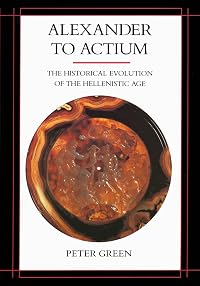
Alexander to Actium: The Historical Evolution of the Hellenistic Age
by Peter Green
On This Page
Description
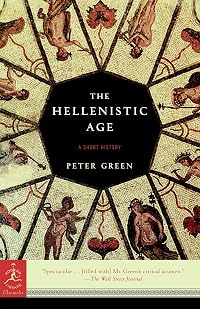
The Hellenistic Age, the three extraordinary centuries from the death of Alexander in 323 B. C. to Octavian's final defeat of Antony and Cleopatra at the Battle of Actium, has offered a rich and variegated field of exploration for historians, philosophers, economists, and literary critics. Yet few scholars have attempted the daunting task of seeing the period whole, of refracting its achievements and reception through the lens of a single critical mind. Alexander to Actium was conceived and show more written to fill that gap.In this monumental work, Peter Green-noted scholar, writer, and critic-breaks with the traditional practice of dividing the Hellenistic world into discrete, repetitious studies of Seleucids, Ptolemies, Antigonids, and Attalids. He instead treats these successor kingdoms as a single, evolving, interrelated continuum. The result clarifies the political picture as never before. With the help of over 200 illustrations, Green surveys every significant aspect of Hellenistic cultural development, from mathematics to medicine, from philosophy to religion, from literature to the visual arts.Green offers a particularly trenchant analysis of what has been seen as the conscious dissemination in the East of Hellenistic culture, and finds it largely a myth fueled by Victorian scholars seeking justification for a no longer morally respectable imperialism. His work leaves us with a final impression of the Hellenistic Age as a world with haunting and disturbing resemblances to our own. This lively, personal survey of a period as colorful as it is complex will fascinate the general reader no less than students and scholars. show lessTags
Recommendations

















Member Recommendations

timspalding Green's history of Alexander has somewhat less scholarly apparatus, but a stronger narrative.

timspalding These two books go together very well, with some overlap in content.
Member Reviews
A dense, informative look at the Hellenistic period — one I'd argue is often ignored in Western history classes. We learn about the Greeks and the Persians, about Athens and Sparta, and Alexander's conquests, but then skip forward to the rise of Rome. I knew bits and pieces about this period, but this very comprehensive book has really filled in the gaps.
It doesn't just tackle the straight history of battles and kings, although that's there. Just as much if not more of the book is devoted to the history of Hellenistic art and literature, while other segments throughout focus on science, architecture and philosophy.
The most striking thing about this book to me is that it's so long, dense and thoroughly researched when the author show more appears to dislike everything about the period. I'm sure that's not actually the case, but he is thoroughly critical of just about every aspect of the age: the behavior of its elites, its trends in art and literature, the general lack of progress, the hypocrisy, the religions and philosophies, etc. Even the rare undisputed triumphs of the age, such as medical breakthroughs in Alexandria or a few of Alexander's more talented generals, are dismissed as exceptions to the general rule of stagnation and decadence. And the thing is, I'm not sure he's wrong. But it was striking.
And this period is an important period of history. Despite Green's criticisms, the Hellenistic Age had a huge impact for centuries to come. Its Stoic and Epicurean philosophies, its advances in medicine, astronomy and other sciences, its architecture (the Seven Wonders of the World are almost all from this era), its military innovations, its impact on ancient Judaism, and generally speaking the cultural prestige of the Hellenistic era all profoundly influenced Rome and, at greater remove, our own culture.
If you're interested in filling in the gaps in a thorough way, this book will do it, though it's dense and perhaps — to my tastes anyway — overdetailed on art and literature. For a breezier look, the same author wrote a much shorter survey of the period, though I have not read it and cannot comment on its quality. show less
It doesn't just tackle the straight history of battles and kings, although that's there. Just as much if not more of the book is devoted to the history of Hellenistic art and literature, while other segments throughout focus on science, architecture and philosophy.
The most striking thing about this book to me is that it's so long, dense and thoroughly researched when the author show more appears to dislike everything about the period. I'm sure that's not actually the case, but he is thoroughly critical of just about every aspect of the age: the behavior of its elites, its trends in art and literature, the general lack of progress, the hypocrisy, the religions and philosophies, etc. Even the rare undisputed triumphs of the age, such as medical breakthroughs in Alexandria or a few of Alexander's more talented generals, are dismissed as exceptions to the general rule of stagnation and decadence. And the thing is, I'm not sure he's wrong. But it was striking.
And this period is an important period of history. Despite Green's criticisms, the Hellenistic Age had a huge impact for centuries to come. Its Stoic and Epicurean philosophies, its advances in medicine, astronomy and other sciences, its architecture (the Seven Wonders of the World are almost all from this era), its military innovations, its impact on ancient Judaism, and generally speaking the cultural prestige of the Hellenistic era all profoundly influenced Rome and, at greater remove, our own culture.
If you're interested in filling in the gaps in a thorough way, this book will do it, though it's dense and perhaps — to my tastes anyway — overdetailed on art and literature. For a breezier look, the same author wrote a much shorter survey of the period, though I have not read it and cannot comment on its quality. show less
This is a tremendous book by a tremendous man. As opinionated as Green can be, the book feels weirdly "open"—its very breadth an invitation to a thousand interesting topics—some of which, one feels, have not been studied enough. It easily stops a door and would probably stop a bullet. I wish it were longer.
A massive tome and comprehensive examination of history, culture and philosophy during the Hellenistic era. Alexander was barely cold before his successors began the struggle over ruler ship of his empire. The Greek city-states had resurgent ambitions for independence, repeatedly thwarted. Eventually the civic character of the Greeks turned inward and men of ability concentrated on private riches rather than political ambition. In Egypt, the Ptolemies maintained a basically Greek ruler-ship with little contact with or appreciation of the Egyptian culture. Egypt was simply a rich place to rob. One does wonder about the private lives of some of the rulers--especially the women--married to an uncle as he seizes the throne, divorced and show more married to a brother who has overthrown the uncle, then remarried to the uncle when he manages a comeback. Whole new shades of meaning to "honey, I'm home." An interesting read and an impressive accomplishment. I would hate to be tested on it. So many rulers, so few names. show less
I had a wonderful time with this book! The Hellenistic period is often scanted, with authors jumping from the death of Alexander directly to the Rise of Rome. A lot went on in the Eastern Mediterranean and points east while the Romans laboriously put their method and their state together. for the bulk of the middle Sea's population, the doings of the Ptolemies of Egypt was more important than the Punic Wars. I am glad that this book exists to educate the casual reader in the proportion with which the period should be seen.
Wonderfully comprehensive. Does a great job connecting gaps between the better know events of the period, while focusing on topics like culture, art and intellectual developments that are usually left out of other, more episodic and geo-politically focused studies of the period. Highly recommend if you looking for a more academic but still readable look at the Hellenistic period.
This book presents a fantastically broad overview of the Hellenistic age, including political developments, social and economic history, science, philosophy, art etc. And it's very well written, too. Anyone interested in the Hellenistic age should start with this book.
Sholarly, a little heavy but eminently readable. This covers the age of Hellenism from the Death of Alexander (323 BCE) to the battle of Actium which ended the Roman Republic in 31 BCE. 240 pages of notes and chronology, lots of B&W pictures.
Members
- Recently Added By
Lists

Books We Love to Reread
695 works; 299 members
Author Information

39+ Works 2,952 Members
Peter Green is Dougherty Centennial Professor Emeritus of Classics at the University of Texas at Austin and Adjunct Professor of Classics at the University of Iowa. He is the author of many books and translations, including Alexander to Actium, the poems of Catullus, and Apollonios Rhodios's The Argonautika, all published by UC Press.
Series
Belongs to Publisher Series
Common Knowledge
- Canonical title
- Alexander to Actium: The Historical Evolution of the Hellenistic Age
- Original publication date
- 1990
- People/Characters
- Alexander the Great (326-253 BC); Agathocles (tyrant of Syracuse); Antigonus I Monophthalmos; Antigonus II Gonatas; Antigonus Doson; Antiochus I (show all 55); Antiochus III the Great (241? to 287 BC/BCE); Antiochus IV Epiphanes (175-164 BC/BCE); Apollonius of Rhodes; Aratus; Archimedes of Syracuse; Aristotle (384-322 BC/BCE); Arsinoë II; Attalus I; Julius Caesar; Callimachus; Cassander; Chrysippus; Cleomenes III of Sparta; Cleopatra Thea; Cleopatra VII; Demetrius of Phaleron; Demetrius I Poliorcetes; Epicurus (c.341-c.270 BC/BCE); Eumenes of Cardia; Eumenes II; Flaminius; Lucullus; Lysimachus; Marcus Antonius; Menander; Mithridates VI, King of Pontus; Nabis of Sparta; Augustus Caesar (founder of the Roman Empire and its first Emperor); Panaetius of Rhodes; Perseus, King of Macedon; Philip V of Macedon; Plato (c.428-347 BC/BCE); Plutarch; Polybius; Pompey the Great; Poseidonius of Apamea; Ptolemy I Soter; Ptolemy II "Mikros" Philadelphos; Ptolemy III Euergetes; Ptolemy IV Philopator; Ptolemy VI Philometor; Ptolemy VIII Physcon; Ptolemy XI Auletes; Pyrrhus, King of Epirus; Seleucus I Nicator; Theocritus; Theophrastus; Zeno of Citium; Alexander Balas
- Important places
- Alexandria, Egypt; Antioch; Athens, Greece; Corinth, Greece; Cyprus, ancient; Delos, Greece (show all 11); Pergamon; Rhodes, Greece; Rome, Roman Empire; Sicily, Italy; Sparta, Greece
- Important events
- Death of Alexander the Great (323 BCE-06-11)
- Dedication
- Dis Manibus
F. E. Adcock
G. T. Griffith
W. K. C. Guthrie
J. E. Raven
with gratitude for much wisdom freely shared, and in affectionate memory - First words
- Preface and Acknowledgments -- The Hellenistic age has one great advantage for us: it is easily definable.
- Original language
- English
Classifications
Statistics
- Members
- 445
- Popularity
- 69,188
- Reviews
- 7
- Rating
- (4.38)
- Languages
- English, French
- Media
- Paper, Ebook
- ISBNs
- 6
- ASINs
- 4