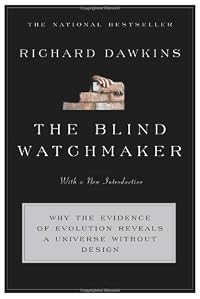
The Blind Watchmaker: Why the Evidence of Evolution Reveals a Universe Without Design
by Richard Dawkins
On This Page
Description
From the author of The God Delusion, Richard Dawkins' The Blind Watchmaker has been acclaimed as the most influential work on evolution in the last hundred years. In 1802 the Rev. William Paley's argued in Natural Theology that just as finding a watch would lead you to conclude that a watchmaker must exist, the complexity of living organisms proves that a Creator exists. Not so, says Richard Dawkins, and in this brilliant and controversial book, the acclaimed evolutionary biologist sets out show more to demonstrate that the theory of evolution by natural selection - the unconscious, automatic, blind yet essentially non-random process discovered by Charles Darwin - is the only answer to the biggest question of all: why do we exist? 'I want to persuade the reader, not just that the Darwinian world-view happens to be true, but that it is the only known theory that could, in principle, solve the mystery of our existence' To Dawkins, The Blind Watchmaker is nature itself, gradually forming order from the very building-blocks of life: DNA. 'This might just be the most important evolution book since Darwin' John Gribbin 'Richard Dawkins has updated evolution ... his subject is nothing less than the meaning of life' The Times 'Enchantingly witty and persusive ... pleasurably intelligible to the scientifically illiterate' Observer Richard Dawkins is a Fellow of both the Royal Society and the Royal Society of Literature, and Vice President of the British Humanist Association. He was first catapulted to fame with The Selfish Gene, which he followed with a string of bestselling books: The Extended Phenotype, The Blind Watchmaker, River Out of Eden, Unweaving the Rainbow, and an impassioned defence of atheism, The God Delusion. show lessTags
Recommendations












Member Recommendations
Member Reviews
NO! life on Earth has nothing to do with chance and, NO! the alternative to chance is not God. NO! the complexity of some organs is not a proof for the existence of an intelligent design. NO!, natural selection doesn't work like a monkey playing Shakespeare with a typewriter... Should I go on? Read Dawkins, he will tell you about it all!
With a contagious passion and a load of patience (because, quite frankly, you need a massive amount of it to face the rubbish circulating on such topics!) the biologist is once again enchanting us. In fact, we feel like a little child holding his hand, admiring all the wonders he's pointing at: nature is wonderful as it is; don't be afraid to toss God (or whatever you want to call it) in the bin.
I was show more already convinced before reading him (hence four stars only) but for all of you unable to see how evolution can be a smack in the face of intelligent design then read it. Urgently. show less
With a contagious passion and a load of patience (because, quite frankly, you need a massive amount of it to face the rubbish circulating on such topics!) the biologist is once again enchanting us. In fact, we feel like a little child holding his hand, admiring all the wonders he's pointing at: nature is wonderful as it is; don't be afraid to toss God (or whatever you want to call it) in the bin.
I was show more already convinced before reading him (hence four stars only) but for all of you unable to see how evolution can be a smack in the face of intelligent design then read it. Urgently. show less
As the title's extension spells out, this is a definitive (as of '87) rebuttal against all comers in favor of Darwinism, but don't let my saying so prove it. Read it for yourself.
All his arguments are crystal clear, but he takes extra time to caricature the caricature of Darwinists, pointing out exactly how the ad absurdum argument really works while also elucidating the fine points of what Darwinism IS versus what it is NOT.
He steps us through the first third of the book showing us how Selection works: from an energy standpoint, a competition standpoint, and a sexual standpoint... from the basic building blocks of proteins to more and more complex forms of DNA and the combo cells that collect all the wonderful multicellular creations, show more including bacteria, that eventually wind up creating us. The descriptions are quite beautiful and clear and all the while, we've got all the foundations for life... without Intelligent Design.
The argument is simple, of course. If we can explain everything, and I mean everything that is life and physics, then what purpose does adding a superfluous layer to the explanation serve?
This is ten years worth of hate mail for the author, people. He has been beset on all sides with genuinely curious and well-meaning seekers of the god-fearing sort and inundated with screaming lunatics telling him he'll burn in hell for his first book, [b:The Selfish Gene|61535|The Selfish Gene|Richard Dawkins|https://images.gr-assets.com/books/1366758096s/61535.jpg|1746717], which, by the way, didn't really give a rat's ass about creationism or the people who support it. It just laid out a very cogent theory that fit all the copious mountains of data in biology. And yet, after that point, a Mr. Dawkins who professes not to want or need a PR team or lawyers, decides to put his foot down and tackle the problem that has reared its muti-angled head in his direction and DEFEND Darwinism.
He does so beautifully, I might add.
Every step of the way, he defines the complaints with due diligence and proceeds to demolish them sonar-producing batlike grace, with light humor, sharp intellect, and sometimes he makes of his opponents an overzealous meal.
Can you blame him? Granted, by this point it's only been a decade of Creationist hate. Give it a decade or a decade and a half more before we see a truly flame worthy attack from Mr.Dawkins. I'm looking forward to seeing some of it in his books. I hope it's there and not just in his interviews which I still haven't seen. Alas.
Seriously, though, this book is pretty wonderful for its lucid and quoteworthy passages and vivid descriptions of how Darwinism works, from gene level to the kinds of time-spans that can only be described as geological when it comes to real changes in evolution. I particularly loved the fact that he used computer terminology to describe how our genes are nothing more than complex computers. I've heard this before, of course, but the way he laid it out was particularly enlightening.
This stuff is pretty damn great. Just from the science viewpoint, even leaving out the whole defense, it's well worth reading and not nearly as acerbic or rabid as certain other mass-produced troll-attacks make him appear. But then again, I've only read one of his later books, the [b:The Magic of Reality: How We Know What's Really True|11256979|The Magic of Reality How We Know What's Really True|Richard Dawkins|https://images.gr-assets.com/books/1327883246s/11256979.jpg|16183684], which was just a charming bi-modal description of science versus magical thinking which also happened to "gently" draw people away from having to add that extra layer of explanation to reality. :) I guess I'll see what the other books bring, no? show less
All his arguments are crystal clear, but he takes extra time to caricature the caricature of Darwinists, pointing out exactly how the ad absurdum argument really works while also elucidating the fine points of what Darwinism IS versus what it is NOT.
He steps us through the first third of the book showing us how Selection works: from an energy standpoint, a competition standpoint, and a sexual standpoint... from the basic building blocks of proteins to more and more complex forms of DNA and the combo cells that collect all the wonderful multicellular creations, show more including bacteria, that eventually wind up creating us. The descriptions are quite beautiful and clear and all the while, we've got all the foundations for life... without Intelligent Design.
The argument is simple, of course. If we can explain everything, and I mean everything that is life and physics, then what purpose does adding a superfluous layer to the explanation serve?
This is ten years worth of hate mail for the author, people. He has been beset on all sides with genuinely curious and well-meaning seekers of the god-fearing sort and inundated with screaming lunatics telling him he'll burn in hell for his first book, [b:The Selfish Gene|61535|The Selfish Gene|Richard Dawkins|https://images.gr-assets.com/books/1366758096s/61535.jpg|1746717], which, by the way, didn't really give a rat's ass about creationism or the people who support it. It just laid out a very cogent theory that fit all the copious mountains of data in biology. And yet, after that point, a Mr. Dawkins who professes not to want or need a PR team or lawyers, decides to put his foot down and tackle the problem that has reared its muti-angled head in his direction and DEFEND Darwinism.
He does so beautifully, I might add.
Every step of the way, he defines the complaints with due diligence and proceeds to demolish them sonar-producing batlike grace, with light humor, sharp intellect, and sometimes he makes of his opponents an overzealous meal.
Can you blame him? Granted, by this point it's only been a decade of Creationist hate. Give it a decade or a decade and a half more before we see a truly flame worthy attack from Mr.Dawkins. I'm looking forward to seeing some of it in his books. I hope it's there and not just in his interviews which I still haven't seen. Alas.
Seriously, though, this book is pretty wonderful for its lucid and quoteworthy passages and vivid descriptions of how Darwinism works, from gene level to the kinds of time-spans that can only be described as geological when it comes to real changes in evolution. I particularly loved the fact that he used computer terminology to describe how our genes are nothing more than complex computers. I've heard this before, of course, but the way he laid it out was particularly enlightening.
This stuff is pretty damn great. Just from the science viewpoint, even leaving out the whole defense, it's well worth reading and not nearly as acerbic or rabid as certain other mass-produced troll-attacks make him appear. But then again, I've only read one of his later books, the [b:The Magic of Reality: How We Know What's Really True|11256979|The Magic of Reality How We Know What's Really True|Richard Dawkins|https://images.gr-assets.com/books/1327883246s/11256979.jpg|16183684], which was just a charming bi-modal description of science versus magical thinking which also happened to "gently" draw people away from having to add that extra layer of explanation to reality. :) I guess I'll see what the other books bring, no? show less
Reading Dawkins seems somehow more relevant and refreshing in 2019 than it probably was in the 80's when The Blind Watchmaker & The Selfish Gene were written. In a world where vaccines cause autism, climate change is a hoax and the Earth is still somehow f'ing flat (!), reading the thoughts of a purely rational & smart person is the brains equivalent of taking a big gulp of cold, spring water when you're dying of thirst.
The Selfish Gene is one of my favorite books and this one is not straying far from it in terms of it being a "pillar of belief" for my own conceptions of science and critical thinking.
The Selfish Gene is one of my favorite books and this one is not straying far from it in terms of it being a "pillar of belief" for my own conceptions of science and critical thinking.
Richard Dawkins is a well known evolutionary biologist and prominent advocate for atheism. In The Blind Watchmaker, he seeks to “persuade the reader, not just that the Darwinian world-view happens to be true, but that it is the only known theory that could, in principle, solve the mystery of our existence”—an ambitious project, indeed. In my case he was preaching to the choir, and although I think he succeeds in proving the truth of evolution, he may fall a little short in showing that it is the only possible explanation of the complex forms of life we find on earth.
The title of the book comes from a famous treatise by the 18th century British theologian, William Paley, who argued that the complexity of the living world could be show more explained only by positing a creative designer, in other words, God. Paley contrasted the experience of finding a stone on the ground compared to finding a watch in the same place. To him, the stone could have “lain there forever.” But “the watch must have had a maker…who comprehended its construction, and designed its use.” Paley found a similar need to intuit the existence of designer of the complex entities we see as animal life.
Dawkins, on the other hand, contends:
“Paley’s argument is made with passionate sincerity and is informed by the best biological scholarship of his day, but it is wrong, gloriously and utterly wrong.”
Dawkins then proceeds to explain how Darwin’s theory of evolution through blind natural selection provides a consistent and cogent explanation of how complex life arose and came to its current state. Along the way, he explains the role of randomness in evolution: mutations are random, but the ones that survive and flourish are due not to randomness, but to their fitness or adaptation to their environments. In fact, only a tiny minority of mutations improve the adaptation of species.
Dawkins also discusses the mechanism and role of genetics in passing on random variation in animal structure (the phenotype). Further, he demolishes the arguments of Lamarck, who taught that acquired characteristics could be inherited.
Darwin’s theory makes it possible to be a intellectually satisfied atheist since, as Dawkins correctly points out, evolution provides a sufficient explanation for complex life forms. However, he falls short of proving it is a necessary (that is, the only possible) explanation. But then science has rarely if ever provided necessary explanations. It is good enough to provide a sufficient explanation that is also plausible.
(JAB) show less
The title of the book comes from a famous treatise by the 18th century British theologian, William Paley, who argued that the complexity of the living world could be show more explained only by positing a creative designer, in other words, God. Paley contrasted the experience of finding a stone on the ground compared to finding a watch in the same place. To him, the stone could have “lain there forever.” But “the watch must have had a maker…who comprehended its construction, and designed its use.” Paley found a similar need to intuit the existence of designer of the complex entities we see as animal life.
Dawkins, on the other hand, contends:
“Paley’s argument is made with passionate sincerity and is informed by the best biological scholarship of his day, but it is wrong, gloriously and utterly wrong.”
Dawkins then proceeds to explain how Darwin’s theory of evolution through blind natural selection provides a consistent and cogent explanation of how complex life arose and came to its current state. Along the way, he explains the role of randomness in evolution: mutations are random, but the ones that survive and flourish are due not to randomness, but to their fitness or adaptation to their environments. In fact, only a tiny minority of mutations improve the adaptation of species.
Dawkins also discusses the mechanism and role of genetics in passing on random variation in animal structure (the phenotype). Further, he demolishes the arguments of Lamarck, who taught that acquired characteristics could be inherited.
Darwin’s theory makes it possible to be a intellectually satisfied atheist since, as Dawkins correctly points out, evolution provides a sufficient explanation for complex life forms. However, he falls short of proving it is a necessary (that is, the only possible) explanation. But then science has rarely if ever provided necessary explanations. It is good enough to provide a sufficient explanation that is also plausible.
(JAB) show less
This must be one of the classic books explaining modern evolutionary theory to a popular audience. What Dawkins offers is an ability to articulate his impeccable logic in ways that render often slightly subtle concepts easy to understand.
"The Blind Watchmaker" is very much a companion to "Climbing Mount Improbable". Both seek to explain how Darwin's theory of natural selection can explain what appears to highly improbably complexity in nature. "Watchmaker" is particularly insistent that not only does natural selection explain it, it's the only explanation that we have.
In the current climate, with opponents of science becoming ever more-vocal, the book retains its power in explaining key parts of evolutionary theory, and simultaneously show more debunking any alternatives and refuting common criticisms.
It starts by demonstrating quite what is improbable and complex about nature, using the sonar of bats as an example of a system that appears so well-refined as to be the product of design. Chapters go on to discuss the accumulation and selection of small changes in the genome, the role of DNA in replication, the possible origins of life and sexual selection.
Attacks on alternative theories include a detailed commentary on Eldredge and Gould's "punctuationism", disputes in taxonomy, and everything from Lamarckism to creationism. Sometimes there's a sense that Dawkins is fighting battles with scientific colleagues that would be better left to the specialist reader, but personally I found these squabbles helped illuminate the wider subject.
There's very little here on the evidence that evolution has occurred, whether from genetics or palaeontology. "Watchmaker's" territory is to explain how it has occurred, and why only natural selection can explain the complexity of life. show less
"The Blind Watchmaker" is very much a companion to "Climbing Mount Improbable". Both seek to explain how Darwin's theory of natural selection can explain what appears to highly improbably complexity in nature. "Watchmaker" is particularly insistent that not only does natural selection explain it, it's the only explanation that we have.
In the current climate, with opponents of science becoming ever more-vocal, the book retains its power in explaining key parts of evolutionary theory, and simultaneously show more debunking any alternatives and refuting common criticisms.
It starts by demonstrating quite what is improbable and complex about nature, using the sonar of bats as an example of a system that appears so well-refined as to be the product of design. Chapters go on to discuss the accumulation and selection of small changes in the genome, the role of DNA in replication, the possible origins of life and sexual selection.
Attacks on alternative theories include a detailed commentary on Eldredge and Gould's "punctuationism", disputes in taxonomy, and everything from Lamarckism to creationism. Sometimes there's a sense that Dawkins is fighting battles with scientific colleagues that would be better left to the specialist reader, but personally I found these squabbles helped illuminate the wider subject.
There's very little here on the evidence that evolution has occurred, whether from genetics or palaeontology. "Watchmaker's" territory is to explain how it has occurred, and why only natural selection can explain the complexity of life. show less
i’m not sure who this was written for. it’s technical enough to lose people whose knowledge and interest in scientific study is nil or close to nil but colloquial enough to engage those of us not familiar with deeper, more professional levels of biology, chemistry, and probability. but i’m afraid to those people who might really need to understand the concepts described therein (ie creationists), the book will be found boring and unassailable.
i also think that the organization of the book is a bit off. the first half of the book deals with the title topic: the blind watchmaker or how the universe operates without a guiding godly hand. it’s a great argument he makes and it is on point. the latter parts of the book serve to just show more flesh out evolutionary theory- the history of, historical and modern reactions to, Big Names in the field, etc. i think the overall argument would have been served better had Dawkins placed this information more forward in the book. do an introductory chapter or two on the blind watchmaker concept, segue into explaining evolutionary theory to create a habitat for this idea, then swing back to the original treatise for the last few chapters to bring the whole ideological journey home.
having said that, i did learn a few things even though there was quite a bit that i already knew. Dawkins is a clear and, at times, eloquent writer who makes analogies and finds explanations that put new spins on old information or help introduce at-first-blush information. i think it would be a great book to use as a core text for a class on evolution or probability. it’s also for anyone who has a somewhat to fairly solid understanding of science but wants to better understand the concepts behind evolution. show less
i also think that the organization of the book is a bit off. the first half of the book deals with the title topic: the blind watchmaker or how the universe operates without a guiding godly hand. it’s a great argument he makes and it is on point. the latter parts of the book serve to just show more flesh out evolutionary theory- the history of, historical and modern reactions to, Big Names in the field, etc. i think the overall argument would have been served better had Dawkins placed this information more forward in the book. do an introductory chapter or two on the blind watchmaker concept, segue into explaining evolutionary theory to create a habitat for this idea, then swing back to the original treatise for the last few chapters to bring the whole ideological journey home.
having said that, i did learn a few things even though there was quite a bit that i already knew. Dawkins is a clear and, at times, eloquent writer who makes analogies and finds explanations that put new spins on old information or help introduce at-first-blush information. i think it would be a great book to use as a core text for a class on evolution or probability. it’s also for anyone who has a somewhat to fairly solid understanding of science but wants to better understand the concepts behind evolution. show less
Great read. Despite what the title and some negative reviews may lead you to believe, this book is not so much anti-creationist as pro-Darwinist. Using rigorous logic and arguments rooted in biology, probability theory and information theory, Dawkins proves that Darwinism is still the most plausible and consistent theory explaining the emergence and development of life on Earth. Even though a big part of the book is dedicated to debunking creationist arguments, it also includes the critique of competing scientific theories (for example those that do not consider natural selection to be the primary driving force behind evolution).
Members
- Recently Added By
Published Reviews
ThingScore 100
Almost everything about this book – the instances, the writing, the passion, the lyrical imagery – confirms again and again that there is nothing dry about science, nothing heartless about research, and nothing unfeeling about the way a biologist looks at an animal.
added by PickledOnion42
Lists

Best Science Books for Non-Scientists
113 works; 56 members

Top Five Books of 2013
1,562 works; 715 members

Falling for Science
56 works; 3 members

Alan Kay's Reading List
103 works; 3 members

Ten Books That Have Stayed With Me
160 works; 30 members

Atheism, humanism, freethought, &c. — Best nonfiction books in favour of
167 works; 14 members

Blue Pyramid 1,276 Best Books of All Time
1,248 works; 32 members

al.vick-parents books
301 works; 1 member
Folio Society
831 works; 48 members

The Great Courses: Brain Myths Exploded
7 works; 1 member

The Great Courses: The Darwinian Revolution
50 works; 1 member

The Torchlight List
95 works; 1 member

In Our Time books
4,934 works; 2 members

LT picks: Blue Books
197 works; 44 members
Author Information

75+ Works 64,017 Members
Richard Dawkins was educated at Oxford University and taught zoology at the University of California and Oxford University, holding the position of the Charles Simonyi Professor of the Public Understanding of Science. He writes about such topics as DNA and genetic engineering, virtual reality, astronomy, and evolution. His books include The show more Selfish Gene, The Extended Phenotype, The Blind Watchmaker, River Out of Eden, Climbing Mount Improbable, The God Delusion, and An Appetite for Wonder: The Making of a Scientist. (Bowker Author Biography) show less
Some Editions
Awards and Honors
Awards
Notable Lists
Torchlight List (#13)
Series
Belongs to Publisher Series
Work Relationships
Is contained in
Contains
Common Knowledge
- Canonical title*
- 盲目の時計職人
- Original title
- The Blind Watchmaker: Why the Evidence of Evolution Reveals a Universe without Design
- Original publication date
- 1986
- People/Characters
- Charles Darwin [Charles Robert: 1809-1882]; Stephen J. Gould; R. A. Fisher; William Paley; Richard Dawkins
- Related movies
- "Horizon" The Blind Watchmaker (1987 | IMDb)
- Dedication
- To my parents
- First words
- We animals are the most complicated things in the known Universe.
- Quotations
- The Argument from Personal Incredulity is an extremely weak argument, as Darwin himself noted. [...]
This should be translated:
I personally, off the top of my head sitting in my study, never having visited the ... (show all)Arctic, never having seen a polar bear in the wild, and having been educated in classical literature and theology, have not so far managed to think of a reason why polar bears might benefit from being white. (p.38) - Last words
- (Click to show. Warning: May contain spoilers.)But they cannot be the whole truth, for they deny the very heart of the evolution theory, which gives it the power to dissolve astronomical improbabilities and explain prodigies of apparent miracle.
- Blurbers
- Smith, John Maynard; Gribbin, John; Amis, Martin
- Original language
- English
*Some information comes from Common Knowledge in other languages. Click "Edit" for more information.
Classifications
Statistics
- Members
- 6,853
- Popularity
- 1,737
- Reviews
- 60
- Rating
- (4.15)
- Languages
- 20 — Czech, Dutch, English, Finnish, French, German, Greek, Hebrew, Hungarian, Italian, Japanese, Korean, Polish, Portuguese, Romanian, Russian, Spanish, Swedish, Turkish, Chinese, traditional
- Media
- Paper, Audiobook, Ebook
- ISBNs
- 66
- ASINs
- 36