On This Page
Description
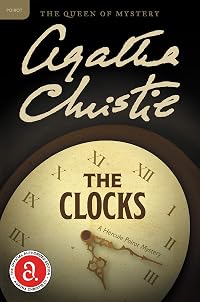
Sheila Webb expected to find a respectable blind lady waiting for her at 19 Wilbraham Crescent-not the body of a middle-aged man sprawled across the living room floor. But when old Miss Pebmarsh denies sending for her in the first place, or of owning all the clocks that surround the body, it's clear that they are going to need a very good detective. "This crime is so complicated that it must be quite simple," declares Hercule Poirot. But there's a murderer on the loose, and time is ticking show more away.… show lessTags
Recommendations

















Member Reviews
This is an almost perfect example of a late Christie: brilliant initial premise; fun, often comic human observation; and a lingering sense that she gave up on the most interesting possibilities about halfway through. It's never not readable, but there's a point midway where you realize she's probably never going to follow through, and she doesn't - although she gets a lot closer than the mid-book lull suggests.
There are hints, as in so many later Christies, that she really wanted to be writing a different kind of book. Hercule Poirot only shows up for four extended scenes, one of which largely involves him casting judgment on the various authors of detective fiction: a long, languorous interlude that feels like Christie's two-fingered show more salute to a publishing contract. (You want officious little Monsieur Poirot with his quirks? You got it.) He shows up at the climax to smirkily reveal that he knows it all, infuriating the book's actual protagonist - but to what end? Some of the most interesting aspects of Christie's setup are revealed as red herrings, and at least one of Poirot's revelations is veering toward an admonishment to both character and reader to pay better attention. It feels like a lot of trouble and misdirection just so we can all have a bit of a lecture.
The best sequences of the book are darkly comic vignettes of everyday human bloodthirstiness: the woman who keeps too many cats and forces visitors to cope; the little girl who watches her neighbors from the window, gives them pretend names, and glories in the speculation of a murderer; the neighborhood boys who sheepishly admit to raiding a crime scene for trinkets. These could all be in a Hitchcock film, and it wouldn't surprise me to learn Christie had seen pictures like "Shadow of a Doubt" or "Strangers on a Train." That's the sort of thing I think she'd clearly like to be writing: a darkly humorous thriller, well shy of Poirot or any of his ilk.
(As usual, Hugh Fraser proves a highly enjoyable narrator of the unabridged audiobook. He made the story putter along even at points where I think the physical book would have frustrated me, and I'm guessing he's responsible for a half-star, if not a full one, of my rating.) show less
There are hints, as in so many later Christies, that she really wanted to be writing a different kind of book. Hercule Poirot only shows up for four extended scenes, one of which largely involves him casting judgment on the various authors of detective fiction: a long, languorous interlude that feels like Christie's two-fingered show more salute to a publishing contract. (You want officious little Monsieur Poirot with his quirks? You got it.) He shows up at the climax to smirkily reveal that he knows it all, infuriating the book's actual protagonist - but to what end? Some of the most interesting aspects of Christie's setup are revealed as red herrings, and at least one of Poirot's revelations is veering toward an admonishment to both character and reader to pay better attention. It feels like a lot of trouble and misdirection just so we can all have a bit of a lecture.
The best sequences of the book are darkly comic vignettes of everyday human bloodthirstiness: the woman who keeps too many cats and forces visitors to cope; the little girl who watches her neighbors from the window, gives them pretend names, and glories in the speculation of a murderer; the neighborhood boys who sheepishly admit to raiding a crime scene for trinkets. These could all be in a Hitchcock film, and it wouldn't surprise me to learn Christie had seen pictures like "Shadow of a Doubt" or "Strangers on a Train." That's the sort of thing I think she'd clearly like to be writing: a darkly humorous thriller, well shy of Poirot or any of his ilk.
(As usual, Hugh Fraser proves a highly enjoyable narrator of the unabridged audiobook. He made the story putter along even at points where I think the physical book would have frustrated me, and I'm guessing he's responsible for a half-star, if not a full one, of my rating.) show less
An unabashed four stars for this mystery, which is thoroughly loony but in a good way. It begins with a shorthand typist named Sheila Webb, sent to a house to do some work for a client. She is instructed to wait in the sitting room if the client is out. She does so, but to her great horror finds a dead body! And the room is filled with clocks... but the owner of the house, who is blind, insists that there are only two clocks in the room. Very strange indeed!
Of course, this being a Poirot mystery, he relishes the challenge of solving this one, which is brought to his attention via a friend named Colin Lamb (who happens on the scene when Sheila runs out of the house screaming). Agatha constructs a particularly twisting and turning show more plotline with all sorts of bizarre clues and dead ends that makes it difficult to predict just what the ending will be.
Along the way we are treated to Poirot's lectures on the finer points of crime fiction (to the great delight of my friend, he mentions John Dickson Carr) -- when Colin brings him the mystery of the clocks, he is conducting a study of the masters -- as well as a stunning description of a bookshop that I wish actually existed so I could visit: one of those crammed-to-the-gills secondhand bookshops that are only loosely organized, with boxes of books and scads of shelves.
This mystery was published in 1963 but feels somewhat older -- motor cars are still kind of a novelty, and the murder victim, who is about 60, is described as "elderly" (I don't know about you, but I think these days people's definition of "elderly" has been bumped up by 10 to 20 years... at least my definition has). Amusing points of interest for me.
All in all this is a fun way to spend a couple of hours on a rainy afternoon. show less
Of course, this being a Poirot mystery, he relishes the challenge of solving this one, which is brought to his attention via a friend named Colin Lamb (who happens on the scene when Sheila runs out of the house screaming). Agatha constructs a particularly twisting and turning show more plotline with all sorts of bizarre clues and dead ends that makes it difficult to predict just what the ending will be.
Along the way we are treated to Poirot's lectures on the finer points of crime fiction (to the great delight of my friend, he mentions John Dickson Carr) -- when Colin brings him the mystery of the clocks, he is conducting a study of the masters -- as well as a stunning description of a bookshop that I wish actually existed so I could visit: one of those crammed-to-the-gills secondhand bookshops that are only loosely organized, with boxes of books and scads of shelves.
This mystery was published in 1963 but feels somewhat older -- motor cars are still kind of a novelty, and the murder victim, who is about 60, is described as "elderly" (I don't know about you, but I think these days people's definition of "elderly" has been bumped up by 10 to 20 years... at least my definition has). Amusing points of interest for me.
All in all this is a fun way to spend a couple of hours on a rainy afternoon. show less
A young agency typist receives instructions to go to an address, enter the home, and wait for its owner in the sitting room. Upon her arrival, Sheila Webb finds, not the blind woman that she expected, but a room filled with clocks and a dead man behind the sofa. As she runs out screaming, she runs into a young man who is looking for a different address. Colin Lamb knows the detective inspector working the case, so he lends a hand. This is just the sort of puzzle that might interest Colin’s old friend, retired private detective Hercule Poirot.
I read most of Christie’s works in my teens and twenties. I think this is one that I missed. I think I would have remembered Poirot’s comments on the crime fiction genre. I can’t help show more wondering how closely Poirot’s opinions of books and authors mirrors Christie’s own opinions. The typing agency would be familiar to Christie, who used typists, but less familiar to many of her readers who wouldn’t have used such a service. Christie isn’t the only crime novelist to incorporate a service familiar to authors. Typists play a major role in Rex Stout’s Murder by the Book.
There are actually two mysteries in this book – a murder and a spy network that Colin Lamb is trying to identify. I figured out Lamb’s mystery pretty quickly, but I missed a key clue concerning the murder. I listened to the audio version mostly in the car, and I think I must have been distracted when the clue was presented. It’s not Christie’s best plot since it relies too heavily on coincidence. show less
I read most of Christie’s works in my teens and twenties. I think this is one that I missed. I think I would have remembered Poirot’s comments on the crime fiction genre. I can’t help show more wondering how closely Poirot’s opinions of books and authors mirrors Christie’s own opinions. The typing agency would be familiar to Christie, who used typists, but less familiar to many of her readers who wouldn’t have used such a service. Christie isn’t the only crime novelist to incorporate a service familiar to authors. Typists play a major role in Rex Stout’s Murder by the Book.
There are actually two mysteries in this book – a murder and a spy network that Colin Lamb is trying to identify. I figured out Lamb’s mystery pretty quickly, but I missed a key clue concerning the murder. I listened to the audio version mostly in the car, and I think I must have been distracted when the clue was presented. It’s not Christie’s best plot since it relies too heavily on coincidence. show less
This was written very differently and the plot development was unique also. For starters, the narrative voice changed several times from third person to first person (and it wasn't Poirot as first person either). I thought at first this might create problems like with time jumping but after a few chapters the transitions felt familiar and smooth. Secondly, Poirot never set foot on the crime scenes and he never spoke to any of the suspects. From what I've read, this is the only time Christie employed this tactic and it was mostly to show that it was possible for the Belgian detective to accomplish such a feat. As per usual, I thought I had the whole thing figured out only to discover that it was all a pile-up of red herrings and I'd been show more duped again. Oh, Agatha! show less
I always come back to Agatha Christie – it’s a world I understand, everything makes sense because it all gets tidied up so neatly. I saw this novel mentioned somewhere else recently, and I realised I couldn’t remember if I had ever read it. I own a nice first edition, with tatty dustjacket but once the fragile wrapper had been removed I was happy to read it carefully.
First published in 1963, it does feature an ageing Poirot, although he rightly gets to do the best bit (the reveal) – Poirot features much less than in earlier mysteries. Although to be fair – he is getting on a bit by 1963 – so that seems fair enough.
“To every problem, there is a most simple solution.”
It seems like a perfectly ordinary day at The Cavendish show more secretarial and Typewriting Bureau in Crowdean; Edna has broken the heel off her shoe, and Sheila Webb is a little late back from lunch. Upon her return Sheila is called into Miss Martindale’s office – a request has been telephoned in, for Sheila to go to Wilbraham Crescent, number 19 and if there is no one in to let herself in and wait. Slightly puzzled at the request – for she can’t remember having worked for this client before – Sheila follows the instructions exactly. Sheila finds herself in the sitting room of number 19 Wilbraham Crescent, she is not alone, behind the sofa is the body of a man. Moments later, Miss Pebmarsh arrives home, a blind, braille teacher – who later claims to have never called The Cavendish Secretarial and Typewriting Bureau. Aside from the presence of a dead body, the other notable addition to the room are four clocks – set to thirteen minutes past four.
As any self-respecting secretary would, Sheila rushes screaming from the house – straight into the arms of one Colin Lamb, a marine biologist come intelligence officer. We later learn that Colin is an old friend of Poirot’s (there is a suggestion that his father was one of the police Inspectors to benefit from the Belgian’s brilliance.) Colin was following a lead in one of his own cases, looking for a spy in hiding – when he happens upon an altogether different puzzle.
The police are soon on the scene, Detective Inspector Hardcastle in charge of what looks like a fiendishly difficult case. Hardcastle is a friend of Colin’s too – and quite happy to have him tag along as he interviews the neighbours – and attempts to identify the dead man. There are naturally, many questions. Did anyone see or hear anything? How did the body get into the house? What do the clocks mean? Why was Sheila asked for by name?
Colin quickly starts to feel very protective towards Sheila – who he feels Hardcastle is looking at suspiciously. The two are drawn to one another – and Hardcastle isn’t sure that he approves.
“I looked at her. Sheila was my girl–the girl I wanted–and wanted for keeps. But it wasn’t any use having illusions about her. Sheila was a liar and probably always would be a liar. It was her way of fighting for survival–the quick easy glib denial. It was a child’s weapon–and she’d probably never got out of using it. If I wanted Sheila, I must accept her as she was–be at hand to prop up the weak places. We’ve all got our weak places. Mine were different from Sheila’s, but they were there.”
Colin decides to pay a visit to his old friend Hercule Poirot. He remembers how Poirot once claimed that he could solve a crime, merely by sitting in his chair and giving the matter serious thought. Colin gives the details of the case to the old detective, hoping at the very least to relieve some of boredom he knows Poirot often feels. Poirot is happy to give the case his consideration, although he hasn’t been entirely idle – he has been making a detailed study of famous works of crime fiction. Having Poirot’s take on The Levenworth Case, The Mystery of the Yellow Room and Sherlock Holmes is great fun for those who like their vintage crime.
Another bookish joy I wanted to share with you is this description of a tiny cluttered bookshop.
“Inside, it was clear that the books owned the shop rather than the other way about. Everywhere they had run wild and taken possession of their habitat, breeding and multiplying and clearly lacking any strong hand to keep them down. The distance between bookshelves was so narrow that you could only get along with great difficulty. There were piles of books perched on every shelf or table. On a stool in a corner, hemmed in by books, was an old man in a pork pie hat with a large flat face like a stuffed fish. He had the air of one who has given up an unequal struggle.”
Back in Crowdean and the inquest of the dead man is opened and adjourned, within hours of the inquest however, there is another violent death – leading to more questions. Inevitably, Hardcastle’s case and Colin’s hunt for a spy look like they may be connected, and eventually someone comes forward to identify the dead man.
I really don’t want to say any more about this story – which I think is really well plotted mystery, firmly rooted in the 1960s. The solution is clever, and one can sense Poirot’s old eyes twinkling as he reveals all – a minor point: the ending is perhaps a tiny bit rushed – overall though, of course I thoroughly enjoyed it. show less
First published in 1963, it does feature an ageing Poirot, although he rightly gets to do the best bit (the reveal) – Poirot features much less than in earlier mysteries. Although to be fair – he is getting on a bit by 1963 – so that seems fair enough.
“To every problem, there is a most simple solution.”
It seems like a perfectly ordinary day at The Cavendish show more secretarial and Typewriting Bureau in Crowdean; Edna has broken the heel off her shoe, and Sheila Webb is a little late back from lunch. Upon her return Sheila is called into Miss Martindale’s office – a request has been telephoned in, for Sheila to go to Wilbraham Crescent, number 19 and if there is no one in to let herself in and wait. Slightly puzzled at the request – for she can’t remember having worked for this client before – Sheila follows the instructions exactly. Sheila finds herself in the sitting room of number 19 Wilbraham Crescent, she is not alone, behind the sofa is the body of a man. Moments later, Miss Pebmarsh arrives home, a blind, braille teacher – who later claims to have never called The Cavendish Secretarial and Typewriting Bureau. Aside from the presence of a dead body, the other notable addition to the room are four clocks – set to thirteen minutes past four.
As any self-respecting secretary would, Sheila rushes screaming from the house – straight into the arms of one Colin Lamb, a marine biologist come intelligence officer. We later learn that Colin is an old friend of Poirot’s (there is a suggestion that his father was one of the police Inspectors to benefit from the Belgian’s brilliance.) Colin was following a lead in one of his own cases, looking for a spy in hiding – when he happens upon an altogether different puzzle.
The police are soon on the scene, Detective Inspector Hardcastle in charge of what looks like a fiendishly difficult case. Hardcastle is a friend of Colin’s too – and quite happy to have him tag along as he interviews the neighbours – and attempts to identify the dead man. There are naturally, many questions. Did anyone see or hear anything? How did the body get into the house? What do the clocks mean? Why was Sheila asked for by name?
Colin quickly starts to feel very protective towards Sheila – who he feels Hardcastle is looking at suspiciously. The two are drawn to one another – and Hardcastle isn’t sure that he approves.
“I looked at her. Sheila was my girl–the girl I wanted–and wanted for keeps. But it wasn’t any use having illusions about her. Sheila was a liar and probably always would be a liar. It was her way of fighting for survival–the quick easy glib denial. It was a child’s weapon–and she’d probably never got out of using it. If I wanted Sheila, I must accept her as she was–be at hand to prop up the weak places. We’ve all got our weak places. Mine were different from Sheila’s, but they were there.”
Colin decides to pay a visit to his old friend Hercule Poirot. He remembers how Poirot once claimed that he could solve a crime, merely by sitting in his chair and giving the matter serious thought. Colin gives the details of the case to the old detective, hoping at the very least to relieve some of boredom he knows Poirot often feels. Poirot is happy to give the case his consideration, although he hasn’t been entirely idle – he has been making a detailed study of famous works of crime fiction. Having Poirot’s take on The Levenworth Case, The Mystery of the Yellow Room and Sherlock Holmes is great fun for those who like their vintage crime.
Another bookish joy I wanted to share with you is this description of a tiny cluttered bookshop.
“Inside, it was clear that the books owned the shop rather than the other way about. Everywhere they had run wild and taken possession of their habitat, breeding and multiplying and clearly lacking any strong hand to keep them down. The distance between bookshelves was so narrow that you could only get along with great difficulty. There were piles of books perched on every shelf or table. On a stool in a corner, hemmed in by books, was an old man in a pork pie hat with a large flat face like a stuffed fish. He had the air of one who has given up an unequal struggle.”
Back in Crowdean and the inquest of the dead man is opened and adjourned, within hours of the inquest however, there is another violent death – leading to more questions. Inevitably, Hardcastle’s case and Colin’s hunt for a spy look like they may be connected, and eventually someone comes forward to identify the dead man.
I really don’t want to say any more about this story – which I think is really well plotted mystery, firmly rooted in the 1960s. The solution is clever, and one can sense Poirot’s old eyes twinkling as he reveals all – a minor point: the ending is perhaps a tiny bit rushed – overall though, of course I thoroughly enjoyed it. show less
The Clocks (1963) (Poirot #37) by Agatha Christie. Here we have Poirot proving his point that a detective need not snoop about like a bloodhound, traipsing across the countryside, magnifying glass in hand, just to catch a killer. Sitting and thinking after the facts have been presented to him is all he does in this outing. And, of course, it works.
Here the problem presented is one so extraordinary that it could never happen in real life. Sheila Webb is a young woman who is a typist in an agency that specializes in temporary office workers. She is sent to an upscale address where she discovers a murdered man. There are six clocks set about him, four having been stopped at 4:13 while a cuckoo clock sticks 3.
Sheila runs from the house show more and into the arms of a Special Branch agent looking into a mystery of his own which has brought him to the same address. Questioning the locals gives him an odd assortment of answers and, puzzled, he turns to Poirot for revelations. It seems the young man’s father and Poirot worked on cases of their own and he had heard marvelous things about the little Belgian.
This is a nice tale and a good puzzle and we find Poirot at his best, sitting and thinking. This is a good read for people who are currently loathe to leave their residences for any reason and proof positive that important work can continue from your own home.
Yeah! show less
Here the problem presented is one so extraordinary that it could never happen in real life. Sheila Webb is a young woman who is a typist in an agency that specializes in temporary office workers. She is sent to an upscale address where she discovers a murdered man. There are six clocks set about him, four having been stopped at 4:13 while a cuckoo clock sticks 3.
Sheila runs from the house show more and into the arms of a Special Branch agent looking into a mystery of his own which has brought him to the same address. Questioning the locals gives him an odd assortment of answers and, puzzled, he turns to Poirot for revelations. It seems the young man’s father and Poirot worked on cases of their own and he had heard marvelous things about the little Belgian.
This is a nice tale and a good puzzle and we find Poirot at his best, sitting and thinking. This is a good read for people who are currently loathe to leave their residences for any reason and proof positive that important work can continue from your own home.
Yeah! show less
Haven't read a Christie in years, I forgot how enjoyable they are, tightly written, fast reads. There's a touch of meta here as an aging Poirot extols the virtues of various crime writers, but otherwise it's a fiendish and clever little tale about a ridiculously baffling murder, with some expertly deployed red herrings.
Members
- Recently Added By
Lists

Crime and Mysteries to Read
746 works; 31 members

British Mystery
469 works; 14 members

Anthony Boucher's Best Crime Fiction of the Year
115 works; 5 members

Books About Murder
313 works; 7 members

Agatha Christie Poirot
43 works; 2 members

Detective Stories
343 works; 5 members

Favorite Books from the 1960s
34 works; 3 members

Books Read in 2014
2,344 works; 89 members

Books Read in 2017
4,249 works; 129 members

Books With Time Words in the Title
160 works; 4 members

Books Read in 2020
4,379 works; 124 members

Books Read in 2022
5,226 works; 115 members

Best Mysteries With a Historical Setting
292 works; 160 members

TBR
77 works; 1 member

Books Read in 2024
4,727 works; 128 members

Agatha Christie Chronology
93 works; 1 member
Author Information

2,196+ Works 442,328 Members
One of the most successful and beloved writer of mystery stories, Agatha Mary Clarissa Christie was born in 1890 in Torquay, County Devon, England. She wrote her first novel, The Mysterious Affair at Styles, in 1920, launching a literary career that spanned decades. In her lifetime, she authored 79 crime novels and a short story collection, 19 show more plays, and six novels written under the name of Mary Westmacott. Her books have sold over a billion copies in the English language with another billion in 44 foreign languages. Some of her most famous titles include Murder on the Orient Express, Mystery of the Blue Train, And Then There Were None, 13 at Dinner and The Sittaford Mystery. Noted for clever and surprising twists of plot, many of Christie's mysteries feature two unconventional fictional detectives named Hercule Poirot and Miss Jane Marple. Poirot, in particular, plays the hero of many of her works, including the classic, The Murder of Roger Ackroyd (1926), and Curtain (1975), one of her last works in which the famed detective dies. Over the years, her travels took her to the Middle East where she met noted English archaeologist Sir Max Mallowan. They married in 1930. Christie accompanied Mallowan on annual expeditions to Iraq and Syria, which served as material for Murder in Mesopotamia (1930), Death on the Nile (1937), and Appointment with Death (1938). Christie's credits also include the plays, The Mousetrap and Witness for the Prosecution (1953; film 1957). Christie received the New York Drama Critics' Circle Award for 1954-1955 for Witness. She was also named Dame Commander of the Order of the British Empire in 1971. Christie died in 1976. (Bowker Author Biography) show less
Some Editions
Awards and Honors
Distinctions
Series

Belongs to Publisher Series
Club des Masques (50)
Le Masque (853)
Nova terra (120)
Work Relationships
Common Knowledge
- Canonical title
- The Clocks
- Original title
- The Clocks
- Original publication date
- 1963-11-07
- People/Characters
- Beck (Colonel); Josiah Bland (61 Wilbraham Crescent); Valerie Bland (61 Wilbraham Crescent); Edna Brent; Geraldine Mary Alexandra Brown; R. H. Curry (show all 24); Dick Hardcastle (Detective Inspector); Mrs. Hemmings (20 Wilbraham Crescent, Diana Lodge); Colin Lamb (marine biologist); Mrs. Lawton (Sheila Webb's aunt); Katherine Martindale (Sandy Cat); Angus McNaughton (63 Wilbraham Crescent); Mrs. McNaughton (63 Wilbraham Crescent); Millicent Pebmarsh (19 Wilbraham Crescent); Hercule Poirot; Purdy (Professor, archaeologist); Bill Ramsay (62 Wilbraham Crescent); Mrs. Ramsay (62 Wilbraham Crescent); Todd Ramsay (62 Wilbraham Crescent); Merlina Rival (Flo); James Waterhouse (18 Wilbraham Crescent); Edith Waterhouse (18 Wilbraham Crescent); Sheila Webb; Ephraim Pikeaway (colonel)
- Important places
- Crowdean, England, UK; London, England, UK
- Important events
- Cold War
- Dedication
- To my old friend
Mario
with happy memories of delicious food at the Caprice - First words
- The afternoon of the 9th of September was exactly like any other afternoon.
- Last words
- (Click to show. Warning: May contain spoilers.)All the best.
Yours,
Richard Hardcastle - Original language
- English UK
Classifications
Statistics
- Members
- 4,333
- Popularity
- 3,486
- Reviews
- 77
- Rating
- (3.54)
- Languages
- 24 — Catalan, Czech, Danish, Dutch, English, Estonian, Finnish, French, German, Greek, Hungarian, Italian, Japanese, Lithuanian, Norwegian (Bokmål), Norwegian, Polish, Portuguese, Romanian, Russian, Slovenian, Spanish, Swedish, Turkish
- Media
- Paper, Audiobook, Ebook
- ISBNs
- 138
- UPCs
- 1
- ASINs
- 73