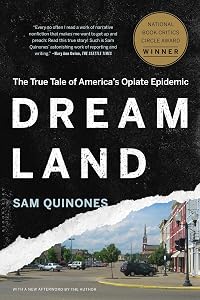
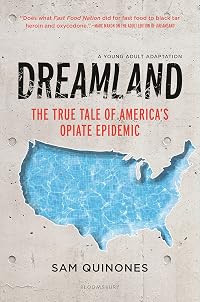
Dreamland: The True Tale of America's Opiate Epidemic
by Sam Quinones
On This Page
Description
Sam Quinones chronicles how, over the past 15 years, enterprising sugar cane farmers in a small county on the west coast of Mexico created a unique distribution system that brought black tar heroin-- the cheapest, most addictive form of the opiate, 2 to 3 times purer than its white powder cousin-- to the veins of people across the United States.Tags
Recommendations





Member Recommendations
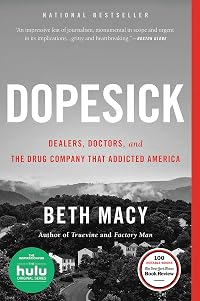
sparemethecensor Dopesick looks at the same issue in a more focused fashion.
AKBouterse An earlier book about Oxycontin
lulaa Together, these provide a masterful, humanistic and even hopeful exploration of the ongoing opiate/fentanyl/meth epidemic in the U.S., its costs to families and communities.
Member Reviews
The opiate epidemic in America that Sam Quinones chronicles in his revelatory 2015 book, “Dreamland,” continues unabated. Just this past week in Columbus Ohio, 27 heroin overdoses were reported in one 24-hour period (9/27/16) and another 21 were reported the next day. Quinones’ book traces the epidemic back to the 1980’s and shows how two phenomena: corporate greed and liberal prescribing of opiates such as OxyContin for pain relief and a decentralized trafficking and distribution system for heroin devised by enterprising migrants from Xalisco in the Mexican state of Nayarit converged to create a devastating epidemic that has spread throughout the United States.
In 1980, a one-paragraph letter to the editor in the New England show more Journal of Medicine made the unsubstantiated assertion that addiction occurred in less than 1% of patients prescribed opiates for pain relief. A “revolution” in pain management began, and physicians were encouraged to treat it liberally with opiates. In 1986, Purdue Pharma released OxyContin and aggressively promoted it to physicians for the treatment of chronic pain. Unscrupulous sales promotions were followed by establishment of pain clinics, many of which were nothing more than “pill mills” where unethical doctors prescribed opiates to patients willing to pay cash for their visit and walk away with a prescription. Some of these people had Medicare cards that allowed them to obtain opiates with a co-pay of a few dollars, and then they turned around and sold the drugs on the street for hundreds of dollars. Thus, American taxpayers unwittingly subsidized the spread of these drugs. Addicts who could not afford the street price of the drugs turned to shoplifting to obtain merchandise that could be traded for drugs and a barter economy was established. One of the original doctors who ran a pill mill in South Shore, Kentucky ultimately pled guilty to drug trafficking and served 11 years in prison. By 2007, Purdue Pharma pled guilty to misdemeanor charges of false branding and was fined $634 million.
During the time that Americans were becoming addicted to prescription opiates, migrants from Xalisco were establishing a heroin trafficking business in California’s San Fernando Valley, using “black tar” heroin processed from poppies grown in the hills of Nayarit. A system was developed that ultimately spread to cities all over the United States such as Portland OR, Reno and Las Vegas NV, Salt Lake City UT, Phoenix AZ, Santa Fe NM, Denver CO, Nashville and Memphis TN, Lexington KY, Charlotte NC, and Columbus, Cincinnati, and Dayton OH. These “cells” intentionally followed the pattern of Mexican immigration across the United States, so the traffickers could blend in seamlessly. They specifically avoided cities without substantial Mexican immigrant populations. The Xalisco boys delivered heroin to young affluent white kids as if it were pizza. The user placed a call to a dispatcher who would send the driver to a specific location based on coded messages. The “black tar” heroin was very pure (80%) and could be sold cheaply as a result of the large sales volume. The drivers were courteous, carried no weapons and were dedicated to customer service. The rolled-up balls of “black tar” were carried in their mouths in uninflated balloons that could be swallowed if they were pulled over by the police. These delivery boys were smart enough to never use the product themselves – they understood the consequences of addiction. Instead, they sent their profits back to Mexico where they built houses and spent lavishly on friends and family. Despite Operation Tar Pit in 2000 and Operation Black Gold Rush in 2006, “cells” kept springing back up as soon as one was shut down. It was like the arcade game where you smash a little pop-up monster with a hammer only to have another one pop up nearby – there was an inexhaustible supply of young Mexicans willing to take the risk involved for money and fame back home. The switch from prescription painkillers to heroin was logical in retrospect because the efficient marketing and delivery system of the Xalisco boys made it cheaper and more convenient than prescription opiates.
The insight provided by Quinones’ book is as mind boggling as the epidemic is devastating for American society. This book should be required reading for every student entering high school (maybe even for middle school students). show less
In 1980, a one-paragraph letter to the editor in the New England show more Journal of Medicine made the unsubstantiated assertion that addiction occurred in less than 1% of patients prescribed opiates for pain relief. A “revolution” in pain management began, and physicians were encouraged to treat it liberally with opiates. In 1986, Purdue Pharma released OxyContin and aggressively promoted it to physicians for the treatment of chronic pain. Unscrupulous sales promotions were followed by establishment of pain clinics, many of which were nothing more than “pill mills” where unethical doctors prescribed opiates to patients willing to pay cash for their visit and walk away with a prescription. Some of these people had Medicare cards that allowed them to obtain opiates with a co-pay of a few dollars, and then they turned around and sold the drugs on the street for hundreds of dollars. Thus, American taxpayers unwittingly subsidized the spread of these drugs. Addicts who could not afford the street price of the drugs turned to shoplifting to obtain merchandise that could be traded for drugs and a barter economy was established. One of the original doctors who ran a pill mill in South Shore, Kentucky ultimately pled guilty to drug trafficking and served 11 years in prison. By 2007, Purdue Pharma pled guilty to misdemeanor charges of false branding and was fined $634 million.
During the time that Americans were becoming addicted to prescription opiates, migrants from Xalisco were establishing a heroin trafficking business in California’s San Fernando Valley, using “black tar” heroin processed from poppies grown in the hills of Nayarit. A system was developed that ultimately spread to cities all over the United States such as Portland OR, Reno and Las Vegas NV, Salt Lake City UT, Phoenix AZ, Santa Fe NM, Denver CO, Nashville and Memphis TN, Lexington KY, Charlotte NC, and Columbus, Cincinnati, and Dayton OH. These “cells” intentionally followed the pattern of Mexican immigration across the United States, so the traffickers could blend in seamlessly. They specifically avoided cities without substantial Mexican immigrant populations. The Xalisco boys delivered heroin to young affluent white kids as if it were pizza. The user placed a call to a dispatcher who would send the driver to a specific location based on coded messages. The “black tar” heroin was very pure (80%) and could be sold cheaply as a result of the large sales volume. The drivers were courteous, carried no weapons and were dedicated to customer service. The rolled-up balls of “black tar” were carried in their mouths in uninflated balloons that could be swallowed if they were pulled over by the police. These delivery boys were smart enough to never use the product themselves – they understood the consequences of addiction. Instead, they sent their profits back to Mexico where they built houses and spent lavishly on friends and family. Despite Operation Tar Pit in 2000 and Operation Black Gold Rush in 2006, “cells” kept springing back up as soon as one was shut down. It was like the arcade game where you smash a little pop-up monster with a hammer only to have another one pop up nearby – there was an inexhaustible supply of young Mexicans willing to take the risk involved for money and fame back home. The switch from prescription painkillers to heroin was logical in retrospect because the efficient marketing and delivery system of the Xalisco boys made it cheaper and more convenient than prescription opiates.
The insight provided by Quinones’ book is as mind boggling as the epidemic is devastating for American society. This book should be required reading for every student entering high school (maybe even for middle school students). show less
An absolutely fantastically well researched and timely book. This book, made me so angry and so aware of the origins of America's opiate epidemic. As a Hoosier I am quite familiar with heroin and pills. It's everywhere. Not only do I read the arrest records, but I deal with the public in my job, have been trained to use Narcan, and years ago dated someone who was an addict. Everything I knew about opiates fit neatly into this tome and helped explain the bigger picture. It's infuriating. This book made me so mad at the pharmaceutical companies, doctors, lawmakers, coaches, and parents. how did we all let this happen?! An eye opening book that helped me view our country in a new light.
I am not at all surprised by anything I read in Dreamland, being that I grew up in a small town that easily could have been profiled in this book.
What strikes me most was how many tendrils of policy that have been hallmarks of Republican politics led to the opiate epidemic (and yes, I *AM* going to blame this on Republicans).
Classism and white supremacy meant that nobody dealt with drug problems when they were killing poor people, people of color, or the mentally ill. Republicans didn't mind if Black people were getting killed over drugs or overdosing (let 'em die, or throw 'em in jail), but as soon as white people, and specifically, middle and upper class white people, were doing so, it became a BIG PROBLEM. Well-off white people show more can't go to jail! Let's send them to treatment centers instead! Maybe the problem wouldn't have gotten out of hand if they had treated everybody, instead of sitting on their hands until the problem had the same color skin as they did.
Allowing pharmaceutical companies to market to doctors and the public allowed medications to enter the public consciousness in a way that had been unheard of previously; a watered-down FDA meant that not enough vetting went into drug approval (it still doesn't). And allowing the insurance industry to continue getting away with murder meant that patients were unable to get comprehensive help for their injuries, leading doctors to overprescribe instead.
Finally, the Republican politics that resulted in so many jobs disappearing from the US just hammered the nail in the coffin. Rural towns often had little else going on. The youth of those towns had to while away their time in boredom until they were old enough to finally leave. Unfortunately, abusing opiates, which certainly mitigated boredom at first, had the ironic side effect of leaving them chained to those very same rural towns.
In all, Dreamland was a very interesting look into the opioid epidemic, although at times I felt the narrative to be too meandering and repeated itself too much. I believe it is an important story to be told. I would be interested in reading follow-up; to find out what steps have been taken since the book was published to help deal with the problem. show less
What strikes me most was how many tendrils of policy that have been hallmarks of Republican politics led to the opiate epidemic (and yes, I *AM* going to blame this on Republicans).
Classism and white supremacy meant that nobody dealt with drug problems when they were killing poor people, people of color, or the mentally ill. Republicans didn't mind if Black people were getting killed over drugs or overdosing (let 'em die, or throw 'em in jail), but as soon as white people, and specifically, middle and upper class white people, were doing so, it became a BIG PROBLEM. Well-off white people show more can't go to jail! Let's send them to treatment centers instead! Maybe the problem wouldn't have gotten out of hand if they had treated everybody, instead of sitting on their hands until the problem had the same color skin as they did.
Allowing pharmaceutical companies to market to doctors and the public allowed medications to enter the public consciousness in a way that had been unheard of previously; a watered-down FDA meant that not enough vetting went into drug approval (it still doesn't). And allowing the insurance industry to continue getting away with murder meant that patients were unable to get comprehensive help for their injuries, leading doctors to overprescribe instead.
Finally, the Republican politics that resulted in so many jobs disappearing from the US just hammered the nail in the coffin. Rural towns often had little else going on. The youth of those towns had to while away their time in boredom until they were old enough to finally leave. Unfortunately, abusing opiates, which certainly mitigated boredom at first, had the ironic side effect of leaving them chained to those very same rural towns.
In all, Dreamland was a very interesting look into the opioid epidemic, although at times I felt the narrative to be too meandering and repeated itself too much. I believe it is an important story to be told. I would be interested in reading follow-up; to find out what steps have been taken since the book was published to help deal with the problem. show less
Dreamland is important book, and perhaps even an essential one, but it's by no means perfect. The author does a lot of things very well here. He's good on background, telling readers how both doctors' and patients' perceptions of pain, coping strategies, and opiates evolved over the course of the last hundred years. He provides a clear, concise description of what makes OxyContin different from the painkillers that came before it. His description of the heroin and smuggling distribution network that grew out of the out-of-the-way Mexican town of Xalisco is meticulous and fascinating, and he apparently took the time to interview a significant number of individuals that were involved in both building and combating this unusual criminal show more enterprise. He paints a vivid portrait of the Appalachian communities ravaged by the opiate epidemic. These parts of "Dreamland" will certainly sate the appetites of readers on the lookout for disaster porn, as will his descriptions of the wild scenes that took place inside -- and even in the parking lots of -- the notorious "pill mills" that grew up around rust-belt towns during the first decade of the new millennium. Even so, his account of the parents who chose to break their silence and discuss their children's struggle with opiates directly is both sensitive and heart-wrenching. There are places in "Dreamland" that eloquently address the social climate that facilitated the growth of the opiate epidemic, from increasing social isolation to medical malpractice to industrial decline to governmental neglect. In some ways, Quinones seems to have been writing about the opiate epidemic in real time: my copy of the book contains an afterword, but was published before the fentanyl epidemic really hit and bootleg pills became commonplace. "Dreamland" ends on a positive note, showing the various ways in which the southern Ohio town of Portsmouth has staged a brave comeback in recent years, even as its drug problem persists. But one can't help but wonder how the town fared in the years after "Dreamland" was published, when the opiate epidemic grew even worse.
The book has its weaknesses, though. I got the sense that Quinones found two interesting stories -- one involving a small town in Mexico that set up an unusually efficient and resilient drug-distribution operation and the other that involves America's disastrous addiction to potent painkillers -- and decided to combine them in the same book. As fascinating as it is to read about, the author never quite convinced me that the Xalisco Boys network was essential to the opiate epidemic and that it would not have happened had this network not existed. The author readily admits that there were big markets that the Xalisco Boys network never touched and that opiates have been a persistent problem in some American cities for generations. I tend to think that supply tends to follow demand in these situations, and, at one point, he basically admits that if they hadn't somebody else -- perhaps the already established Mexican cartels -- would have sold dope to rural Americans. Quinones also seems to put a lot of emphasis on how the demographics of heroin usage has shifted, but it's unclear whether it's he or his subjects who seem appalled that well-off white kids are getting high and dying from heroin rather than the sort of people who've traditionally been drawn to the drug, which would include poor urban black folks and artsy types. Furthermore, I was never quite convinced that the Dreamland -- once a much-loved public pool in Portsmouth, Ohio -- made a fantastic allegory for the American experience, but towards the end of the book the author really ratchets up the nostalgia in a way that I found truly exasperating, taking aim at trigger warnings and parents who won't let their kids play outside anymore. It's a shame that a book that's so frequently insightful would end with such banal musings on how Americans have gone all soft. In other words, the author seems to be requesting that the reader get off his lawn. Despite these misgivings, "Dreamland" is an eye-opening read, one of those books that you wish every American would read. Not perfect, but certainly recommended. show less
The book has its weaknesses, though. I got the sense that Quinones found two interesting stories -- one involving a small town in Mexico that set up an unusually efficient and resilient drug-distribution operation and the other that involves America's disastrous addiction to potent painkillers -- and decided to combine them in the same book. As fascinating as it is to read about, the author never quite convinced me that the Xalisco Boys network was essential to the opiate epidemic and that it would not have happened had this network not existed. The author readily admits that there were big markets that the Xalisco Boys network never touched and that opiates have been a persistent problem in some American cities for generations. I tend to think that supply tends to follow demand in these situations, and, at one point, he basically admits that if they hadn't somebody else -- perhaps the already established Mexican cartels -- would have sold dope to rural Americans. Quinones also seems to put a lot of emphasis on how the demographics of heroin usage has shifted, but it's unclear whether it's he or his subjects who seem appalled that well-off white kids are getting high and dying from heroin rather than the sort of people who've traditionally been drawn to the drug, which would include poor urban black folks and artsy types. Furthermore, I was never quite convinced that the Dreamland -- once a much-loved public pool in Portsmouth, Ohio -- made a fantastic allegory for the American experience, but towards the end of the book the author really ratchets up the nostalgia in a way that I found truly exasperating, taking aim at trigger warnings and parents who won't let their kids play outside anymore. It's a shame that a book that's so frequently insightful would end with such banal musings on how Americans have gone all soft. In other words, the author seems to be requesting that the reader get off his lawn. Despite these misgivings, "Dreamland" is an eye-opening read, one of those books that you wish every American would read. Not perfect, but certainly recommended. show less
from Erin:
A thoroughly engrossing read detailing the history of opiate use in America, and the explosion of opiate pill use in the late 90s, which coincided with a new model of heroin trafficking created and run by one small town in Mexico. Quinones obviously spent years researching and interviewing individuals on all sides of the issue: Mexican traffickers, parents of kids addicted to opiates, pioneers in the pain management field which unwittingly began the over-prescribing of opiates, civil servants in municipal and state health offices who first noticed the disturbing uptick on opiate-related deaths, law enforcement at all levels, and addicts themselves. The book's title comes from Portsmouth, Ohio, which became an epicenter for the show more epidemic as the "pill mill" capital of the US. The old swimming pool known as Dreamland represented for many people growing up in Portsmouth a symbol of a successful middle class life, a place for the community to come together, take care of each other, and watch the town's children grow. Children who, in the late 90s, began to die at alarming rates from opiate overdoses. Pill abuse moved west from Appalachia and rural Ohio just as the incredibly successful Mexican trade of cheap black tar heroin moved east. Medicaid unwittingly paid for millions of dollars of pills that replaced case as the basis of the economy of Portsmouth. A very well-written and engaging read, which ends with a bit of hope for the town of Portsmouth. Quinones' summary of the roots of the issue stuck with me after I read it: "That it began in voiceless parts of the country - in Appalachia and rural America - helped keep it quiet at first." A must-read. show less
A thoroughly engrossing read detailing the history of opiate use in America, and the explosion of opiate pill use in the late 90s, which coincided with a new model of heroin trafficking created and run by one small town in Mexico. Quinones obviously spent years researching and interviewing individuals on all sides of the issue: Mexican traffickers, parents of kids addicted to opiates, pioneers in the pain management field which unwittingly began the over-prescribing of opiates, civil servants in municipal and state health offices who first noticed the disturbing uptick on opiate-related deaths, law enforcement at all levels, and addicts themselves. The book's title comes from Portsmouth, Ohio, which became an epicenter for the show more epidemic as the "pill mill" capital of the US. The old swimming pool known as Dreamland represented for many people growing up in Portsmouth a symbol of a successful middle class life, a place for the community to come together, take care of each other, and watch the town's children grow. Children who, in the late 90s, began to die at alarming rates from opiate overdoses. Pill abuse moved west from Appalachia and rural Ohio just as the incredibly successful Mexican trade of cheap black tar heroin moved east. Medicaid unwittingly paid for millions of dollars of pills that replaced case as the basis of the economy of Portsmouth. A very well-written and engaging read, which ends with a bit of hope for the town of Portsmouth. Quinones' summary of the roots of the issue stuck with me after I read it: "That it began in voiceless parts of the country - in Appalachia and rural America - helped keep it quiet at first." A must-read. show less
Dreamland is a true capitalist success story. In The Wire, Stringer Bell's animating force is a drug trade of pure economics; heroin to cash via the arms of addicts (and please ignore the human wreckage). No corners, no soldiers, no gangster bullshit, just money. Stringer Bell died a failure, shot down by players he tried to play, but in the real world, two very different groups succeeded at this dream, with horrible costs for the rest of us.
The first was the sales team at Perdue Pharmaceutical. Perdue manipulated standards of care and safety evidence through the 80s and 90s to push two points. First, pain was the fifth vital sign and patients have the right to be free of pain. And second, Perdue's new drug OxyContin was non-addictive show more and perfectly safe even in high doses. In towns across America, but especially prominent in the Appalachian Rust Belt, pill mills sprang up, staffed by unscrupulous doctors who prescribed ever higher doses to their patients.
Small-town Oxy addicts were the perfect target markets for the Xalisco Boys, a franchise operation of Mexican heroin dealers. Traditionally, heroin has been defined by long international chains where everybody steps on the product. These complex hierarchical structures are worthy targets for major busts by law enforcement. The Xalisco Boys played by different rules. Addicts would call a cell phone number, and within a few minutes a driver would be on the way, pre-measured balloons of heroin in his mouth. Xalisco Boys avoided confrontation, and since they carried only a few grams of drugs, they'd be deported rather than charged. They worked on salary, their shit was pure, and in the unstable world of junkies, they were reliable. They were basically like any other Mexican immigrant working in agriculture or construction or food, reliably doing a job White Americans won't, except that the product was drugs.
Two different business models for "clean" dope; doctors and easy prescriptions orchestrated by pharmaceutical marketers, and an "internet of drugs" run by Mexican gangsters. Together, it meant that by 2008 drug overdoses were exceeding automobile accidents as a cause of death.
Quinones has a real fondness for ranchero culture and the world of the Xalisco Boys, as exhibited by a couple of prior books on the subject of rural Mexico, so those parts are incredibly well done. By comparison, the story of the white coat epidemic feels pro-forma, without much venom for the people who twisted the medical system to their ends, or much detail on how an epidemic of pain mismanagement was created. The third part, the sociology of addiction, again falls into hoary generalities. Unlike prior heroin epidemics or the ongoing War on Drugs, this wave hit middle class white kids hardest, the valedictorian-star athlete-cheerleader child of professionals and civic pillars. It's easy to castigate other heroin users as avante garde degenerates or the products of failing families, but this time around it was people just like us. Quinones has some phrases about a wall of respectable silence that kept people from acknowledging the epidemic until it was far too late, and about the loss of community in places like Portsmouth, Ohio.
But I keep thinking about the thick description of The Corner, and about how Burns and Simon let junkies and junk speak for themselves. And while Quinones has plenty from dealers, cops, public health officials, and grieving parents, he shies away from the addicts and the drugs, from what it's really like at the center of epidemic. And this flinch weakens the book.
Addicts are people just like us. But they're not us.
We're better.
So far. show less
The first was the sales team at Perdue Pharmaceutical. Perdue manipulated standards of care and safety evidence through the 80s and 90s to push two points. First, pain was the fifth vital sign and patients have the right to be free of pain. And second, Perdue's new drug OxyContin was non-addictive show more and perfectly safe even in high doses. In towns across America, but especially prominent in the Appalachian Rust Belt, pill mills sprang up, staffed by unscrupulous doctors who prescribed ever higher doses to their patients.
Small-town Oxy addicts were the perfect target markets for the Xalisco Boys, a franchise operation of Mexican heroin dealers. Traditionally, heroin has been defined by long international chains where everybody steps on the product. These complex hierarchical structures are worthy targets for major busts by law enforcement. The Xalisco Boys played by different rules. Addicts would call a cell phone number, and within a few minutes a driver would be on the way, pre-measured balloons of heroin in his mouth. Xalisco Boys avoided confrontation, and since they carried only a few grams of drugs, they'd be deported rather than charged. They worked on salary, their shit was pure, and in the unstable world of junkies, they were reliable. They were basically like any other Mexican immigrant working in agriculture or construction or food, reliably doing a job White Americans won't, except that the product was drugs.
Two different business models for "clean" dope; doctors and easy prescriptions orchestrated by pharmaceutical marketers, and an "internet of drugs" run by Mexican gangsters. Together, it meant that by 2008 drug overdoses were exceeding automobile accidents as a cause of death.
Quinones has a real fondness for ranchero culture and the world of the Xalisco Boys, as exhibited by a couple of prior books on the subject of rural Mexico, so those parts are incredibly well done. By comparison, the story of the white coat epidemic feels pro-forma, without much venom for the people who twisted the medical system to their ends, or much detail on how an epidemic of pain mismanagement was created. The third part, the sociology of addiction, again falls into hoary generalities. Unlike prior heroin epidemics or the ongoing War on Drugs, this wave hit middle class white kids hardest, the valedictorian-star athlete-cheerleader child of professionals and civic pillars. It's easy to castigate other heroin users as avante garde degenerates or the products of failing families, but this time around it was people just like us. Quinones has some phrases about a wall of respectable silence that kept people from acknowledging the epidemic until it was far too late, and about the loss of community in places like Portsmouth, Ohio.
But I keep thinking about the thick description of The Corner, and about how Burns and Simon let junkies and junk speak for themselves. And while Quinones has plenty from dealers, cops, public health officials, and grieving parents, he shies away from the addicts and the drugs, from what it's really like at the center of epidemic. And this flinch weakens the book.
Addicts are people just like us. But they're not us.
We're better.
So far. show less
Dreamland: The True Tale of America's Opiate Epidemic is essential reading because we will all be in pain someday, and doctors will want to prescribe opiates, for example 120 pills when you might only need 10. Eighty-percent of the worlds opiates are prescribed in the USA. We live in a culture of no-pain and instant gratification and the end result is an epidemic. It started with Purdue Pharma which has been described as a legal drug cartel. They unleashed a wave of opiates on America starting in the 90s in Ohio and Kentucky (thus "Hillbilly Heroin"). They made ungodly amounts of money selling highly addictive Oxycontin under the false premise it was not addictive (for people in pain). When casual users became hooked, they turned to show more cheaper heroin - same molecule, different packaging. Enter the Mexican heroin ("black tar") dealers.
The book is full of fascinating stories and insights into how the heroin world works. Nearly every preconception I had was shattered. Heroin has gone mainstream, it's middle-class and gentrified. The dealers resemble pizza delivery franchises and work in nice neighborhoods favoring only whites. No guns, no violence, only good customer service and high quality product delivered to you within the hour. Safe, cheap, reliable, abundant. All sourced to the same town in Mexico. Indeed most of the dealers are from the same town. It goes on. show less
The book is full of fascinating stories and insights into how the heroin world works. Nearly every preconception I had was shattered. Heroin has gone mainstream, it's middle-class and gentrified. The dealers resemble pizza delivery franchises and work in nice neighborhoods favoring only whites. No guns, no violence, only good customer service and high quality product delivered to you within the hour. Safe, cheap, reliable, abundant. All sourced to the same town in Mexico. Indeed most of the dealers are from the same town. It goes on. show less
Members
- Recently Added By
Published Reviews
... a meticulously researched new book ... Mr Quinones tells many tragic tales, including of the deaths of teenagers drawn to heroin after they were wrongly prescribed strong opioid painkillers. He also has some more uplifting stories of policemen and district attorneys who slowly pieced together the Xalisco Boys’ business model and took action
added by Lemeritus
...a book that every American should read. And I state that without reservation ... Dreamland is the result of relentless research and legwork on the part of Quinones, as well as his talented storytelling. The opiate addiction epidemic was caused by a convergence of multiple, seemingly unrelated factors, and Quinones takes these narrative strands and weaves them together seamlessly.
added by Lemeritus
Lists

Recommend the 20 best books you've read in the last five years
2,168 works; 606 members

Investigations - a dissenting opinion
3 works; 1 member

Top Five Books of 2019
387 works; 107 members

Non-Fiction Worth Reading
1,016 works; 256 members

Science: Health & Medical
100 works; 1 member

Bloomsbury Publishing
37 works; 2 members

GAL Book Club
75 works; 3 members
Books That Changed Our Perspective
423 works; 168 members
Author Information

Some Editions
Awards and Honors
Awards
Distinctions
Notable Lists
Work Relationships
Has the adaptation
Common Knowledge
- Original publication date
- 2015
- Important places
- Portsmouth, Ohio, USA; Ohio, USA; Xalisco, Nayarit, Mexico; Nayarit, Mexico; Scioto County, Ohio, USA; Floyd County, Kentucky, USA (show all 7); Kentucky, USA
- Dedication
- To my girls
- First words
- In 1929, three decades into what were the great years for the blue-collar town of Portsmouth, on the Ohio River, a private swimming pool opened and they called it Dreamland. -Preface
In the middle-class neighborhood on the east side of Columbus, Ohio, where Myles Schoonover grew up, the kids smoked weed and drank. But while Myles was growing up he knew no one who did heroin. -Introduction
One hot day in the summer of 1999, a young man with tight-cropped hair, new shoes, a clean cream-colored button-down shirt, and pressed beige pants used a phony U.S. driver's license to cross the border into Arizona. -Part I - Quotations
- West Virginia was one of the seven states with no known Mexican drug-trafficking presence, according to a U.S. Department of Justice 2009 report I had seen. Police had a simple reason for this: There was no Mexican community ... (show all)in which to hide. Mexican immigrants followed the jobs, functioning as a sort of economic barometer: Mexicans in your community meant your area was growing. Huntington and West Virginia had no jobs, no Mexicans either.
Like no other particle on earth, the morphine molecule seemed to possess heaven and hell. It allowed for modern surgery, saving and improving too many lives to count. It stunted and ended too many lives to count with addictio... (show all)n and overdose. Discussing it, you could invoke some of humankind’s greatest cultural creations and deepest questions: Faust, Dr. Jekyll and Mr. Hyde, discussions on the fundamental nature of man and human behavior, of free will and slavery, of God and evolution. Studying the molecule you naturally wandered into questions like, Can mankind achieve happiness without pain? Would that happiness even be worth it? Can we have it all?
“No physician would simply go on with the same unsuccessful treatment, but that is what happens with opioids,” said Loeser. “Patients come and say, ‘That’s great, Doc, but I need more.’ The doctor gives them a hig... (show all)her dose. Then, three months later, they say the same thing, and so on. The point is if it were working, you wouldn’t need more.”
FDA examiner Dr. Curtis Wright, supervisor of the agency’s team that examined Purdue’s application, thought OxyContin might well possess addictive side effects and thought its only benefit was to reduce the number of pill... (show all)s a patient had to take every day. “Care should be taken to limit competitive promotion,” Wright is quoted as writing in an FDA report by the New York Times’s Barry Meier in his 2003 book on OxyContin, Pain Killer. Wright later left the FDA to work for Purdue.
The FDA approved a unique warning label for OxyContin. It allowed Purdue to claim that OxyContin had a lower potential for abuse than other oxycodone products because its timed-release formula allowed for a delay in absorbing... (show all) the drug. “No other manufacturer of a Schedule II narcotic ever got the go-ahead from the FDA to make such a claim,” Meier wrote. “It was a claim that soon became a cornerstone of the marketing of OxyContin.”
In Pain Killer, Barry Meier describes at length Purdue’s sales techniques and training. The company put its sales reps through several weeks of training. One question they addressed concerned the risk of addiction to pain p... (show all)atients when treated with narcotics. “The correct answer was ‘less than one percent,’” Meier wrote.
A pharmaceutical Wild West emerged. Salespeople stampeded into offices. They made claims that helped sell the drugs to besieged doctors. Those claims also led years later to blockbuster lawsuits and criminal cases against the... (show all)ir companies.
Purdue increased the sales quota of OxyContin needed to make bonuses. Even so, salespeople surpassed every goal. In 1996, Purdue paid one million dollars in bonuses tied to Oxy sales, and forty million dollars in bonuses five... (show all) years later. Some Purdue reps—particularly in southern Ohio, eastern Kentucky, and other areas first afflicted with rampant Oxy addiction—were reported to have made as much as a hundred thousand dollars in bonuses in one quarter during these years.
...the bonuses to Purdue salespeople in these regions had little relation to those paid at most U.S. drug companies. They bore instead a striking similarity to the kinds of profits made in the drug underworld.
Purdue offered OxyContin coupons to physicians, who could in turn give them to patients for a onetime free prescription at a participating pharmacy. By the time Purdue discontinued the program, thirty-four thousand coupons ha... (show all)d been redeemed.
Oxy prescriptions for chronic pain rose from 670,000 in 1997 to 6.2 million in 2002. Those for cancer pain rose from 250,000 to just over a million over the same time.
By the 2000s, the American pain revolution was complete. Most of the country’s hundred million chronic-pain patients were now receiving opiate painkillers, as it was accepted on faith that virtually none of them would grow ... (show all)addicted. They usually weren’t receiving prescriptions from pain specialists. Their prescriptions came instead from general practitioners with little time and little training in pain management—the kind of docs Purdue Pharma targeted in its sales campaign.
Overdose deaths involving opiates rose from ten a day in 1999 to one every half hour by 2012. Abuse of prescription painkillers was behind 488,000 emergency room visits in 2011, almost triple the number of seven years before.
...a government survey found that the number of people who reported using heroin in the previous year rose from 373,000 in 2007 to 620,000 in 2011. Eighty percent of them had used a prescription painkiller first.
Finally, in 2005, in a paper published in the American Journal of Industrial Medicine, Franklin and Mai reported that forty-four people with chronic pain in Washington’s workers’ comp system had died due definitely, proba... (show all)bly, or possibly to prescription opiate use between 1995 and 2002. Most had died after 1999, the year the state’s intractable pain regulation was written. Most were men; most were under fifty years old. They had come to workers’ comp with non-life-threatening ailments—lower back pain or carpal tunnel syndrome, say—for which they were prescribed Schedule II opiates, and were dead a short while later.
He was immediately shocked at the patients in the UW clinic. “These were people on tons of opioids for a long time, completely broken and abused. We’re talking hundreds of milligrams of morphine-equivalent doses. Doses Iâ... (show all)€™d never seen in my life: four hundred, five hundred, six hundred milligrams a day.” What’s more, no one tracked the effects of opiates on a patient’s pain, function, depression, sleep. He called colleagues elsewhere and found this to be true across the United States.
An insurance company would reimburse thousands of dollars for a procedure. But Cahana couldn’t get them to reimburse seventy-five dollars for a social worker, even if it was likely that some part of a patient’s pain was r... (show all)ooted in unemployment or marital strife.
His political career showed promise. He was being mentioned as a potential candidate for state attorney general, even governor. Still, he saw no reason to postpone the long and complicated case. That afternoon, he had receive... (show all)d approval from DOJ higher-ups to proceed with it. He said he told Elston to “go away.” Brownlee signed the plea agreement with Purdue the next morning. Eight days later, his name showed up on a list compiled by Elston of federal prosecutors recommended to be fired. Nine were fired. In the end, John Brownlee was not one of them. But, he testified the next year, he believed his inclusion on the list was retaliation for not delaying the Purdue settlement. The Purdue episode lingered amid the Bush administration controversy in which top attorney general officials were accused of political meddling in the work of their far-flung prosecutors and recommending some be fired for not complying with what were perceived as political orders. Elston later resigned. An attorney for Elston told the Washington Post later that there was no connection between the phone call that night and Brownlee’s name appearing on the list of prosecutors recommended to be fired. John Brownlee spent another year as the U.S. attorney from western Virginia. In 2008, he resigned to seek the Republican nomination for state attorney general and lost in the primary. Talk of a future gubernatorial bid wilted. His political career stalled. He is now in private practice
OxyContin first, introduced by reps from Purdue Pharma over steak and dessert and in air-conditioned doctors’ offices. Within a few years, black tar heroin followed in tiny, uninflated balloons held in the mouths of sugarca... (show all)ne farm boys from Xalisco driving old Nissan Sentras to meet-ups in McDonald’s parking lots.
Treatment has always been more effective and cheaper than prison for true drug addicts. What’s changed, Norman said, is that no longer are most of the accused African American inner-city crack users and dealers. Most of the... (show all) new Tennessee junkies come from the white middle and upper-middle classes, and from the state’s white rural heartland—people who vote for, donate to, live near, do business with, or are related to the majority of Tennessee legislators.
Let’s just say that firsthand exposure to opiate addiction can change a person’s mind about a lot of things. Many of their constituents were no longer so enamored with that “tough on crime” talk now that it was their ... (show all)kids who were involved.
As opiates quietly killed unprecedented numbers of kids, it was as if the morphine molecule narcotized public ire as well. That it began in voiceless parts of the country—in Appalachia and rural America—helped keep it qui... (show all)et at first.
Heroin had spread to most corners of the country because the rising sea level of opiates flowed there first. The story resembled the heroin scourge a century before, ushered in on the prescription pads of physicians, the vast... (show all) majority of whom were sincere in intent. Drug traffickers only arrived later, and took far less profit than did the companies that made the legitimate drugs that started it all.
To go from ‘I can do anything’ to ‘I deserve everything’ is very quick. “All of a sudden, we can’t go to college without Adderall; you can’t do athletics without testosterone; you can’t have intimacy without V... (show all)iagra. We’re all the time focused on the stuff and not on the people.
Pills had been prescribed with wanton carelessness. Then black tar heroin from the Nayarit mountains was sold to them like pizza. More and more parents continued on without their children. They suffered pain as chronic and li... (show all)fe mangling as any those doctors and Purdue Pharma decided should be treated with opiate pills.
Years into the opiate scourge, the prospect was weirdly real in some areas that if you wanted treatment help, you would have to go to jail.
Where we stand as a country has a lot to do with the nature of drugs containing the morphine molecule. By the time I began research for this book in 2012, we had, I believe, spent decades destroying community in America, mock... (show all)ing and clawing at the girdings of government that provide the public assets and infrastructure that we took for granted and that make communal public life possible. Meanwhile, we exalted the private sector. We beat Communism and thus came to believe the free market was some infallible God. Accepting this economic dogma, we allowed, encouraged even, jobs to go overseas. We lavishly rewarded our priests of finance for pushing those jobs offshore. We demanded perfection from government and forgave the private sector its trespasses.
Part of the private sector developed a sense of welfare entitlement. Certainly, in this opiate scourge, it is the private sector that has taken the profits; the costs of dealing with the vast collateral damage have fallen to ... (show all)the public sector.
We seemed to fear the public sphere. Parents hovered over kids. Alarmed at some menace out in public, they accompanied their kids everywhere they went. In one case, a couple was actually charged with allowing their nine-year-... (show all)old daughter and her sister to go to the park alone.
It doesn’t surprise me to hear that in universities, students, raised indoors on screens, apparently lived in some crystalline terror of any kind of emotional anguish. A 2015 story in the Atlantic called “The Coddling of ... (show all)the American Mind” reported on the phenomenon of college students—kids who grew up in the era of hyper-protection from physical pain—demanding to be protected as well from painful ideas. They were demanding professors provide “trigger warnings” in advance of ideas that might provoke a strong emotional content—for example, a novel that describes racial violence.
Heroin is, I believe, the final expression of values we have fostered for thirty-five years. It turns every addict into narcissistic, self-absorbed, solitary hyper-consumers. A life that finds opiates turns away from family a... (show all)nd community and devotes itself entirely to self-gratification by buying and consuming one product—the drug that makes being alone not just all right, but preferable. - Last words
- (Click to show. Warning: May contain spoilers.)Back to that place called Dreamland. -Part V
(Click to show. Warning: May contain spoilers.)And if it is, and for all it has taught us and forced us to recognize about ourselves and how we live, as one woman told me, "we may thank heroin some day." -Afterword - Canonical DDC/MDS
- 362.2930973
- Canonical LCC
- HV5840.M4
Classifications
- Genres
- Sociology, General Nonfiction, Nonfiction
- DDC/MDS
- 362.2930973 — Society, government, & culture Social problems and social services Social Welfare Mental illness Substance abuse Narcotics - Heroin, Opium
- LCC
- HV5840 .M4 — Social sciences Social pathology. Social and public welfare. Criminology Social pathology. Social and public welfare. Drug habits. Drug abuse
- BISAC
Statistics
- Members
- 1,300
- Popularity
- 18,695
- Reviews
- 38
- Rating
- (4.10)
- Languages
- English, Polish
- Media
- Paper, Audiobook, Ebook
- ISBNs
- 12
- UPCs
- 2
- ASINs
- 6