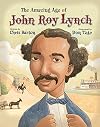
The Amazing Age of John Roy Lynch
by Chris Barton
On This Page
Description
"A picture book biography of John Roy Lynch, one of the first African-Americans elected into the United States Congress"--Provided by publisher.Tags
Recommendations




Member Reviews
This story of John Roy Lynch, the first African-American speaker of the Mississippi House of Representatives, is a terrific book for several reasons. The most important is, the author actually gets the story of the Reconstruction Era correct. While many Americans know a lot about the Civil War, the great majority don’t know much about Reconstruction, and what they have learned is riddled with myth and inaccuracies. As historian Eric Foner points out, we are still dealing with many of the same issues today as we did during this time period, making it all the more critical that we are aware of what actually happened. Chris Barton does a great job not only in presenting the truth, but in doing so in a way that will be understandable to show more younger readers.
Another reason this book stands out is because of John Roy Lynch himself, whose story is pretty amazing. Lynch, his mother, and brother were slaves, but were about to be bought and thereby liberated by his white father in 1849 when the father became sick and died. The father had entrusted a friend to complete the process, but the “friend” just sold the family to a new owner.
John Roy’s new job was to serve the owner’s wife by such chores as fanning her and shooing flies from her food. On Sundays, he and the other slaves listened to sermons about doing their master’s will. But John Roy spoke out of place one day, and was sent across the river in 1862 to work in the swampy cotton fields. But by then the Civil War had started, and when the Yankees came to Mississippi, John Roy experienced “true emancipation” when he sold a chicken for a dime and bought a boat ride to Natchez.
After the war ended, Mississippi whites, like those in other parts of the South, began passing laws to incarcerate as many young black men as they could; in essence, re-enslaving them to use their manpower as before. The labor of prisoners was bought and sold by sheriffs and judges among other opportunists to corporations such as U.S. Steel, Tennessee Coal, railroads, lumber camps, and factories. The prisoners who were sent to mines were chained to their barracks at night, and required to work all day. Hundreds died of disease, accidents, or homicide, and in fact, mass burial fields near these old mines can still be located. (You can read about this in the excellent 2008 book by Douglas Blackmon, Slavery By Another Name.)
John Roy managed to escape “recapture” by becoming a messenger for a local portrait shop, and was soon running it himself. He went to night school to learn to read and write, and got involved in the Natchez Republican club.
In 1868 the new U.S. Government-appointed Governor of Mississippi named John Roy Justice of the Peace, and John Roy hastened to learn law. He then got elected to the Mississippi House of Representatives, which chose John Roy as Speaker of the House. He was still only twenty-four years old. In 1872, voters sent him to the U.S. House of Representatives. His own success belied the fact that there was still plenty of resistance to black advancement in the South, and violence by whites steadily increased. John Roy, however, continued throughout his long life to believe in the power of law to bring peace and justice.
John Roy Lynch’s story is followed by a timeline, an Author’s Note, Illustrator’s note, a list of references for further reading, and a map.
Illustrator Don Tate chose a “childlike, naive style of art,” as he explains in his note, in the hope that the more lighthearted style would help temper the harsh aspects of the story. I think he made a great decision. His watercolors are also framed in sepia, helping establish the historical nature of the story.
Evaluation: “Black history” has been dominated for so long by a very few figures, that it is great to see authors bringing attention to new trailblazers and role models. And as mentioned above, it is always very gratifying when an author does his or her research, and is not reluctant to figure out ways to share essential aspects of American history with younger ears. show less
Another reason this book stands out is because of John Roy Lynch himself, whose story is pretty amazing. Lynch, his mother, and brother were slaves, but were about to be bought and thereby liberated by his white father in 1849 when the father became sick and died. The father had entrusted a friend to complete the process, but the “friend” just sold the family to a new owner.
John Roy’s new job was to serve the owner’s wife by such chores as fanning her and shooing flies from her food. On Sundays, he and the other slaves listened to sermons about doing their master’s will. But John Roy spoke out of place one day, and was sent across the river in 1862 to work in the swampy cotton fields. But by then the Civil War had started, and when the Yankees came to Mississippi, John Roy experienced “true emancipation” when he sold a chicken for a dime and bought a boat ride to Natchez.
After the war ended, Mississippi whites, like those in other parts of the South, began passing laws to incarcerate as many young black men as they could; in essence, re-enslaving them to use their manpower as before. The labor of prisoners was bought and sold by sheriffs and judges among other opportunists to corporations such as U.S. Steel, Tennessee Coal, railroads, lumber camps, and factories. The prisoners who were sent to mines were chained to their barracks at night, and required to work all day. Hundreds died of disease, accidents, or homicide, and in fact, mass burial fields near these old mines can still be located. (You can read about this in the excellent 2008 book by Douglas Blackmon, Slavery By Another Name.)
John Roy managed to escape “recapture” by becoming a messenger for a local portrait shop, and was soon running it himself. He went to night school to learn to read and write, and got involved in the Natchez Republican club.
In 1868 the new U.S. Government-appointed Governor of Mississippi named John Roy Justice of the Peace, and John Roy hastened to learn law. He then got elected to the Mississippi House of Representatives, which chose John Roy as Speaker of the House. He was still only twenty-four years old. In 1872, voters sent him to the U.S. House of Representatives. His own success belied the fact that there was still plenty of resistance to black advancement in the South, and violence by whites steadily increased. John Roy, however, continued throughout his long life to believe in the power of law to bring peace and justice.
John Roy Lynch’s story is followed by a timeline, an Author’s Note, Illustrator’s note, a list of references for further reading, and a map.
Illustrator Don Tate chose a “childlike, naive style of art,” as he explains in his note, in the hope that the more lighthearted style would help temper the harsh aspects of the story. I think he made a great decision. His watercolors are also framed in sepia, helping establish the historical nature of the story.
Evaluation: “Black history” has been dominated for so long by a very few figures, that it is great to see authors bringing attention to new trailblazers and role models. And as mentioned above, it is always very gratifying when an author does his or her research, and is not reluctant to figure out ways to share essential aspects of American history with younger ears. show less
This is the story of a man who went from being a slave to being a U.S. Congressman in just 10 years. There are very few books about the Reconstruction era for young people, especially when you compare it to the amazing wealth of books about slavery and the Civil Rights Movement. So, this book fills a very important void. There is a lot to like about it- the straightforward language and lighthearted illustrations. I wish that the additional information given in the afterward was incorporated into the text. Sometimes the individual story of John Roy is too narrow and I want there to be more context. I think this book will raise a lot of questions for kids, and I wish I had more resources to give them to learn more.
The Amazing Age of John Roy Lynch is a nonfiction picture book for school-age readers and listeners. More than just an inspirational story of a former slave who becomes a landholder, judge, and United States Congressman, it is a story that focuses on the great possibilities presented during the period of Reconstruction.
"In 1868 the U.S. government appointed a young Yankee general as a governor of Mississippi. The whites who had been in charge were swept out of office. By river and by railroad, John Roy traveled to Jackson to hand Governor Ames a list of names to fill those positions in Natchez. After John Roy spoke grandly of each man's merits, the governor added another name to the list: John Roy Lynch, Justice of the Peace.
Justice. show more Peace. Black people saw reason to believe that these were now available to them. Just twenty-one, John Roy doubted that he could meet all those expectations. But he dove in and learned the law as fast as he could."
Sadly, the reason that John Roy Lynch's story is amazing to today's reader is because the opportunities that abounded durin Reconstruction dried up and disappeared as quickly as they had come. The period of hope and optimism for African Americans in the years from 1865 to 1877 gets scant attention today.
To make sometimes difficult scenes accessible to younger readers, Don Tate employs a self-described, "naive ... even whimsical" style. It works well with the sepia-tinged hues that help to set the time frame.
The Amazing Age of John Roy Lynch is a powerful, historical reminder of what was, what might have been, and what is.
A Timeline, Historical Note, Author's Note, Illustrator's Note, For Further Reading, and maps round out the book.
http://shelf-employed.blogspot.com show less
"In 1868 the U.S. government appointed a young Yankee general as a governor of Mississippi. The whites who had been in charge were swept out of office. By river and by railroad, John Roy traveled to Jackson to hand Governor Ames a list of names to fill those positions in Natchez. After John Roy spoke grandly of each man's merits, the governor added another name to the list: John Roy Lynch, Justice of the Peace.
Justice. show more Peace. Black people saw reason to believe that these were now available to them. Just twenty-one, John Roy doubted that he could meet all those expectations. But he dove in and learned the law as fast as he could."
Sadly, the reason that John Roy Lynch's story is amazing to today's reader is because the opportunities that abounded durin Reconstruction dried up and disappeared as quickly as they had come. The period of hope and optimism for African Americans in the years from 1865 to 1877 gets scant attention today.
To make sometimes difficult scenes accessible to younger readers, Don Tate employs a self-described, "naive ... even whimsical" style. It works well with the sepia-tinged hues that help to set the time frame.
The Amazing Age of John Roy Lynch is a powerful, historical reminder of what was, what might have been, and what is.
A Timeline, Historical Note, Author's Note, Illustrator's Note, For Further Reading, and maps round out the book.
http://shelf-employed.blogspot.com show less
 This review was written for LibraryThing Early Reviewers.
John Roy Lynch lived a life worth writing about and his story was brought to life in a fantastic book that I recommend. I enjoy being exposed to stories of Americans that detail the truth about how harsh society is to people. I can talk to a class about the plight of African Americans in the late 19th century and the issues may not connect. Well, this book covers every issue that is relevant to talking about pre-and post-Civil War America through a person that lived it. The detail is evident from the cover. A well-dressed smiling man with a riverboat and carriages. I know when and where we are before I opened the book. The illustrator, Don Tate, did a masterclass that I would say is detailed simplicity. I liked that the people are drawn show more with a style that you would see in comic book. Mr. Tate covered topics from medicine, slavery, war, love, family, reconstruction, and politics with respect. None of the illustrations are similar and have some flair. My favorite is how the House of Representatives is drawn in an arc. I could spend an hour talking about that decision alone.
The book is well written. I like that the author, Chris Barton, worded the narrative from a specific point of view. This is noted on the page where John is fanning Mrs. Davis when he includes a line that gives you an informed insight. This was insight into Mrs. Davis’s reality and John’s reality. Like she, I was “grateful for the privilege” this detail gave me. This is a great book. John’s life is worth sharing with a class and I think its relatable to today’s culture. It’s a simple read that could be done in a few minutes. It offers so many direction due to the words that were chosen. Like slavery, Natchez, Altamont, Lincoln, and many more. It’s like a gold mine for historians.
This is a great book with lots of features. It’s an illustrated biography with a detailed historical note that covers heavier information in more detail. A timeline that is detailed with the story of the U.S. and John overlapping is great. I appreciated having two different colors so I could focus on how one action affected the next. I like that at the end, the book included a map to visualize this journey. The end. show less
The book is well written. I like that the author, Chris Barton, worded the narrative from a specific point of view. This is noted on the page where John is fanning Mrs. Davis when he includes a line that gives you an informed insight. This was insight into Mrs. Davis’s reality and John’s reality. Like she, I was “grateful for the privilege” this detail gave me. This is a great book. John’s life is worth sharing with a class and I think its relatable to today’s culture. It’s a simple read that could be done in a few minutes. It offers so many direction due to the words that were chosen. Like slavery, Natchez, Altamont, Lincoln, and many more. It’s like a gold mine for historians.
This is a great book with lots of features. It’s an illustrated biography with a detailed historical note that covers heavier information in more detail. A timeline that is detailed with the story of the U.S. and John overlapping is great. I appreciated having two different colors so I could focus on how one action affected the next. I like that at the end, the book included a map to visualize this journey. The end. show less
A fascinating picture book biography of John Roy Lynch, who went from 16-year-old half Irish freed slave to U.S. Congressman in ten years! He lived in Natchez Mississippi, where his father was the plantation overseer who had planned to liberate him but died when John was only two. It wasn't until 14 years later that John was finally freed and began to make his way in the world, rising from photographer's assistant to justice of the peace and to eloquent statesman. His story is also that of Reconstruction--freedom and equality for blacks existed briefly after the Civil War but later were taken away by Southern whites. The whimsical illustrations soften the harsh reality of what they depict. It's an inspiring text that explains slavery show more and discrimination clearly and eloquently. Includes author and illustrator notes, extensive timeline, and a list of further reading. Refers readers to Chris Barton's website for "more about the research and writing of" the book. show less
This review was written for LibraryThing Early Reviewers.This book is very well written and easily educates children about a man that went through slavery and became so much more. It tells it how it was lightly so there is no debate, but does not water it down as to forget what slavery was. Thoroughly enjoyed it from beginning to end.
This review was written for LibraryThing Early Reviewers.Grade Level: 4th grade and up
This book is about John Roy who became the African American elected into the United States Congress.The book begins with his life during his days on the plantation. John's mother was a salve and his father was a Caucasian overseer, after his father bought his mother and siblings they were supposed to be freed but his father died before it happened. John grew up a servant and did not become a free man until after the civil war. Once he became a free man he learned how to read, became a photographer, and speaker of the Mississippi House of Representatives. In 1872, he became the first African American Elected into the United States House of Representatives.
I would use this book in my classroom during black show more history month to teach the students about an African american historical figure. show less
This book is about John Roy who became the African American elected into the United States Congress.The book begins with his life during his days on the plantation. John's mother was a salve and his father was a Caucasian overseer, after his father bought his mother and siblings they were supposed to be freed but his father died before it happened. John grew up a servant and did not become a free man until after the civil war. Once he became a free man he learned how to read, became a photographer, and speaker of the Mississippi House of Representatives. In 1872, he became the first African American Elected into the United States House of Representatives.
I would use this book in my classroom during black show more history month to teach the students about an African american historical figure. show less
Members
- Recently Added By
Author Information

21 Works 3,411 Members
Some Editions
Awards and Honors
Awards
Distinctions
Notable Lists
Series
Belongs to Publisher Series
Common Knowledge
- Original publication date
- 2015-04-01
- People/Characters
- John Roy Lynch
- Important places
- Vidalia, Louisiana (Tacony Plantation); Natchez, Mississippi, USA; Jackson, Mississippi, USA; Washington, D.C., USA; Chicago, Illinois, USA
- Dedication
- To Jenny, for our own amazing age.
– C. B.
To Rita Painter and Rachel McInnes, two amazing library divas
– D. T. - First words
- John Roy Lynch had an Irish father and an enslaved mother.
- Quotations
- When every man, woman, and child can feel and know that his, her, and their rights are fully protected by the strong arm of a generous and grateful Republic, than we can all truthfully say that this beautiful land of ours, ov... (show all)er which the Star Spangled Banner so triumphantly waves, is, in truth and in fact, the “land of the free and the home of the brave.” – John Roy Lynch, from a speech made on the floor of the U. S. House of Representatives in support of the 1875 Civil Rights Act.
- Last words
- (Click to show. Warning: May contain spoilers.)He continued to believe that the people of this land could bring about peace.
Classifications
Statistics
- Members
- 233
- Popularity
- 139,238
- Reviews
- 28
- Rating
- (4.04)
- Languages
- English
- Media
- Paper, Ebook
- ISBNs
- 4