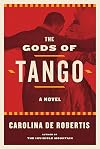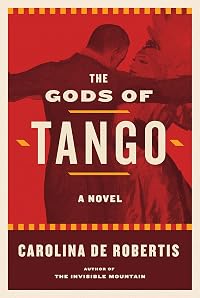
The Gods of Tango
by Carolina De Robertis
On This Page
Description
"February 1913. Seventeen-year-old Leda, clutching a suitcase and her father's cherished violin, leaves her small Italian village for a new home (and husband) halfway across the world in Argentina. Upon her arrival in Buenos Aires, Leda is shocked to find that her bridegroom has been killed. Unable to fathom the idea of returning home, she remains in this unfamiliar city, living in a commune, without friends or family, on the brink of destitution. She finally acts on a passion she has kept show more secret for years: mastering the violin"--Dust jacket flap. show lessTags
Recommendations


























Member Reviews
My blog is called History and Books and Dance and Stuff so a historical fiction book about tango ticks pretty well all the boxes. And The Gods of Tango has quite a lot of Stuff too. In fact it’s a vast, sprawling work about tango and Buenos Aires and Italy and sexuality and those old tango perennials, love and death.
I can’t begin to discuss the plot, partly because there are twists and turns and I don’t want to spoil it for you and partly because the 384 packed pages defy synopsification. (Is that a word? It should be.)
What you need to know is that the story starts in 1913 with Leda arriving in Buenos Aires, leaving a narrow life in a village just outside Naples in search of opportunity in the New World. In the first of many show more shocks in the book, all her plans are thrown into disarray before she has even left the boat and she finds herself struggling to survive in a city that seems to teeter forever on the edge of madness.
It’s a story packed with characters, all so perfectly drawn that you never get lost, but one of the biggest, most important, characters is Buenos Aires itself and particularly San Telmo, a part of the city I feel particularly at home in. The danger, excitement and opportunity of the city is perfectly captured. It is overcrowded and filthy (even more so in 1913 than now). Yet, as today, it holds you. Leda knows that Buenos Aires destroys its children, yet she cannot bring herself to leave. A peaceful life in a small Italian village is no longer something she can settle for.
Leda falls in love with tango. The music, she thinks, can save her. And it does, though it means she must sacrifice everything. (No spoilers, but ‘everything’ isn’t too much of a stretch here.) She carves out a life in the violent world of tango. She is there as tango moves from the bars and the brothels to the dance halls and eventually the grand clubs and cabarets, even achieving an international respectability. But for Leda, it is always about the music of the people, starting with the rhythms brought from Africa with slavery. (The Gods of Tango is unusual in featuring a black bandoneon player whose grandfather was probably a slave. Argentina used to have a substantial black population but no one talks about that now.)
If you are interested in the history of tango (you’ve probably realised I am), then The Gods of Tango is worth reading just for its description of how and why the music developed through the Golden Age. But the book is much, much more than that. I’ve never read a book by a woman which understands so well the reality of being a man. And when she deals with different aspects of sexuality, she writes better than anyone else I have read, or ever expect to read.
De Robertis has won prizes and fellowships and is definitely a ‘literary author’, a label I am generally suspicious of. But this is someone who has earned their reputation through extraordinary hard work as well as an exceptional ability to write. Leda’s life in Italy was researched in Italy. De Robertis reached Italian emigration to Argentina and Afro-Argentinian history (an area which, as I’ve mentioned, is generally overlooked). She studied the violin as well as tango history and learned to dance. She has explored Buenos Aires today and developed a deep understanding of its history. And she writes fantastic prose. (I just said that, but I’m saying it again.)
I’m getting carried away. All I can say is that this is an astonishing book.
Read it. show less
I can’t begin to discuss the plot, partly because there are twists and turns and I don’t want to spoil it for you and partly because the 384 packed pages defy synopsification. (Is that a word? It should be.)
What you need to know is that the story starts in 1913 with Leda arriving in Buenos Aires, leaving a narrow life in a village just outside Naples in search of opportunity in the New World. In the first of many show more shocks in the book, all her plans are thrown into disarray before she has even left the boat and she finds herself struggling to survive in a city that seems to teeter forever on the edge of madness.
It’s a story packed with characters, all so perfectly drawn that you never get lost, but one of the biggest, most important, characters is Buenos Aires itself and particularly San Telmo, a part of the city I feel particularly at home in. The danger, excitement and opportunity of the city is perfectly captured. It is overcrowded and filthy (even more so in 1913 than now). Yet, as today, it holds you. Leda knows that Buenos Aires destroys its children, yet she cannot bring herself to leave. A peaceful life in a small Italian village is no longer something she can settle for.
Leda falls in love with tango. The music, she thinks, can save her. And it does, though it means she must sacrifice everything. (No spoilers, but ‘everything’ isn’t too much of a stretch here.) She carves out a life in the violent world of tango. She is there as tango moves from the bars and the brothels to the dance halls and eventually the grand clubs and cabarets, even achieving an international respectability. But for Leda, it is always about the music of the people, starting with the rhythms brought from Africa with slavery. (The Gods of Tango is unusual in featuring a black bandoneon player whose grandfather was probably a slave. Argentina used to have a substantial black population but no one talks about that now.)
If you are interested in the history of tango (you’ve probably realised I am), then The Gods of Tango is worth reading just for its description of how and why the music developed through the Golden Age. But the book is much, much more than that. I’ve never read a book by a woman which understands so well the reality of being a man. And when she deals with different aspects of sexuality, she writes better than anyone else I have read, or ever expect to read.
De Robertis has won prizes and fellowships and is definitely a ‘literary author’, a label I am generally suspicious of. But this is someone who has earned their reputation through extraordinary hard work as well as an exceptional ability to write. Leda’s life in Italy was researched in Italy. De Robertis reached Italian emigration to Argentina and Afro-Argentinian history (an area which, as I’ve mentioned, is generally overlooked). She studied the violin as well as tango history and learned to dance. She has explored Buenos Aires today and developed a deep understanding of its history. And she writes fantastic prose. (I just said that, but I’m saying it again.)
I’m getting carried away. All I can say is that this is an astonishing book.
Read it. show less
Narrated by the author. The audiobook would have benefited from a more perceptive performance. While the author's youthful and impassioned voice suits young adult immigrants forging new lives in a new world, it runs roughshod over moments that are much more nuanced, at times coming off as breathlessly overwrought. Otherwise if you are a fan of tango music and dance and Buenos Aires, it's a compelling story of Leda/Dante's rocky and daring journey from widowed teen immigrant to notable tanguero.
I love this author - her books are engrossing, always teach me something, and her writing is gorgeous. This book wavered between 4 and 4.5 stars for me. It's the story of a young woman who arrives in Buenos Aires Argentina in 1910 to begin life with her new husband only to learn upon arrival that he had been killed in a human rights demonstration. Instead of focusing on returning home to Italy, she falls in love with the tango and begins identifying herself as a man in order to play the music that opens her heart.
The story line was slow to start, but I'm glad I persevered as it became more interesting as Dante began playing music and joining a band. This is the story of following dreams,acting out of courage rather than fear, gender show more fluidity, music, and the culture of the salons of Buenos Aires in the early 1900s. show less
The story line was slow to start, but I'm glad I persevered as it became more interesting as Dante began playing music and joining a band. This is the story of following dreams,acting out of courage rather than fear, gender show more fluidity, music, and the culture of the salons of Buenos Aires in the early 1900s. show less
I wanted to like this book. And I do. But... I really think it tries to do too much. The story of the tango is interesting - it's evolution in South America from African drums through the music of the lower class and brothels, and to the risqué dancing halls of the rich. Paralleling the changes in clientele is the change in instruments and their sound. It's a good story. I wouldn't mind a soundtrack to go along with the book. Maybe in the audio version?
Then there is the theme of the immigrant woman, Leda, married by proxy, who travels alone from Italy to Argentina to join her husband only to find out he had been killed there. Her story of how she survives - hiding her identity, taking on the role of a man, learning his gestures and show more "man talk" - is wrapped in the story of the tango. Certainly all immigrants didn't do this; but from the description of living conditions on the conventillos of Buenos Aires one can see why it might happen.
Then there are the two themes that unnecessarily complicate, and perhaps distract from the story. One is the theme of lesbian love, complicated by Leda's concealed gender; there is quite a lot about this theme, and, of course, it is another big complication in Leda's life. But is it necessary to the story? The other is the early death of Leda's cousin-friend, Cora, in Italy, to whom she was strongly attached. It crops up multiple times but is never fully explained, and only seems to affect Leda in Cora's desire for them to to move away together.
The writing is good. So I'd like to give the book 5 stars ( and I'd like to know more about the tango) I feel it's more like a 3.5 for me. show less
Then there is the theme of the immigrant woman, Leda, married by proxy, who travels alone from Italy to Argentina to join her husband only to find out he had been killed there. Her story of how she survives - hiding her identity, taking on the role of a man, learning his gestures and show more "man talk" - is wrapped in the story of the tango. Certainly all immigrants didn't do this; but from the description of living conditions on the conventillos of Buenos Aires one can see why it might happen.
Then there are the two themes that unnecessarily complicate, and perhaps distract from the story. One is the theme of lesbian love, complicated by Leda's concealed gender; there is quite a lot about this theme, and, of course, it is another big complication in Leda's life. But is it necessary to the story? The other is the early death of Leda's cousin-friend, Cora, in Italy, to whom she was strongly attached. It crops up multiple times but is never fully explained, and only seems to affect Leda in Cora's desire for them to to move away together.
The writing is good. So I'd like to give the book 5 stars ( and I'd like to know more about the tango) I feel it's more like a 3.5 for me. show less
Leda leaves Italy to travel to Argentina to live with her new husband Dante but when she arrives she learns he has died. Unable to go home she does her best to make a living sewing for others but she wants to play the violin. Tango is the rage in Argentina and as she listens to it she learns to play it. She then takes bold action to dress and act as a man so she can live by playing the tango. Her life becomes very different after that.
I love the tango. I liked how this is a story of more than Leda. It gives the history of tango and how it changed through the years. Ms. DeRobertis has captured the flavor of the time and the dance that I felt I was back in Argentina listening as the tango was played in the courtyards while dancing it show more myself. Showing the precariousness of Leda's life as a man, how carefully she has to guard herself, and how she eventually takes over that life was fascinating to watch especially when things go south for her but she does pick herself up and goes on. The characterization is wonderful to watch as Leda goes from a girl of her times to a man to make a living and to protect herself.
This book was so good that I cannot wait to read more of Ms. DeRobertis. Fortunately I just picked up her newest book show less
I love the tango. I liked how this is a story of more than Leda. It gives the history of tango and how it changed through the years. Ms. DeRobertis has captured the flavor of the time and the dance that I felt I was back in Argentina listening as the tango was played in the courtyards while dancing it show more myself. Showing the precariousness of Leda's life as a man, how carefully she has to guard herself, and how she eventually takes over that life was fascinating to watch especially when things go south for her but she does pick herself up and goes on. The characterization is wonderful to watch as Leda goes from a girl of her times to a man to make a living and to protect herself.
This book was so good that I cannot wait to read more of Ms. DeRobertis. Fortunately I just picked up her newest book show less
Forbidden love, immigrant struggles and the transformative power of music all combine to make this novel immensely entertaining and wonderfully moving. Plus, the poetry-infused sentences lend a wonderful rhythm to the subject matter – adding to the power of the narrative. Our heroine leaves Italy to find her husband killed when she arrives in Buenos Aires and slowly transforms herself - and the lives of the people in her life - in order to survive. The passion of the characters could have been so tawdry and resembled a soap opera in the hands of a less-talented author.
I've read both of de Robertis' previous novels, The Invisible Mountain and Perla. I adored them both. These tales of dictatorships and strong, decisive women have stuck in my heart for years now. I was disappointed that I did not enjoy The Gods of Tango the same way. I think primarily, it was a case of my expectations being too high – this was still a good book, and dealt with a theme I find interesting (namely, women in history refusing to comply with the norms forced on them by virtue of their sex)… it just didn't meet the dizzying heights of the others.
So. This novel tells the story of Dante, who starts out as Leda, a seventeen-year-old widow who's just travelled across the seas from small-town Italy to Buenos Aires to be with show more her cousin-husband, only to discover he'd been shot dead at a protest just before her arrival. This poses a problem, since for a single, working-class woman in 1910s Buenos Aires, there is no way to keep oneself afloat besides prostitution, a fate Leda naturally wishes to avoid.
So she reinvents herself. She takes a violin she brought over from Italy and her husband's clothes, and becomes Dante. Through persistence and a highly fortunate prodigious talent for the violin, she joins a tango orquesta and earns a living as a professional musician. She quickly adjusts to the masculine world, one of boozing, smoking and whoring. She finds other women alluring, irresistible, but is distressed by her inability to truly be intimate with them, seeing as she can't ever risk her secret being exposed. At last, she meets another woman, one who found a different way of transgressing those feminine gender norms, and they share a happily ever after together.
Put like that, I very much enjoyed this story. On the other hand, the plot moved very slowly (and the entire first half held nothing that you didn't already know from the blurb, which seemed like a poor choice on the publisher's part) and the characters were less than strongly portrayed. At times I felt like the author got too caught up in her beautiful melodic prose (and really, it is lovely) and forgot to ensure the plot was rock-solid. There were a couple of sections where she switched to the point of view of another character, not Leda/Dante, when that wasn't really necessary. There was a fairly prominent subplot that ultimately proved pointless(all we learned was that sometimes girls are raped by their fathers… was that necessary?) . The ending seemed to move a bit too quickly, and be a bit too neat. I felt that Leda/Dante herself was a bit of a cipher, someone who adapted her entire being to her circumstances rather than having a strong core identity of her own… which was, perhaps, the point, but I found it somewhat unsatisfying.
Overall, I'd call this a worthwhile read if the themes or setting particularly interest you, but the story itself seems a bit on the weak side. A solid three-star book. (Jun 2018) show less
So. This novel tells the story of Dante, who starts out as Leda, a seventeen-year-old widow who's just travelled across the seas from small-town Italy to Buenos Aires to be with show more her cousin-husband, only to discover he'd been shot dead at a protest just before her arrival. This poses a problem, since for a single, working-class woman in 1910s Buenos Aires, there is no way to keep oneself afloat besides prostitution, a fate Leda naturally wishes to avoid.
So she reinvents herself. She takes a violin she brought over from Italy and her husband's clothes, and becomes Dante. Through persistence and a highly fortunate prodigious talent for the violin, she joins a tango orquesta and earns a living as a professional musician. She quickly adjusts to the masculine world, one of boozing, smoking and whoring. She finds other women alluring, irresistible, but is distressed by her inability to truly be intimate with them, seeing as she can't ever risk her secret being exposed. At last, she meets another woman, one who found a different way of transgressing those feminine gender norms, and they share a happily ever after together.
Put like that, I very much enjoyed this story. On the other hand, the plot moved very slowly (and the entire first half held nothing that you didn't already know from the blurb, which seemed like a poor choice on the publisher's part) and the characters were less than strongly portrayed. At times I felt like the author got too caught up in her beautiful melodic prose (and really, it is lovely) and forgot to ensure the plot was rock-solid. There were a couple of sections where she switched to the point of view of another character, not Leda/Dante, when that wasn't really necessary. There was a fairly prominent subplot that ultimately proved pointless
Overall, I'd call this a worthwhile read if the themes or setting particularly interest you, but the story itself seems a bit on the weak side. A solid three-star book. (Jun 2018) show less
Members
- Recently Added By
Lists

School library books removed after TX state legislator inquiry
429 works; 6 members
Author Information

8+ Works 1,657 Members
Carolina De Robertis is the author of Perla, The Invisible Mountain, and The Gods of Tango. She is the recipient of Italy's Rhegium Julii Prize and a 2012 fellowship from the National Endowment for the Arts. (Bowker Author Biography)
Some Editions
Awards and Honors
Common Knowledge
- Canonical title
- The Gods of Tango
Classifications
Statistics
- Members
- 217
- Popularity
- 150,553
- Reviews
- 15
- Rating
- (3.74)
- Languages
- 5 — English, French, German, Italian, Korean
- Media
- Paper, Audiobook, Ebook
- ISBNs
- 14
- ASINs
- 4