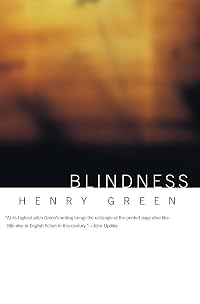
Blindness
by Henry Green
On This Page
Description
"Blindness is the story of John Haye, a young student, and begins with an excerpt from his diary, brimming with excitement and affectation and curiosity about life and literature. Then a freak accident robs John of his sight, plunging him into despair. Forced to live with his highhanded, horsey stepmother in the country, John begins a weird dalliance with a girl named Joan, leading to a new determination. Blindness is the curse of youth and inexperience and love and ambition, and blindness, show more John discovers, can also be the source of vision"-- show lessTags
Recommendations














Member Reviews
The night I finished reading Blindness I couldn't sleep. Every time I began to doze off, I would awake with a jolt, fighting for air. This happened once, twice, three times. Probably more. I finally just gave up the fight and went downstairs to watch television. The droning of the voices brought some calmness, and I was eventually able to get some sleep.
I should have known better than to read this.
Blindness has been my Achilles' heel hell all my life. It haunts me in a way I can never express fully.
There is blindness in my family. Two of my brothers suffer(ed) from Retinitis Pigmentosa (RP) and all through my childhood, I watched as each lost his vision: a long, slow decline that robbed them each day of some precious little gift. A show more new indignity would crop up daily, it seemed, until the darkness was all-encompassing.
The loss of freedom was the worst of all: always to rely on someone else's eyes, someone else's timing. There was no "I" anymore, without the "we". We'll go for a walk. We'll go to the store soon. We'll go to the bank. We'll go to the doctor.
The loss of freedom was most unbearable to two young men, both of artistic temperament, and both great sports enthusiasts: loving nothing more than to curl up with a good book and read away all the available hours (when they were not engaged in baseball or hockey), this deprivation shaped their lives in painful ways. Practicing their music became a blur when the notes were no longer readable -- until they found a music teacher with a heart and mind who empathized and found creative solutions. Everything they loved, that they were most passionate about, was no longer within their grasp.
To add to their darkness, it should be understood this was a time long before cellphones and iPads and talking computers and talking watches -- all those little conveniences which today make the world, not necessarily more bearable for the blind, but certainly more navigable by giving an iota of simulated freedom.
All this I understood in the matter of seconds as I read John's plight in the novel. It seems to me Henry Green understood it very well too -- the despair that comes from knowing you have no choice: you either put one step ahead of you every day, even though the path is barely discernible, or you sink and you die. You. Have. No. Choice.
The state of not having a choice results, usually, in some very bad choices ultimately. Henry Green understood that very well too for John makes some rather silly choices, early on, grasping at the straws of existence-without-sight.
I want to feel solid again because I feel I'm disappearing.This is something I learned very early with my brothers' regrettable choices sometimes. Living so completely in the darkness, you start to question at times whether you even exist yourself. And you fight -- and you fight -- and you fight for air. I can't breathe.
You can wrap a blindfold around your eyes and simulate blindness, but it's all a joke. Just knowing that you can take that blindfold off at anytime changes the experience completely. There can never be complete understanding of blindness. That too, Green understood, and telegraphed those thoughts through John's deteriorating mental status.
I can't breathe.
If you don't find equilibrium; if you don't have willpower of steel; if you waiver for just a little bit on the nature of your existence, you succumb, like John. Like my elder brother did because his choices were so much more broken than my younger brother's. It was easier for my younger brother to take direction and accept the guiding hand of one who loved him. It was so much harder for my elder brother because he was so used to being the helper, to being the one in control. It is so much easier to give up control when you haven't had much experience with it; it is almost impossible to do when you've been someone who was the mainstay of the family. (My father died when I was quite young, leaving a whole collection of us to make our way in the world; the elder brother took on the role of helper in the family, so for him, the loss was unbearable, unmanageable, unforgivable.)
All these torments, Green understood.
The novel is as oppressive as the condition: it becomes a metaphor, a simulation of blindness. Read with caution. Read at your own risk. show less
I should have known better than to read this.
Blindness has been my Achilles' heel hell all my life. It haunts me in a way I can never express fully.
There is blindness in my family. Two of my brothers suffer(ed) from Retinitis Pigmentosa (RP) and all through my childhood, I watched as each lost his vision: a long, slow decline that robbed them each day of some precious little gift. A show more new indignity would crop up daily, it seemed, until the darkness was all-encompassing.
The loss of freedom was the worst of all: always to rely on someone else's eyes, someone else's timing. There was no "I" anymore, without the "we". We'll go for a walk. We'll go to the store soon. We'll go to the bank. We'll go to the doctor.
The loss of freedom was most unbearable to two young men, both of artistic temperament, and both great sports enthusiasts: loving nothing more than to curl up with a good book and read away all the available hours (when they were not engaged in baseball or hockey), this deprivation shaped their lives in painful ways. Practicing their music became a blur when the notes were no longer readable -- until they found a music teacher with a heart and mind who empathized and found creative solutions. Everything they loved, that they were most passionate about, was no longer within their grasp.
To add to their darkness, it should be understood this was a time long before cellphones and iPads and talking computers and talking watches -- all those little conveniences which today make the world, not necessarily more bearable for the blind, but certainly more navigable by giving an iota of simulated freedom.
All this I understood in the matter of seconds as I read John's plight in the novel. It seems to me Henry Green understood it very well too -- the despair that comes from knowing you have no choice: you either put one step ahead of you every day, even though the path is barely discernible, or you sink and you die. You. Have. No. Choice.
The state of not having a choice results, usually, in some very bad choices ultimately. Henry Green understood that very well too for John makes some rather silly choices, early on, grasping at the straws of existence-without-sight.
I want to feel solid again because I feel I'm disappearing.This is something I learned very early with my brothers' regrettable choices sometimes. Living so completely in the darkness, you start to question at times whether you even exist yourself. And you fight -- and you fight -- and you fight for air. I can't breathe.
You can wrap a blindfold around your eyes and simulate blindness, but it's all a joke. Just knowing that you can take that blindfold off at anytime changes the experience completely. There can never be complete understanding of blindness. That too, Green understood, and telegraphed those thoughts through John's deteriorating mental status.
I can't breathe.
If you don't find equilibrium; if you don't have willpower of steel; if you waiver for just a little bit on the nature of your existence, you succumb, like John. Like my elder brother did because his choices were so much more broken than my younger brother's. It was easier for my younger brother to take direction and accept the guiding hand of one who loved him. It was so much harder for my elder brother because he was so used to being the helper, to being the one in control. It is so much easier to give up control when you haven't had much experience with it; it is almost impossible to do when you've been someone who was the mainstay of the family. (My father died when I was quite young, leaving a whole collection of us to make our way in the world; the elder brother took on the role of helper in the family, so for him, the loss was unbearable, unmanageable, unforgivable.)
All these torments, Green understood.
The novel is as oppressive as the condition: it becomes a metaphor, a simulation of blindness. Read with caution. Read at your own risk. show less
Henry Green’s debut novel, published in 1926 when he was 21 years old and a student at Oxford, is a remarkably mature work. One may not suspect this at first superficial glance of the plot summary - a young man is blinded in an accident and adjusts to life without sight, pretty obvious symbolism opportunity there! - and the titles of the novel’s three parts: Caterpillar, Chrysalis, Butterfly. I’d suspect a pretty simplistic book just knowing those three factors (first novel, plot, reductive outline). But in fact it’s not a simple text at all, and while not exactly Green’s mature style it provides some hints of it.
Primarily I’m thinking here of Green’s avowed intent to take the author out of the picture and just present the show more reader with what can be seen and heard directly, and to make his or her own meaning from it, which reached an apogee with a couple of nearly all-dialogue novels. Green hasn’t got there yet of course at this point, but dialogue like this, using spoken language between characters instead of authorial narration to suggest something about a character’s state of mind, bears a resemblance:
This novel’s central character, John, also shares Green’s attitude in respects of the reader forming meaning. The fictional John is, like the real Green, at the very start of his writing career and sees his his role not as dictating meaning directly but allowing the reader to form it:
What Green would get rid of in later novels was lots of descriptive prose, which approach may have its interest and virtues, but when Green is capable or writing prose like this about a waning day before age 21, one can’t help imagining it as a loss:
Primarily I’m thinking here of Green’s avowed intent to take the author out of the picture and just present the show more reader with what can be seen and heard directly, and to make his or her own meaning from it, which reached an apogee with a couple of nearly all-dialogue novels. Green hasn’t got there yet of course at this point, but dialogue like this, using spoken language between characters instead of authorial narration to suggest something about a character’s state of mind, bears a resemblance:
“I was to lead a public life of the greatest possible brilliance. It is different now.”
“How wonderful that would be.”
“You know what I mean? One planned everything out on a broad scale, remembering little scraps of flattery that someone or other had been so good as to throw one and building on that. One was so hungry for flattery. The funny thing is that when one goes blind life goes on just the same, only half of it is lopped off.”
“Yes?”
“One would think that life would stop, wouldn’t you? But it always goes on, goes on, and that is rather irritating.”
This novel’s central character, John, also shares Green’s attitude in respects of the reader forming meaning. The fictional John is, like the real Green, at the very start of his writing career and sees his his role not as dictating meaning directly but allowing the reader to form it:
He would write about these things, for life was only beginning again, and there were many things to say. Besides, one couldn’t for ever be sitting in a chair like this, and be for the rest of one’s life someone to be sorry for. And perhaps the way he saw everything was the right way, though there could be no right way but one’s own. Art was what created in the looker-on, and he would have to try and create in others.
What Green would get rid of in later novels was lots of descriptive prose, which approach may have its interest and virtues, but when Green is capable or writing prose like this about a waning day before age 21, one can’t help imagining it as a loss:
The air began to get rid of the heaviness, and so became fresher as the dew soaked the grass. A blackbird thought aloud of bed, and was followed by another and then another. The sun was flooding the sky in waves of colour while he grew redder and redder in the west, the trees were a red gold too where he caught them. The sky was enjoying herself after the boredom of being blue all day. She was putting on and rejecting yellow for gold, gold for red, then red for deeper reds, while the blue that lay overhead was green. A cloud of starlings flew by to roost with a quick rush of wings, and sleepy rooks cawed. Far away a man whistled on his way home.show less
The authors you love, I’ve found, do not come about due to wide or deep reading of their oeuvre, but from a single piece of work, usually in the first half dozen or so by that author you’ve read. It blows you away… and it colours all your other encounters with that author’s works. With Lowry, it was his novella ‘Through the Panama’, with Durrell it was The Alexandria Quartet, with Blixen it was her story ‘Tempest’… and with Green it was the first novel by him I read, Loving. A pitch-perfect control of voice, a refusal to tell the story using normal narrative techniques, and an excellent eye for detail… what’s not to love? Blindness is Green’s first novel, and concerns a public schoolboy whose bright future is show more snatched from him in an accident which blinds him (a kid throws a stone at a passing train, smashing a window through which the protagonist is looking). The story is told firstly through letters, then through semi-stream-of-consciousness narratives by the young man and his mother and the young woman (of an unsuitable family) whose company he enjoys… It’s very much a story of privilege and deprivation – the main character is the scion of a wealthy family, with a country seat boasting a large staff (members of which which the mother complains about repeatedly); but the young woman is the daughter of an alcoholic vicar fallen on hard times and, if anything, reads more like a DH Lawrence character (on his good days, that is) than a fit companion for the blind boy. Green had a reputation as “a writer’s writer”, which is generally taken to mean he was much admired but sold few copies. It’s true that there’s a dazzling level of technique on display in Blindness, a facility with prose no writer can fail to admire. And it’s Green’s writing prowess I certainly admire, rather than his choice of subjects or the stories he chooses to tell. But there’s a profound pleasure to be found in reading prose that is just put together so well, and that’s why I treasure Green’s writing. show less
The story is of a 17 year old boy named John who is blinded in an accident on the way home from boarding school.
Set in the English countryside of the 1920's, the book starts out before the accident, and then proceeds to after the accident.
I find the concept of going blind terrifying, and it made me think about how one would cope with such an event. I can't imagine how hard it would be to go through for both the person and their family members/people close to them, and suspect it would be easy to seem insensitive.
That said, I was surprised and put off to find all the characters coming across as selfish and basically unlikeable.
Yet all in all the book was quite readable.
Set in the English countryside of the 1920's, the book starts out before the accident, and then proceeds to after the accident.
I find the concept of going blind terrifying, and it made me think about how one would cope with such an event. I can't imagine how hard it would be to go through for both the person and their family members/people close to them, and suspect it would be easy to seem insensitive.
That said, I was surprised and put off to find all the characters coming across as selfish and basically unlikeable.
Yet all in all the book was quite readable.
Green's first novel is not as good as what came after but still has much to recommend it. In the dialogue there are flashes of the quicksilver genius on display in books like Loving, Nothing, and Doting; many of the poetic descriptive passages are lovely although a few bubble over into purple prosiness. Green's treatment / evocation of blindness seems very astute for someone so young, and I liked the way he introduced Joan as a potential happy ending, only to buck the conventional narrative expectation (although I found the characters of Joan and her alcoholic ex-priest father hard to believe and rather melodramatic).
Overall Blindness feels patchy and somewhat incoherent. It reads rather as though it was cobbled together from fragments show more - especially the adolescent diary entries that form the first section. I'm glad I read this but I'm also glad it was the seventh, and not the first of his novels that I read. show less
Overall Blindness feels patchy and somewhat incoherent. It reads rather as though it was cobbled together from fragments show more - especially the adolescent diary entries that form the first section. I'm glad I read this but I'm also glad it was the seventh, and not the first of his novels that I read. show less
The story is of a young man, John Haye. The book is divided into sections called Caterpillar, Chrysalis and Butterfly so we know that there will be change and maturing. The story starts with John at Public School of Noat. John is a boy who loves art, writing and plays. He enjoys beauty such as daffodil blooming amongst the grass in the garden. In his senior year, John loses his eyesight in a freak accident. In Chrysalis, John is at home in the country with his stepmother and nanny. He is getting used to seeing a new way. He spends some time with the daughter of a defrocked parson and then his stepmother rushes John to the London, a new life. In the first part of the book, we are reading John’s diary. In the second part, we are show more learning the story of Joan (the parson’s daughter). John’s narration switches to his inner dialogue. The author was around 20 or 21 when he wrote this story and used several new techniques of modernism in writing his first novel.
The actual accident is perhaps a little unbelievable but the author did a great job of describing blindness and the way people behave around the handicapped person.
The chapter called Picture Postcardism-- focused a lot on the visual. What John could no longer see but what others (Joan) could see.
Social commentary: John’s mother’s treatment of servants (appalling). the defrocked Vicar feeling like he is entitled. show less
The actual accident is perhaps a little unbelievable but the author did a great job of describing blindness and the way people behave around the handicapped person.
The chapter called Picture Postcardism-- focused a lot on the visual. What John could no longer see but what others (Joan) could see.
Social commentary: John’s mother’s treatment of servants (appalling). the defrocked Vicar feeling like he is entitled. show less
Let me preface this by saying that Henry Green published this novel, which incorporates a number of highly advanced modernist techniques, in 1926; that this was one year after Woolf's To The Lighthouse, and one year before her Mrs. Dalloway; and that he managed to do this when he was 21. That's an amazing achievement, and more than enough reason for me to look forward to reading his later work.
Unfortunately, I won't be re-reading this one. His use of dialogue is worth plenty of attention (the scenes in which John and 'June' discuss their malformed expectations are wonderful), and it's fun to train-spot eminent Etonians through the early diaristic bits. But the internal monologues, technically advanced and all, are *torturously* dull: show more repetitive thinking about boring aspects of life does not make for a worthwhile read. Anyone who continues to spout the idea that one must 'show, not tell,' should be forced to read these monologues, just once, and that should put them on the right track. You can tell people things.
One particularly interesting trick, though, is the way he changes tense in order to indicate a switch from narration to a character's direct thought; it's something I've toyed with myself. But Green puts thought in the past tense and narrates in the present; I went the other way round. I hope to find this in other authors, to see how they used it. show less
Unfortunately, I won't be re-reading this one. His use of dialogue is worth plenty of attention (the scenes in which John and 'June' discuss their malformed expectations are wonderful), and it's fun to train-spot eminent Etonians through the early diaristic bits. But the internal monologues, technically advanced and all, are *torturously* dull: show more repetitive thinking about boring aspects of life does not make for a worthwhile read. Anyone who continues to spout the idea that one must 'show, not tell,' should be forced to read these monologues, just once, and that should put them on the right track. You can tell people things.
One particularly interesting trick, though, is the way he changes tense in order to indicate a switch from narration to a character's direct thought; it's something I've toyed with myself. But Green puts thought in the past tense and narrates in the present; I went the other way round. I hope to find this in other authors, to see how they used it. show less
Members
- Recently Added By
Lists

Henry Green ranked
9 works; 2 members

1,001 BYMRBYD Concensus
723 works; 27 members

My TBR
371 works; 3 members
Author Information

16+ Works 4,372 Members
Writing under the pseudonym Henry Green, Henry Vincent Yorke kept his life as a wealthy industrialist separate from his literary persona. Although he had friends who were authors, he did not travel in literary circles and refused to be photographed, to protect his anonymity. Yorke was born in 1905 in Gloucestershire, England, and worked as a show more laborer before becoming managing director of a food engineering firm. From the publication of his first book Blindness (1926), which was begun when he was 17 years old and a student at Eton, he was admired for his unfailing sense of dialogue and characterization for all classes of British life. Green's last novel, Nothing, was published in 1950. Although he is still relatively unknown in the United States, he is recognized by authors such as John Updike and W. H. Auden as a masterful storyteller and one of the greatest English writers of the 20th century. He died in 1973 (Bowker Author Biography) show less
Some Editions
Awards and Honors
Series
Belongs to Publisher Series
Work Relationships
Is contained in
Common Knowledge
- Original publication date
- 1926
- People/Characters
- John Haye; Mrs. Haye; Joan Entwhistle; Mr. Entwhistle
- First words
- Diary of John Haye, Secretary to the Noat Art Society, and in J. W. P.'s House at the Public School of Noat.
- Last words
- (Click to show. Warning: May contain spoilers.)Why am I so happy today? "Yrs., "John"
Classifications
Statistics
- Members
- 306
- Popularity
- 104,951
- Reviews
- 12
- Rating
- (3.47)
- Languages
- English, German
- Media
- Paper, Ebook
- ISBNs
- 10
- ASINs
- 6