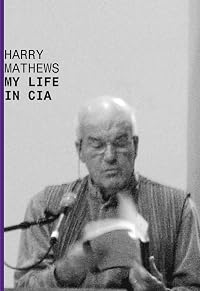
My Life In CIA: A Chronicle of 1973
by Harry Mathews
On This Page
Description
"It's outrageous that an educated man and a gifted writer like Mr. Mathews could make such a public confession of such shameful activities." Q. Kuhlmann, author of The Eye of Anguish: Subversive Activity in the German Democratic RepublicTags
Recommendations







Member Recommendations
Member Reviews
Mathews’ faux-roman-á-clef spy-caper conjuration feels just right at this moment when everyone seems to be running a con, the discourse is tetchy and hollow, and retreat to the shadows feels like an affirmation of resolve.
This is Harry’s last novel. (He died in 2017 at the age of 86). He is at the height of his craft. Good fiction is art/ifice. Harry is pretending. Art provides a kind of paradise, says Harry. The milieu sounds real―Parisian street names, his artist friends. Events in the news circa 1973 jangle like an incantation: Le Pen, Baader-Meinhof, Pinochet. Is it dangerous? The stops along your itinerary are arranged in alphabetical order. Harry writes for fun. He says you can never trust a novelist. His mock infiltration show more is blocked when he is outed as an Oulipian. When Harry’s tryst with the seamstress is almost discovered, he hides in a rolled-up carpet and is accidentally delivered to a dinner party at the home of a notorious fascist thug where he is fingered as a patsy but escapes with the help of a nymphomaniacal dwarf twin who seduces him on the altar of Les Six Saints Jean, but at the last minute the sexton appears, his ultrawhite skin cultivated as a kind of inverse totemic shrine to an unconsummated affair with a dark black boy on Corsica. Perhaps things begin to unravel. Harry is at the height of his craft. He goes on the lam. Nabokov said that a writer’s greatest creation is his readers, and in the end Harry is saved by his. Goodbye, Harry. show less
This is Harry’s last novel. (He died in 2017 at the age of 86). He is at the height of his craft. Good fiction is art/ifice. Harry is pretending. Art provides a kind of paradise, says Harry. The milieu sounds real―Parisian street names, his artist friends. Events in the news circa 1973 jangle like an incantation: Le Pen, Baader-Meinhof, Pinochet. Is it dangerous? The stops along your itinerary are arranged in alphabetical order. Harry writes for fun. He says you can never trust a novelist. His mock infiltration show more is blocked when he is outed as an Oulipian. When Harry’s tryst with the seamstress is almost discovered, he hides in a rolled-up carpet and is accidentally delivered to a dinner party at the home of a notorious fascist thug where he is fingered as a patsy but escapes with the help of a nymphomaniacal dwarf twin who seduces him on the altar of Les Six Saints Jean, but at the last minute the sexton appears, his ultrawhite skin cultivated as a kind of inverse totemic shrine to an unconsummated affair with a dark black boy on Corsica. Perhaps things begin to unravel. Harry is at the height of his craft. He goes on the lam. Nabokov said that a writer’s greatest creation is his readers, and in the end Harry is saved by his. Goodbye, Harry. show less
Yup, this was fun. A (most likely fictionalized) memoir; living in Paris in the late 60s and early 70s, the time of student revolts, espionage and terrorism from extremists on both sides, Mathews often found himself - especially as the only American member of Oulipo, frequently hanging out with left-leaning intellectuals convinced of their own importance - suspected of being a CIA informant. So eventually, rather than denying it, he decides to play along; not by admitting it, but by denying it in a very obvious way, setting up what looks like a cover, making contacts with various odd freelance spooks trying to buy and sell anything that looks like a secret, making sure to be seen delivering and collecting odd packages in a conspicuously show more inconspicuous manner... Which is all fun and games until the big boys (or at least, people who think they're big boys, which in this cloak-and-dagger business can be the same thing) start taking him seriously too. There's more than a little of Foucault's Pendulum in this, though not on as grand a scale, and perhaps not as overtly oulipian as I'd been hoping for. But definitely recommended. (And Georges Perec fans should note that Perec, or maybe that should be "Perec", is a fairly major character in the book too.) show less
Harry Mathews worked for CIA. I have proof. In the late 1950’s my father occasionally took work as a courier for a small Parisian publishing house called Dencours with a small apartment office off the rue Mouffetard in le cinquieme arrondissment. I believe they were a marginally leftist House with a small catalog in ideological tracts and pamphlets. They also distributed bible stories in comic book form to third world countries without asking permission. My father was habitually unemployed after the war and would take whatever work he could get. He liked to travel. He would often be called into Dencours to pick up a packet that had been left with Una Autre the publisher to be delivered to a Monsieur Mathews who was staying at the time show more in Neuilly-sur-Seine. Everyone knew he was the gardener at the American Embassy…
Well of course all of the above is silly. But I’ve been so enthralled in the conceit of Harry Mathews’ latest book, My Life in CIA, that I just want to play along. I have no idea if it is all true or all fantasy or, more likely a mix of both, but it is all marvelous and, surprisingly, a real page turner. I don’t typically read spy thrillers (excepting Eric Ambler and Graham Greene) but the book reads like a primer on How To Be A Spy (Or Not). A plethora of beautiful exotic women, evil archvillains and minor poets and academicians…
Mathews, an American living in Paris in the 70’s, cannot convince his friends that he is not, as they believe, an agent of CIA (insiders never say the CIA), and so decides to live the part, setting up a cover business as an exotic travel consultant (“Fear-free Travel for the Hopelessly Dyslexic”) and eventually making contact with a motley crew of fascist crime bosses, Russian intelligence agents, Stasi assassins and beautiful midgets… It all becomes a little too real and Mathews has to quickly disappear, in the best spy thriller fashion. show less
Well of course all of the above is silly. But I’ve been so enthralled in the conceit of Harry Mathews’ latest book, My Life in CIA, that I just want to play along. I have no idea if it is all true or all fantasy or, more likely a mix of both, but it is all marvelous and, surprisingly, a real page turner. I don’t typically read spy thrillers (excepting Eric Ambler and Graham Greene) but the book reads like a primer on How To Be A Spy (Or Not). A plethora of beautiful exotic women, evil archvillains and minor poets and academicians…
Mathews, an American living in Paris in the 70’s, cannot convince his friends that he is not, as they believe, an agent of CIA (insiders never say the CIA), and so decides to live the part, setting up a cover business as an exotic travel consultant (“Fear-free Travel for the Hopelessly Dyslexic”) and eventually making contact with a motley crew of fascist crime bosses, Russian intelligence agents, Stasi assassins and beautiful midgets… It all becomes a little too real and Mathews has to quickly disappear, in the best spy thriller fashion. show less
A hoot. Serious, witty and amusing. But the final third lets it down. I sensed the filler material was more made up nonsense than fiction. Fiction would've been better rather than memoir giving way in the absence of material.
I could not get into this book. The writing was good enough, and there was a consistency of tone throughout. But, unfortunately, that tone just didn't resonate with me. I realize the story was supposed to be ironic and humorous, but I found the constant self-importance of the narrator to be annoying. Maybe that was part of the joke? At any rate I didn't have the capacity to appreciate it.
There are a variety of reasons we read books, from the sheer joy of well-constructed sentences to the knowledge that may be gained from an author. In the case of an Oulipian like Harry Mathews, those reasons hold—and more. Mathews' My Life in CIA is, in two words: pure joy.
Read the rest of my review at: http://www.sascha.com/2009/07/business-as-usual.html
Read the rest of my review at: http://www.sascha.com/2009/07/business-as-usual.html
Members
- Recently Added By
Published Reviews
No more than four people alive today would mistake Mathews for a secret agent, but in the late 1960s, after a vacation in Laos to visit a friend who also happened to be a British diplomat, Mathews found himself the subject of a rumor linking him with the CIA. For many years, even his close Parisian friends were convinced Mathews was working undercover, despite his protests.
added by paradoxosalpha
Author Information

58+ Works 2,575 Members
Harry Mathews was born in New York City on February 14, 1930. He attended Princeton University in 1947, but left in his sophomore year to join the United States Navy. Once his military service was completed, he received a B.A. in music from Harvard University in 1952. He was the only American to become a member of Oulipo, an experimental group of show more French writers and mathematicians who believe constrained writing techniques are the key to invention. He was an author and editor of the Paris Review literary magazine. His novels included The Conversions, My Life in CIA, and The Solitary Twin. He died on January 25, 2017 at the age of 86. (Bowker Author Biography) show less
Awards and Honors
Distinctions
Series
Belongs to Publisher Series
Common Knowledge
- Canonical title
- My Life In CIA: A Chronicle of 1973
- Original publication date
- 2005
- People/Characters
- Harry Mathews; Georges Perec
- Important places
- Paris, France
Classifications
Statistics
- Members
- 207
- Popularity
- 158,586
- Reviews
- 8
- Rating
- (3.69)
- Languages
- English, French, Swedish
- Media
- Paper
- ISBNs
- 4
- ASINs
- 2