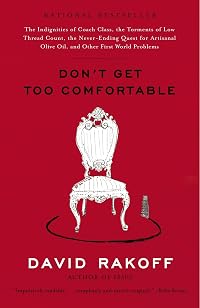
Don't Get Too Comfortable
by David Rakoff
On This Page
Description
Biography & Autobiography. Essays. Nonfiction. Humor (Nonfiction.) HTML:A bitingly funny grand tour of our culture of excess from an award-winning humorist.Whether David Rakoff is contrasting the elegance of one of the last flights of the supersonic Concorde with the good-times-and-chicken-wings populism of Hooters Air; working as a cabana boy at a South Beach hotel; or traveling to a private island off the coast of Belize to watch a soft-core video shoot—where he is provided with his show more very own personal manservant—rarely have greed, vanity, selfishness, and vapidity been so mercilessly skewered. Somewhere along the line, our healthy self-regard has exploded into obliterating narcissism; our manic getting and spending have now become celebrated as moral virtues. Simultaneously a Wildean satire and a plea for a little human decency, Don’t Get Too Comfortable shows that far from being bobos in paradise, we’re in a special circle of gilded-age hell.
This edition includes an excerpt from... show less
Tags
Recommendations






















Member Reviews
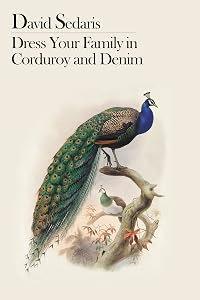
It's fair to say that David Rakoff is a charter member of the gay Rat Pack, composed, more or less, of Rakoff, David Sedaris, Dan Savage, Augusten Burroughs, and Henry Alford. Unfortunately for Rakoff, he's often compared unfavorably to Sedaris, presumably because they're both gay, both named David, and both humor writers. Rakoff, however, is actually funnier, smarter, and a far better writer than Sedaris. (I should say that not only do I find Sedaris utterly unfunny, but I don't think I can name another writer, apart from John Seabrook, whose boundless self-regard is quite so evident in every sentence. Yeah, yeah, like everyone else, I liked the Macy's elf essay, but have you read his recent stuff? It's mostly about how much money he's show more made from his work and how everyone adores him. Who gives a fuck? He'd probably make a good topic for an essay in a book like Rakoff's, actually, what with his constant essays in the New Yorker about his forays to France.)
I will confess that as I read, I became a wee bit confused by the title of this book, as it gives the impression that Rakoff discusses, well, the indignities of coach class, the torments of low thread count, artisinal olive oil, and the like. In fact, none of those things shows up in the book. However, Rakoff does take on high-end Florida hotels, organic dining (at an unnamed restaurant that's obviously Chez Panisse), fasting, high fashion, and cryogenics (yep, there are people still interested in cryogenics), and other instruments of upper middle-class self-obsession.
Like a lot of the Gay Rat Pack's work the book is often embarrassing to read on the subway because you'll laugh too much. (New Yorkers have a more or less undeserved reputation for being surly, but they really will give you odd looks if you start giggling too much. Although you're probably safe if you don't giggle and mumble about The End of the World at the same time. Yes, I have actually seen someone doing that on the 6 train.) Rakoff's writing is also smart and pointed -- he takes apart the Log Cabin Republicans in an especially satisfying and effective way, and boy, does he destroy the vile Karl Lagerfeld. So ignore the weird cover copy and enjoy the essays. show less
I will confess that as I read, I became a wee bit confused by the title of this book, as it gives the impression that Rakoff discusses, well, the indignities of coach class, the torments of low thread count, artisinal olive oil, and the like. In fact, none of those things shows up in the book. However, Rakoff does take on high-end Florida hotels, organic dining (at an unnamed restaurant that's obviously Chez Panisse), fasting, high fashion, and cryogenics (yep, there are people still interested in cryogenics), and other instruments of upper middle-class self-obsession.
Like a lot of the Gay Rat Pack's work the book is often embarrassing to read on the subway because you'll laugh too much. (New Yorkers have a more or less undeserved reputation for being surly, but they really will give you odd looks if you start giggling too much. Although you're probably safe if you don't giggle and mumble about The End of the World at the same time. Yes, I have actually seen someone doing that on the 6 train.) Rakoff's writing is also smart and pointed -- he takes apart the Log Cabin Republicans in an especially satisfying and effective way, and boy, does he destroy the vile Karl Lagerfeld. So ignore the weird cover copy and enjoy the essays. show less
The full title, Don't Get Too Comfortable: The Indignities of Coach Class, the Torments of Low Thread Count, the Never-Ending Quest for Artisanal Olive Oil, and Other First World Problems, might lead you to believe this book might be a little too much. Not so. Clever, but not pretentious. Funny, but not cruel. Angry, but never strident. Somehow I missed Rakoff's earlier Fraud, but I'm adding it to my wish list now.
I've come to realize that there is no prose I find more enjoyable than that of a snarky gay man. For me, this book is just rapturous. Hilarious, charming and witty, this little collection of essays promises an evening or two of unmitigated reading pleasure. Much recommended.
Of course you compare him to David Sedaris, who is Dave-Barry funnier (maybe Dave Barry’s evil twin). But Rakoff is the better writer, both a humorist and an intellectual whose elegant fey voice you can hear in every essay. His takedown of the Log Cabin Republicans is masterful and well thought out, and the scabrous paragraph he devotes to Karl Lagerfeld, who foolishly challenged him to write anything novel about fashion, had me falling off my chair.
David Rakoff is my hero (and one of my many, *many* gay Canadian boyfriends). He's hilariously funny, but there's real meat to this volume, too. My favorite essays are the one exploring Rakoff's mixed feelings upon deciding to become an American citizen, and the chapter about the Log Cabin Republicans. In the latter Rakoff presents himself as sympathetic to their plight yet understandably completely baffled by gay Republicans' attempts to earn a place inside "the big tent" (the essay's called "Beat Me, Daddy"--and for good reason); there's a humanity to his political commentary that's increasingly rare these days.
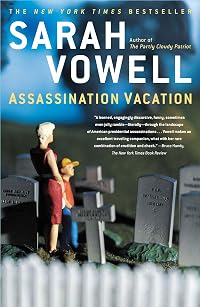
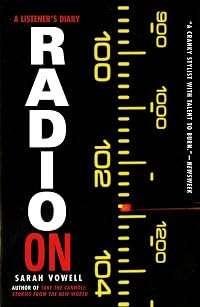
Like Sarah Vowell, Rakoff is a contributor to This American Life. I enjoyed Vowell’s book, but Rakoff’s was laugh-out-loud funny. Something about the way he takes on modern life—from Martha Stewart (he’s a fan) to foraging for eatables in Prospect Park to cryogenic freezing to the Log Cabin Republicans—just struck my funny bone. Fore instance, he always refers to unmentionables as “underpants,” whether belonging to men or women. About his decision to mark on his US citizenship application (he is originally Canadian) that yes, he would, if required by law, bear arms on behalf of the United State, he writes, “if there ever came a time when the government of my new homeland was actually calling up the forty-something show more asking-and-telling homosexuals with hyperactive thyroids to take up arms, something very calamitous indeed will have to have happened.”
A lot of people seem to find David Sedaris witty and hysterical; I liked exactly one essay out of his book that I read (“Six to Eight Black Men,” about Christmas in the Netherlands). I find him, frankly, boring. And while both men are gay, David Sedaris makes his homosexuality gross and a little threatening, as when he’s ogling other men (many of them straight) in locker rooms or manipulating other (straight) boys into touching him. Rakoff is able to talk about being gay—although he doesn’t very much, as that’s not what the book’s about—in a much more benign way. show less
A lot of people seem to find David Sedaris witty and hysterical; I liked exactly one essay out of his book that I read (“Six to Eight Black Men,” about Christmas in the Netherlands). I find him, frankly, boring. And while both men are gay, David Sedaris makes his homosexuality gross and a little threatening, as when he’s ogling other men (many of them straight) in locker rooms or manipulating other (straight) boys into touching him. Rakoff is able to talk about being gay—although he doesn’t very much, as that’s not what the book’s about—in a much more benign way. show less
I enjoyed this book - I am a huge fan of This American Life and the essayists who regularly contribute to it - that being said I thought this book definitely had some essays that were much much better than others. i found a few of them really on the boring side (the log cabin republican one and the one about freezing people after death - to name a couple) but on the other hand - I thought a few were really hilarious and above average - (loved the Concorde/Hooters one and the fasting one...)
All in all - a good read.
All in all - a good read.
Members
- Recently Added By
Published Reviews
ThingScore 50
It's a terrific idea for a book, perfectly suited for a self-indulgent and self-analytical generation, and Rakoff has some stinging things to say. But there's no getting around the fact that, at heart, this is more a collection of vaguely related magazine pieces (much of the material here has already appeared in places like Details, Harper's Bazaar, Seed and GQ, and on public radio's "This show more American Life," where Rakoff is a regular) than a coherent seriocomic manifesto. show less
added by jlelliott
Lists

To Read
617 works; 7 members
Author Information

9+ Works 4,042 Members
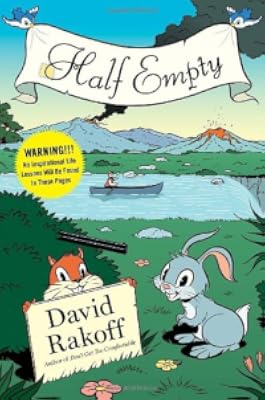
David Rakoff was born in Montreal, Canada on November 27, 1964. He received a bachelor's degree in East Asian studies from Columbia University in 1986. He briefly worked in Japan as a translator before being diagnosed with Hodgkin's lymphoma. He moved back to Canada for more than a year of treatment and remained free of cancer for two decades. show more Before becoming a full-time writer, he worked as an editor and publicist for various publishers. His essays appeared in numerous publications including The New York Times, GQ, Details, Salon, and Slate. He also wrote three essay collections. Fraud and Don't Get Too Comfortable received Lambda Literary Awards and Half Empty received the Thurber Prize for American Humor. He appeared frequently on This American Life. He also acted in several stage plays written by David Sedaris. He wrote the screen adaptation for, and starred in, a 20-minute film, The New Tenants, which won the Academy Award for best live-action short film in 2009. He died from cancer on August 9, 2012 at the age of 47. (Bowker Author Biography) show less
Awards and Honors
Awards
Common Knowledge
- Canonical title
- Don't Get Too Comfortable
- Original publication date
- 2005
- First words
- George W. Bush made me want to be an American.
Classifications
- Genres
- Nonfiction, General Nonfiction, Biography & Memoir
- DDC/MDS
- 081 — Computer science, information & general works Anthologies and Quotations General collections in American English
- LCC
- AC8 .R217 — General Works Collections. Series. Collected works Collections. Series. Collected works Collections of monographs, essays, etc. American and English
- BISAC
Statistics
- Members
- 1,497
- Popularity
- 15,500
- Reviews
- 50
- Rating
- (3.54)
- Languages
- English, French
- Media
- Paper, Audiobook, Ebook
- ISBNs
- 15
- ASINs
- 10