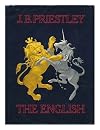
The English
by J. B. Priestley
On This Page
Tags
Recommendations









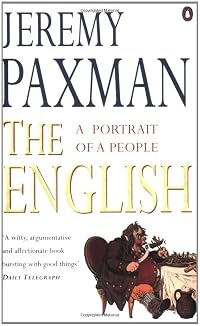














Member Recommendations


SomeGuyInVirginia For John, puddlejumper.
Member Reviews
In this rambling work J. B. Priestley (or Eh By Gum Priestly as Betjeman teased) attempts to define the English character, but gets a little confused in meeting the challenge, unlike his wonderful English Journey (http://www.librarything.com/work/361248 ) where his descriptions of the England and the English workers he found in his journey drew a picture of that valiant and dogged English determination, in this work he rather loses his way.
Any attempt to define English culture is, of course, fraught with the difficulties of explaining the juxtaposed conflict between British patriotism and dogma and the willing ability to compromise. The sheer fuzziness of the “typical” English character, or rather social values, defies logical show more explanation ... but those conflicts between strong insistence (the stiff upper-lip) and the willingness to live and let live, do indeed seem to define us.
Betjeman’s own work Tennis Whites and Teacakes (http://www.librarything.com/work/3481454/book/84345384 ) offers a clearer view of those essential foibles in British life and attitudes than J.B. achieves. This reader found this a difficult book to read, but having so enjoyed many of his other works slowly completed the book but with a sense of dissatisfaction and loss, as though the author had actually missed the essence of the English. show less
Any attempt to define English culture is, of course, fraught with the difficulties of explaining the juxtaposed conflict between British patriotism and dogma and the willing ability to compromise. The sheer fuzziness of the “typical” English character, or rather social values, defies logical show more explanation ... but those conflicts between strong insistence (the stiff upper-lip) and the willingness to live and let live, do indeed seem to define us.
Betjeman’s own work Tennis Whites and Teacakes (http://www.librarything.com/work/3481454/book/84345384 ) offers a clearer view of those essential foibles in British life and attitudes than J.B. achieves. This reader found this a difficult book to read, but having so enjoyed many of his other works slowly completed the book but with a sense of dissatisfaction and loss, as though the author had actually missed the essence of the English. show less
Ratings
Members
- Recently Added By
Author Information

235+ Works 6,953 Members
English novelist, playwright, and critic J. B. Priestley was born in Bradford in Yorkshire, the setting for many of his stories, and was educated at Cambridge University. Although he first established a reputation with critical writings such as The English Comic Characters (1925), The English Novel (1927), and English Humor (1928), it is for his show more novels and plays that he is best known. Priestley was, like John Galsworthy and Somerset Maugham, a novelist only partially committed to his playwriting. Yet he became the dominant literary figure in the London West End during the 1930s, as he attempted to make realistically rendered domestic conversation the vehicle for a mature study of personality and emotion. Philosophical theories about time, Socialist dogmatism (often erupting into sermons), and a taste for dramatic expressionism may be said to have finally deflected him from his goal. Priestley's experimental bent nevertheless yielded, among his more than 25 plays, a number of striking theatrical situations---the soliloquies of Ever since Paradise, the reviewed life in Johnson over Jordan (1939), the replay of an ill-fated conversational turn in Dangerous Corner (his most successful play, 1934), and the supernatural visitation in An Inspector Calls (his acknowledged masterpiece, 1946). (Bowker Author Biography) show less
Classifications
- Genres
- Nonfiction, History, Travel, Biography & Memoir, Anthropology, General Nonfiction
- DDC/MDS
- 914.2 — History & geography Geography & travel Geography of and travel in Europe England and Wales
- LCC
- DA118 .P68 — History of Europe, Asia, Africa and Oceania Great Britain History of Great Britain England History Antiquities. Social life and customs. Ethnography
Statistics
- Members
- 57
- Popularity
- 539,733
- Reviews
- 1
- Rating
- (2.00)
- Languages
- English, Japanese
- Media
- Paper
- ISBNs
- 4
- ASINs
- 2