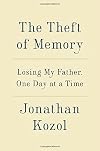
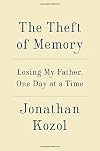
The Theft of Memory: Losing My Father, One Day at a Time
by Jonathan Kozol
On This Page
Description
National Book Award winner Jonathan Kozol is best known for his fifty years of work among our nation's poorest and most vulnerable children. Now, in the most personal book of his career, he tells the story of his father's life and work as a nationally noted specialist in disorders of the brain and his astonishing ability, at the onset of Alzheimer's disease, to explain the causes of his sickness and then to narrate, step-by-step, his slow descent into dementia.Dr. Harry Kozol was born in show more Boston in 1906. Classically trained at Harvard and Johns Hopkins, he was an unusually intuitive clinician with a special gift for diagnosing interwoven elements of neurological and psychiatric illnesses in highly complicated and creative people. "One of the most intense relationships of his career," his son recalls, "was with Eugene O'Neill, who moved to Boston in the last years of his life so my father could examine him and talk with him almost every day."
At a later stage in his career, he evaluated criminal defendants, including Patricia Hearst and the Boston Strangler, Albert H. DeSalvo, who described to him in detail what was going through his mind while he was killing thirteen women.
But The Theft of Memory is not primarily about a doctor's public life. The heart of the book lies in the bond between a father and his son and the ways that bond intensified even as Harry's verbal skills and cogency progressively abandoned him. "Somehow," the author says, "all those hours that we spent trying to fathom something that he wanted to express, or summon up a vivid piece of seemingly lost memory that still brought a smile to his eyes, left me with a deeper sense of intimate connection with my father than I'd ever felt before."
Lyrical and stirring, The Theft of Memory is at once a tender tribute to a father from his son and a richly colored portrait of a devoted doctor who lived more than a century.
. show less
Tags
Recommendations



Member Recommendations

Member Reviews
This is a beautiful book. It’s an ode to a beloved person who is living inside a stranger. The author and son, Jonathan Kozol, visits his father, Dr. Harry Kozol, who suffers from Alzheimer’s disease, in a care facility. The son carefully records his interactions with his dad— noting both the deterioration in his father’s thinking process, and also the sudden bright spots of memory that deeply endear him to his dad. In addition, Jonathan brings his dog, Persnickity, to visit his father who becomes quite fond of this canine.
Jonathan notes which personnel who care for his dad most appreciate his father by how they actively interact with him. The son expresses disdain for people who talk “over” others with cognitive defects, show more treating those affected as if they are not an active part of a surrounding conversation. Later, Jonathan moves his father out of the care facility back into the home in which he lived with his wife prior to his mental deterioration.
I liked that the author talked about issues that were related to his parents, but not specifically about them — the idea that some individuals believe older people lose their worth to society and are seen as more expendable and also the idea that some medical practitioners are not as “on the ball” as we expect them to be. This latter issue left me particularly uneasy.
What I liked most about this book was the author’s love and devotion to both parents. It came across clearly, page after page, until the end. What a beautiful tribute to both of the author’s parents this memoir is.
I found the epilogue to be especially stirring. In it, the author’s father reversed a previous demand that Jonathan give up his employment fighting for social justice and instead go into a more academic-oriented career. He relented to his son with the words to encourage Jonathan to follow his own heart, saying “You’re going to be fine.”
I would love to read other books by this author. He has such a sensitivity for others, and I like how he expresses this in words. This is a book written with love and respect, and for that I found it warm and endearing. It did a job on my heartstrings. Read it if you have/had parents whom you love/loved despite any difficulties they suffer/suffered. show less
Jonathan notes which personnel who care for his dad most appreciate his father by how they actively interact with him. The son expresses disdain for people who talk “over” others with cognitive defects, show more treating those affected as if they are not an active part of a surrounding conversation. Later, Jonathan moves his father out of the care facility back into the home in which he lived with his wife prior to his mental deterioration.
I liked that the author talked about issues that were related to his parents, but not specifically about them — the idea that some individuals believe older people lose their worth to society and are seen as more expendable and also the idea that some medical practitioners are not as “on the ball” as we expect them to be. This latter issue left me particularly uneasy.
What I liked most about this book was the author’s love and devotion to both parents. It came across clearly, page after page, until the end. What a beautiful tribute to both of the author’s parents this memoir is.
I found the epilogue to be especially stirring. In it, the author’s father reversed a previous demand that Jonathan give up his employment fighting for social justice and instead go into a more academic-oriented career. He relented to his son with the words to encourage Jonathan to follow his own heart, saying “You’re going to be fine.”
I would love to read other books by this author. He has such a sensitivity for others, and I like how he expresses this in words. This is a book written with love and respect, and for that I found it warm and endearing. It did a job on my heartstrings. Read it if you have/had parents whom you love/loved despite any difficulties they suffer/suffered. show less
 This review was written for LibraryThing Early Reviewers.
As someone who has long read and utilized Jonathan Kozol's work in both my teaching and my research, I was looking forward to reading this book. In a nutshell, this is about the years during which Dr. Kozol, Jonathan's father, became progressively less aware of his surroundings. But this story is so much more than that.
Rather than simply present a "this happened then this happened" approach like so many other such stories, Kozol chose to use the chronology of the illness as a frame upon which he weaves the interconnected story of his father's life and of Jonathan's place within it. I found this approach both compelling and reminiscent of what I recall about the time during which my father was dying (though over a considerably shorter show more time).
The reader gets a sense of the type of doctor Dr. Kozol was to his patients as well as the kind of mind he possessed. It is in the juxtaposition of his life of mental sharpness placed against the deterioration of his memories and cognitive abilities that the story is most stunning.
I would recommend this book to anyone interested in biographical works as well as anyone familiar with Jonathan Kozol's previous work.
Reviewed from a copy made available by the publisher via LibraryThing. show less
Rather than simply present a "this happened then this happened" approach like so many other such stories, Kozol chose to use the chronology of the illness as a frame upon which he weaves the interconnected story of his father's life and of Jonathan's place within it. I found this approach both compelling and reminiscent of what I recall about the time during which my father was dying (though over a considerably shorter show more time).
The reader gets a sense of the type of doctor Dr. Kozol was to his patients as well as the kind of mind he possessed. It is in the juxtaposition of his life of mental sharpness placed against the deterioration of his memories and cognitive abilities that the story is most stunning.
I would recommend this book to anyone interested in biographical works as well as anyone familiar with Jonathan Kozol's previous work.
Reviewed from a copy made available by the publisher via LibraryThing. show less
This review was written for LibraryThing Early Reviewers.This is no ordinary story about a father’s decline into Alzheimer’s narrated by a loving and dutiful son. Nobody would ever mistake the author, Jonathan Kozol, or his father, Harry Kozol, as ordinary. Both men are singular geniuses as well as professionals who each succeeded in reaching the highest ranks of their respective professions. This book tells the story of a personal journey through the lense of a heartless disease. The book is intellectually intriguing, emotionally revealing, and in parts, quite heartfelt.
Dr. Harry Kozol (1906 – 2008) was a preeminent neurologist. Among other achievements, he helped establish the new fields of forensic psychiatry and neuropsychiatry. He is also well known for the professional work he show more accomplished with three famous cases: he was Eugene O’Neill’s neurologist, psychiatrist, and long-time family friend; in addition, he served as a forensic psychiatrist during the criminal phase of the trials of the Boston Strangler and Patty Hearst.
Jonathan Kozol (b. 1936), Harry’s son, is a renowned nonfiction writer, social activist, and educator. He has earned significant public acclaim for his lifelong career investigating and writing about educational inequalities within the U.S. public education system. He graduated summa cum laude from Harvard (during that time he studied poetry for two years under the mentorship of Archibald MacLeish); was awarded a Rhodes Scholarship to Oxford; did independent study in Paris collaborating with authors William Styron and James Jones; won the Olympia Award, Sexton Fellowship in creative writing award, the National Book Award, two Guggenheim Fellowships, a Field Foundation Fellowship; a Ford Foundation Fellowship; a Rockefeller Fellowship; a Robert F. Kennedy Book Award; a Conscience in Media Award; two Christopher Awards; a New England Book Award; a National Book Critics Circle Award; an Anisfield-Wolf Book Award; and finally, the Puffin/Nation Prize for Creative Citizenship. That last prize is given by The Nation magazine and the Puffin Foundation, honoring artists and others for socially responsible work and challenges to authority. The prize is intended to encourage the recipients to continue their work, and to inspire others to challenge the prevailing orthodoxies they face in their careers.
This particular memoir has a narrow focus. The scope is almost exclusively on these three things: the relationship between the author and his father, on the father’s career as it intersected with his son’s life, and on the memories that the two of them shared. He wrote the book in the first year after his father died. During that phase, he frequently consulted the extensive archive of papers his father left him. He put the book aside for many years thinking that he might expand it with further research into his father’s archives. The book is noteworthy both for its emotional detachment and well as its rare glimpses of emotional depth.
Personally, I found the first chapter and the epilogue to be the two most fascinating parts of this tale. What I found stunning in the first chapter was an almost verbatim transcript of a tape recording that occurred between father and son the day the father told his son about his fear that he was having multiple and frequent vascular ministrokes. The father expertly and clinically discusses exactly what he felt each time one of these events occurred. (If you’ve ever heard neuroanatomist Jill Bolte Taylor’s TED talk about what she felt being inside the body of someone having a stroke…well, this chapter reminded me of that!) In addition, the epilogue is very revealing about the father-son dynamic, especially about the son’s intense desire to live up to his father’s exceptional high academic expectations for him.
Within the body of the book, I was also moved by the son’s long inability to sign off on a “Do Not Resuscitate” order for his father despite the father’s chronic hospitalizations for painful infections, his father’s extreme mental decline, and the fact that the parents had both long-ago exhausted their financial resources and were living almost completely on their son’s assistance.
What I personally learned in the first chapter of this book was reward enough for the entire volume. Reading it was welcomed neurological validation that what my (now deceased) mother spoke of often during the time when she was no doubt having multiple vascular ministrokes was, indeed, just that. We’d explain her words to neurologists and they’d just shake their heads and say they did not understand. You see, my mother would often complain that she experienced “a tight, hot cap” on her head, like a too-hot and too-small “swimming cap.” When you read the first chapter of this book, you’ll see the close similarity to the author’s father’s description of his bodily feelings during these cerebral events.
This book was more intellectually than emotional compelling. It is not the first book I’d recommend for someone interested in a story about a loved one’s descent into Alzheimer’s. To me it is much more revealing and exceptional as an account of the relationship between an exceptionally gifted father and his equally gifted son. Obviously, both men can be described as singular geniuses. How they related to each other makes an interesting story, especially to those, like me, who are fascinated in the qualities and experiences of people of genius. show less
Dr. Harry Kozol (1906 – 2008) was a preeminent neurologist. Among other achievements, he helped establish the new fields of forensic psychiatry and neuropsychiatry. He is also well known for the professional work he show more accomplished with three famous cases: he was Eugene O’Neill’s neurologist, psychiatrist, and long-time family friend; in addition, he served as a forensic psychiatrist during the criminal phase of the trials of the Boston Strangler and Patty Hearst.
Jonathan Kozol (b. 1936), Harry’s son, is a renowned nonfiction writer, social activist, and educator. He has earned significant public acclaim for his lifelong career investigating and writing about educational inequalities within the U.S. public education system. He graduated summa cum laude from Harvard (during that time he studied poetry for two years under the mentorship of Archibald MacLeish); was awarded a Rhodes Scholarship to Oxford; did independent study in Paris collaborating with authors William Styron and James Jones; won the Olympia Award, Sexton Fellowship in creative writing award, the National Book Award, two Guggenheim Fellowships, a Field Foundation Fellowship; a Ford Foundation Fellowship; a Rockefeller Fellowship; a Robert F. Kennedy Book Award; a Conscience in Media Award; two Christopher Awards; a New England Book Award; a National Book Critics Circle Award; an Anisfield-Wolf Book Award; and finally, the Puffin/Nation Prize for Creative Citizenship. That last prize is given by The Nation magazine and the Puffin Foundation, honoring artists and others for socially responsible work and challenges to authority. The prize is intended to encourage the recipients to continue their work, and to inspire others to challenge the prevailing orthodoxies they face in their careers.
This particular memoir has a narrow focus. The scope is almost exclusively on these three things: the relationship between the author and his father, on the father’s career as it intersected with his son’s life, and on the memories that the two of them shared. He wrote the book in the first year after his father died. During that phase, he frequently consulted the extensive archive of papers his father left him. He put the book aside for many years thinking that he might expand it with further research into his father’s archives. The book is noteworthy both for its emotional detachment and well as its rare glimpses of emotional depth.
Personally, I found the first chapter and the epilogue to be the two most fascinating parts of this tale. What I found stunning in the first chapter was an almost verbatim transcript of a tape recording that occurred between father and son the day the father told his son about his fear that he was having multiple and frequent vascular ministrokes. The father expertly and clinically discusses exactly what he felt each time one of these events occurred. (If you’ve ever heard neuroanatomist Jill Bolte Taylor’s TED talk about what she felt being inside the body of someone having a stroke…well, this chapter reminded me of that!) In addition, the epilogue is very revealing about the father-son dynamic, especially about the son’s intense desire to live up to his father’s exceptional high academic expectations for him.
Within the body of the book, I was also moved by the son’s long inability to sign off on a “Do Not Resuscitate” order for his father despite the father’s chronic hospitalizations for painful infections, his father’s extreme mental decline, and the fact that the parents had both long-ago exhausted their financial resources and were living almost completely on their son’s assistance.
What I personally learned in the first chapter of this book was reward enough for the entire volume. Reading it was welcomed neurological validation that what my (now deceased) mother spoke of often during the time when she was no doubt having multiple vascular ministrokes was, indeed, just that. We’d explain her words to neurologists and they’d just shake their heads and say they did not understand. You see, my mother would often complain that she experienced “a tight, hot cap” on her head, like a too-hot and too-small “swimming cap.” When you read the first chapter of this book, you’ll see the close similarity to the author’s father’s description of his bodily feelings during these cerebral events.
This book was more intellectually than emotional compelling. It is not the first book I’d recommend for someone interested in a story about a loved one’s descent into Alzheimer’s. To me it is much more revealing and exceptional as an account of the relationship between an exceptionally gifted father and his equally gifted son. Obviously, both men can be described as singular geniuses. How they related to each other makes an interesting story, especially to those, like me, who are fascinated in the qualities and experiences of people of genius. show less
Harry Kozol was a neurologist and psychiatrist, acutely aware of the diagnosis and prognosis when he developed symptoms of Alzheimer’s at age 88. He lived to age 102. This book covers his deterioration in a nursing home that fell short of ideal (though it was the best that a prominent doctor and his famous son could arrange), and eventual return home (where his wife, slightly older and very frail but mentally intact, referred to him as “the baby”) after a team of caretakers had been established, entwined with episodes of his career (reconstructed from notes and interviews, perhaps selected to represent his public persona but tinged with name droppiness) and the relationship of father and son (an ambitious immigrant at the top of show more an elite profession was not fully supportive when his son opted off a similar path to advocate for civil rights through public education). It’s not, and not meant to be, a complete portrait of person or family; father as doctor seems viewed from a distance, mother and sister have minor roles. This is both a weakness, raising questions, and a strength, a narrow focus on loss. show less
This review was written for LibraryThing Early Reviewers.I listened to this book as an audiobook, read wonderfully by Sean Runnette. This is the story of the author's relationship with his father (with both his parents, really), in his father's final years, as his decline from Alzheimer's takes its inevitable toll.
Jonathan Kozol is an educator and established writer in his own right, often writing about the state of education in the United States. His father, Dr. Harry Kozol was a neuropsychiatrist, highly respected and accomplished in his field. His clients included some rather high-profile names, as well, but, as his son Jonathan recounts, in going through his father's papers, notes and files, the elder Kozol was a highly ethical man in his dealings with all his patients and always show more treated everyone with the same care and respect. I did wonder about some of the details revealed about some of those high profile patients, but I am going to assume that Kozol, being a seasoned writer himself, did due diligence when it came to permissions and patient confidentiality, I enjoyed the trips down memory lane for Jonathan, as he revealed his father's (and to a lesser degree, his mother's) early lives. Both parents lived long, full lives (both dying at 100+ years). This memoir chronicles with great love, lives well-lived and the tragedy of this insidious disease. He also chronicles the tremendous amount of care (and expense) required to allow a life of dignity to proceed to its natural end. He was fortunate that he had the resources, financial and otherwise, to allow this to happen for his parents, as I suspect that many - maybe most - people would not have such means available to them. The quality of care, too, for the very elderly, and infirm, is another source of very real concern, as Kozol experienced first hand from his father's primary physicians. I wish this was an area of medicine that was making better progress, as we age, ourselves. Overall, I enjoyed this book. The reader's voice was excellent, soft-spoken, and loving. show less
This a fascinating and compelling book; I read the whole thing today. The son paints a picture of his very complex father and particularly their changing relationship over the entire span of his life. He chronicles the gradual and heartbreaking loss of intellectual capacity of due to dementia. The use of his father's years of files to help jog his memory and illustrate certain qualities of his father is very effective. I was a little uncomfortable with his advocacy for agressive medical care during times of medical crisis despite his father's advanced age and stage of dementia. It is a very difficult topic and I recognize that how I feel now may radically change if and when I'm in the position of making care decisions for someone else. show more This is an important book and I highly recommend it. show less
This review was written for LibraryThing Early Reviewers.A very astute and discerning memoir about Kozol's relationship with his father, a prominent Boston neurologist and psychiatrist, who is aware that he is developing Alzheimer's disease. Because I worked for years in dementia units and a non-profit organization dedicated to helping people with dementia, I was especially intrigued by this topic.
I appreciated Kozol's fierce desire to maintain his father's independence, connection and individuality as the disease progressed. I celebrated with him the positive interpretation of any "feisty" behavior as being a manifestation of his father's personality and expression of his wishes. I admire Kozol's desire to give his father - and his increasingly frail mother - the best medical and supportive show more care possible.
I also admired his ability to tell the story of his father's medical practice through his own eyes as an admiring son. And, he even reveals some difficult truths about all of the family relationships that are always a part of the story of aging and families. There are parts of this book that feel very honest and intimate to me - the finest kind of memoir. And others, partly be being observations of his father's life - that feel a little more distant and perhaps a little distracting from this homage to Dr. Kozol. Yet, at the end, I am pleased to have met both the father and son through this book.
Note: This honest review is offered in return for an advanced copy of the book. show less
I appreciated Kozol's fierce desire to maintain his father's independence, connection and individuality as the disease progressed. I celebrated with him the positive interpretation of any "feisty" behavior as being a manifestation of his father's personality and expression of his wishes. I admire Kozol's desire to give his father - and his increasingly frail mother - the best medical and supportive show more care possible.
I also admired his ability to tell the story of his father's medical practice through his own eyes as an admiring son. And, he even reveals some difficult truths about all of the family relationships that are always a part of the story of aging and families. There are parts of this book that feel very honest and intimate to me - the finest kind of memoir. And others, partly be being observations of his father's life - that feel a little more distant and perhaps a little distracting from this homage to Dr. Kozol. Yet, at the end, I am pleased to have met both the father and son through this book.
Note: This honest review is offered in return for an advanced copy of the book. show less
This review was written for LibraryThing Early Reviewers.Members
- Recently Added By
Author Information

19+ Works 7,388 Members
Educator and author Jonathan Kozol was born in Boston. He graduated from Harvard University in 1958. Kozol has an concerns with topics such as illiteracy, children trying to learn in bad neighborhoods and homelessness. His books include Death at an Early Age, Illiterate American and Rachel and Her Children: Homeless Families in America. (Bowker show more Author Biography) show less
Awards and Honors
Distinctions
Common Knowledge
- Canonical title
- The Theft of Memory: Losing My Father, One Day at a Time
- Original publication date
- 2015-06 (Crown Publishers, New York) (Crown Publishers, New York)
- People/Characters
- Dr. Harry Kozol; Jonathan Kozol; Ruth Kozol; Lucinda; Silvia Garcia; Alejandro Gomez (show all 10); Julia Walker; Eugene O'Neill; Patty Hearst; Albert DeSalvo
- Important places
- Boston, Massachusetts, USA
- Dedication
- For Matthew
with deepest gratitude - First words
- My father was diagnosed with Alzheimer's disease in 1994 when he was eighty-eight years old.
- Quotations
- I know the time has long passed when doctors, no matter what their specialty might be, would interrupt their private lives so willingly, in order to fulfill their sense of obligation to a patient. Maybe it's beyond all reason... (show all) to regret the passing of that era. Still, I wished the doctor at the nursing home had retained a little more of that tradition of attentiveness. I would come to have the same wish later on about another geriatrician my father would rely upon. I never felt they gave him back in full, or even in small part, what he had given once unstintingly to people who had placed their trust in him.
My grandmother seemed to me a woman of the Bible. She lit candles in front of me and said her prayers and gave me blessings and good dinners. Even when I was twenty-one years old, she’d still put candy Kisses in my po... (show all)cket when I was about to leave.
I told him it reminded me of when he used to take me fishing with him on a lake in Maine when I was a child, maybe eight or ten years old.
Those who work as home attendants and companions to the elderly are given little of the respect and, of course, a great deal less of the remuneration that are given to physicians and others in the higher reaches of the health... (show all)care industry. But in many situations they are the only ones who truly know the patients and the ones who advocate with greatest diligence on their behalf.
You’re still living as if you regard yourself as some kind of mild-mannered, Harvard educated reembodiment of Che Guevara. (Dr. Harry Kozol) - Last words
- (Click to show. Warning: May contain spoilers.)Some of the blessings that our parents give us, I need to believe, outlive the death of memory.
Classifications
- Genres
- Nonfiction, Biography & Memoir, General Nonfiction, Health & Wellness
- DDC/MDS
- 616.8 — Applied science & technology Medicine & health Diseases, Allergies, Skin Conditions Nervous Disorders: Autism, Anorexia, OCD
- LCC
- RC523.2 .K68 — Medicine Internal medicine Internal medicine Neurosciences. Biological psychiatry. Neuropsychiatry Psychiatry Psychopathology Psychoses
- BISAC
Statistics
- Members
- 154
- Popularity
- 212,831
- Reviews
- 44
- Rating
- (3.73)
- Languages
- English
- Media
- Paper, Audiobook, Ebook
- ISBNs
- 15
- UPCs
- 1
- ASINs
- 3