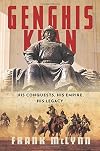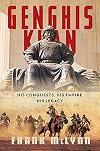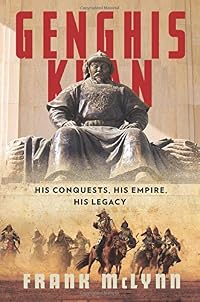
Genghis Khan : his conquests, his empire, his legacy
by Frank McLynn
On This Page
Description
Mongol leader Genghis Khan was by far the greatest conqueror the world has ever known. His empire stretched from the Pacific Ocean to central Europe, including all of China, the Middle East, and Russia. So how did an illiterate nomad rise to such colossal power and subdue most of the known world, eclipsing Alexander the Great, Julius Caesar, and Napoleon? Credited by some with paving the way for the Renaissance, condemned by others for being the most heinous murderer in history, who was show more Genghis Khan? His actual name was Temujin, and the story of his success is that of the Mongol people: a loose collection of fractious tribes who tended livestock, considered bathing taboo, and possessed an unparalleled genius for horseback warfare. United under Genghis, a strategist of astonishing cunning and versatility, they could dominate any sedentary society they chose. Combining fast-paced accounts of battles with rich cultural background and the latest scholarship, Frank McLynn brings vividly to life the strange world of the Mongols, describes Temujin's rise from boyhood outcast to becoming Genghis Khan, and provides the most accurate and absorbing account yet of one of the most powerful men ever to have lived. show lessTags
Recommendations






Member Reviews
To be fair to McLynn, he is treading already pioneered ground with Genghis Khan: The Man Who Conquered the World (big claim but hey! Hyperbole works). So necessarily, he attempts to maneuver away from the established precedent of maps and mind games to present a different Genghis Khan. What he ends up doing though is providing a saucy story of sorts interspersed with the occasional historic fact. So what good is his book then?
In my humble opinion, McLynn provides an intermediate level biography of Khan and the factors which led him to conquer the world (borrowing from the title-note, I did not mention 'entire') which does away with the cobweb latticed perfunctory histories of years past while also avoiding the grandiose child of destiny show more narrative foisted upon the world by 21st century historians.
Is this the most authentic/most relevant biography of Temujin? That would be too daring a claim to make given humanity is always upgrading. But to McLynn's credit, he provides a trailblazing history of sorts which disallows the reader from getting bored. So overall, much nuanced reconstruction of the past augmented with a thrilling rendition of Genghis as an everyday commander. show less
In my humble opinion, McLynn provides an intermediate level biography of Khan and the factors which led him to conquer the world (borrowing from the title-note, I did not mention 'entire') which does away with the cobweb latticed perfunctory histories of years past while also avoiding the grandiose child of destiny show more narrative foisted upon the world by 21st century historians.
Is this the most authentic/most relevant biography of Temujin? That would be too daring a claim to make given humanity is always upgrading. But to McLynn's credit, he provides a trailblazing history of sorts which disallows the reader from getting bored. So overall, much nuanced reconstruction of the past augmented with a thrilling rendition of Genghis as an everyday commander. show less
Genghis Khan: His Conquests, His Empire, His Legacy by Frank McLynn is a detailed history of Asia's most famous ruler. McLynn is a British author, biographer, historian and journalist. He is noted for critically acclaimed biographies of Napoleon Bonaparte, Robert Louis Stevenson, Carl Jung, Richard Francis Burton and Henry Morton Stanley. He was Alistair Horne Research Fellow at St Antony's College, Oxford (1987–88) and was visiting professor in the Department of Literature at the University of Strathclyde (1996–2001) and professorial fellow at Goldsmiths College London (2000–2002) before becoming a full-time writer
There is hardly a person who has not heard the name Genghis Khan. The Mongols have been a namesake to rock bands and show more biker gangs. They both invoke powerful images of violence, discipline, empire, and military conquest. He was a man that lived eight hundred years ago but has one of the most detailed histories of the period. This is the second biography and history of the Mongols I have read and at 704 pages, it was much shorter than the other biography I read. There is certainly not a lack of information on Genghis Khan.
Like Ivan IV of Russia and Machiavelli, their negative information in common culture far exceeds any positive information. The truth of the matter is different. Although the Mongols under Genghis Khan were responsible for many massacres, they had rules. For example, they highly valued diplomatic emissaries and to kill one was a great insult. They openly accepted and valued new religions in their lands. However, the killing of all the residents of the city over ten years old, except for select artisans and harem women is true. Genghis Khan did deploy a “surrender or die” ultimatum to cities. Those that did not surrender were destroyed. Those that did surrender and came to a tribute agreement were left alone. Gaining land without losing warriors was always preferred. Trade became important too with the agreement with the Venetians and bringing the Silk Road under Mongol control.
Genghis Khan cover the life of Temujin from his birth to his rise to Khan of all Khans. The road was not easy it is a story of alliances, friendships, and conquests in small steps. It is also a story of creating a society under laws and codes and balancing that with dictatorial rule. One of his first tasks as Khan was to set up a civil government and military. Genghis Khan used meritocracy to fill in the ranks. It was not uncommon for shepherds to become military leaders based on experience. Many rules of the society were practical for people living on the steppes. Rules around running water were interesting in what was considered polluting it. Water had an almost supernatural quality to it for the people of the steppes. A wide variety of “crimes” carried the death penalty on the steppes including polluting running water, slaughtering animals in an improper way, assisting an escaped slave, adultery, and horse thievery.
The author offers some interesting information on the way the westward expansion stopped. Having conquered the east to the Pacific Ocean, the westward expansion stopped in Europe. There are many theories discussed in the book on why the Mongols did not continue, but one strikes me as the most interesting. The Mongols were practical people. They lived and conquered on the steppes, it was their universe. The forests of Europe to them would be considered a wasteland to them. The land was not useful to their way of life and they saw no reason to fight for it. That, however, is only one of many theories.
McLynn gives a very detailed, but very readable history of Genghis Khan and the Mongol Empire. The book contains information on troops, captured, treasures, military tactics, and information that seems to come from government records on the numbers of animals, economic, and even environmental information. The history cover Temujin life and the empire through Kublai Khan and the final conquest of China. Very well worth the read for the historical insight and an understanding of the people. show less
There is hardly a person who has not heard the name Genghis Khan. The Mongols have been a namesake to rock bands and show more biker gangs. They both invoke powerful images of violence, discipline, empire, and military conquest. He was a man that lived eight hundred years ago but has one of the most detailed histories of the period. This is the second biography and history of the Mongols I have read and at 704 pages, it was much shorter than the other biography I read. There is certainly not a lack of information on Genghis Khan.
Like Ivan IV of Russia and Machiavelli, their negative information in common culture far exceeds any positive information. The truth of the matter is different. Although the Mongols under Genghis Khan were responsible for many massacres, they had rules. For example, they highly valued diplomatic emissaries and to kill one was a great insult. They openly accepted and valued new religions in their lands. However, the killing of all the residents of the city over ten years old, except for select artisans and harem women is true. Genghis Khan did deploy a “surrender or die” ultimatum to cities. Those that did not surrender were destroyed. Those that did surrender and came to a tribute agreement were left alone. Gaining land without losing warriors was always preferred. Trade became important too with the agreement with the Venetians and bringing the Silk Road under Mongol control.
Genghis Khan cover the life of Temujin from his birth to his rise to Khan of all Khans. The road was not easy it is a story of alliances, friendships, and conquests in small steps. It is also a story of creating a society under laws and codes and balancing that with dictatorial rule. One of his first tasks as Khan was to set up a civil government and military. Genghis Khan used meritocracy to fill in the ranks. It was not uncommon for shepherds to become military leaders based on experience. Many rules of the society were practical for people living on the steppes. Rules around running water were interesting in what was considered polluting it. Water had an almost supernatural quality to it for the people of the steppes. A wide variety of “crimes” carried the death penalty on the steppes including polluting running water, slaughtering animals in an improper way, assisting an escaped slave, adultery, and horse thievery.
The author offers some interesting information on the way the westward expansion stopped. Having conquered the east to the Pacific Ocean, the westward expansion stopped in Europe. There are many theories discussed in the book on why the Mongols did not continue, but one strikes me as the most interesting. The Mongols were practical people. They lived and conquered on the steppes, it was their universe. The forests of Europe to them would be considered a wasteland to them. The land was not useful to their way of life and they saw no reason to fight for it. That, however, is only one of many theories.
McLynn gives a very detailed, but very readable history of Genghis Khan and the Mongol Empire. The book contains information on troops, captured, treasures, military tactics, and information that seems to come from government records on the numbers of animals, economic, and even environmental information. The history cover Temujin life and the empire through Kublai Khan and the final conquest of China. Very well worth the read for the historical insight and an understanding of the people. show less
Though ostensibly a biography of Genghis Khan, this is actually a book that tracks the ascendancy of the Mongol “nation” from the childhood of Temugen through his death and the subsequent rule of his sons and grandsons.
While I am sure this book is impeccably researched, I’ve got to say it is virtually unreadable. It is a near stream of consciousness recitation of East Asian place names and personalities that is impossible to follow. Despite several very general maps in the front of the book, the map of China is completely useless when trying to follow the narratives which describe the various Mongol campaigns. The Middle East and European maps, while marginally better, are also lacking.
A collection of small maps, widely show more scattered throughout the book would have been extremely helpful in trying to follow the text. Unfortunately, no maps, no ability to understand the maneuvers described by the author. In addition, the author employs a VERY informal writing style which becomes irritating at times, even ascribing supernatural and magical causes for many of the Mongol exploits.
Possibly the most disappointing “biography” I have encountered, and I’ve read dozens. show less
While I am sure this book is impeccably researched, I’ve got to say it is virtually unreadable. It is a near stream of consciousness recitation of East Asian place names and personalities that is impossible to follow. Despite several very general maps in the front of the book, the map of China is completely useless when trying to follow the narratives which describe the various Mongol campaigns. The Middle East and European maps, while marginally better, are also lacking.
A collection of small maps, widely show more scattered throughout the book would have been extremely helpful in trying to follow the text. Unfortunately, no maps, no ability to understand the maneuvers described by the author. In addition, the author employs a VERY informal writing style which becomes irritating at times, even ascribing supernatural and magical causes for many of the Mongol exploits.
Possibly the most disappointing “biography” I have encountered, and I’ve read dozens. show less
Not a bad biography of Genghis Khan, but a bit dry throughout.
Got about 15% through this book. Way too deeply detailed for me, at least in this phase of my life. Maybe I’ll pick it up again someday, who knows...
Ratings
Members
- Recently Added By
Lists

History: Asia
103 works; 1 member
Author Information

36 Works 3,234 Members
Frank McLynn is currently visiting professor in the Department of Literature at Strathclyde University.
Some Editions
Common Knowledge
- Canonical title
- Genghis Khan : his conquests, his empire, his legacy
- Alternate titles
- Genghis Khan: The Man Who Conquered the World
- Original publication date
- 2015
- People/Characters
- Genghis Khan; Güyük Khan
- Important places
- Mongolia; China; Central Asia
- Important events
- Mongol Empire
- Dedication
- To the four important
Ladies in my life:
Pauline, Julie, Lucy, Ellen - First words
- Central Asia is allegedly the cradle of so much -- Neaderthal Man, nomadic pastoralism, warfare itself, even UFO sightings -- but it is all but useless as an explanatory concept in history.
- Last words
- (Click to show. Warning: May contain spoilers.)And it was the Franciscans who first made contact with the Mongols and brought back an amazing story that will endure as long as mankind itself: the career of Genghis Khan.
Classifications
Statistics
- Members
- 287
- Popularity
- 111,255
- Reviews
- 5
- Rating
- (3.62)
- Languages
- English
- Media
- Paper, Audiobook, Ebook
- ISBNs
- 13
- UPCs
- 1
- ASINs
- 3