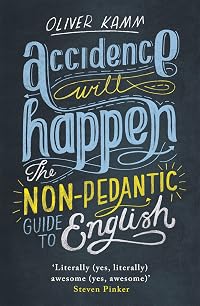
Accidence Will Happen: The Non-Pedantic Guide to English Usage
by Oliver Kamm
On This Page
Description
Are standards of English alright{OCLCbr#95}or should that be all right? To knowingly split an infinitive or not to? And what about ending a sentence with preposition, or for that matter beginning one with "and"? We learn language by instinct, but good English, the pedants tell us, requires rules. Yet, as Oliver Kamm cleverly demonstrates in this new book, many of the purists' prohibitions are bogus and can be cheerfully disregarded. Accidence Will Happen is an authoritative and deeply show more reassuring guide to grammar, style, and the linguistic conundrums we all face. show lessTags
Recommendations











Member Reviews
Are using flat adverbs, splitting infinitives, starting sentences by 'And' or, spelling 'all right' instead of 'alright' signs of a bad English? According to Oliver Kamm, 'leader writer and columnist for The Times': no. No, and, his stance is not an opinion coming out of the blue (like, past manuals about grammar picked at random -gnark gnark^^) but, supported by solid evidence -coming not only from various linguistic fields (e.g. the history and evolution of English language itself) but, also reinforced by literary examples (Shakespeare, Jane Austen, Dickens etc.).
In fact, and here's why I really loved 'Accidence will Happen', he not only take the time to debunk all those silly and ungrounded rules about supposed bad grammar, spelling show more and punctuation. He, most importantly to me, stresses how such prescriptivism (or superstitious and ignorant pedantry, as he labels it) is in fact counter-productive when it comes to our use of language. Indeed, beyond the fact that sticklers do not know what they are talking about (again, he debunks all their rules by relying on solid evidence) their attitude towards language is, actually, damaging to literacy. In a nutshell: Standard English has nothing to do with 'good' English ( as opposed to 'bad' ones, then) and, if you really care about the use of English language then, care about registers (of which StandardS are just a part of) and stop worrying about shibboleths. Will sticklers ever be able to understand that? Let's doubt it:
'If the sticklers were interested in language they'd read research on (to name but a few) the grammar of English and other tongues; neuroscience and psychology, to illuminate how the brain processes the written word; computer science, to understand the use of artificial intelligence in simulating language; anthropology, to understand how languages develop across cultures; and philosophy, to understand the link between language and logical thought. Instead their mental universe is populated with instances of a small phonetic confusion between the word EFFECT and AFFECT, or a purportedly (though not actually) incorrect use of INFER. It's not only the pedants' lack of linguistic inquisitiveness that's dispiriting: it's the smallness of their world.'
Clear, straightforward, strongly but well argued and, even, reassuring, 'Accidence will Happen' is bold and refreshing. Whose who really care about language will love this book. show less
In fact, and here's why I really loved 'Accidence will Happen', he not only take the time to debunk all those silly and ungrounded rules about supposed bad grammar, spelling show more and punctuation. He, most importantly to me, stresses how such prescriptivism (or superstitious and ignorant pedantry, as he labels it) is in fact counter-productive when it comes to our use of language. Indeed, beyond the fact that sticklers do not know what they are talking about (again, he debunks all their rules by relying on solid evidence) their attitude towards language is, actually, damaging to literacy. In a nutshell: Standard English has nothing to do with 'good' English ( as opposed to 'bad' ones, then) and, if you really care about the use of English language then, care about registers (of which StandardS are just a part of) and stop worrying about shibboleths. Will sticklers ever be able to understand that? Let's doubt it:
'If the sticklers were interested in language they'd read research on (to name but a few) the grammar of English and other tongues; neuroscience and psychology, to illuminate how the brain processes the written word; computer science, to understand the use of artificial intelligence in simulating language; anthropology, to understand how languages develop across cultures; and philosophy, to understand the link between language and logical thought. Instead their mental universe is populated with instances of a small phonetic confusion between the word EFFECT and AFFECT, or a purportedly (though not actually) incorrect use of INFER. It's not only the pedants' lack of linguistic inquisitiveness that's dispiriting: it's the smallness of their world.'
Clear, straightforward, strongly but well argued and, even, reassuring, 'Accidence will Happen' is bold and refreshing. Whose who really care about language will love this book. show less
Imagine that, a language style guide that permits virtually anything you want to say virtually any way you want to say it! It's like a libertarian law book. That's what Oliver Kamm, chief columnist for the London Times, gives us in “Accidence Will Happen” (2016).
The book represents a slap in the face to what Kamm refers to a pedants, amateur grammarians, sticklers, prescriptivists and other less flattering terms. These are the people who get worked up over split infinitives and prepositions at the end of sentences. What these people call rules, Kamm calls conventions, at best, and superstitions, at worst.
While pedants worry that the English language is endangered, Kamm says, "If there is one language that isn't endangered, it's show more English. The language is changing because that's what a living language does."
He devotes most of the book to his permissive style guide in which he not only explains why usages frowned upon by the pedants are perfectly acceptable and often more clear than so-called proper usage but also provides examples of their use by many of the most respected writers in the English language. If Jane Austen can use they as a singular pronoun, why can't you? If Herman Melville and Thomas Hardy can use the phrase "under the circumstances," why shouldn't you?
He finds nothing wrong with the word hopefully, with the phrase "free gift" or with a phrase like "less people." Only a pedant would say, "It's I." The rest of us say, "It's me," and Kamm thinks that's just fine.
Kamm does concede that certain usages are more conventional than others and are preferable in certain situations. What's important to him is to be understood and to avoid sounding stuffy. Thus when you are in doubt about whether to say who or whom, Kamm advises us to stick with who. "Nobody but a stickler will fault you for anything worse than informality, and that is no sin," he writes. show less
The book represents a slap in the face to what Kamm refers to a pedants, amateur grammarians, sticklers, prescriptivists and other less flattering terms. These are the people who get worked up over split infinitives and prepositions at the end of sentences. What these people call rules, Kamm calls conventions, at best, and superstitions, at worst.
While pedants worry that the English language is endangered, Kamm says, "If there is one language that isn't endangered, it's show more English. The language is changing because that's what a living language does."
He devotes most of the book to his permissive style guide in which he not only explains why usages frowned upon by the pedants are perfectly acceptable and often more clear than so-called proper usage but also provides examples of their use by many of the most respected writers in the English language. If Jane Austen can use they as a singular pronoun, why can't you? If Herman Melville and Thomas Hardy can use the phrase "under the circumstances," why shouldn't you?
He finds nothing wrong with the word hopefully, with the phrase "free gift" or with a phrase like "less people." Only a pedant would say, "It's I." The rest of us say, "It's me," and Kamm thinks that's just fine.
Kamm does concede that certain usages are more conventional than others and are preferable in certain situations. What's important to him is to be understood and to avoid sounding stuffy. Thus when you are in doubt about whether to say who or whom, Kamm advises us to stick with who. "Nobody but a stickler will fault you for anything worse than informality, and that is no sin," he writes. show less
While he writes a column about being pedantic he really prefers following usage rather than being pedantic with English and while he acknowledges that sometimes formal English Grammar has it's place he also points out that a lot of it is quite arbitrary and that there are plenty of well-regarded writers who break the rules. I loved the quotes from GAA reportage that litter the examples. Entertaining and while he does get a little bogged down occasionally he was quite entertaining and thorough.
Boils down to: Find your own voice; make it sound like you're saying it; ignore sticklers (someone will always find fault anyway); enjoy and if you are asked to; follow local usage, which includes style guides where applicable.
Boils down to: Find your own voice; make it sound like you're saying it; ignore sticklers (someone will always find fault anyway); enjoy and if you are asked to; follow local usage, which includes style guides where applicable.
I love this book's attitude and approach to unsubstansiated rules of grammar, and the gentle acceptance it shows towards non-standard, but regionally used, turns of phrase. However, Oliver Kamm's own writing style is somewhat pompous. He demonstrates that his vocabularly is extensive, leading me to scribble definition in the margins. As much as I enjoy learning new words, I can imagine that for many this would make the book more of an ordeal than desired.
Saw this in a remainder bookshop, and decided that it's GOT to be bought, just so that I can laugh at some of the ghastly grammar errors we see all too often
Ratings
Members
- Recently Added By
Lists

Writing
81 works; 1 member
Author Information
6 Works 132 Members
Oliver Kamm is a chief columnist for the London Times. As a self-confessed reformed pedant he is the newspaper's unofficial expert on language and style, a subject he tackles in his long-running immensely popular weekly column "The Pedant." He is a regular columnist for The Jewish Chronicle, and his writings have also appeared in The Guardian, The show more New York Times, The New Republic, Foreign Policy, and The New Statesman. He lives in England. show less
Classifications
Statistics
- Members
- 96
- Popularity
- 336,715
- Reviews
- 5
- Rating
- (3.79)
- Languages
- English
- Media
- Paper, Ebook
- ISBNs
- 6
- ASINs
- 3