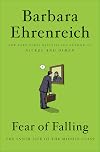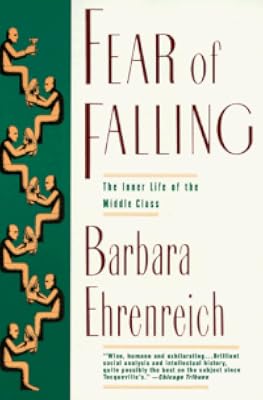
Fear of Falling: The Inner Life of the Middle Class
by Barbara Ehrenreich
On This Page
Description
A brilliant and insightful exploration of the rise and fall of the American middle class by New York Times bestselling author, Barbara Ehrenreich. One of Barbara Ehrenreich's most classic and prophetic works, Fear of Falling closely examines the insecurities of the American middle class in an attempt to explain its turn to the right during the last two decades of the 20th century. Weaving finely-tuned expert analysis with her trademark voice, Ehrenreich traces the myths about the middle show more class to their roots, determines what led to the shrinking of what was once a healthy percentage of the population, and how, in its ambition and anxiety, that population has retreated from responsible leadership. Newly reissued and timely as ever, Fear of Falling places the middle class of yesterday under the microscope and reveals exactly how we arrived at the middle class of today. show lessTags
Recommendations





































Member Reviews
When I picked this up in the sale bin of East Ave books in Adelaide for $1 I was hoping to get insight into the surreal nightmare of the US’s current state. A better dollar I will never spend. It was published early 1990s, which was exactly what I wanted. I didn’t want a hindsight constructed narrative. Trump is no more than a casually mentioned billionaire of a type towards the end of Ehrenreich’s account of the middle class and its relationship to the other classes in the US during the course of the twentieth century. She explains the rise of the new Right in the US as well as the new Left. The book is highly readable whilst being dense; it’s both deeply and widely researched. I will be reading all her books. I think everybody show more should read this one.
The story she tells in this one is painful. She shows the rise of the middle-class, how they made themselves a financial and politically important group based on professionalising what they did and excluding others. She talks of its permanent insecurity as a consequence. Even though I’ve always known about it, her analysis of the exploitation of the educated youth and their university-student-led rebellion of the sixties and seventies when university students were actually mowed down by troops in the US was particularly illuminating and excruciatingly sad; staff in universities trying to protect their status from the questioning of the kids who were expected to work at derisory rates in their young professional years. Staff more or less on the side of the troops. None of this has changed, one might add. She documents the discovery by the middle class, to its great astonishment, that there were poor people in the US and she examines the way in which the middle class then set about categorising them and determining how to relate to them. She shows the fabulously patronising attitudes to those below them and the trouble it has ultimately caused.
rest here:
https://alittleteaalittlechat.wordpress.com/2017/02/20/fear-of-falling-by-barbar... show less
The story she tells in this one is painful. She shows the rise of the middle-class, how they made themselves a financial and politically important group based on professionalising what they did and excluding others. She talks of its permanent insecurity as a consequence. Even though I’ve always known about it, her analysis of the exploitation of the educated youth and their university-student-led rebellion of the sixties and seventies when university students were actually mowed down by troops in the US was particularly illuminating and excruciatingly sad; staff in universities trying to protect their status from the questioning of the kids who were expected to work at derisory rates in their young professional years. Staff more or less on the side of the troops. None of this has changed, one might add. She documents the discovery by the middle class, to its great astonishment, that there were poor people in the US and she examines the way in which the middle class then set about categorising them and determining how to relate to them. She shows the fabulously patronising attitudes to those below them and the trouble it has ultimately caused.
rest here:
https://alittleteaalittlechat.wordpress.com/2017/02/20/fear-of-falling-by-barbar... show less
“If the characteristic delusion of the American left is that it has the mass support of “the people,” the parallel delusion of the right is that it is a lonely band of risk-takers, willing to stand up for capitalism when the capitalist themselves are too weak or befuddled to fight back .” P 151 brilliant book all the more fascinating are it resonates with frightening accuracy in 2025 but written in 1989. The same the same the same: the cycles of affluence and class struggles manipulated by the dark hand of consumerism.
Ratings
Members
- Recently Added By
Author Information

35+ Works 22,859 Members
Barbara Ehrenreich is the author of "Blood Rites"; "The Worst Years of Our Lives"; "Fear of Falling", which was nominated for a National Book Critics Circle Award, & eight other books. A frequent contributor to Time, Harper's, Esquire, The New Republic, Mirabella, The Nation, The New York Magazine, she lives near Key West, Florida. (Publisher Fact show more Sheets) Political activist and writer Barbara Ehrenreich was born in Butte, Montana on August 26, 1941. She studied physics at Reed College and graduated in 1963. She received a Ph.D. in Cell Biology from Rockefeller University in 1968. Rather than pursuing a career in science, however, she decided to focus on social change. Ehrenreich has written columns and contributed articles to publications including Time Magazine, The Progressive, The New York Times, Mother Jones, The Atlantic Monthly, Ms, The New Republic, Harper's Magazine, and The Nation. She taught essay writing at the Graduate School of Journalism at the University of California, Berkeley in 1998 and 2000. Ehrenreich has written many books, with 2001's Nickel and Dimed: On (Not) Getting by in America and 2005's Bait and Switch, The (Futile) Pursuit of the American Dream both becoming New York Times bestsellers. Nickel and Dimed examines working-class poverty, while Bait and Switch discusses white-collar unemployment. Her next bestseller was in 2014 with Living With a Wild God: A Nonbeliever's Search for the Truth about Everything. In 1998 Ehrenreich was named Humanist of the Year by the American Humanist Association, and she received the Nation Institute/Puffin Foundation Prize for Creative Citizenship in 2004. (Bowker Author Biography) show less
Awards and Honors
Awards
Classifications
- Genres
- Sociology, Economics, Nonfiction, General Nonfiction
- DDC/MDS
- 305.550973 — Society, government, & culture Social sciences, sociology & anthropology Social group - Age, Gender, Ethnicity People by social and economic levels Middle Class North America
- LCC
- HT690 .U6 .E47 — Social sciences Communities. Classes. Races Communities. Classes. Races Classes Classes arising from occupation
- BISAC
Statistics
- Members
- 405
- Popularity
- 76,668
- Reviews
- 2
- Rating
- (3.90)
- Languages
- English, German, Portuguese
- Media
- Paper, Audiobook, Ebook
- ISBNs
- 11
- UPCs
- 1
- ASINs
- 4