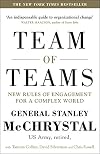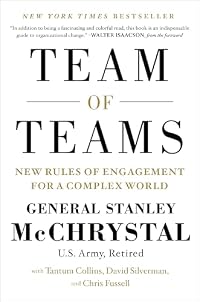
Team of Teams: New Rules of Engagement for a Complex World
by Stanley A. McChrystal, Tantum Collins, Chris Fussell, David Silverman
On This Page
Description
As commander of Joint Special Operations Command (JSOC), General Stanley McChrystal played a crucial role in the War on Terror. But when he took the helm in 2004, America was losing that war badly: despite vastly inferior resources and technology, Al Qaeda was outmaneuvering America's most elite warriors. McChrystal came to realize that today's faster, more interdependent world had overwhelmed the conventional, top-down hierarchy of the U.S. military. Al Qaeda had seen the future: a show more decentralized network that could move quickly and strike ruthlessly. To defeat such an enemy, JSOC would have to discard a century of management wisdom, and pivot from a pursuit of mechanical efficiency to organic adaptability. Under McChrystal's leadership, JSOC remade itself, in the midst of a grueling war, into something entirely new: a network that combined robust centralized communication with decentralized managerial authority. As a result, they beat back Al Qaeda. In this book, McChrystal shows not only how the military made that transition, but also how similar shifts are possible in all organizations, from large companies to startups to charities to governments. In a turbulent world, the best organizations think and act like a team of teams, embracing small groups that combine the freedom to experiment with a relentless drive to share what they've learned. Drawing on a wealth of evidence from his military career, the private sector, and sources as diverse as hospital emergency rooms and NASA's space program, McChrystal frames the existential challenge facing today's organizations, and proposes a compelling, effective solution. show lessTags
Recommendations















Member Reviews
Team of Team is one of those odd hybrid books, applying lessons from the military to business and vice versa, structured around General McChrystal's personal memoir of transforming Joint Special Operations Command (JSOC) into the globe-spanning terrorist-hunting "sword and shield" that it is today, structured around the elimination of Abu Musab al-Zarqawi, commander of Al Qaeda in Iraq.
McChrystal and his co-authors (Yale grad Tantum Collins appears to have done a lot of the heavy lifting in terms of research and actual word-smithing) lay out a fairly simply story. Modern corporations are structured around efficiency, whether through explicitly Taylorist management practices where every motion is clocked and redesigned for speed, or show more implicitly through bureaucratic silos. Efficient organizations are great, until they interact with complex and chaotic systems, at which point efficiency becomes less important than adaptability. There are plenty of the usual examples from aviation and natural disasters, to make the case that efficiency and resilience are different goals, and that while machines should be efficient, the parts with humans in them need to be resilience.
The JSOC that McChrystal took over was an organization finely tuned to fight the last war, complicated operations along the lines of the Tehran Hostage Rescue debacle in 1980. In Iraq in 2003, they were stepping up operations and raids from 10 a night to 18 a night, but failing to stop the underground growth of Al Qaeda in Iraq. McChrystal realized that his problems were organizational above all else: Vital intelligence went stale as overworked analysts tried to get a handle on a growing backlog of interrogations, documents, and surveillance video. Each individual unit in JSOC was world-class, but the organization was riddle with rivalries and barriers to trust and communication between operations (SEALs, Delta Force, Rangers, etc), analysts, and partner agencies in the intelligence community (CIA, NSA, NRO), not to mention the regular military, the rest of the government, and foreign partners. And above all, no one had a coherent strategic picture.
To fight a netwar, JSOC had to rewire itself. McChrystal institued an open bullpen organization layout at his headquarters in a fortified hanger at Baghdad International Airport. He instituted mandatory daily video conference calls for Operations and Intelligence, at 9 AM EST and 4 PM local time, as Washington was starting its day and operators were moving out for a night of raids. These calls involved thousands of participants, and allowed/required McChrystal to model the deeply inquisitive form of command he saw as necessary to win. JSOC became more flexible and fluid, an organization that made raids based on 'audible' calls and the immediate exploitation of intelligence. Actions went from an average of ~19 a night to over 300. In 2006, they got their man, tracking the elusive Zarqawi through personal networks and killing him with an airstrike.
Some of the stuff in here should be business conventional wisdom: Adaptability is key; architecture is destiny; missions-driven organizations that empower their employees succeed. McChrystal has some very good advice on the importance of asking the right questions, leadership being mostly about setting culture, and that while organizations should be as transparent as possible, leaders MUST MUST MUST resist the urge to micromanage. Delegate, cultivate, and focus on priorities and people rather than processes.
I have a few minor caveats. There's a bit of unwarranted techno-analogizing between computer networks and organization networks. Some of the hard questions about creating a "team of team" are left a little opaque, with that you should check out McChrystal's consulting firm, although the references are discrete and reasonable. Finally, McChrystal elides entirely the major strategic questions surrounding his tenure at JSOC and later in Afghanistan. At best, he achieved medium-level successes that have been submerged in larger strategic reversals. And his habit of 'thinking out loud' in front of a Rolling Stone reporter cost him his command. Anything he could say about the War would be outdated, but if you're looking for that perspective, try another book. show less
McChrystal and his co-authors (Yale grad Tantum Collins appears to have done a lot of the heavy lifting in terms of research and actual word-smithing) lay out a fairly simply story. Modern corporations are structured around efficiency, whether through explicitly Taylorist management practices where every motion is clocked and redesigned for speed, or show more implicitly through bureaucratic silos. Efficient organizations are great, until they interact with complex and chaotic systems, at which point efficiency becomes less important than adaptability. There are plenty of the usual examples from aviation and natural disasters, to make the case that efficiency and resilience are different goals, and that while machines should be efficient, the parts with humans in them need to be resilience.
The JSOC that McChrystal took over was an organization finely tuned to fight the last war, complicated operations along the lines of the Tehran Hostage Rescue debacle in 1980. In Iraq in 2003, they were stepping up operations and raids from 10 a night to 18 a night, but failing to stop the underground growth of Al Qaeda in Iraq. McChrystal realized that his problems were organizational above all else: Vital intelligence went stale as overworked analysts tried to get a handle on a growing backlog of interrogations, documents, and surveillance video. Each individual unit in JSOC was world-class, but the organization was riddle with rivalries and barriers to trust and communication between operations (SEALs, Delta Force, Rangers, etc), analysts, and partner agencies in the intelligence community (CIA, NSA, NRO), not to mention the regular military, the rest of the government, and foreign partners. And above all, no one had a coherent strategic picture.
To fight a netwar, JSOC had to rewire itself. McChrystal institued an open bullpen organization layout at his headquarters in a fortified hanger at Baghdad International Airport. He instituted mandatory daily video conference calls for Operations and Intelligence, at 9 AM EST and 4 PM local time, as Washington was starting its day and operators were moving out for a night of raids. These calls involved thousands of participants, and allowed/required McChrystal to model the deeply inquisitive form of command he saw as necessary to win. JSOC became more flexible and fluid, an organization that made raids based on 'audible' calls and the immediate exploitation of intelligence. Actions went from an average of ~19 a night to over 300. In 2006, they got their man, tracking the elusive Zarqawi through personal networks and killing him with an airstrike.
Some of the stuff in here should be business conventional wisdom: Adaptability is key; architecture is destiny; missions-driven organizations that empower their employees succeed. McChrystal has some very good advice on the importance of asking the right questions, leadership being mostly about setting culture, and that while organizations should be as transparent as possible, leaders MUST MUST MUST resist the urge to micromanage. Delegate, cultivate, and focus on priorities and people rather than processes.
I have a few minor caveats. There's a bit of unwarranted techno-analogizing between computer networks and organization networks. Some of the hard questions about creating a "team of team" are left a little opaque, with that you should check out McChrystal's consulting firm, although the references are discrete and reasonable. Finally, McChrystal elides entirely the major strategic questions surrounding his tenure at JSOC and later in Afghanistan. At best, he achieved medium-level successes that have been submerged in larger strategic reversals. And his habit of 'thinking out loud' in front of a Rolling Stone reporter cost him his command. Anything he could say about the War would be outdated, but if you're looking for that perspective, try another book. show less
Having read several books recently on teamwork and collaboration, what I've not found is one that demonstrates how a leader realized what limiting factors needed to be addressed in their particular situation. Team of Teams does just that. Based on McChrystal's successful tour commanding the hunt for insurgents in Iraq, this book uses that journey as a story arc for explaining how to achieve the teamwork needed in our complex, fast-changing modern world. The military cases are as illuminating as they are gripping, and the author shares just as many examples from business and medicine so as not to make this a self-congratulatory biopic. To overcome the natural inertia of siloed intelligence gathering and decision making in an show more interdependent, fast-changing world, the answer is to develop great teamwork within teams and across teams. These teams of teams won't naturally bond the same way a smaller team of ten or up to thirty people might. By seeding at least some individual rapport across teams and encouraging open access to common information, leaders can cultivate shared purpose and trust, which gets reinforced the more the whole network sees examples of success toward their common end. show less
"Shared consciousness is a carefully maintained set of centralized forums for bringing people together. Empowered execution is a radically decentralized system for pushing authority out to the edges of the organization." Excellent discussion of how implementing both (starting with shared consciousness) multiplies speed and success of organization initiatives.
I picked up Stanley McChrystal's book, Team of Teams: New Rules of Engagement for a Complex World because I really enjoyed the message he shared when writing My Share of the Task: A Memoir. I was curious how he pulled it together and what lessons he had to share. More importantly, I was looking for ideas I could use for my small team and institution. I was not disappointed. This book helped to flesh out some points he made in his first book. Team of Teams focused on his operations in Iraq and the interworkings of countless agencies. I would be curious how the lessons could be applied for a business. Personally, I enjoyed the book; however, I think some would be put off on the heavy focus on military operations. Read more
In looking for ideas on how to improve relative to my work I read much on various management/leadership and technology topics. This was one of those searches for new ideas on which to build improvement. It came recommended to me by someone from work and seemed to begin with much promise, but I found I kept waiting for the ideas and new concepts to come. The first three-fourths of this book seems to focus on building the argument for the last fourth, and when I got to the solutions, I found them relatively stale and uninspiring. Some of the stories and examples in the book were entertaining, but I never uncovered anything of significant value.
Team of Teams by Gen. Stanley McChrystal talks about organisational dynamics and leadership in the US army. Stanley McChrystal is a US General who lead Special Task Forces and had to modify his army’s organisation to better fight Al-Qaeda militants in Iraq. The book is a personal memoir of transforming Joint Special Operations Command. It describes how to adapt old hierarchical structures to fit the current complex world and create an agile organisation that can rapidly react to outside quick challenges. The book presents steps as well as strategies regarding resilience and adaptability with regards to confronting difficult situations. The aim of the book is to show that the strategy used in Iraq could effectively be applied to show more businesses as well as different institutions.
Anyway, McChrystal starts with Iraq where he found that the standard model of commanding the US army didn’t work. This was not a war of planning and discipline, but more agility and innovation situation. in the old model of business, planning was one of the most important keys to overall success but in the past, the world and industries weren’t changing as quickly as now. Of course, the planning process is still crucial, but now it’s about agility and innovation. The book says that today’s world is less about how to optimise for the known, the relatively stable set of variables. We should be rather looking for to innovate and change with the times.
Next, the book talks a lot about empowerment, care and relentless nurturing of competence and ability of your team. What innovation requires is a great team of people underneath you, the team that can come up with ideas. The author compares this process to gardening which needs your time and patience. When it comes to caring, McChrystal writes a lot about competition and even antagonisms between different units in the US army. Military culture has a sense of tribalism where different components see themselves as being better than others. Then he presents his approach to consolidate his teams and develop a way to establish links between them as teams whose members know one another perform better. Such teams can self monitor each other which save a lot of time regarding day to day supervision, of course, if needed. This also implies continuous communication at all times.
In addition to empowerment, McChrystal presents transparency as something extremely important in the lower military ranks. They watch the actions of their leaders and not only listen to what they have to say. Each member of the US army needs to feel they have a stake in the outcome, therefore, they need motivation and reward. As a manager, you have to remember that your team is made up of people who each have a certain role to achieve a specific goal. The funny thing here is that the author supports this thesis by saying that: “If you ask people what their vision is, it’s not: ‘Hey, I’m here cutting this stone.’ It’s: ‘I’m part of a team-building a cathedral.” I’ve used the same anecdote in my public speech 2 weeks...(if you like to read my full review please visit my blog https://leadersarereaders.blog/team-of-teams/) show less
Anyway, McChrystal starts with Iraq where he found that the standard model of commanding the US army didn’t work. This was not a war of planning and discipline, but more agility and innovation situation. in the old model of business, planning was one of the most important keys to overall success but in the past, the world and industries weren’t changing as quickly as now. Of course, the planning process is still crucial, but now it’s about agility and innovation. The book says that today’s world is less about how to optimise for the known, the relatively stable set of variables. We should be rather looking for to innovate and change with the times.
Next, the book talks a lot about empowerment, care and relentless nurturing of competence and ability of your team. What innovation requires is a great team of people underneath you, the team that can come up with ideas. The author compares this process to gardening which needs your time and patience. When it comes to caring, McChrystal writes a lot about competition and even antagonisms between different units in the US army. Military culture has a sense of tribalism where different components see themselves as being better than others. Then he presents his approach to consolidate his teams and develop a way to establish links between them as teams whose members know one another perform better. Such teams can self monitor each other which save a lot of time regarding day to day supervision, of course, if needed. This also implies continuous communication at all times.
In addition to empowerment, McChrystal presents transparency as something extremely important in the lower military ranks. They watch the actions of their leaders and not only listen to what they have to say. Each member of the US army needs to feel they have a stake in the outcome, therefore, they need motivation and reward. As a manager, you have to remember that your team is made up of people who each have a certain role to achieve a specific goal. The funny thing here is that the author supports this thesis by saying that: “If you ask people what their vision is, it’s not: ‘Hey, I’m here cutting this stone.’ It’s: ‘I’m part of a team-building a cathedral.” I’ve used the same anecdote in my public speech 2 weeks...(if you like to read my full review please visit my blog https://leadersarereaders.blog/team-of-teams/) show less
Fantastic book. Sure would like to see what McChrystal Group or CrossLead could do with leadership in education. I envisioned so many applications while reading this.
Members
- Recently Added By
Lists

Books recommended by Calgary Public Library staff
1,588 works; 4 members
Author Information

8+ Works 1,450 Members
2 Works 837 Members
2 Works 929 Members
11 Works 477 Members
Common Knowledge
- Original publication date
- 2015
Classifications
- Genres
- Business, Nonfiction, General Nonfiction
- DDC/MDS
- 658.4022 — Applied Science & Technology Management & public relations General management Executive Internal organization Teams
- LCC
- HD66 .M38185 — Social sciences Industries. Land use. Labor Industries. Land use. Labor Work groups. Team work in industry.
- BISAC
Statistics
- Members
- 841
- Popularity
- 32,440
- Reviews
- 8
- Rating
- (4.11)
- Languages
- English, German, Korean
- Media
- Paper, Audiobook, Ebook
- ISBNs
- 14
- UPCs
- 1
- ASINs
- 5