
Jeff Sutherland
Author of Scrum: The Art of Doing Twice the Work in Half the Time
About the Author
Image credit: By Anders Wegge Keller - Self-photographed, CC BY-SA 3.0, https://commons.wikimedia.org/w/index.php?curid=6084059
Works by Jeff Sutherland
Scrum 4 copies
Scrum Guide 2 copies
Tagged
Common Knowledge
- Gender
- male
Members
Reviews
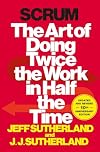
Good management is good management. Cargo cult gibberish is cargo cult gibberish. And the intersection of the two is Scrum, a management philosophy that promises orders of magnitude improvements everywhere.
Some parts of scrum are obvious. Spend time doing things that are valuable to the customer. Delivery that value quickly and incrementally. Don't get bogged down in monumental efforts tied to thousands of pages of documentation that no one has actually read, or actually understands. The show more basic unit of action is a small, 5-7 person, cross-functional team, capable of moving a project from conception to done. Happy is contagious, and happy teams are effective teams.
But the cargo cult elements of scrum are in the jargon, which obscure the hard points of writing code. Story points, daily-stand ups, and sprint cycles are all well and good, but if you haven't figured out what you're doing and why, it doesn't matter. Small teams can self-organize, but what about coordinating big organizations and big projects? And while cross-functionality seems very important, most conventional businesses are organized in top-down, 'disciplinary' silos (sales, IT, development, finance, etc), so how do product owners and scrum masters interact with the conventional management hierarchy. And of course the big questions remain largely unanswered. How does a team figure out what objectives and capabilities are important, and how do you do a proper sprint retrospective to capture what went right?
And finally, some of the examples Sutherland uses are not quite right. There's a lot of pointing to Boyd's OODA loop, which Sutherland says he learned as a RF-4 pilot in Vietnam, except John Boyd only developed the OODA loop after his stint as Commander of 56th Combat Support Group in 1973. And Sutherland points to Valve as a company which has successfully implemented scrum, which may be true, except that despite sitting on a literal neverending pile of money in the form the Steam store, Valve hasn't released a significant game of its own since 2013. Rich Geldritch, a disgruntled former manager, alleges Valve is a morass of abusive management and inefficiency.
This book is enthusiastic, but cheering 'hip hip hooray being great!' is a far cry from actually being great. show less
Some parts of scrum are obvious. Spend time doing things that are valuable to the customer. Delivery that value quickly and incrementally. Don't get bogged down in monumental efforts tied to thousands of pages of documentation that no one has actually read, or actually understands. The show more basic unit of action is a small, 5-7 person, cross-functional team, capable of moving a project from conception to done. Happy is contagious, and happy teams are effective teams.
But the cargo cult elements of scrum are in the jargon, which obscure the hard points of writing code. Story points, daily-stand ups, and sprint cycles are all well and good, but if you haven't figured out what you're doing and why, it doesn't matter. Small teams can self-organize, but what about coordinating big organizations and big projects? And while cross-functionality seems very important, most conventional businesses are organized in top-down, 'disciplinary' silos (sales, IT, development, finance, etc), so how do product owners and scrum masters interact with the conventional management hierarchy. And of course the big questions remain largely unanswered. How does a team figure out what objectives and capabilities are important, and how do you do a proper sprint retrospective to capture what went right?
And finally, some of the examples Sutherland uses are not quite right. There's a lot of pointing to Boyd's OODA loop, which Sutherland says he learned as a RF-4 pilot in Vietnam, except John Boyd only developed the OODA loop after his stint as Commander of 56th Combat Support Group in 1973. And Sutherland points to Valve as a company which has successfully implemented scrum, which may be true, except that despite sitting on a literal neverending pile of money in the form the Steam store, Valve hasn't released a significant game of its own since 2013. Rich Geldritch, a disgruntled former manager, alleges Valve is a morass of abusive management and inefficiency.
This book is enthusiastic, but cheering 'hip hip hooray being great!' is a far cry from actually being great. show less
Scrum. A Arte de Faze o Dobro do Trabalho na Metade do Tempo (Em Portuguese do Brasil) by Jeff Sutherland
Antes de ler esse livro, eu tinha um receio dele ser um livro que falava sobre o Framework Scrum e algumas ideias de como aplicar, e, devido à minha experiência, não iria agregar muito.
Porém esse livro fala sobre diversos exemplos, não apenas na área de tecnologia, em que a transição do cascata para ágil foi aplicado. E vai além disso, fala sobre motivação de equipes, de como há uma necessidade da mudança de pensamento da sociedade para o nosso dia a dia no trabalho e vida show more pessoal.
Tirei reflexões relevantes, porém gostaria que tivesse um detalhamento maior de aplicações, resultados, como foram medidos, feedback, etc.
Um excelente ponto do livro, que na essência é sobre Scrum, é trazer o fato de que não necessariamente precisamos sair aplicando todas as práticas do framework scrum e esperar que elas funcionem na nossa equipe. É importante entender as particularidades de cada time, organização, contexto, porém tem esses valores (e outros, dependendo do time) como essência. Defendo isso demais no meu dia a dia.
No mais, recomendo para todas as pessoas. show less
Porém esse livro fala sobre diversos exemplos, não apenas na área de tecnologia, em que a transição do cascata para ágil foi aplicado. E vai além disso, fala sobre motivação de equipes, de como há uma necessidade da mudança de pensamento da sociedade para o nosso dia a dia no trabalho e vida show more pessoal.
Tirei reflexões relevantes, porém gostaria que tivesse um detalhamento maior de aplicações, resultados, como foram medidos, feedback, etc.
Um excelente ponto do livro, que na essência é sobre Scrum, é trazer o fato de que não necessariamente precisamos sair aplicando todas as práticas do framework scrum e esperar que elas funcionem na nossa equipe. É importante entender as particularidades de cada time, organização, contexto, porém tem esses valores (e outros, dependendo do time) como essência. Defendo isso demais no meu dia a dia.
No mais, recomendo para todas as pessoas. show less
Scrum pioneer Jeff Sutherland responded to the suggestion his son, J.J. Sutherland did to collaborate on a book on the truly remarkable journey Scrum has taken them on since 1993. The shippable product, Scrum: The Art of Doing Twice the Work in Half the Time is challenging critics and cynics alike. More can be done faster and cheaper. Other than presenting just another text book on Scrum, Sutherland's narrative emphasizes the backgrounds and reasons for assembling what we now know as show more Scrum.
From Toyota Production System, Lean Manufacturing, professors Takeuchi and Nonaka, the first endeavors of Sutherland and co-creator Ken Schwaber to Deming's Plan-Do-Check-Act cycle and the problems with Gannt charts. It's good to know the origins and the initial stages of implementation. Scrum nowadays not only is used for software development. The book highlights great examples of eduScrum at Dutch schools (makes me proud as Dutch reviewer), micro credit enterprises in Uganda, as well as churches (thanks to Jeff's wife Arline) and journalism in the Middle-East (J.J. Sutherland).
Scrum is not wishing for a better world, or surrendering to the existing. It's a actionable way to implement change. Change or die. Since humans want to be great, not only pursuit happiness, but be successful, Scrum is provided as efficient way to get things done faster and cheaper than using waterfall, gate-phased approaches, or having specialists working in silos. You'll learn why Japanese cars are built more efficiently than German cars.
Sutherland draws from his own 30+ years experience as a West Point-educated fighter pilot, robotics, engineering, and martial arts to contemporary companies like Valve and his own Scrum Inc. From Toyota Prius to wedding planners. And of course, all elements of Scrum are woven into the story line. Too good to be true? Still not convinced? Read first this book, reflect on your current production process and figure out what you're missing. show less
From Toyota Production System, Lean Manufacturing, professors Takeuchi and Nonaka, the first endeavors of Sutherland and co-creator Ken Schwaber to Deming's Plan-Do-Check-Act cycle and the problems with Gannt charts. It's good to know the origins and the initial stages of implementation. Scrum nowadays not only is used for software development. The book highlights great examples of eduScrum at Dutch schools (makes me proud as Dutch reviewer), micro credit enterprises in Uganda, as well as churches (thanks to Jeff's wife Arline) and journalism in the Middle-East (J.J. Sutherland).
Scrum is not wishing for a better world, or surrendering to the existing. It's a actionable way to implement change. Change or die. Since humans want to be great, not only pursuit happiness, but be successful, Scrum is provided as efficient way to get things done faster and cheaper than using waterfall, gate-phased approaches, or having specialists working in silos. You'll learn why Japanese cars are built more efficiently than German cars.
Sutherland draws from his own 30+ years experience as a West Point-educated fighter pilot, robotics, engineering, and martial arts to contemporary companies like Valve and his own Scrum Inc. From Toyota Prius to wedding planners. And of course, all elements of Scrum are woven into the story line. Too good to be true? Still not convinced? Read first this book, reflect on your current production process and figure out what you're missing. show less
There are surely better SCRUM books to buy. The author, CEO of Scrum, Inc. (it's his story, co-authored with his son), is a bit self-congratulatory, and his cheerleading for SCRUM often comes across like he's plugging a miracle weight loss regimen. That said, it did get me excited about some scrummy ideas, and inspire me to try to put some into practice.
Awards

You May Also Like


Associated Authors
Statistics
- Works
- 7
- Members
- 836
- Popularity
- #30,568
- Rating
- 4.0
- Reviews
- 20
- ISBNs
- 35
- Languages
- 8