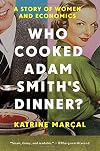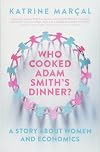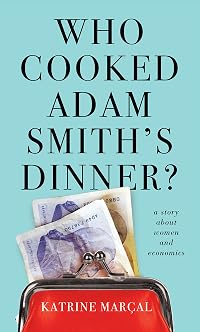
Who Cooked Adam Smith's Dinner?
by Katrine Marçal
On This Page
Description
How do you get your dinner? That is the basic question of economics. When economist and philosopher Adam Smith proclaimed that all our actions were motivated by self-interest, he used the example of the baker and the butcher as he laid the foundations for the "economic man." He argued that the baker and butcher didn't give bread and meat out of the goodness of their hearts. It's an ironic point of view coming from a bachelor who lived with his mother for most of his life-a woman who cooked show more his dinner every night. Nevertheless, the economic man has dominated our understanding of modern-day capitalism, with a focus on self-interest and the exclusion of all other motivations. Such a point of view disregards the unpaid work of mothering, caring, cleaning, and cooking. It insists that if women are paid less, then that's because their labor is worthless. Economics has told us a story about how the world works, and we have swallowed it, hook, line, and sinker. This story has not served women well. Now it's time to change it. A kind of feminist Freakonomics, Who Cooked Adam Smith's Dinner? charts the myth of the economic man-from its origins at Adam Smith's dinner table to its adaptation by the Chicago School and its disastrous role in the 2008 Global Financial Crisis-in a witty and courageous dismantling of one of the biggest myths of our time. show lessTags
Recommendations










Member Reviews
An interesting, well reasoned take on economic theory that provides a useful primer on the basics (which I forgot a very long time ago), and then cleverly dissects them to reveal the significant gaps. The central message being that economic theory ignores the value of work done by women and that this (possibly deliberate) oversight means that the theory the world spins on is dangerously flawed.
It’s engagingly written throughout and never gets to heavy even if, like me, you’re not used to reading economics tomes. The feminist slant ends up feeling like common sense rather than a polemic and I can see myself reflecting back on the message in coming weeks and months.
It’s engagingly written throughout and never gets to heavy even if, like me, you’re not used to reading economics tomes. The feminist slant ends up feeling like common sense rather than a polemic and I can see myself reflecting back on the message in coming weeks and months.
Economic theory is based around the idea of Economic Man - a perfectly rational individual whose only relationships with other people are in trade or in competition (all traditionally masculine traits, of course). Of course, humans aren't like this, but over time Economic Man has gone from a simplification for the purposes of theorizing to an ideal that we strive to emulate in all things. This isn't just wrong, it's damaging. It leaves out fundamental, necessary parts of the human experience, like bodies, like dependency, like love. It breaks people and economies and societies, and because we don't understand what we're doing, we just keep doing it over and over again.
The GDP doesn't include unpaid women's labor - childcare, show more housekeeping, cooking for the family. Feminism's economic progress has been calculated in terms of how many women take paid jobs, but has ignored the fact that this means that their unpaid labor still needs doing, and that this represents a massive shift in the way our economy functions (or, too often, doesn't).
The prose in this book is written in crisp, short sentences in short paragraphs, which, combined with the subject matter, gives the impression of a cold, sarcastic rage. Marçal is engaged in the process of tearing down one of the pillars of society, and she's doing it with a vengeance. I wish I had faith that she would succeed. show less
The GDP doesn't include unpaid women's labor - childcare, show more housekeeping, cooking for the family. Feminism's economic progress has been calculated in terms of how many women take paid jobs, but has ignored the fact that this means that their unpaid labor still needs doing, and that this represents a massive shift in the way our economy functions (or, too often, doesn't).
The prose in this book is written in crisp, short sentences in short paragraphs, which, combined with the subject matter, gives the impression of a cold, sarcastic rage. Marçal is engaged in the process of tearing down one of the pillars of society, and she's doing it with a vengeance. I wish I had faith that she would succeed. show less
Homo Economicus is a concept in economics that is wrong. It has failed almost every test, every environment, and every theory. Katrine Marçal has found a new way it is has failed. It totally misjudges women. It helps repress them, keep them subservient, underpaid and unappreciated. They are second class contributors when they are considered at all. Economic models are developed basically without them. This is hardly the first book to damn homo economicus, but he persists and thrives nonetheless. It just continues to make economics wrong. The book is a thorough and thoughtful attack on homo economicus, from a feminist standpoint.
Marçal writes in a very fast style. Her paragraphs seem very often single sentences, which quickens the show more pace. It doesn’t stop her from beating a point to death, but it makes reading the book a breeze. Economics can be so absurd she only has to report on it and it comes across as sarcastic and satirical. It usually doesn’t even require a comment from her. But the book is an endless stream of such nonsense – that we actually operate by. Our governments make faulty decisions based on faulty statistics plugged into faulty models.
The core argument is that housework should count. Canada once calculated women’s work – maintenance, childcare, cooking – to be worth between 30 and 45% of GDP. But GDP includes none of it. This is hardly the only problem with GDP, an unrealistic and artificial fabrication, and ignoring the value contributed by women is an age-old festering sore that Marçal picks at gleefully.
There are so very many reasons why economics is wrong. This is a major one, but there are more important missing components, like natural resources. Raw materials are not part of any standard economic model. We assume they are always available. Free. Free to consume and free to waste and free to pollute. This is the biggest reason the planet is wheezing and groaning – because economists decided homo economicus was no longer part of the ecosystem. He was above it and could exploit as he pleased without accounting or consequence. Marçal finally gets to this point at the very end, giving it one page.
Marçal’s neutral, positive solution: “Economic science should be about how one turns a social vision into a modern economic system.” If only.
David Wineberg show less
Marçal writes in a very fast style. Her paragraphs seem very often single sentences, which quickens the show more pace. It doesn’t stop her from beating a point to death, but it makes reading the book a breeze. Economics can be so absurd she only has to report on it and it comes across as sarcastic and satirical. It usually doesn’t even require a comment from her. But the book is an endless stream of such nonsense – that we actually operate by. Our governments make faulty decisions based on faulty statistics plugged into faulty models.
The core argument is that housework should count. Canada once calculated women’s work – maintenance, childcare, cooking – to be worth between 30 and 45% of GDP. But GDP includes none of it. This is hardly the only problem with GDP, an unrealistic and artificial fabrication, and ignoring the value contributed by women is an age-old festering sore that Marçal picks at gleefully.
There are so very many reasons why economics is wrong. This is a major one, but there are more important missing components, like natural resources. Raw materials are not part of any standard economic model. We assume they are always available. Free. Free to consume and free to waste and free to pollute. This is the biggest reason the planet is wheezing and groaning – because economists decided homo economicus was no longer part of the ecosystem. He was above it and could exploit as he pleased without accounting or consequence. Marçal finally gets to this point at the very end, giving it one page.
Marçal’s neutral, positive solution: “Economic science should be about how one turns a social vision into a modern economic system.” If only.
David Wineberg show less
I agree with much of the author's criticism of economics. I agree with her that women are still discriminated against. I disagree with her that the concept of homo oeconomicus is to blame for this state of affairs. The entire polemic is based on unsound logic and anachronistic arguments. The German translation is sloppy in parts where the translator didn't check his facts. And I can't help wondering why the German and English publishers chose such sensationalist titles for their translations where the original simply speaks of "The only sex"?
Great in the parts when it addresses the book's advertised point regarding a feminist reading of economic theory, but this covers only around a third of the book with more general economic criticism filling the rest. Interesting enough, if a little 101, but not what I signed up for.
A good book about the hidden labor of women and how traditionally unappreciated/uncompensated domestic tasks prop up the economy
Adam Smtih said 'It is not from the benevolence of the butcher, the brewer, or the baker that we expect our dinner, but from their regard to their own interest.' This book is based on an interesting and thought-provoking observation: Adam Smith lived with his mother for all of her life, and she cooked his dinner every day. The butcher, baker and brewer may all demand payment for their work, but the work done by Mrs Smith was done out of love, and she was never paid for it. The book explores the simple observation that huge amounts of work are done without payment, the work of cooking, cleaning, childcare, elderly care, social care. Without this work capitalism could hardly survive - it is only because someone else is taking care of show more their day to day provisions that workers are free to dedicate themselves to paid work.
However, having made this observation, the book repetitively meanders, approaching it from various angles but never really following it through to any strong conclusions, and never really addressing it with any rigorous attention to the numbers.
The pros, cons and consequences of wages for all the kinds of work that are currently unpaid are never really explored in this book. Certainly not to the extent of the radical feminists of the 70s who made this same observation and followed with a load of demands for wages for housework, wages for childcare or transhumanist revolution of reproductive work.
Likewise, the economic consequences of women giving up all their unpaid caring work are not really explored. Would the economy collapse if women all simply refused to raise the next generation unless they were paid for it? Or would it thrive from a massive influx of women, suddenly free to focus on careers the way married men can? There are some frightening or exhilarating futures possible here, but they're hardly even mentioned.
The general gist of the argument seems to be: 'Women do a lot of necessary but unpaid work. That's a bit unfair, isn't it?'
Or perhaps: 'Men may refuse to do anything without immediate personal gain, but women aren't so selfish.' show less
However, having made this observation, the book repetitively meanders, approaching it from various angles but never really following it through to any strong conclusions, and never really addressing it with any rigorous attention to the numbers.
The pros, cons and consequences of wages for all the kinds of work that are currently unpaid are never really explored in this book. Certainly not to the extent of the radical feminists of the 70s who made this same observation and followed with a load of demands for wages for housework, wages for childcare or transhumanist revolution of reproductive work.
Likewise, the economic consequences of women giving up all their unpaid caring work are not really explored. Would the economy collapse if women all simply refused to raise the next generation unless they were paid for it? Or would it thrive from a massive influx of women, suddenly free to focus on careers the way married men can? There are some frightening or exhilarating futures possible here, but they're hardly even mentioned.
The general gist of the argument seems to be: 'Women do a lot of necessary but unpaid work. That's a bit unfair, isn't it?'
Or perhaps: 'Men may refuse to do anything without immediate personal gain, but women aren't so selfish.' show less
Members
- Recently Added By
Lists

Books Read in 2016
4,666 works; 197 members

Books Read in 2020
4,379 works; 124 members
Author Information

16 Works 527 Members
Some Editions
Awards and Honors
Common Knowledge
- Canonical title
- Who Cooked Adam Smith's Dinner?
- Original title
- Det enda könet
- First words
- Feminism has always been about economics. - Prologue
How do you get your dinner? - Last words
- (Click to show. Warning: May contain spoilers.)And that's when you take off your shoes - prepared to stay a while.
(Click to show. Warning: May contain spoilers.)The epilogue to this story has been written in a garden in North London against greenish-blue garden furniture, the climbing roses in bloom, and in hope of exactly that. - Epilogue - Original language
- Swedish
Classifications
Statistics
- Members
- 326
- Popularity
- 97,484
- Reviews
- 8
- Rating
- (3.54)
- Languages
- 8 — Dutch, English, Finnish, German, Polish, Portuguese, Spanish, Swedish
- Media
- Paper, Audiobook, Ebook
- ISBNs
- 26
- ASINs
- 6