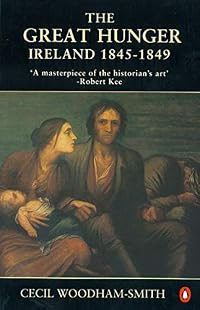
The Great Hunger: Ireland 1845-1849
by Cecil Woodham-Smith
On This Page
Description
The Great Hunger is the story of one of the worst disasters in world history: the Irish potato famine of the 1840s. Within five years, one million people died of starvation; emigrants by the hundreds of thousands sailed for America and Canada. Most emigrant ships were small, ill-equipped, dangerously unsanitary, and often unseaworthy. Some ships never arrived; those that did carried passengers already infected with and often dying of typhus. The Irish who managed to reach the United States show more alive had little or no money and were often too weak to work. They crowded into dark, dirty cellars; begged in the streets; and took whatever employment they could get at wages which no American would accept. Epidemics, riots and chaos followed in their wake, so that Irish immigrants came to be regarded as a danger to the health of the community and a burden on society. The Great Hunger is a heartbreaking story of suffering, insensitivity, and blundering stupidity; yet it is also an epic tale of courage, dignity and despite all odds, a hardly supportable optimism. show lessTags
Recommendations















Member Reviews
While it is very, very difficult to read, the dehumanising of an oppressed people has many parallels in our society today: from the genocide in Rwanda, to the survivors of Hurrican Katrina, the similarities are stark. And appalling.
Ms. Woodham-Smith has done her research and found numbers and statistics from tiny towns to the British Parliament's documents to show how utterly devastated the Irish people were even before the Famine. She starts in the years before, most especially with the Devon Commission in 1838 that warned of a looming disaster for the island. At especial risk were the poor tenant farmers who could not afford the land on which to work, and were forced to live in the worst sort of housing. A pig and a pile of manure show more were often their only possessions.
She then starts, month by month, sometimes day by day, to document the sudden and irreversible blight that struck the Irish potato crop. She also pulls in the documentation from other parts of Western Europe that also show a complete loss of the potato crop, most notably in Belgium and England, though only in Ireland was there widespread famine.
The British Government refusing to allow soup kitchens, forcing people to work at building roads in order to earn money to pay for food, and consigning people to work houses is grim reading. The fact that the Irish did not speak English and were used to a barter economy, rather than a monetary economy, did not help. Many did not know what money was. Most importantly, in order to keep the cost of corn and other food commodities high, no food from Ireland was allowed to feed the people of Ireland: it had the highest food imports during that year of any British colony. Economic decisions affected this time and caused the deaths of millions.
The census of 1840 put the Irish population at 8,000,000, while those who knew the country know that there were another million or so living in bogs and on mountains. By the end of the famine, in about 1848-9, with the deaths and immigrations, there were about 2,000,000 living Irish on the island.
Excellent, well-researched book that is difficult to read (both in language in subject matter), but well worth the effort. show less
Ms. Woodham-Smith has done her research and found numbers and statistics from tiny towns to the British Parliament's documents to show how utterly devastated the Irish people were even before the Famine. She starts in the years before, most especially with the Devon Commission in 1838 that warned of a looming disaster for the island. At especial risk were the poor tenant farmers who could not afford the land on which to work, and were forced to live in the worst sort of housing. A pig and a pile of manure show more were often their only possessions.
She then starts, month by month, sometimes day by day, to document the sudden and irreversible blight that struck the Irish potato crop. She also pulls in the documentation from other parts of Western Europe that also show a complete loss of the potato crop, most notably in Belgium and England, though only in Ireland was there widespread famine.
The British Government refusing to allow soup kitchens, forcing people to work at building roads in order to earn money to pay for food, and consigning people to work houses is grim reading. The fact that the Irish did not speak English and were used to a barter economy, rather than a monetary economy, did not help. Many did not know what money was. Most importantly, in order to keep the cost of corn and other food commodities high, no food from Ireland was allowed to feed the people of Ireland: it had the highest food imports during that year of any British colony. Economic decisions affected this time and caused the deaths of millions.
The census of 1840 put the Irish population at 8,000,000, while those who knew the country know that there were another million or so living in bogs and on mountains. By the end of the famine, in about 1848-9, with the deaths and immigrations, there were about 2,000,000 living Irish on the island.
Excellent, well-researched book that is difficult to read (both in language in subject matter), but well worth the effort. show less
The Potato Famine almost certainly caused more civilian deaths in Europe than any event since the Black Death and until the influenza epidemic of 1918. The exact tally isn’t known, but Ireland was the only European country with an overall population decrease in the nineteenth century, and apparently didn’t recover to a pre-Famine population level until well into the twentieth. The Famine also precipitated the great Irish Diaspora to the United States, which still colors American politics (When I lived in Chicago, I once completely forgot it was St. Patrick’s day and couldn’t figure out why traffic was so horrible on a Saturday until I crossed a bridge and noticed that the Chicago River below was bright emerald green. I don’t show more recall anybody dyeing the river on Kosciusko Day or von Steuben Day or Martin Luther King Day.)
Cecil Woodham-Smith’s (Cecil’s a she; I wonder why her parents didn’t name her Cecilia) account of the Famine is a great read, and provides a lot of insight into what happened and why. The basics are simple enough; the Irish peasantry depended on the potato; fungus blight destroyed almost the entire potato crop in 1845, 1846, and 1848; the Irish starved to death, died of disease, or fled to America.
It’s the details that are fascinating. The one unfortunate thing about this otherwise excellent book is that Woodham-Smith blames the laissez-faire policies of the British government for the disaster (well, it was politically correct to do so in 1962 when the book was published). However, Woodham-Smith’s own account makes it clear that the Famine was precipitated by a long series of non-market based government policies, and that by the time the famine got started, no possible government action could have done anything more than slightly ameliorate it (those wishing to make analogies to Hurricane Katrina and New Orleans are entirely welcome to do so).
Although Woodham-Smith doesn’t go quite that far back, the whole thing started when England went Protestant and Ireland didn’t. That and subsequent disputes with Oliver Cromwell and King William III left Ireland largely in the hands of Protestant landlords and Catholic tenants. Various “anti-Papist” laws were enacted; the one with the most bearing on the Famine allowed primogeniture for Protestants but required Catholic land to be divided among all surviving male heirs at the death of the “owner”. (“Owner” is in quotes here because it wasn’t actually land ownership that was divided, but land tenancy).
A second factor was the Corn Laws. Woodham-Smith claims that no factor in English history other than outright civil war provoked more passion than the Corn Laws. These controlled the price of bread in England, prohibiting grain imports until the price of wheat rose above a certain level. Their repeal in 1845 was prompted by the Famine, but by then the damage was done.
Another factor was the Irish Poor Law. This required all landlords to contribute “rates” for the establishment of a workhouse for paupers in their area. This required landlords to collect rent from their tenants or go bankrupt. Under Irish law, these “rates” were assessed against the land, rather than the landowner, and remained attached to it as debts if they weren’t paid. Thus a bankrupt landlord usually couldn’t sell his land unless the buyer was willing to assume the debts.
A fourth contributor was not an economic policy, but the fact that the British ruling class was completely clueless about conditions in Ireland. As Woodham-Smith puts it
“…the desolate, starving west was assumed to be served by snug grocers and prosperous merchants and to be a field for private enterprise; bankrupt squireens, living in jerry-built mansions, with rain dripping through the roof, became country gentry, and plans for sea transport were made as if the perilous harbours of the west coast were English ports.”
The overall effect was this;
* the anti-Papist laws resulted in subdivision into smaller and smaller tenancies; however, the introduction of potatoes allowed a family of six to live on an acre and a half – as long as there were potatoes. There was no technology to effectively store potatoes at the time; the peasants lived from year to year.
* The Corn Laws gave a tremendous incentive for landlords to grow wheat for export to England. They had a guaranteed price.
* The Irish tenants worked growing wheat but lived off potatoes. Wheat was grown for export only, to the extent that there was no infrastructure for processing it in Ireland. Woodham-Smith reports that a contemporary never saw an oven in an Irish peasant’s cabin, Irish housewives had no idea how to bake bread, and the closest flour mill to the city of Cork (as an example) was 30 miles away.
* Since Ireland was self-sufficient in food (as long as there were potatoes) there was no incentive to develop an infrastructure for food imports and practically no importers existed.
* Since tenants paid rent in kind (with the wheat harvest) and grew their own food, there was a severe shortage of actual money since there was no need for it. Woodham-Smith reports that Irish peasants that somehow acquired (for example) a pound note or a guinea coin usually pawned it for a fraction of its value in small change – since nobody had enough pennies to break it.
Thus everything the British government tried foundered on the rock of Irish reality. First it was attempted to import “Indian corn” (maize) from America. That didn’t work because there were few facilities to grind corn and most people didn’t know what to do with it once it was ground. It didn’t help that there was a minor bad year in the rest of Europe as well, and the French and Prussian governments had bought up most of the available corn, wheat and rye in America before the British got around to it. The Irish were assured that “food was coming in” when all that had actually happened was that agents in the US were instructed to purchase grain that wasn’t actually available.
Then an attempt was made to provide public works – usually roads (Woodham-Smith comments that there are still roads in Ireland that don’t seem to go anywhere, because they were make-work projects during the Famine). That didn’t work either; the road workers were paid, but there was no food to buy with the money.
Various other schemes were tried, and finally the British government threw up its hands and announced that Ireland would have to feed itself. (It didn’t help that England had a financial crisis of its own and at one point was in danger of running out of gold reserves.) “Rates” on landowners were raised to confiscatory levels so that the starving could be supported in workhouses under the Poor Law; the only result, of course, was landlords desperately trying to export even more food to try and pay their debts, and evicting tenants so they would go somewhere else and some other workhouse would have to support them.
Every peasant that could afford it fled to America. Woodham-Smith points out that most actually fled to Canada, since the passage was cheaper; there was an extensive trade in timber from Canada, but most of the timber ships went back in ballast because there wasn’t enough population in Canada to support an import market. Ship-owners quickly found that Irish made perfectly good ballast and “coffin ships” crossed the Atlantic, throwing the deceased overboard as they died of starvation or “ship fever” (typhus). The survivors were quarantined, first on an island in the Saint Lawrence, then on the ships themselves when the island filled up. Anybody who made it through that quickly crossed the border to the US, having soured on anywhere in the British Empire.
The life lost in the Famine is controversial; Woodham-Smith estimates a million but concedes that nobody really has a good count and many people probably died unrecorded in Ireland, on ships, or in quarantine in Canada. Some estimates are as high as six million.
I found Woodham-Smith (who was of Irish ancestry herself) is an eminently readable historian and has excellent insights into the causes, effects, and results of the Famine. As mentioned, the only flaw I find was her failure to realize that it was Government policy that had screwed up Ireland with an artificial economy in the first place and that more Government policy couldn’t fix it. There’s lots of meat here to make analogies to modern times – governments and individuals that assume that Third World countries have the same infrastructure as the First World; the profound failure to recognize the Law of Unintended Consequences in government actions; and the assumption that governments have infinite resources and just need to apply them to solve any problem. Highly recommended. show less
Cecil Woodham-Smith’s (Cecil’s a she; I wonder why her parents didn’t name her Cecilia) account of the Famine is a great read, and provides a lot of insight into what happened and why. The basics are simple enough; the Irish peasantry depended on the potato; fungus blight destroyed almost the entire potato crop in 1845, 1846, and 1848; the Irish starved to death, died of disease, or fled to America.
It’s the details that are fascinating. The one unfortunate thing about this otherwise excellent book is that Woodham-Smith blames the laissez-faire policies of the British government for the disaster (well, it was politically correct to do so in 1962 when the book was published). However, Woodham-Smith’s own account makes it clear that the Famine was precipitated by a long series of non-market based government policies, and that by the time the famine got started, no possible government action could have done anything more than slightly ameliorate it (those wishing to make analogies to Hurricane Katrina and New Orleans are entirely welcome to do so).
Although Woodham-Smith doesn’t go quite that far back, the whole thing started when England went Protestant and Ireland didn’t. That and subsequent disputes with Oliver Cromwell and King William III left Ireland largely in the hands of Protestant landlords and Catholic tenants. Various “anti-Papist” laws were enacted; the one with the most bearing on the Famine allowed primogeniture for Protestants but required Catholic land to be divided among all surviving male heirs at the death of the “owner”. (“Owner” is in quotes here because it wasn’t actually land ownership that was divided, but land tenancy).
A second factor was the Corn Laws. Woodham-Smith claims that no factor in English history other than outright civil war provoked more passion than the Corn Laws. These controlled the price of bread in England, prohibiting grain imports until the price of wheat rose above a certain level. Their repeal in 1845 was prompted by the Famine, but by then the damage was done.
Another factor was the Irish Poor Law. This required all landlords to contribute “rates” for the establishment of a workhouse for paupers in their area. This required landlords to collect rent from their tenants or go bankrupt. Under Irish law, these “rates” were assessed against the land, rather than the landowner, and remained attached to it as debts if they weren’t paid. Thus a bankrupt landlord usually couldn’t sell his land unless the buyer was willing to assume the debts.
A fourth contributor was not an economic policy, but the fact that the British ruling class was completely clueless about conditions in Ireland. As Woodham-Smith puts it
“…the desolate, starving west was assumed to be served by snug grocers and prosperous merchants and to be a field for private enterprise; bankrupt squireens, living in jerry-built mansions, with rain dripping through the roof, became country gentry, and plans for sea transport were made as if the perilous harbours of the west coast were English ports.”
The overall effect was this;
* the anti-Papist laws resulted in subdivision into smaller and smaller tenancies; however, the introduction of potatoes allowed a family of six to live on an acre and a half – as long as there were potatoes. There was no technology to effectively store potatoes at the time; the peasants lived from year to year.
* The Corn Laws gave a tremendous incentive for landlords to grow wheat for export to England. They had a guaranteed price.
* The Irish tenants worked growing wheat but lived off potatoes. Wheat was grown for export only, to the extent that there was no infrastructure for processing it in Ireland. Woodham-Smith reports that a contemporary never saw an oven in an Irish peasant’s cabin, Irish housewives had no idea how to bake bread, and the closest flour mill to the city of Cork (as an example) was 30 miles away.
* Since Ireland was self-sufficient in food (as long as there were potatoes) there was no incentive to develop an infrastructure for food imports and practically no importers existed.
* Since tenants paid rent in kind (with the wheat harvest) and grew their own food, there was a severe shortage of actual money since there was no need for it. Woodham-Smith reports that Irish peasants that somehow acquired (for example) a pound note or a guinea coin usually pawned it for a fraction of its value in small change – since nobody had enough pennies to break it.
Thus everything the British government tried foundered on the rock of Irish reality. First it was attempted to import “Indian corn” (maize) from America. That didn’t work because there were few facilities to grind corn and most people didn’t know what to do with it once it was ground. It didn’t help that there was a minor bad year in the rest of Europe as well, and the French and Prussian governments had bought up most of the available corn, wheat and rye in America before the British got around to it. The Irish were assured that “food was coming in” when all that had actually happened was that agents in the US were instructed to purchase grain that wasn’t actually available.
Then an attempt was made to provide public works – usually roads (Woodham-Smith comments that there are still roads in Ireland that don’t seem to go anywhere, because they were make-work projects during the Famine). That didn’t work either; the road workers were paid, but there was no food to buy with the money.
Various other schemes were tried, and finally the British government threw up its hands and announced that Ireland would have to feed itself. (It didn’t help that England had a financial crisis of its own and at one point was in danger of running out of gold reserves.) “Rates” on landowners were raised to confiscatory levels so that the starving could be supported in workhouses under the Poor Law; the only result, of course, was landlords desperately trying to export even more food to try and pay their debts, and evicting tenants so they would go somewhere else and some other workhouse would have to support them.
Every peasant that could afford it fled to America. Woodham-Smith points out that most actually fled to Canada, since the passage was cheaper; there was an extensive trade in timber from Canada, but most of the timber ships went back in ballast because there wasn’t enough population in Canada to support an import market. Ship-owners quickly found that Irish made perfectly good ballast and “coffin ships” crossed the Atlantic, throwing the deceased overboard as they died of starvation or “ship fever” (typhus). The survivors were quarantined, first on an island in the Saint Lawrence, then on the ships themselves when the island filled up. Anybody who made it through that quickly crossed the border to the US, having soured on anywhere in the British Empire.
The life lost in the Famine is controversial; Woodham-Smith estimates a million but concedes that nobody really has a good count and many people probably died unrecorded in Ireland, on ships, or in quarantine in Canada. Some estimates are as high as six million.
I found Woodham-Smith (who was of Irish ancestry herself) is an eminently readable historian and has excellent insights into the causes, effects, and results of the Famine. As mentioned, the only flaw I find was her failure to realize that it was Government policy that had screwed up Ireland with an artificial economy in the first place and that more Government policy couldn’t fix it. There’s lots of meat here to make analogies to modern times – governments and individuals that assume that Third World countries have the same infrastructure as the First World; the profound failure to recognize the Law of Unintended Consequences in government actions; and the assumption that governments have infinite resources and just need to apply them to solve any problem. Highly recommended. show less
https://fromtheheartofeurope.eu/the-great-hunger-ireland-1845-9-by-cecil-woodham...
Like most schoolchildren in Ireland, I was taught about the famine in history classes as one of the fundamental facts of Irish history. The 1841 census found that the population of Ireland was 8.5 million; today, combining both parts, it is just over seven million. The populations of counties Clare, Fermanagh, Longford, Sligo, Tipperary, Mayo and Cavan today are less than half what they were in 1841. The populations of counties Monaghan and Roscommon are less than a third of their 1841 numbers. Leitrim’s population today is 22% of the 1841 figure.
Cecil Woodham-Smith’s 1962 book was the first popular history book of the twentieth century to cover the show more whole period in detail. It came after successful books on the Charge of the Light Brigade and Florence Nightingale, and she later wrote a biography of Queen Victoria. She was from an Irish military family; she claimed to be descended from the Dukes of Leinster, but I have to say that my research does not support this. She was clearly a good story-teller, and Alan Bennet has a couple of funny anecdotes about her.
We were taught at school that the Famine came about as a combination of the natural disaster of a fungal infection, the potato blight, killing the crop on which most Irish people survived, and the unwillingness of the British government to provide relief for the starving population; meanwhile corn which could have fed the hungry was exported and thousands of impoverished tenants were evicted, driving the great wave of Irish emigration to the USA (and to an extent Canada and Australia) which still shapes Irish-American relations today.
A lot of this is rooted in The Great Hunger. But there’s a huge difference between reading the awful, but sanitised, version of history in my schoolbooks forty-five years ago, and reading the primary documentation that Woodham-Smith assembled. The direct accounts of the misery and squalor endured by the population are really tough reading. One cannot defend the authorities in Dublin Castle or in London on the grounds of ignorance. Indeed, the British Prime Minister wrote: “we have made it the most degraded and most miserable country in the world…all the world is crying shame upon us.”
Woodham-Smith is also very enlightening on the second prong of the received historical account, the ideological opposition of the London government to effective aid. Like most governments, of course, Sir Robert Peel and then Lord John Russell were particularly motivated by their need to keep a parliamentary majority, and Russell’s attempts to take a more proactive stance were blocked by others within his coalition. In the end, the buck stops at the top, and also with Charles Trevelyan, who as Assistant Secretary to the Treasury was the single most influential voice on maintaining laissez-faire (what we would today call libertarian) policies, which killed a million people.
I was less familiar with other parts of the story. I had vaguely clocked the fact that more people died of disease than malnutrition; but Woodham-Smith fleshes this out with details of the epidemics that swept through the devastated population, based to a certain extent on the advance of medical knowledge between 1845 and 1962. The worst of all was the effect on emigrants crammed together in unhealthy conditions on the ships going to North America, and then quarantined together when they arrived. On Grosse Isle, just off Quebec, at least 3,000 Irish immigrants are known to have died of various diseases and at least 5,000 are known to be buried. The true figures are obscure, but those numbers are bad enough.
Although the English politicians were more culpable because they were in power, Irish politicians did not cover themselves in glory either, and Woodham-Smith spends a couple of chapters looking at the failure of the Young Ireland movement and the pathetic 1848 rebellion. I admit that it’s difficult to prescribe what politicians could do as society disintegrates around them, but calling on the starving masses to seize arms against the entrenched forces of the largest army in the world probably isn’t it.
Having said all that, the book ends on a weird high note describing the visit of Queen Victoria and Prince Albert to Ireland in 1849, as a kind of coda to the whole story. The royals had a great time, cruising along the coast from Cork to Dublin and then doing official engagements in Dublin and Belfast. Woodham-Smith presents this as a huge success. I guess it was cathartic, but the direct effects of the famine continued until 1852, so the royal visit wasn’t really the end of the story as it is presented here.
Parenthesis: Victoria’s 1849 visit was the first by a British monarch since her uncle, George IV, had turned up in 1821; and only the second since the War of the Three Kingdoms in 1689-90 had seen James II and William III in direct combat at the Battle of the Boyne. Before that, only three English monarchs had set foot in Ireland during their reigns: Richard II in 1394, King John in 1210 and Henry II in 1171. show less
Like most schoolchildren in Ireland, I was taught about the famine in history classes as one of the fundamental facts of Irish history. The 1841 census found that the population of Ireland was 8.5 million; today, combining both parts, it is just over seven million. The populations of counties Clare, Fermanagh, Longford, Sligo, Tipperary, Mayo and Cavan today are less than half what they were in 1841. The populations of counties Monaghan and Roscommon are less than a third of their 1841 numbers. Leitrim’s population today is 22% of the 1841 figure.
Cecil Woodham-Smith’s 1962 book was the first popular history book of the twentieth century to cover the show more whole period in detail. It came after successful books on the Charge of the Light Brigade and Florence Nightingale, and she later wrote a biography of Queen Victoria. She was from an Irish military family; she claimed to be descended from the Dukes of Leinster, but I have to say that my research does not support this. She was clearly a good story-teller, and Alan Bennet has a couple of funny anecdotes about her.
We were taught at school that the Famine came about as a combination of the natural disaster of a fungal infection, the potato blight, killing the crop on which most Irish people survived, and the unwillingness of the British government to provide relief for the starving population; meanwhile corn which could have fed the hungry was exported and thousands of impoverished tenants were evicted, driving the great wave of Irish emigration to the USA (and to an extent Canada and Australia) which still shapes Irish-American relations today.
A lot of this is rooted in The Great Hunger. But there’s a huge difference between reading the awful, but sanitised, version of history in my schoolbooks forty-five years ago, and reading the primary documentation that Woodham-Smith assembled. The direct accounts of the misery and squalor endured by the population are really tough reading. One cannot defend the authorities in Dublin Castle or in London on the grounds of ignorance. Indeed, the British Prime Minister wrote: “we have made it the most degraded and most miserable country in the world…all the world is crying shame upon us.”
Woodham-Smith is also very enlightening on the second prong of the received historical account, the ideological opposition of the London government to effective aid. Like most governments, of course, Sir Robert Peel and then Lord John Russell were particularly motivated by their need to keep a parliamentary majority, and Russell’s attempts to take a more proactive stance were blocked by others within his coalition. In the end, the buck stops at the top, and also with Charles Trevelyan, who as Assistant Secretary to the Treasury was the single most influential voice on maintaining laissez-faire (what we would today call libertarian) policies, which killed a million people.
I was less familiar with other parts of the story. I had vaguely clocked the fact that more people died of disease than malnutrition; but Woodham-Smith fleshes this out with details of the epidemics that swept through the devastated population, based to a certain extent on the advance of medical knowledge between 1845 and 1962. The worst of all was the effect on emigrants crammed together in unhealthy conditions on the ships going to North America, and then quarantined together when they arrived. On Grosse Isle, just off Quebec, at least 3,000 Irish immigrants are known to have died of various diseases and at least 5,000 are known to be buried. The true figures are obscure, but those numbers are bad enough.
Although the English politicians were more culpable because they were in power, Irish politicians did not cover themselves in glory either, and Woodham-Smith spends a couple of chapters looking at the failure of the Young Ireland movement and the pathetic 1848 rebellion. I admit that it’s difficult to prescribe what politicians could do as society disintegrates around them, but calling on the starving masses to seize arms against the entrenched forces of the largest army in the world probably isn’t it.
Having said all that, the book ends on a weird high note describing the visit of Queen Victoria and Prince Albert to Ireland in 1849, as a kind of coda to the whole story. The royals had a great time, cruising along the coast from Cork to Dublin and then doing official engagements in Dublin and Belfast. Woodham-Smith presents this as a huge success. I guess it was cathartic, but the direct effects of the famine continued until 1852, so the royal visit wasn’t really the end of the story as it is presented here.
Parenthesis: Victoria’s 1849 visit was the first by a British monarch since her uncle, George IV, had turned up in 1821; and only the second since the War of the Three Kingdoms in 1689-90 had seen James II and William III in direct combat at the Battle of the Boyne. Before that, only three English monarchs had set foot in Ireland during their reigns: Richard II in 1394, King John in 1210 and Henry II in 1171. show less
An excellent case study in compassionate conservatism of how the English, unaffected by the potato famine upheld their purity in the belief about the free markets and watched from afar in horror how the wretched Irish died. As John F. Kennedy's reading of The Guns of August helped him understand and resolve the Cuban Missile Crisis, so this book could have prevented most of the misery caused by austerity politics as the Irish had 150 years earlier experienced that pulling oneself out by one's own bootstraps only succeeds if Baron Münchhausen does it.
The British failure were: 1. Ballistic (one-off) decisions that were unable to cope with dynamic situations. The planting and ordering cycle meant that an annual and conservative approach show more was almost certain to undershoot the required help. 2. Reliance on local inept management. Ireland was in part poor due to the absence of a functional bureaucracy and good government. In the crisis the British should have used their navy and army to quickly establish a support system. 3. Too early cut backs of the help. The British dismantled the barely coping systems before the patient was stabilized (think: US government austerity) so that Ireland fell to experience a fully unnecessary cycle of suffering.
In contrast to the myth ("send me your tired and poor"), the United States closed off its harbors to Irish immigrants as good as it could (requiring ship owners to post bonds for the creditworthiness of their Irish passengers). Canada took in more and poorer Irish immigrants (who then moved south of the border). show less
The British failure were: 1. Ballistic (one-off) decisions that were unable to cope with dynamic situations. The planting and ordering cycle meant that an annual and conservative approach show more was almost certain to undershoot the required help. 2. Reliance on local inept management. Ireland was in part poor due to the absence of a functional bureaucracy and good government. In the crisis the British should have used their navy and army to quickly establish a support system. 3. Too early cut backs of the help. The British dismantled the barely coping systems before the patient was stabilized (think: US government austerity) so that Ireland fell to experience a fully unnecessary cycle of suffering.
In contrast to the myth ("send me your tired and poor"), the United States closed off its harbors to Irish immigrants as good as it could (requiring ship owners to post bonds for the creditworthiness of their Irish passengers). Canada took in more and poorer Irish immigrants (who then moved south of the border). show less
The mendacity of the British government in denying the extent of Irish suffering and the absurdity of English culpability into exacerbating that suffering issue clearly laid out in this touchstone of historical prose.
2.75 stars
In the mid-1800s, the main food in Ireland was potatoes. A disease (blight) hit potatoes and was devastating for the people of Ireland. There was nothing else to substitute, as it’s what the most vulnerable populations ate.
This was an audio, and as soon as I heard the narrator, I had a bad feeling. I’m sure I’ve listened to this narrator before; also male and a British accent – sadly both of those are warnings that I am more likely to lose interest and miss a lot of what’s going on. And that’s what happened.
Although, I did follow more than I expected. There was also a lot of politics – coming out of England, how would they help the people (or not)? I followed at least some of the issues with the potatoes, the show more starving population, and some of the immigration to North America; I missed something about a trial (no idea what that was about), and the queen visited Ireland after it was over, but I missed most of that, as well (beyond that everyone loved her during her first trip). Given how much of it I missed, I couldn’t quite rate it “ok”, but I didn’t want to rate it too low, either, as what I did pay attention to was interesting. show less
In the mid-1800s, the main food in Ireland was potatoes. A disease (blight) hit potatoes and was devastating for the people of Ireland. There was nothing else to substitute, as it’s what the most vulnerable populations ate.
This was an audio, and as soon as I heard the narrator, I had a bad feeling. I’m sure I’ve listened to this narrator before; also male and a British accent – sadly both of those are warnings that I am more likely to lose interest and miss a lot of what’s going on. And that’s what happened.
Although, I did follow more than I expected. There was also a lot of politics – coming out of England, how would they help the people (or not)? I followed at least some of the issues with the potatoes, the show more starving population, and some of the immigration to North America; I missed something about a trial (no idea what that was about), and the queen visited Ireland after it was over, but I missed most of that, as well (beyond that everyone loved her during her first trip). Given how much of it I missed, I couldn’t quite rate it “ok”, but I didn’t want to rate it too low, either, as what I did pay attention to was interesting. show less
A devestating review of the details of the almost unimaginably horrible Irish famine of the late 1800's. Relentless and eye-opening.
Jim Cramer mentioned it on "Mad Money" and I picked it up at the library that week out of curiosity. Wow. I have to admit though, I only read half of it by the time it was due back, and haven't re-checked it out yet. The first half was harrowing enough, and I don't know if I want to learn what came later.
Jim Cramer mentioned it on "Mad Money" and I picked it up at the library that week out of curiosity. Wow. I have to admit though, I only read half of it by the time it was due back, and haven't re-checked it out yet. The first half was harrowing enough, and I don't know if I want to learn what came later.
Members
- Recently Added By
Lists

The Torchlight List
95 works; 1 member

In Our Time books
4,934 works; 2 members
Author Information

7+ Works 2,694 Members
Awards and Honors
Distinctions
Notable Lists
Torchlight List (48)
Common Knowledge
- Canonical title
- The Great Hunger: Ireland 1845-1849
- Original publication date
- 1962
- People/Characters
- Daniel O'Connell; Robert Peel; Arthur Wellesley, 1st Duke of Wellington; Randolph Routh; Charles Trevelyan, 1st Baronet; Colonel Harry Jones (show all 19); Robert Kane; Charles Wood; John Russell, 1st Earl Russell; Edward Pine Coffin; Father Theobald Mathew; James Hack Tuke; W. E. Forster; Major-General Sir John Burgoyne; Henry Labouchere, 1st Baron Taunton; Robert Whyte; John Mills, Mayor of Montreal; Jacob Harvey; Dr. John Griscom
- Important places
- Ulster, Ireland; Dublin, Ireland; County Mayo, Ireland; Skibbereen, County Cork, Ireland; Kilkee, County Clare, Irland; Cork, County Cork, Ireland (show all 27); Limerick, County Limerick, Ireland; County Kerry, Ireland; Donegal, County Donegal, Ireland; Longford, County Longford, Ireland; County Roscommon, Ireland; Kilmoe, County Cork, Ireland; Crookhaven, County Cork, Ireland; Erris, County Mayo, Ireland; Schull, County Cork, Ireland; Baltimore, County Cork, Ireland; Castlehaven, County Cork, Ireland; Bandon, County Cork, Ireland; Bantry, County Cork, Ireland; Quebec City, Quebec, Canada; Grosse Isle, Quebec, Canada; Point St. Charles, Montreal, Quebec, Canada; Deer Island, Boston, Massachusetts, USA; Boston, Massachusetts, USA; New York, New York, USA; Staten Island, New York, New York, USA; Liverpool, England, UK
- Important events
- Penal Laws (1695 | 1829); Act of Union (1801); Irish Poor Law Act (1838); Irish Potato Famine (1845 | 1849); Corn Laws (1815 | 1846); Irish Famine of 1839 (show all 16); Bill for the Protection of Life in Ireland (1846); Labor Rate Act (1832); Irish Arms Bill (1807); British Association (1847-1-1); Irish Fever Bill (1847-4-27); Liverpool Building Act (1842); Liverpool Sanitary Act (1846); British Public Health Act (1848); Irish Poor Law Extension Bill (1847); Soup Kitchen Act (1847)
- Dedication
- Once again to G.I.W.-S.
- First words
- At the beginning of the year 1845 the state of Ireland was, as it had been for nearly seven hundred years, a source of grave anxiety to England.
- Quotations
- A fearful malady has broken out among the potato crop. On all sides we hear of the destruction. In Belgium the fields are said to be completely desolated. There is hardly a sound sample in Covent Garden market...As for the cu... (show all)re for this distemper there is none...We are visited by a great calamity which we must bear. - August 2, 1845, Dr. Lindley
The great evil with which we have to contend, is not not the physical evil of the famine, but the moral evil of the selfish, perverse, and turbulent character of the people.' - Charles Edward Trevelyan to Colonel Jones, Dec 2... (show all), 1846
When we entered a village, our first question was, how many deaths? 'The hunger is upon us' was everywhere the cry, and involuntarily, we found ourselves regarding this hunger as we should an epidemic, looking upon starvation... (show all) as a disease.' - W.E. Forster
By that cross, Mary, I swear to avenge your death. As soon as I earn the price of my passage home I'll go back and shoot the man that murdered you - and that's the landlord. - Meath emigrant at his wife's funeral
To preserve from desecration, the remains o f 6,000 immigrants who died from ship fever A.D. 1847-48, this stone is erected by the workmen of Messrs. Peto, Brassey and Betts employed in the construction of the Victoria Bridge... (show all) A.D. 1859. - The Victoria Bridge and railway sidings now occupy the site of the sheds at Point St. Charles
In this secluded spot lie the mortal remains of 5,294 persons, who flying from pestilence and famine in Ireland in the year 1847, found in America but a grave. - Monument at Grosse Isle
'Sacred to the memory of thousands of Irish immigrants who to preserve the faith suffered hunger and exile in 1847-8, and stricken with fever ended here their sorrowful pilgrimage....Thousands of the children of the Gael were... (show all) lost on this island while fleeing from foreign tyrannical laws and an artificial famine in the years 1847-8. God bless them. God save Ireland!' - Monument at Grosse Island, erected by the Ancient Order of the Hibernians in America, 1909
Classifications
Statistics
- Members
- 1,012
- Popularity
- 25,566
- Reviews
- 10
- Rating
- (4.21)
- Languages
- English, German
- Media
- Paper, Audiobook, Ebook
- ISBNs
- 19
- ASINs
- 34