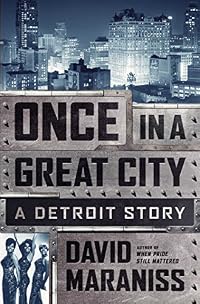
Once in a Great City: A Detroit Story
by David Maraniss
On This Page
Description
"As David Maraniss captures it with power and affection, Detroit summed up America's path to music and prosperity that was already past history. It's 1963 and Detroit is on top of the world. The city's leaders are among the most visionary in America: Grandson of the first Ford; Henry Ford II; influential labor leader Walter Reuther; Motown's founder Berry Gordy; the Reverend C.L. Franklin and his daughter, the amazing Aretha; Governor George Romney, Mormon and Civil Rights advocate; super show more car salesman Lee Iacocca; Mayor Jerome Cavanagh, a Kennedy acolyte; Police Commissioner George Edwards; Martin Luther King. It was the American auto makers' best year; the revolution in music and politics was underway. Reuther's UAW had helped lift the middle class. The time was full of promise. The auto industry was selling more cars than ever before and inventing the Mustang. Motown was capturing the world with its amazing artists. The progressive labor movement was rooted in Detroit with the UAW. Martin Luther King delivered his "I Have a Dream" speech there two months before he made it famous in the Washington march. Once in a Great City shows that the shadows of collapse were evident even then. Before the devastating riot. Before the decades of civic corruption and neglect, and white flight. Before people trotted out the grab bag of rust belt infirmities--from harsh weather to high labor costs--and competition from abroad to explain Detroit's collapse, one could see the signs of a city's ruin. Detroit at its peak was threatened by its own design. It was being abandoned by the new world. Yet so much of what Detroit gave America lasts"-- show lessTags
Recommendations


















Member Recommendations
tangledthread a Detroit story from the 1920's
Member Reviews
I have read my fair share of books on Detroit, but this one was different. Maraniss is not trying to provide a definitive history of the city but rather focuses on a small window of 18 historic months, fall 1962 through spring 1964. He teases out interrelated themes that weave in and out of the book. At the end, he even provides a handy diagram showing all of the connections.
This was the heyday, the peak of Detroit. Historic events were happening there. The vibe in the city was electric. This was the moment before the denouement, the time when you don’t yet know that it is the end of many things, the end of an era.
President Kennedy (“ask not”) and Martin Luther King (“I have a dream”) tried out their famous lines in Detroit show more during this period. The Ford Mustang was hyped and unveiled. Motown took the world by storm. The mayor (Cavanagh), the governor (Romney), the head of the United Auto Workers labor union (Reuther), all had the president’s ear and played parts in the future of the nation. The civil rights movement geared up here with an historic and peaceful march.
I learned a great deal about this part of the city’s history that other books I’ve read were not able to relate in such an in-depth way. Maraniss could really focus on individuals and how those individuals shaped the city and in some cases the nation or the world. I always get kind of sappy when I read books about Detroit, and in this case it was especially true. show less
This was the heyday, the peak of Detroit. Historic events were happening there. The vibe in the city was electric. This was the moment before the denouement, the time when you don’t yet know that it is the end of many things, the end of an era.
President Kennedy (“ask not”) and Martin Luther King (“I have a dream”) tried out their famous lines in Detroit show more during this period. The Ford Mustang was hyped and unveiled. Motown took the world by storm. The mayor (Cavanagh), the governor (Romney), the head of the United Auto Workers labor union (Reuther), all had the president’s ear and played parts in the future of the nation. The civil rights movement geared up here with an historic and peaceful march.
I learned a great deal about this part of the city’s history that other books I’ve read were not able to relate in such an in-depth way. Maraniss could really focus on individuals and how those individuals shaped the city and in some cases the nation or the world. I always get kind of sappy when I read books about Detroit, and in this case it was especially true. show less
Read by the author who does a great job.
Excellent for what it is, which is a nostalgia for a time and place - Detroit in the early 1960's. Maraniss pulls lots of interesting stories together to paint a picture of a vibrant city on the rise, but with hints of the decline to come. Interestingly, the timing (based on what I heard Maraniss say in his recent interview with Chris Hayes on the "Why is this Happening" podcast) appears to be about when Maraniss and his family moved from Detroit to Washington DC. His interest in, even love for this time and place, for whatever personal reasons, clearly comes through.
Disappointing for what it's not, which is an analysis of why things went from there to here. While "hints" are there of the decline show more in the offing, Maraniss doesn't spend much time in analysis, he'd rather evoke for us the time and place that was.
If you, like the author, have an interest in Detroit in the early 60's you'll like this book. As a native of Michigan born in 1960 who rarely saw Detroit in person, and then mostly from the neighborhood around Tiger Stadium, I learned much I had not known before, and I found the book really interesting. I just hoped it would be more. show less
Excellent for what it is, which is a nostalgia for a time and place - Detroit in the early 1960's. Maraniss pulls lots of interesting stories together to paint a picture of a vibrant city on the rise, but with hints of the decline to come. Interestingly, the timing (based on what I heard Maraniss say in his recent interview with Chris Hayes on the "Why is this Happening" podcast) appears to be about when Maraniss and his family moved from Detroit to Washington DC. His interest in, even love for this time and place, for whatever personal reasons, clearly comes through.
Disappointing for what it's not, which is an analysis of why things went from there to here. While "hints" are there of the decline show more in the offing, Maraniss doesn't spend much time in analysis, he'd rather evoke for us the time and place that was.
If you, like the author, have an interest in Detroit in the early 60's you'll like this book. As a native of Michigan born in 1960 who rarely saw Detroit in person, and then mostly from the neighborhood around Tiger Stadium, I learned much I had not known before, and I found the book really interesting. I just hoped it would be more. show less
An examination of Detroit during a narrow period of time with an expected liberal bias about race, government and business. Interesting narrative about Detroit' attempt at obtaining the 1968 Olympic games and the cities contribution to the music world. Epilogue showed author's blind spot toward the corruption/ incompetence of the Coleman Young and Kwame Kilpatrick administrations that contributed as greatly to Detroit's physical and spiritual deterioration as did the globalization of the auto industry and the flight to the suburbs.
ONCE IN A GREAT CITY is a history book, and it reads like a history book. In other words, it contains lots and lots of information, but it's not a page turner. I want to read page turners, so perhaps this review is not fair to David Maraniss, considering all the extensive research he did for this.
But I saw this book on at least one best-of-the-month list and read that it told how, even with all the greatness of people and events in Detroit during the early 1960s, there were signs that the city was going to fall apart. This is not how I understand the book.
Granted, there are examples throughout of the city's greatness in the early 1960s, mainly the rise of Motown music, cars (particularly the Mustang), civil rights, and unionization. show more But so much of that ends up being political. And the political discussions are, as political discussions always are, the way some people, not all of them, saw what took place. A reader should be suspicious of an author's objectivity when he writes about politics or, at least, the objectivity of his sources.
The only discussion I see of signs of the city's downfall is a Wayne State University prediction. Yes, when Detroiters, both black and white, had the means to do so, they moved to the suburbs. But why? Something Maraniss presents as great wasn't. That's what should be discussed. What was wrong and could have been prevented? show less
But I saw this book on at least one best-of-the-month list and read that it told how, even with all the greatness of people and events in Detroit during the early 1960s, there were signs that the city was going to fall apart. This is not how I understand the book.
Granted, there are examples throughout of the city's greatness in the early 1960s, mainly the rise of Motown music, cars (particularly the Mustang), civil rights, and unionization. show more But so much of that ends up being political. And the political discussions are, as political discussions always are, the way some people, not all of them, saw what took place. A reader should be suspicious of an author's objectivity when he writes about politics or, at least, the objectivity of his sources.
The only discussion I see of signs of the city's downfall is a Wayne State University prediction. Yes, when Detroiters, both black and white, had the means to do so, they moved to the suburbs. But why? Something Maraniss presents as great wasn't. That's what should be discussed. What was wrong and could have been prevented? show less
Once in a Great City A Detroit Story, by David Maraniss (read 14 Aug 2016) This is the 4th book I have read authored by David Maraniss. He is a facile and readable writer, and the theme of this book is not an obvious one. It covers a little less than two years in Detroit's history--from 1962 to 1964. Maraniss was born in Detroit though he left there when he was six. But he tells an evocative and attention-holding story of momentous times in Detroit's history--of a time when Detroit still had a population of over a million people (its population now is under 700,000). If I had more interest in music I would have appreciated the book more but its account of George Romney, Walter Reuther, LBJ, and other political figures of the day is of show more great interest. A very good book. show less
Disclaimer: I received this book as a GoodReads FirstReads give away.
This book is a snapshot in time, from 1962 to early 1963. It describes events that were happening throughout the United States, from the perspective of the people in the city of Detroit. The focus is on Berry Gordy, founder of Motown Records, and his stable of stars, Rev. C.L. Franklin, father of Aretha, Henry Ford II and Lee Iacocca, father of the Mustang, and many other people who were leaders of the government, the civil rights struggle and business. JFK and LBJ, Martin L. King and Malcolm X all make appearances. As someone who lived through those times, albeit in a different location (near Philadelphia, PA), I found it fascinating to see how the events that I show more remember so well appeared to people in another, very different part of the country. If, like me, you lived during this period, you may also find this book well worth a look. show less
This book is a snapshot in time, from 1962 to early 1963. It describes events that were happening throughout the United States, from the perspective of the people in the city of Detroit. The focus is on Berry Gordy, founder of Motown Records, and his stable of stars, Rev. C.L. Franklin, father of Aretha, Henry Ford II and Lee Iacocca, father of the Mustang, and many other people who were leaders of the government, the civil rights struggle and business. JFK and LBJ, Martin L. King and Malcolm X all make appearances. As someone who lived through those times, albeit in a different location (near Philadelphia, PA), I found it fascinating to see how the events that I show more remember so well appeared to people in another, very different part of the country. If, like me, you lived during this period, you may also find this book well worth a look. show less
Format: I listened to half of this book on mp3.
Background: I love Detroit. Visited the city once in 2007 and couldn't understand what all the hysteria was about. Living in the United States, everyone has their own image of Detroit. Most often that image involves African-Americans, automobiles, and crime. After that trip, Detroit fell off my radar until 2013, when I only lightly followed its bankruptcy. This past May I visited the city again and this time I fell in love. Everything people say is undoubtably true to some degree, yet most people don't emphasize the beauty of a city that has reached the highest of the highs and the lowest of the lows. Living in "rust belt" cities most of my life, I've gained a new appreciation for these show more down-trodden wonders. A counter point of course, is that many are now coming back, slowly but surely. I believe these cities will be able to re-emerge, more streamlined and sustainably-succesfull than ever before. For some context, I chose this book to learn a bit about the boom era of this incredible city.
Review: The book was only partially interesting in that it discussed contextualized specifics about 1963 Detroit. The playful candor and witty remarks didn't add anything to the book. Many times I thought the book moved away from the city of Detroit and focused too much on individuals' lives and histories. There is a place for such histories, but with a title "Once a Great City," I expected something else. Upon hearing the first passages I figured the book would be a more narrow view than I wanted but I was willing to see where it went. I must say that the real aspect of the book that threw me off is the narrator of the mp3 version. I couldn't continue listening to his voice, home-y and grandfather-like, telling me about the "good old days." I realize that the format of engaging with the work is not-so-much a reflection of the work itself but I expected more, more background, more relation to the following years of downturn or even the present situation. 1963 only matters in so much as it is a part of historical trends and conditions. When the book veers away from these trends and conditions it feels like a personal story, which for me is give or take. I will investigate other Detroit books to satiate my desire to learn more about this riveting city. show less
Background: I love Detroit. Visited the city once in 2007 and couldn't understand what all the hysteria was about. Living in the United States, everyone has their own image of Detroit. Most often that image involves African-Americans, automobiles, and crime. After that trip, Detroit fell off my radar until 2013, when I only lightly followed its bankruptcy. This past May I visited the city again and this time I fell in love. Everything people say is undoubtably true to some degree, yet most people don't emphasize the beauty of a city that has reached the highest of the highs and the lowest of the lows. Living in "rust belt" cities most of my life, I've gained a new appreciation for these show more down-trodden wonders. A counter point of course, is that many are now coming back, slowly but surely. I believe these cities will be able to re-emerge, more streamlined and sustainably-succesfull than ever before. For some context, I chose this book to learn a bit about the boom era of this incredible city.
Review: The book was only partially interesting in that it discussed contextualized specifics about 1963 Detroit. The playful candor and witty remarks didn't add anything to the book. Many times I thought the book moved away from the city of Detroit and focused too much on individuals' lives and histories. There is a place for such histories, but with a title "Once a Great City," I expected something else. Upon hearing the first passages I figured the book would be a more narrow view than I wanted but I was willing to see where it went. I must say that the real aspect of the book that threw me off is the narrator of the mp3 version. I couldn't continue listening to his voice, home-y and grandfather-like, telling me about the "good old days." I realize that the format of engaging with the work is not-so-much a reflection of the work itself but I expected more, more background, more relation to the following years of downturn or even the present situation. 1963 only matters in so much as it is a part of historical trends and conditions. When the book veers away from these trends and conditions it feels like a personal story, which for me is give or take. I will investigate other Detroit books to satiate my desire to learn more about this riveting city. show less
Members
- Recently Added By
Lists

Books Read in 2020
4,379 works; 124 members
Author Information

15+ Works 4,432 Members
David Maraniss is a Pulitzer Prize winning journalist who chronicled the Clinton era during his time at the Washington Post. After leaving the Washington Post, Maraniss wrote "First in His Class," a book about Clinton that won the American Society of Newspaper Editors Jesse Laventhal Prize. He has also published "The Clinton Enigma," a book show more interpreting the Clinton scandal. (Bowker Author Biography) show less
Awards and Honors
Awards
Distinctions
Notable Lists
Common Knowledge
- Original publication date
- 2015
- People/Characters
- Jerome Cavanaugh; Berry Gordy; Henry Ford II; Walter Reuther; Rev. C.L. Franklin; Rev. Albert Cleague (show all 7); Martin Luther King, Jr.
- Important places
- Detroit, Michigan, USA
- Dedication
- To the people of Detroit
- First words
- The ninth of November 1962 was unseasonably pleasant in the Detroit area.
- Last words
- (Click to show. Warning: May contain spoilers.)President Johnson said they would just have to wait and see.
(Click to show. Warning: May contain spoilers.)You could hear the answer in every song. - Blurbers
- Talese, Gay
- Original language
- English US
Classifications
Statistics
- Members
- 300
- Popularity
- 106,481
- Reviews
- 9
- Rating
- (3.74)
- Languages
- English
- Media
- Paper, Audiobook, Ebook
- ISBNs
- 8
- ASINs
- 3