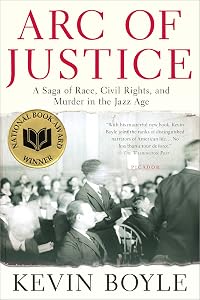
Arc of Justice: A Saga of Race, Civil Rights, and Murder in the Jazz Age
by Kevin Boyle
On This Page
Description
An electrifying story of the sensational murder trial that divided a city and ignited the civil rights struggleIn 1925, Detroit was a smoky swirl of jazz and speakeasies, assembly lines and fistfights. The advent of automobiles had brought workers from around the globe to compete for manufacturing jobs, and tensions often flared with the KKK in ascendance and violence rising. Ossian Sweet, a proud Negro doctor-grandson of a slave-had made the long climb from the ghetto to a home of his own show more in a previously all-white neighborhood. Yet just after his arrival, a mob gathered outside his house; suddenly, shots rang out: Sweet, or one of his defenders, had accidentally killed one of the whites threatening their lives and homes.
And so it began-a chain of events that brought America's greatest attorney, Clarence Darrow, into the fray and transformed Sweet into a controversial symbol of equality. Historian Kevin Boyle weaves the police investigation and courtroom drama of Sweet's murder trial into an unforgettable tapestry of narrative history that documents the volatile America of the 1920s and movingly re-creates the Sweet family's journey from slavery through the Great Migration to the middle class. Ossian Sweet's story, so richly and poignantly captured here, is an epic tale of one man trapped by the battles of his era's changing times.
Arc of Justice is the winner of the 2004 National Book Award for Nonfiction.
. show less
Tags
Recommendations





Member Reviews
Kevin Boyle’s Arc of Justice is a powerful, meticulously researched narrative that brings to life the 1925 trial of African American physician Ossian Sweet in Detroit and the broader racial tensions of the Jazz Age. Boyle blends courtroom drama, social history, and biographical detail to illuminate how Sweet’s case exposed entrenched segregation, white violence, and the struggle for civil rights long before the modern movement; his prose is clear and empathetic, his archival work impressive, and his portrayal of both the Sweet family and key figures like Clarence Darrow nuanced. The book’s strength lies in making complex legal and social forces accessible without sacrificing depth, though readers seeking a purely legal analysis show more may find its social context-heavy approach more illuminating than technical. Overall, Arc of Justice is a compelling, essential read for anyone interested in American race relations, urban history, and the long arc of justice. show less
In 1925 Detroit, Dr. Ossian Sweet bought a house in an all white neighborhood. The Ku Klux Klan as well as other white supremacists moved in and agitated their future neighbours to keep them from moving into their new house. During the second night of riots, the terrorized Afro-Americans fired shots at the crowd killing one man. Arrested and jailed, the NAACP and other organizations fought to give the defendants a fair trial eventually bringing in Clarence Darrow to lead the defense team.
Even though they were eventually acquitted of the killing on grounds of self-defense, the cost was high for Sweet. While in jail, his wife contacted TB, passed it on to her baby and both eventually died. It was years before he actually lived in the show more house.
While the murder trial is the focus of the book but in setting up the scene, Boyle gives us an excellent history of Jim Crow and how it was making its way to the Northern states in the early years of the 20th Century. This is not a period of US history Americans can be proud of. It still has consequences for American cities today with their segregated neighbourhoods. A tough subject to read about but Boyle does a wonderful job of keeping the reader fascinated by the material. show less
Even though they were eventually acquitted of the killing on grounds of self-defense, the cost was high for Sweet. While in jail, his wife contacted TB, passed it on to her baby and both eventually died. It was years before he actually lived in the show more house.
While the murder trial is the focus of the book but in setting up the scene, Boyle gives us an excellent history of Jim Crow and how it was making its way to the Northern states in the early years of the 20th Century. This is not a period of US history Americans can be proud of. It still has consequences for American cities today with their segregated neighbourhoods. A tough subject to read about but Boyle does a wonderful job of keeping the reader fascinated by the material. show less
This is a detailed study of the life of Ossian Sweet. Sweet was an American physician in Detroit, Michigan, noted for his armed self-defense in 1925 of his newly purchased home in a white Detroit neighborhood against a racist mob trying to force him out. This lengthy account is his life from Bartow, FL to his lonely suicide March 20, 1960, in his office apartment in Detroit, MI. Beside details of the day Sweet, family members, and friends found themselves in an armed stand-off with the crowd (I am sure some details are up for debate), much is told about this was the genesis of the nascent NAACP's legal defense fun and experience, leading up to Brown v. Board of Education, the landmark United States Supreme Court case in which the Court show more declared state laws establishing separate public schools for black and white students to be unconstitutional. Also, there is the background of frumpy idealist attorney Clarence Darrow who came in to fight for Sweet et al in the first and subsequent trials. Much of this is approaching a scholarly level of detail, which made this a longer time in reading than I expected, but a very important chapter of U.S. and Detroit history. show less
A magnificent account of the trial for murder of 11 African Americans who were defending the home of a couple who had moved into a white neighborhood in Detroit in 1925 (at the height of the KKK's power) when one or more of them fired into the mob outside the house, killing one pystander & injuring another. It's a dramatic story that Boyle tells very well, sets in context expertly & accessibly, & fills with a colorful cast of characters, including the insecure & unlikely heroes, Dr. Ossia Sweet & his self-assured young wife, NAACP execs James Weldon Johnson & ____ White, Clarence Darrow, Frank Murphy, & (to a lesser extent) Reinhold Niebuhr. We had a really good discussion of the book among our "salon" group of historians, & we were show more unanimous in admiring the book. show less
One of the best books I've read in years. It takes place in Detroit, around 1925, and does a great job detailing the tremendous racial pressures of that era. Very well written.
A fine history of a case I knew absolutely nothing about, but now am off in search of more info. I recommend it very highly, but keep in mind that this is not a novel, but a history, and that as such, even though it moves quickly, there are times when the author doesn't go from point A to point B as in a novel but stops to present factors that led up to this period in time.
The case in question begins in 1925 in Detroit, when Dr. Ossian Sweet and his wife move into a house that is outside the boundaries of the "colored" area (I'm just using the terminology in the book here which was appropriate to the time period). Ossian, his wife Gladys, Ossian's brother Henry & some friends were over at the house all preparing to eat the first meal in show more their new house when a neighborhood mob moved in front of the house & began pelting the house with stones etc. They prepared themselves for the worst, but nothing more happened. On the second night, Ossian was ready. He had gathered the same people & a few more (at that time 11 total in the house), and when the mob gathered again and the rocks started flying and actually broke windows in the house, Henry & whoever was upstairs with him started firing into the crowd, killing one man & wounding another. The police took everyone in the house in custody, & eventually all 11 were charged with murder or conspiracy to commit murder. The state contended that there was no mob at all and that Ossian's brother & friends had fired into the crowd unprovoked, killing a man. Eventually the group was put into prison, awaiting trial, and were ultimately defended by Clarence Darrow.
That's the central case; what this book does is to examine the factors behind the allegations, and to examine the motivation of Ossian's neighbors as they worked themselves into mob frenzy. It also looks at racial attitudes on both sides of the coin prevalent at the time, politics both locally in Detroit and nationally, the use of this case by the NAACP, among other issues. In telling Ossian's story, the author also goes into Ossian's family history, as well as that of his wife Gladys from slavery onward, and the history of racial attitudes both North and South.
For example, Boyle goes into great detail about the southern migration of blacks to the north and their attempts to escape Jim Crow only to find themselves victims of the same types of prejudices. Specifically discussing Detroit, the author goes into great detail explaining that the police department was filled with KKK members; he explains the economics behind why, beyond the simple reason of prejudice, white people did not want blacks in their neighborhoods and what happened to those African-Americans who moved into those neighborhoods; he also goes into the politics involved in organizing a defense for the 11 accused & battles fought based on this case against segregation in all aspects of life.
It is really a captivating story, backed up by personal interviews & other primary sources as well as other references. I definitely think if you are interested in the topics of segregation, civil rights, racial attitudes or the workings of the NAACP, you will not want to miss this book. show less
The case in question begins in 1925 in Detroit, when Dr. Ossian Sweet and his wife move into a house that is outside the boundaries of the "colored" area (I'm just using the terminology in the book here which was appropriate to the time period). Ossian, his wife Gladys, Ossian's brother Henry & some friends were over at the house all preparing to eat the first meal in show more their new house when a neighborhood mob moved in front of the house & began pelting the house with stones etc. They prepared themselves for the worst, but nothing more happened. On the second night, Ossian was ready. He had gathered the same people & a few more (at that time 11 total in the house), and when the mob gathered again and the rocks started flying and actually broke windows in the house, Henry & whoever was upstairs with him started firing into the crowd, killing one man & wounding another. The police took everyone in the house in custody, & eventually all 11 were charged with murder or conspiracy to commit murder. The state contended that there was no mob at all and that Ossian's brother & friends had fired into the crowd unprovoked, killing a man. Eventually the group was put into prison, awaiting trial, and were ultimately defended by Clarence Darrow.
That's the central case; what this book does is to examine the factors behind the allegations, and to examine the motivation of Ossian's neighbors as they worked themselves into mob frenzy. It also looks at racial attitudes on both sides of the coin prevalent at the time, politics both locally in Detroit and nationally, the use of this case by the NAACP, among other issues. In telling Ossian's story, the author also goes into Ossian's family history, as well as that of his wife Gladys from slavery onward, and the history of racial attitudes both North and South.
For example, Boyle goes into great detail about the southern migration of blacks to the north and their attempts to escape Jim Crow only to find themselves victims of the same types of prejudices. Specifically discussing Detroit, the author goes into great detail explaining that the police department was filled with KKK members; he explains the economics behind why, beyond the simple reason of prejudice, white people did not want blacks in their neighborhoods and what happened to those African-Americans who moved into those neighborhoods; he also goes into the politics involved in organizing a defense for the 11 accused & battles fought based on this case against segregation in all aspects of life.
It is really a captivating story, backed up by personal interviews & other primary sources as well as other references. I definitely think if you are interested in the topics of segregation, civil rights, racial attitudes or the workings of the NAACP, you will not want to miss this book. show less
3976. Arc of Justice: A Saga of Race, Civil Rights, and Murder in the Jazz Age, by Kevin Boyle (read 21 Jan 2005) This was 2004's winner of the National Book award for nonfiction. It tells of Dr. Ossian Sweet, who was a black who bought a house in a white area in Detroit in 1925 and when he went to move in a threatening mob gathered at the house. A shot was fired from the house and all eleven people in it were charged with murder and jailed. Clarence Darrow represented the defendants and the account of the trial ensuing is enthralling. The judge before whom the case was tried was Supreme Court Justice-to-be Frank Murphy. The book is excellently researched and while the first part of the book is not too attention-holding (I thought the show more author might have tried to be more objective, much as one agrees with his politically correct view) but on balance the book is well worth reading--even though the author is not a lawyer (and sometimes it shows). show less
Members
- Recently Added By
Lists

Books Read in 2021
5,361 works; 114 members

Five star books
1,767 works; 110 members

Favourite Books
1,820 works; 316 members

r/AskHistorians' Recommended Books
1,068 works; 19 members

Books Read in 2020
4,379 works; 124 members
Author Information

5+ Works 930 Members
Kevin Boyle, an associate professor of history at Ohio State University
Awards and Honors
Awards
Distinctions
Notable Lists
Series
Belongs to Publisher Series
Common Knowledge
- Original title
- Arc of Justice: A Saga of Race, Civil Rights, and Murder in the Jazz Age
- Original publication date
- 2004 (First Edition) (First Edition)
- People/Characters
- Ossian Sweet; Gladys Sweet; Henry Sweet; Clarence Darrow; Walter White
- Important places
- Detroit, Michigan, USA; Michigan, USA
- Important events
- Sweet Trials (Detroit, MI : 1925-1926)
- Epigraph
- The arc of the moral universe is long,
But it bends toward justice
-Abolitionist Theodore Parker, c. 1850s
That Justice is a blind goddess
Is a thing to which we blacks are wise.
Her bandage hides two festering sores
That once perhaps were eyes.
-Langston Hughes, 1923 - Dedication
- For Vicky, Abby, and Nan
with all my love - First words
- The streets of Detroit shimmered with heat.
- Last words
- (Click to show. Warning: May contain spoilers.)In the midst of it all, no one seemed to notice Ossian Sweet sitting alone in the row behind his brother, his face buried in his hands.
- Publisher's editor
- Hodgman, George
- Blurbers
- Lewis, David Levering; Roediger, David; Maraniss, David; Hendrickson, Paul; Dray, Philip; Sugrue, Thomas J.
- Canonical DDC/MDS
- 345.73025230977434
- Canonical LCC
- KF224.S8
Classifications
Statistics
- Members
- 779
- Popularity
- 36,063
- Reviews
- 15
- Rating
- (4.30)
- Languages
- English
- Media
- Paper, Audiobook, Ebook
- ISBNs
- 9
- ASINs
- 5