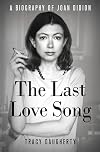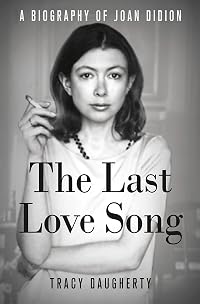
The Last Love Song: A Biography of Joan Didion
by Tracy Daugherty
On This Page
Description
"In The Last Love Song, Tracy Daugherty, the critically acclaimed author of Hiding Man (a New Yorker and New York Times Notable book) and Just One Catch, delves deep into the life of distinguished American author and journalist Joan Didion in this, the first printed biography published about her life. Joan Didion lived a life in the public and private eye with her late husband, writer John Gregory Dunne, whom she met while the two were working in New York City when Didion was at Vogue and show more Dunne was writing for Time. They became wildly successful writing partners when they moved to Los Angeles and co-wrote screenplays and adaptations together. Didion is well-known for her literary journalistic style in both fiction and non-fiction. Some of her most-notable work includes Slouching Towards Bethlehem, Run River, and The Year of Magical Thinking, a National Book Award winner and shortlisted for the Pulitzer Prize, it dealt with the grief surrounding Didion after the loss of her husband and daughter. Daugherty takes readers on a journey back through time, following a young Didion in Sacramento, through to her adult life as a writer interviewing those who know and knew her personally, while maintaining a respectful distance from the reclusive literary great. The Last Love Song reads like fiction; lifelong fans, and readers learning about Didion for the first time will be enthralled with this impressive tribute"-- show lessTags
Recommendations








Member Reviews
"The Last Love Song," Tracy Daugherty’s extensive biography of Joan Didion is immensely informative, and it was all done without the cooperation of his subject. I now have even more respect for what a uniquely odd and superbly talented woman she is. The writing duo of Didion and her husband John Gregory Donne were a major force in the American literary world for many years.
The book goes back to Didion’s roots in Sacramento, which is a subject I always find so geographically familiar and intriguing. She was a member of a privileged generation, and through that, and her writing talents, she was offered the opportunity to move to New York City to work at Vogue magazine. Daugherty also covers the well-known twin tragedies of her life: show more her all-consuming worries about the serious health problems and subsequent death of their daughter Quintana, and Didion’s witnessing of her husband’s death right in front of her. In true Didion’s style, she has to write about both events to learn more about herself in the bestselling books, "The Year of Magical Thinking" and "Blue Nights." As a widower, I appreciate it when Daugherty quotes Didion saying to a friend, “There’s something missing in survival as a reason for being, you know?”
I also like the following line from a New York Times review of this biography. “The Didion who emerges from The Last Love Song is both a frail, angst-ridden outsider and a shrewd Hollywood and New York insider; a vulnerable witness to history and a hardheaded survivor; a writer drawn to theatricality and extremes, and a woman who prizes order and control.
And the book also contained the following odd bit of trivia and personality. Her daughter had taken the author photo for one of her books, and this casual photo caused quite a stir for how inappropriate some found it. Joan was wet and walking across the shallow end of their pool in a dress. The scandal was because as she never wore a bra, her nipples were visible, this for a book that was all about a murderous revolution in El Salvador. Priorities?
It’s an impressive book, but it felt somewhat incomplete. The biographer has a rough time when it comes to discussing Joan’s politics. Her and John were so often held up as this liberal intellectual couple, but she was never totally predictable for where she would come down on a specific issue.
In much of what I’ve read about John Gregory Dunne, he comes across as a very talented writer who loved a good laugh, but was pretty much an aggressive ass much of the time. Later he would become an older man with a seriously weak heart. That weak heart would eventually take his life as the two shared a meal at their own dinner table. Because of his sense of humor, Joan at first believed he was playing a joke on her.
It was Dunne who got entirely sucked into the lucrative world of Hollywood screenwriting, but as they always closely collaborated and edited each other’s work, Joan was right there beside him. But one has to wonder what additional novels he would have been able to write if chasing after screenwriting opportunities hadn’t been such a focus of his life. Even after they moved back to New York City, they were often flying back and forth for movie work in California.
I always found it fascinating that Joan famously said that she didn’t know what she thought about something until she had written about it.
This was a fascinating book about a true American original, a writer whose words I always find myself getting curiously lost in. Much of nonfiction writing suffers from being dated, but the beauty of Didion’s work is that it is never just about what happened here and there, she allows you to experience the events, and then makes you think about them from a unique viewpoint. The work is not just words in type on a page, your own mind is constantly engaged and evolving. She focuses closely on the different aspects of her subjects, and she would let you know much of how she felt about them, all the while she reported factually on them. I sometimes feel that she was writing in her own new style, opinionated objectivity. show less
The book goes back to Didion’s roots in Sacramento, which is a subject I always find so geographically familiar and intriguing. She was a member of a privileged generation, and through that, and her writing talents, she was offered the opportunity to move to New York City to work at Vogue magazine. Daugherty also covers the well-known twin tragedies of her life: show more her all-consuming worries about the serious health problems and subsequent death of their daughter Quintana, and Didion’s witnessing of her husband’s death right in front of her. In true Didion’s style, she has to write about both events to learn more about herself in the bestselling books, "The Year of Magical Thinking" and "Blue Nights." As a widower, I appreciate it when Daugherty quotes Didion saying to a friend, “There’s something missing in survival as a reason for being, you know?”
I also like the following line from a New York Times review of this biography. “The Didion who emerges from The Last Love Song is both a frail, angst-ridden outsider and a shrewd Hollywood and New York insider; a vulnerable witness to history and a hardheaded survivor; a writer drawn to theatricality and extremes, and a woman who prizes order and control.
And the book also contained the following odd bit of trivia and personality. Her daughter had taken the author photo for one of her books, and this casual photo caused quite a stir for how inappropriate some found it. Joan was wet and walking across the shallow end of their pool in a dress. The scandal was because as she never wore a bra, her nipples were visible, this for a book that was all about a murderous revolution in El Salvador. Priorities?
It’s an impressive book, but it felt somewhat incomplete. The biographer has a rough time when it comes to discussing Joan’s politics. Her and John were so often held up as this liberal intellectual couple, but she was never totally predictable for where she would come down on a specific issue.
In much of what I’ve read about John Gregory Dunne, he comes across as a very talented writer who loved a good laugh, but was pretty much an aggressive ass much of the time. Later he would become an older man with a seriously weak heart. That weak heart would eventually take his life as the two shared a meal at their own dinner table. Because of his sense of humor, Joan at first believed he was playing a joke on her.
It was Dunne who got entirely sucked into the lucrative world of Hollywood screenwriting, but as they always closely collaborated and edited each other’s work, Joan was right there beside him. But one has to wonder what additional novels he would have been able to write if chasing after screenwriting opportunities hadn’t been such a focus of his life. Even after they moved back to New York City, they were often flying back and forth for movie work in California.
I always found it fascinating that Joan famously said that she didn’t know what she thought about something until she had written about it.
This was a fascinating book about a true American original, a writer whose words I always find myself getting curiously lost in. Much of nonfiction writing suffers from being dated, but the beauty of Didion’s work is that it is never just about what happened here and there, she allows you to experience the events, and then makes you think about them from a unique viewpoint. The work is not just words in type on a page, your own mind is constantly engaged and evolving. She focuses closely on the different aspects of her subjects, and she would let you know much of how she felt about them, all the while she reported factually on them. I sometimes feel that she was writing in her own new style, opinionated objectivity. show less
No. I got 30 pages in and gave up. Going into it, I didn't realize that the author didn't have access to anything in Didion's life - her, her papers, interviews with anyone close to her - he truly has almost nothing aside from her own published works and the conclusions he wants to draw from them. Her own works tell a much better story of her life than pieces together pile of crAp. Also he tries to mimic her sparse and repetitive way of writing, as well as her singular way of structuring sentences. Gross
Exhaustive and great
Second time reading this and it was even better this time around. This made me want to reread my classic joan stuff and get to the stuff I haven’t read yet.
Second time reading this and it was even better this time around. This made me want to reread my classic joan stuff and get to the stuff I haven’t read yet.
Not a fan. The worship stops here. I hoped to learn about Didion but couldn't handle it.
No. I got 30 pages in and gave up. Going into it, I didn't realize that the author didn't have access to anything in Didion's life - her, her papers, interviews with anyone close to her - he truly has almost nothing aside from her own published works and the conclusions he wants to draw from them. Her own works tell a much better story of her life than pieces together pile of crAp. Also he tries to mimic her sparse and repetitive way of writing, as well as her singular way of structuring sentences. Gross
Ratings
Members
- Recently Added By
Lists

Women's History Month: Suggested Reads
63 works; 6 members
Author Information

21+ Works 682 Members
Tracy Daugherty is the author of four novels, two of which, What Falls Away and Axeman's Jazz, won the Oregon Book Award. He's also the author of a volume of personal essays and two previous story collections, one of which, It Takes a Worried Man, won the Oregon Book Award
Awards and Honors
Common Knowledge
- People/Characters
- Joan Didion
Classifications
- Genres
- Biography & Memoir, Literature Studies and Criticism, Fiction and Literature
- DDC/MDS
- 813.54 — Literature & rhetoric American literature in English American fiction in English 1900-1999 1945-1999
- LCC
- PS3554 .I33 .Z57 — Language and Literature American literature American literature Individual authors 1961-
- BISAC
Statistics
- Members
- 212
- Popularity
- 154,156
- Reviews
- 5
- Rating
- (3.54)
- Languages
- English
- Media
- Paper, Audiobook, Ebook
- ISBNs
- 9
- ASINs
- 4