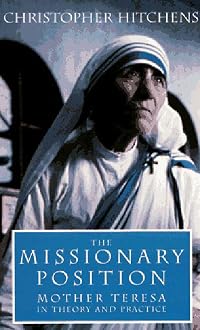
The Missionary Position: Mother Teresa in Theory and Practice
by Christopher Hitchens
On This Page
Description
"A religious fundamentalist, a political operative, a primitive sermonizer, and an accomplice of worldly secular powers. Her mission has always been of this kind. The irony is that she has never been able to induce anybody to believe her. It is past time that she was duly honored and taken at her word." Among his many books, perhaps none has sparked more outrage than The Missionary Position, Christopher Hitchens's meticulous study of the life and deeds of Mother Teresa. A Nobel Peace Prize show more recipient beatified by the Catholic Church in 2003, Mother Teresa of Calcutta was celebrated by heads of state and adored by millions for her work on behalf of the poor. In his measured critique, Hitchens asks only that Mother Teresa's reputation be judged by her actions-not the other way around. With characteristic élan and rhetorical dexterity, Hitchens eviscerates the fawning cult of Teresa, recasting the Albanian missionary as a spurious, despotic, and megalomaniacal operative of the wealthy who long opposed measures to end poverty, and fraternized, for financial gain, with tyrants and white-collar criminals throughout the world. show lessTags
Recommendations






























Member Recommendations


Member Reviews
In attacking the legacy of Mother Teresa, Christopher Hitchens' aim in this polemic is true. It is not so much that she loved the poor but that she fetishized poverty, replacing humility with abjectness and spirituality with anti-materialism. Her missions refused – on dogmatic principles – to deliver proper medical care to the poor and needy who visited, and the places stayed that way for decades, even after the flood of donations that resulted from her fame. (And Hitchens asks: Where did all that money go?) It was a conscious decision to enhance the suffering of the poor, the better to experience 'the glory of God'. Needless to say, Hitchens is not a fan of this needless cruelty.
He also points out that it is hypocritical, for show more whenever 'Mother' herself became ill, she checked into the finest clinics that (other people's donated) money could buy. "There is no conceit equal to false modesty," Hitchens says on page 91, and in the nauseatingly pious Teresa, doing more harm than good, he has the archetype of the foolish religionite he so despised.
You can understand why Hitchens' takedown caused a bit of a stir back when it was published, but you may also wonder whether it is worth reading this book nowadays, given that Mother Teresa is long gone. Well, Hitchens also throws a few punches towards her champions. Politicians and vested-interest-types got a lot of mileage out of their donations to her missions, with the armour provided by their association with her proving very useful indeed (not least to the dictators she also graced with her patronage). Hitchens reserves his best powder for Teresa herself, but these champions in media, politics and elsewhere also get theirs. Their purchased indulgences, and eagerness to use the suffering of the poor as an opportunity to demonstrate their goodness, are what we would nowadays call 'virtue-signalling'.
However, the book is not comprehensive. It is disappointingly short; a sort of cursory overview of what Mother Teresa really was, as opposed to what the media made her out to be. Hitchens introduces each of the points but never goes into great depth about any of them, and before you know it the chapter has moved on and soon the book has ended. The Missionary Position has the right strategy – "judging Mother Teresa's reputation by her actions and words rather than her actions and words by her reputation" (pg. 103) – but does not go on the campaign. It is a fine war map, but with the individual battles left unfought. show less
He also points out that it is hypocritical, for show more whenever 'Mother' herself became ill, she checked into the finest clinics that (other people's donated) money could buy. "There is no conceit equal to false modesty," Hitchens says on page 91, and in the nauseatingly pious Teresa, doing more harm than good, he has the archetype of the foolish religionite he so despised.
You can understand why Hitchens' takedown caused a bit of a stir back when it was published, but you may also wonder whether it is worth reading this book nowadays, given that Mother Teresa is long gone. Well, Hitchens also throws a few punches towards her champions. Politicians and vested-interest-types got a lot of mileage out of their donations to her missions, with the armour provided by their association with her proving very useful indeed (not least to the dictators she also graced with her patronage). Hitchens reserves his best powder for Teresa herself, but these champions in media, politics and elsewhere also get theirs. Their purchased indulgences, and eagerness to use the suffering of the poor as an opportunity to demonstrate their goodness, are what we would nowadays call 'virtue-signalling'.
However, the book is not comprehensive. It is disappointingly short; a sort of cursory overview of what Mother Teresa really was, as opposed to what the media made her out to be. Hitchens introduces each of the points but never goes into great depth about any of them, and before you know it the chapter has moved on and soon the book has ended. The Missionary Position has the right strategy – "judging Mother Teresa's reputation by her actions and words rather than her actions and words by her reputation" (pg. 103) – but does not go on the campaign. It is a fine war map, but with the individual battles left unfought. show less
I've heard of Christopher Hitchens for years, but this is the first time I've read anything by him. In this book, he takes on the iconic Mother Teresa and exposes the duplicity in her messages. His claims are well documented and supported by people who have worked with Mother Teresa.
If it is true that her missions provide inadequate care for the dying while she has accumulated millions in donations, that is, in my mind, a criminal act. If she, and her church, were really concerned about the poor, they would not advocate so strongly against contraception.
Where I disagree with Mr. Hitchens is when he talks about forgiveness...and whether Mother Teresa has a right to forgive -- among others -- him. I think we all have the right to show more forgive what we perceive to be wrongs against ourselves and those we love. Forgiveness, to me, is a personal thing.
This book opened my eyes to two facts. First, the saying that religion is the opiate of the masses. I realized more fully that most of the powerful elite -- not just the leaders of various religions -- want the poor to be faithful. This helps maintain the power inequality in our western societies. China seems to have a different perspective, seeing religion as a rival to the state. So, the book broadened my thinking about who benefits from religion
Secondly, the book can be read as a testament to the lack of investigative journalism. Mother Teresa is good, so no major news media seems to have looked into the story of her financing or life. show less
If it is true that her missions provide inadequate care for the dying while she has accumulated millions in donations, that is, in my mind, a criminal act. If she, and her church, were really concerned about the poor, they would not advocate so strongly against contraception.
Where I disagree with Mr. Hitchens is when he talks about forgiveness...and whether Mother Teresa has a right to forgive -- among others -- him. I think we all have the right to show more forgive what we perceive to be wrongs against ourselves and those we love. Forgiveness, to me, is a personal thing.
This book opened my eyes to two facts. First, the saying that religion is the opiate of the masses. I realized more fully that most of the powerful elite -- not just the leaders of various religions -- want the poor to be faithful. This helps maintain the power inequality in our western societies. China seems to have a different perspective, seeing religion as a rival to the state. So, the book broadened my thinking about who benefits from religion
Secondly, the book can be read as a testament to the lack of investigative journalism. Mother Teresa is good, so no major news media seems to have looked into the story of her financing or life. show less
Hitchens builds a case against Mother Teresa’s image of saintly self-sacrifice helping the poor of Calcutta and the world.
the iconic nature of this woman is such that this book is in the minority when it comes to literature about her. in fact, it’s taken me years to obtain a copy through a library. i have requested it be ordered twice now from my own public library who have said that “funds are not available for new purchases” or they obtain it via interlibrary loan from somewhere else. either way, they have refused to put this book in their collection. appropriately and ironically, the library i finally obtained this from was a public library that services a county which is the location for a prominent Catholic university.
a show more short book, this is more of a “hey, i think we should really be looking into this more” than a piece of investigative journalism. through Mother Teresa’s own quotes, the accounts of people who worked for her, visiting doctors, and a few other documents, Hitchens makes the argument that she is not deserving of her status as icon of compassion and generosity. in fact, she was a staunch champion of the Catholic church’s most regressive and anti-humanitarian doctrines. she worked tireless for perhaps the world’s oldest and most corrupt organization. she consorted with some of the world’s worst purveyors of human suffering (eg the Duvalier’s of Haiti), con artists, and criminals and took money from anyone and everyone she could despite their affiliations to deplorable acts against humanity or denying that she catered to the rich. she amassed millions of dollars and refused to use it to improve conditions within her own missions. she believed that “the world is being much helped by the suffering of the poor.” one physician who visited her facilities in Calcutta remarked that her “approach is clearly separate from the hospice movement. I know which one I prefer.” this after learning that the Missionaries of Charity routinely denied “patients” pain medication other than aspirin and medical diagnosis to determine curability and treatments. another medical professional watched in disbelief as Sisters washed and re-used needles saying that “there’s no point” in sterilizing them since they were dying anyway.
it’s a must read not just for anti-religious or anti-Catholic or ant-bad medical practices readers but because this demonstrates the insidious power and ubiquity of public opinion. Mother Teresa has become synonymous with charity and compassion and gentleness but this is demonstrably not so. breaking open social illusions of this kind can help us tremendously in the fight against disinformation and mindless conformity. understanding that the familiar trope of Mother Teresa which comforts us in knowing someone like her exists, that we can rely on to be there for us when a pithy rejoinder is needed or just a solacing comment about someone’s moral character is not as it appears can lead to the dissolution of many kinds of deception- self-inflicted and otherwise. it is an exercise in critical thinking to explode myths and outright lies like this but more importantly it exposes our willingness to be bamboozled, to be succored by pleasing images despite their falseness, to wallow in the happy safeness of a mythopoeic entity come to life. show less
the iconic nature of this woman is such that this book is in the minority when it comes to literature about her. in fact, it’s taken me years to obtain a copy through a library. i have requested it be ordered twice now from my own public library who have said that “funds are not available for new purchases” or they obtain it via interlibrary loan from somewhere else. either way, they have refused to put this book in their collection. appropriately and ironically, the library i finally obtained this from was a public library that services a county which is the location for a prominent Catholic university.
a show more short book, this is more of a “hey, i think we should really be looking into this more” than a piece of investigative journalism. through Mother Teresa’s own quotes, the accounts of people who worked for her, visiting doctors, and a few other documents, Hitchens makes the argument that she is not deserving of her status as icon of compassion and generosity. in fact, she was a staunch champion of the Catholic church’s most regressive and anti-humanitarian doctrines. she worked tireless for perhaps the world’s oldest and most corrupt organization. she consorted with some of the world’s worst purveyors of human suffering (eg the Duvalier’s of Haiti), con artists, and criminals and took money from anyone and everyone she could despite their affiliations to deplorable acts against humanity or denying that she catered to the rich. she amassed millions of dollars and refused to use it to improve conditions within her own missions. she believed that “the world is being much helped by the suffering of the poor.” one physician who visited her facilities in Calcutta remarked that her “approach is clearly separate from the hospice movement. I know which one I prefer.” this after learning that the Missionaries of Charity routinely denied “patients” pain medication other than aspirin and medical diagnosis to determine curability and treatments. another medical professional watched in disbelief as Sisters washed and re-used needles saying that “there’s no point” in sterilizing them since they were dying anyway.
it’s a must read not just for anti-religious or anti-Catholic or ant-bad medical practices readers but because this demonstrates the insidious power and ubiquity of public opinion. Mother Teresa has become synonymous with charity and compassion and gentleness but this is demonstrably not so. breaking open social illusions of this kind can help us tremendously in the fight against disinformation and mindless conformity. understanding that the familiar trope of Mother Teresa which comforts us in knowing someone like her exists, that we can rely on to be there for us when a pithy rejoinder is needed or just a solacing comment about someone’s moral character is not as it appears can lead to the dissolution of many kinds of deception- self-inflicted and otherwise. it is an exercise in critical thinking to explode myths and outright lies like this but more importantly it exposes our willingness to be bamboozled, to be succored by pleasing images despite their falseness, to wallow in the happy safeness of a mythopoeic entity come to life. show less
An unfortunately titled book that is nevertheless a very well argued if strident argument against the notion that Mother Teresa was the selfless advocate for the poor that her reputation would suggest.
Hitchens argues that her work with the poor was less an attempt to alleviate their suffering than a desire to use them to promote a retrograde worldview; “to propagandize one highly subjective view of human nature and need, so that she may one day be counted as a beatific founder of a new order and discipline within the Church itself.” He backs this up with several lines of evidence.
He interviewed a number of former volunteers with Teresa’s “Missionaries of Charity,” documenting the substandard condition at a number of their show more facilities despite the enormous amounts of money they had been given. The hospice facilities for example, provided almost no palliative care, reused unsterilized equipment, and provided nothing in the way of physical comfort for the patients under their care. In one documented case a 15 year old boy became terminal after the nuns running the hospice facility neglected to get the boy proper medical care. Time after time, “Missionaries of Charity’ declined to provide the resources necessary to actually lift the poor under their care out of the poverty they were suffering under
As Hitchens points out, whenever the needs of the poor conflicted with her religious worldview, it was the religious view that won out. Militantly anti-abortion and anti-contraception, she viewed the over population she saw around her as evidence of God’s grace.
Her reputation as an political neophyte allowed her to escape criticism for letting her name and reputation be used by various crooks, thugs and dictators including the brutal dictator of Haiti Jean-Claude Duvalier, and crook Charles Keating, looking to exculpate their crimes in the eyes of the public. In fact the evidence shows she was not a political neophyte and knew quite well how and when she could use the support of such people without drawing criticism to herself. A blatant example of this is the letter she wrote to Judge Lance Ito asking that Charles Keating be shown leniency in his sentencing for bilking hundreds of millions of dollars from the unsuspecting investors he hoodwinked. When a prosecutor in the case wrote a reply explaining exactly what Keating had done and that perhaps the Christian thing to do would be to return the money she had been given by Keating so it could be returned to its owners, he was met with silence.
I’m not an uncritical fan of Hitchens. He sometimes went out of his way to be insulting (as the title of this books shows). His views on American politics and culture were juvenile and often ill-informed. and of course his support for the Iraq war was a spectacular blunder. Having said all that however, we need folks like Hitchens to stir up the pot and force us to take a critical look at the people and institutions we rely on to make sure we are not deluding ourselves about their effectiveness. This goes for religious institutions as well. Were the facilities under Mother Teresa’s direction subject to the same scrutiny as those run by secular non-profits or the government they would have been shut down, or their funds would have dried up as donors got word of their ineffectiveness.
Both Hitchens and Mother Teresa have passed away of course, so neither can elaborate or defend their positions. I have tried to look for a reasoned look at her work from a sympathetic viewpoint, but all seem to be of the hagiographic variety. I will keep looking
Missionary Position continues to have relevance due to the cautionary tale it highlights. show less
Hitchens argues that her work with the poor was less an attempt to alleviate their suffering than a desire to use them to promote a retrograde worldview; “to propagandize one highly subjective view of human nature and need, so that she may one day be counted as a beatific founder of a new order and discipline within the Church itself.” He backs this up with several lines of evidence.
He interviewed a number of former volunteers with Teresa’s “Missionaries of Charity,” documenting the substandard condition at a number of their show more facilities despite the enormous amounts of money they had been given. The hospice facilities for example, provided almost no palliative care, reused unsterilized equipment, and provided nothing in the way of physical comfort for the patients under their care. In one documented case a 15 year old boy became terminal after the nuns running the hospice facility neglected to get the boy proper medical care. Time after time, “Missionaries of Charity’ declined to provide the resources necessary to actually lift the poor under their care out of the poverty they were suffering under
As Hitchens points out, whenever the needs of the poor conflicted with her religious worldview, it was the religious view that won out. Militantly anti-abortion and anti-contraception, she viewed the over population she saw around her as evidence of God’s grace.
Her reputation as an political neophyte allowed her to escape criticism for letting her name and reputation be used by various crooks, thugs and dictators including the brutal dictator of Haiti Jean-Claude Duvalier, and crook Charles Keating, looking to exculpate their crimes in the eyes of the public. In fact the evidence shows she was not a political neophyte and knew quite well how and when she could use the support of such people without drawing criticism to herself. A blatant example of this is the letter she wrote to Judge Lance Ito asking that Charles Keating be shown leniency in his sentencing for bilking hundreds of millions of dollars from the unsuspecting investors he hoodwinked. When a prosecutor in the case wrote a reply explaining exactly what Keating had done and that perhaps the Christian thing to do would be to return the money she had been given by Keating so it could be returned to its owners, he was met with silence.
I’m not an uncritical fan of Hitchens. He sometimes went out of his way to be insulting (as the title of this books shows). His views on American politics and culture were juvenile and often ill-informed. and of course his support for the Iraq war was a spectacular blunder. Having said all that however, we need folks like Hitchens to stir up the pot and force us to take a critical look at the people and institutions we rely on to make sure we are not deluding ourselves about their effectiveness. This goes for religious institutions as well. Were the facilities under Mother Teresa’s direction subject to the same scrutiny as those run by secular non-profits or the government they would have been shut down, or their funds would have dried up as donors got word of their ineffectiveness.
Both Hitchens and Mother Teresa have passed away of course, so neither can elaborate or defend their positions. I have tried to look for a reasoned look at her work from a sympathetic viewpoint, but all seem to be of the hagiographic variety. I will keep looking
Missionary Position continues to have relevance due to the cautionary tale it highlights. show less
Astonishing. I knew almost nothing about her, except for her reputation as all-loving (good), and her campaign against birth control (not good). So this book was quite an eye-opener.
A few excerpts:
Mother Teresa: "I think it is very beautiful for the poor to accept their lot, to share it with the passion of Christ. I think the world is being much helped by the suffering of the poor people."
My comment: Really? Is that why she's against birth control? To create more suffering poor people? And that helps the world in some weird twisted way?
She described a person ... in the last agonies of cancer and suffering unbearable pain. With a smile, Mother Teresa told the camera what she told this terminal patient: "You are suffering like Christ on show more the cross. So Jesus must be kissing you." ... She then told of the sufferer's reply: "Then please tell him to stop kissing me."
My comment: This is despite having millions of $$ in the bank and access to pain medications. Personally, I'd rather die alone, without Jesus "kissing" me!
As she told an interviewer, if faced with the choice between Galileo and the authority of the Inquisition, she would have sided with the church authorities.
That's downright scary! But after reading this book, it's no surprise. show less
A few excerpts:
Mother Teresa: "I think it is very beautiful for the poor to accept their lot, to share it with the passion of Christ. I think the world is being much helped by the suffering of the poor people."
My comment: Really? Is that why she's against birth control? To create more suffering poor people? And that helps the world in some weird twisted way?
She described a person ... in the last agonies of cancer and suffering unbearable pain. With a smile, Mother Teresa told the camera what she told this terminal patient: "You are suffering like Christ on show more the cross. So Jesus must be kissing you." ... She then told of the sufferer's reply: "Then please tell him to stop kissing me."
My comment: This is despite having millions of $$ in the bank and access to pain medications. Personally, I'd rather die alone, without Jesus "kissing" me!
As she told an interviewer, if faced with the choice between Galileo and the authority of the Inquisition, she would have sided with the church authorities.
That's downright scary! But after reading this book, it's no surprise. show less
If you venerate Mother Teresa, or even if you just think she was a simple woman who sacrificed herself to aid the world’s poor and you want her to remain on a pedestal, don’t read this book. However, if you like to ask questions and look at things from a different angle than we are fed from the mass media, this is a fascinating book. And at only 98 pages, it’s also a quick read.
Every writer has an agenda, and Christopher Hitchens is less than subtle with his: I’ve heard him declare elsewhere that he has contempt for religion. So I expected a virulent attack on the poor old martyr. But that’s not what he delivered. Although Mother Teresa comes off poorly, his writing is not mean spirited. He looks at facts and events from a show more fresh perspective, and asks difficult questions. His information is drawn from his personal visit with Mother Teresa in India, and from interviews with medical workers and religious volunteers who assisted her over the years. Highly recommended. show less
Every writer has an agenda, and Christopher Hitchens is less than subtle with his: I’ve heard him declare elsewhere that he has contempt for religion. So I expected a virulent attack on the poor old martyr. But that’s not what he delivered. Although Mother Teresa comes off poorly, his writing is not mean spirited. He looks at facts and events from a show more fresh perspective, and asks difficult questions. His information is drawn from his personal visit with Mother Teresa in India, and from interviews with medical workers and religious volunteers who assisted her over the years. Highly recommended. show less
My head just exploded.................Wow! What were those biases keeping me from seeing reality once again? How did I manage to keep Mother Teresa in a separate category from Falwell, Bakker, and Oral Roberts so long? Was it it because she was a woman? a Catholic? What?! I get the duality of human nature and still............Ouch!
Hitchens always backs up his work and does so once again. As usual, his claims are evidence based and he uses the letters from Mother Teresa herself and a response from a Deputy District Attorney from Los Angeles, Paul Turley, to tell the story. When Charles Keating was up for sentencing for his financial crimes, Mother Teresa wrote a letter to Judge Ito asking for justice and mercy for this man who had show more stolen millions from others, and given quite a bit to her through the Missionaries of Charity. DDA Turley wrote to her asking what she thought Jesus would do in her circumstances. Turley suggested she could help Keating make reparation by returning the stolen money he had given her to the people from whom Keating stole it. Turley offered to put her in touch with those people. She made no response and no transfer of funds.
On a second point, Hitchens stated in a recent interview that there is one known answer to poverty, one and only one solution that has worked wherever and whenever it has been tried, in a variety of different cultures and circumstances. That solution is addressing issues of women's health and reproductive rights. Mother Teresa has throughout her life, preached against women's rights to use birth control. These are only two of the points Hitchens makes in The Missionary Position.
Read it and weep. show less
Hitchens always backs up his work and does so once again. As usual, his claims are evidence based and he uses the letters from Mother Teresa herself and a response from a Deputy District Attorney from Los Angeles, Paul Turley, to tell the story. When Charles Keating was up for sentencing for his financial crimes, Mother Teresa wrote a letter to Judge Ito asking for justice and mercy for this man who had show more stolen millions from others, and given quite a bit to her through the Missionaries of Charity. DDA Turley wrote to her asking what she thought Jesus would do in her circumstances. Turley suggested she could help Keating make reparation by returning the stolen money he had given her to the people from whom Keating stole it. Turley offered to put her in touch with those people. She made no response and no transfer of funds.
On a second point, Hitchens stated in a recent interview that there is one known answer to poverty, one and only one solution that has worked wherever and whenever it has been tried, in a variety of different cultures and circumstances. That solution is addressing issues of women's health and reproductive rights. Mother Teresa has throughout her life, preached against women's rights to use birth control. These are only two of the points Hitchens makes in The Missionary Position.
Read it and weep. show less
Members
- Recently Added By
Lists

Best books read in 2011
200 works; 51 members
Author Information

88+ Works 29,834 Members
Christopher Hitchens was born in Portsmouth, England on April 13, 1949. He was a contributing editor to Vanity Fair and wrote for numerous other publications throughout his lifetime. He was the author of numerous books including No One Left to Lie To, For the Sake of Argument, Prepared for the Worst, God Is Not Great, Hitch-22: A Memoir, and show more Arguably. He died due to complication from esophageal cancer on December 15, 2011 at the age of 62. (Bowker Author Biography) show less
Some Editions
Work Relationships
Common Knowledge
- Canonical title
- The Missionary Position: Mother Teresa in Theory and Practice
- Original publication date
- 1995
- People/Characters
- Mother Teresa
- Dedication
- For Edwin and Gertrude Blue; saintly but secular.
- First words
- Who would be so base as to pick on a wizened, shrivelled old lady, well stricken in years, who has consecrated her entire life to the needy and the destitute?
- Last words
- (Click to show. Warning: May contain spoilers.)It is past time that she was subjected to the rational critique that she has evaded so arrogantly and for so long.
Classifications
- Genres
- Religion & Spirituality, Nonfiction, General Nonfiction, Biography & Memoir, History
- DDC/MDS
- 271.97 — Religion History of Christianity Religious congregations and orders in church history Orders of Women Other Roman sisterhoods
- LCC
- BX4406.5 .Z8 .H55 — Philosophy, Psychology and Religion Christian Denominations Christian Denominations Catholic Church Monasticism. Religious orders Religious orders of women
- BISAC
Statistics
- Members
- 1,062
- Popularity
- 24,121
- Reviews
- 34
- Rating
- (3.84)
- Languages
- Dutch, English, French, Italian
- Media
- Paper, Audiobook, Ebook
- ISBNs
- 20
- ASINs
- 6