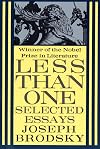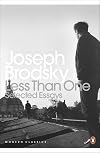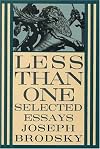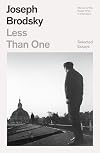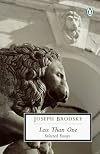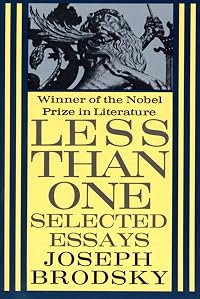
Less Than One: Selected Essays
by Joseph Brodsky
On This Page
Description
Includes essays on Russian writers, Western poets, politics, and the author's native city, Leningrad. "This collection of essays thrusts Brodsky--heretofore known more for his poetry and translations--into the forefront of the "Third Wave" of Russian emigre writers. His insights into the works of Dostoyevsky, Mandelstam, Platonov, as well as non-Russian poets Auden, Cavafy and Montale are brilliant. While the Western popularity of many other Third Wavers has been stunted by their inability show more to write in English, Brodsky consumed the language to attain a "closer proximity" to poets such as Auden. The book, which won a National Book Critics Circle Award, opens and closes with revealing autobiographical essay."--Publisher's website. show lessTags
Recommendations









Member Reviews
Mandelstam was, one is tempted to say, a modern Orpheus: sent to hell, he never returned, while his widow dodged across one-sixth of the earth's surface, clutching the saucepan with his songs rolled up inside, memorizing them by night in the event they were found by Furies with a search warrant.
Brodsky is at his best when speaking about the greats, Tsvetaeva, Mandestam, Auden, Frost. He drifts into crank-ness when speaking philosophically, which he is wont to do in these pages, about Tyranny, Civilization or Evil.
Throughout one’s life, time addresses man in a variety of languages: in those of innocence, love, faith, experience, history, fatigue, cynicism, guilt, decay, etc. Of those, the language of love is clearly the lingua show more franca.
There is a great deal of longing here, for Petersburg, his parents, for a time when life was free from sweeping definitions of Guilt or Innocence. Yet the pull is too strong. Brodsky sees Evil looming, He asserts that poetry precedes prose, that empires are built on language. He champions Platonov and finds Auden the greatest mind of the 20C. He offers extremely close readings of poems, ones which both dazzle and confront. He is betrays periodically his surprise fortune and then just as deftly leaps form the guilt, if only he could.
https://www.youtube.com/watch?v=UPmMFbCI_f0
Keep this in mind when pondering judgement. show less
Brodsky is at his best when speaking about the greats, Tsvetaeva, Mandestam, Auden, Frost. He drifts into crank-ness when speaking philosophically, which he is wont to do in these pages, about Tyranny, Civilization or Evil.
Throughout one’s life, time addresses man in a variety of languages: in those of innocence, love, faith, experience, history, fatigue, cynicism, guilt, decay, etc. Of those, the language of love is clearly the lingua show more franca.
There is a great deal of longing here, for Petersburg, his parents, for a time when life was free from sweeping definitions of Guilt or Innocence. Yet the pull is too strong. Brodsky sees Evil looming, He asserts that poetry precedes prose, that empires are built on language. He champions Platonov and finds Auden the greatest mind of the 20C. He offers extremely close readings of poems, ones which both dazzle and confront. He is betrays periodically his surprise fortune and then just as deftly leaps form the guilt, if only he could.
https://www.youtube.com/watch?v=UPmMFbCI_f0
Keep this in mind when pondering judgement. show less
Brodski é cativante quando conta suas histórias de vida, a infância marginal na União Soviética, a perseguição, a emigração e os problemas dos pais; e também em seus ensaios sobre história e literatura. Ao mesmo tempo que sua história é trágica e comovente, ele nos faz rir, como quando descreve os estranhos trabalhos que teve, ainda na União Soviética. Seus ensaios mostram sua veneração por alguns autores, e excitam, deixam o leitor curioso, louco para ler mais do que os versos que ele apresenta. Ensaios como “A Guide to a Renamed City” ou “Footnote to a Poem” são tão maravilhosos que senti pena quando terminaram. Adoro como ele fala de como a literatura russa escolheu seguir o caminho de Tolstói, não as show more grandiosidades de Dostoiévski. show less
The collection of critical and autobiographical essays from Nobel Prize-winner Joseph Brodsky that catapulted the author--heretofore known more for his poetry and translations--into the forefront of the "Third Wave" of Russian émigré writers.
His insights into the works of Dostoyevsky, Mandelstam, Platonov, as well as non-Russian poets Auden, Cavafy and Montale are brilliant. While the Western popularity of many other Third Wavers has been stunted by their inability to write in English, Brodsky consumed the language to attain a "closer proximity" to poets such as Auden. Less Than One, which won a National Book Critics Circle Award, opens and closes with revealing autobiographical essay.
His insights into the works of Dostoyevsky, Mandelstam, Platonov, as well as non-Russian poets Auden, Cavafy and Montale are brilliant. While the Western popularity of many other Third Wavers has been stunted by their inability to write in English, Brodsky consumed the language to attain a "closer proximity" to poets such as Auden. Less Than One, which won a National Book Critics Circle Award, opens and closes with revealing autobiographical essay.
This collection of Brodsky's essays displays the full range of interests; poetic, literary, political and historical. Essays on writers deal with Akhmatova, Tsvetneva and Madlestam, as well as western poets like Auden, Montale, Cavafy and Derek Walcott. In "Catalogues in the Art", Brodsky addresses the history and future of Russian prose, and in "On Tyranny" and "Flight from Byzantium", he offers meditations on history and the modern age.
Recommended by Kay Ryan.
Amazon: "This collection of essays thrusts Brodsky--heretofore known more for his poetry and translations--into the forefront of the "Third Wave" of Russian emigre writers. His insights into the works of Dostoyevsky, Mandelstam, Platonov, as well as non-Russian poets Auden, Cavafy and Montale are brilliant. While the Western popularity of many other Third Wavers has been stunted by their inability to write in English, Brodsky consumed the language to attain a "closer proximity" to poets such as Auden. The book, which won a National Book Critics Circle Award, opens and closes with revealing autobiographical essay.
Amazon: "This collection of essays thrusts Brodsky--heretofore known more for his poetry and translations--into the forefront of the "Third Wave" of Russian emigre writers. His insights into the works of Dostoyevsky, Mandelstam, Platonov, as well as non-Russian poets Auden, Cavafy and Montale are brilliant. While the Western popularity of many other Third Wavers has been stunted by their inability to write in English, Brodsky consumed the language to attain a "closer proximity" to poets such as Auden. The book, which won a National Book Critics Circle Award, opens and closes with revealing autobiographical essay.
found among Pop's books
Ratings
Members
- Recently Added By
Published Reviews
ThingScore 100
If there's an essential essay collection, it's this one.
added by russianreader
Brodsky’s title piece, “Less Than One,” takes us back to his St. Petersburg childhood, and “A Guide to a Renamed City” is a wonderful evocation of the former capital, a city in which a man “spends as much time on foot as any good Bedouin.” Although Less Than One is vitriolic on the subject of Russian politics, the general effect of these essays is of an intelligence as lyrical show more and benign as Auden’s own. The two pieces on him are outstanding, and there are equally brilliant essays on other poets, on Akhmatova, Tsvetaeva, and Mandelstam, Dante, Montale, and Derek Walcott—the last the most illuminating and understanding appraisal that has been written about the West Indian poet. show less
added by SnootyBaronet
Lists

Russian Literature
184 works; 35 members

Nobel Price Winners
222 works; 20 members

Writers at Risk
106 works; 17 members

In Our Time books
4,934 works; 2 members
Author Information

216+ Works 3,920 Members
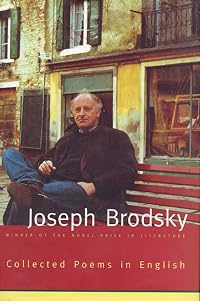
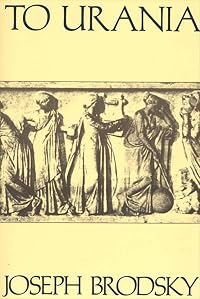
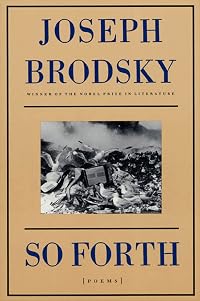
Joseph Brodsky was born in Leningrad on May 24, 1940. He left school at the age of fifteen, taking jobs in a morgue, a mill, a ship's boiler room, and a geological expedition. During this time he taught himself English and Polish and began writing poetry. His first poems appeared mainly in Syntax, a Leningrad underground literary magazine. In show more 1964, he was tried and sentenced to five years of administrative exile for the charge of parasitism. As a result of intervention by prominent Soviet cultural figures, he was freed in 1965. In 1972, under tremendous pressure from the authorities, he emigrated to the United States. He wrote nine volumes of poetry and several collections of essays. His works include A Part of Speech, To Urania, Watermark, On Grief and Reason, So Forth, and Collected Poems in English. He received the Nobel Prize for Literature in 1987 and was named poet laureate of the United States, the first poet whose native language was not English to achieve this honor. He died of a heart attack on January 28, 1996. (Bowker Author Biography) show less
Some Editions
Awards and Honors
Series
Belongs to Publisher Series
Work Relationships
Common Knowledge
- Canonical title*
- Tussen iemand en niemand
- Original title
- Less Than One: Selected Essays
- Original publication date
- 1986
- Important places
- Saint Petersburg, Russia; Leningrad, USSR; Instanbul, Turkey
- Epigraph
- And the heart doesn't die when one thinks it should. Czeslaw Milosz, "Elegy for N.N."
- Dedication
- In memory of my mother and my father In memory of Carl Ray Proffer
- First words
- As failures go, attempting to recall the past is like trying to grasp the meaning of existence.
- Quotations
- What’s interesting about Platonov’s style is that he appears to have deliberately and completely subordinated himself to the vocabulary of his Utopia—with all its cumbersome neologisms, abbreviations, acronyms, bureaucr... (show all)atese, sloganeering, militarized imperatives, and the like.
There is something in the granular texture of the granite pavement next to the constantly flowing, departing water that instills in one’s soles an almost sensual desire for walking. The seaweed-smelling head wind from the s... (show all)ea has cured here many hearts oversaturated with lies, despair, and powerlessness.
To this day, I think that the country would do a hell of a lot better if it had for its national banner not that foul double-headed imperial fowl or the vaguely masonic hammer-and-sickle, but the flag of the Russian Navy: our... (show all) glorious, incomparably beautiful flag of St. Andrew: the diagonal blue cross against a virginwhite background. - Last words
- (Click to show. Warning: May contain spoilers.)The poor tend to utilize everything. I utilize my sense of guilt.
- Original language*
- Engels
*Some information comes from Common Knowledge in other languages. Click "Edit" for more information.
Classifications
- Genres
- Nonfiction, Literature Studies and Criticism, Fiction and Literature
- DDC/MDS
- 809.104 — Literature & rhetoric Literature, rhetoric & criticism History, description, critical appraisal of more than two literatures Poetry
- LCC
- PN1271 .B76 — Language and Literature Literature (General) Literature (General) Poetry History and criticism
- BISAC
Statistics
- Members
- 609
- Popularity
- 47,973
- Reviews
- 6
- Rating
- (4.24)
- Languages
- 10 — Dutch, English, Finnish, Italian, Norwegian (Bokmål), Portuguese, Russian, Serbian, Spanish, Swedish
- Media
- Paper, Ebook
- ISBNs
- 20
- ASINs
- 5