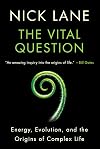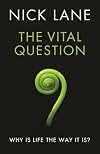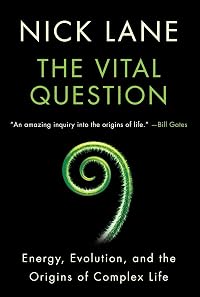
The Vital Question: Energy, Evolution, and the Origins of Complex Life
by Nick Lane
On This Page
Description
A biochemist, building on the pillars of evolutionary theory and drawing on cutting-edge research into the link between energy and genes, argues that the evolution of multicellular life was the result of a single event.Tags
Recommendations
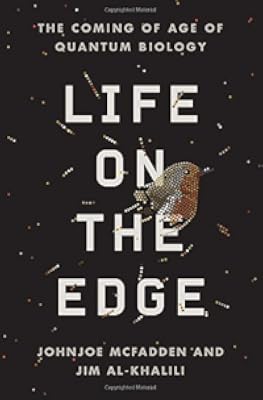
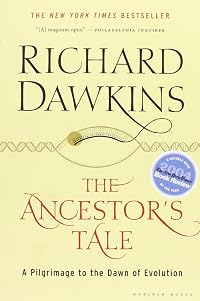
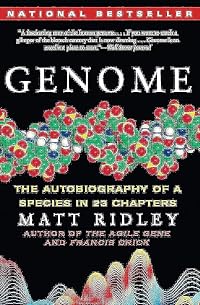
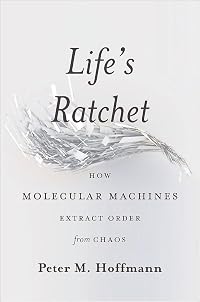
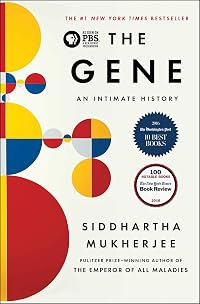
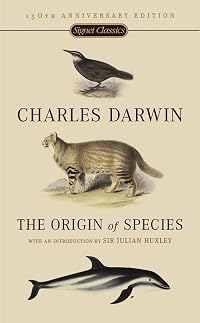
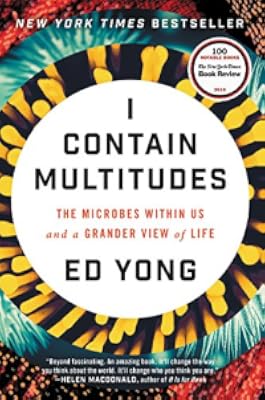
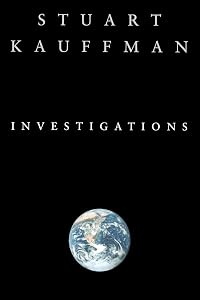

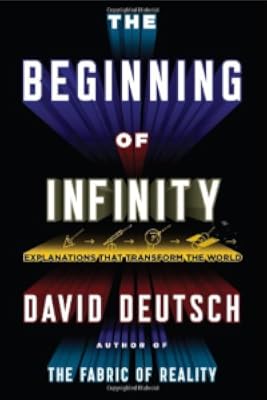
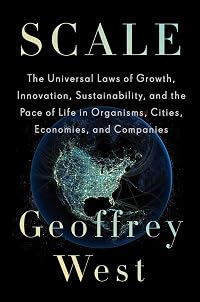
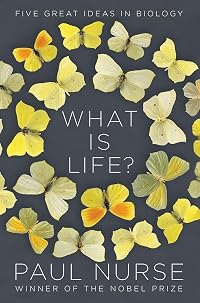
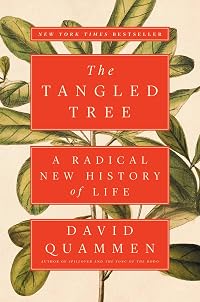
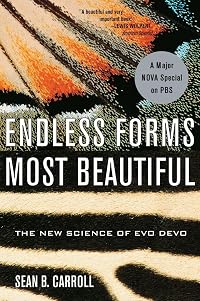
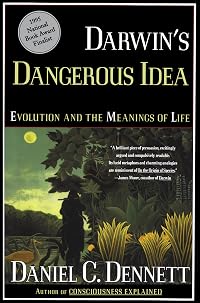
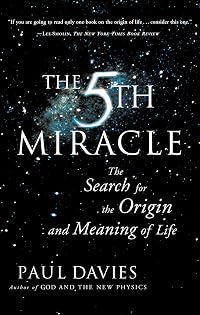
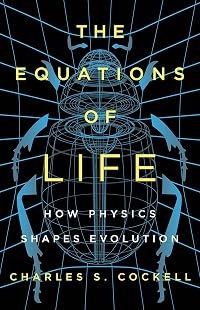

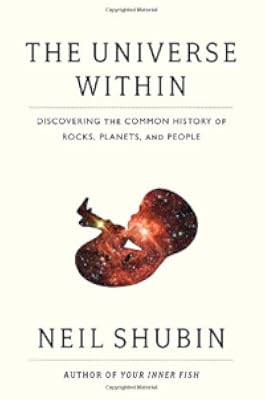
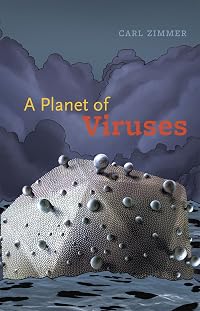
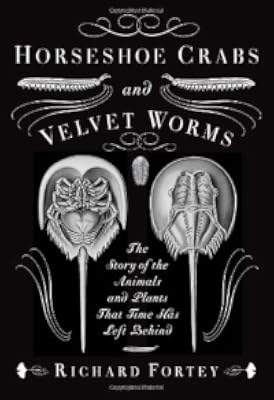
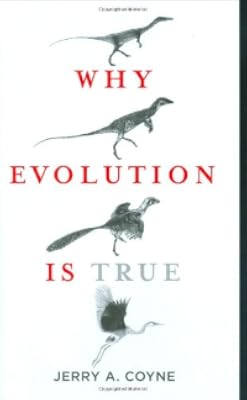
Member Recommendations

stellarexplorer These are complementary books, Lane more focused on energetics and Harold on cellular evolution.
Member Reviews
I’m not going to tell you that this is a hard book, one that requires effort and repays it many times over. Because I don’t want to scare you off. The book is that good.
Why do I recommend this book so highly? Nick Lane is among the world’s leading evolutionary biochemists, and certainly one of biology’s most articulate spokesmen. He never speaks down to the reader, but asks that you open yourself to core principles that are challenging.
If you took biology once upon a time, this is a book that might excite you. It is full of answers to previous unknowns, completions of sentences that once had no endings. Of course each answer raises its new questions, but this book is what happens when you turn your head for a few decades while show more smart people keep right on pointing their ever-sharper tools at the most basic questions.
Lane briefly but meticulously takes the reader through the history of life on Earth. The important events ended around two billion years ago. He explains the current thinking on the relation of the earliest cells to later cells, and offers up a theory that has supplanted Stanley Miller’s 1953 “primordial soup” theory of the origin of life that you may recall from school. The clarion call that rings out is this: the beautiful, symmetrical, functional, graspable double helical structure of DNA tells us about the conservation and replication of information in life. This is vital and necessary. But its vivid intuitive truth may have blinded us to another component of life that is perhaps even more basic and necessary – the energy that powers the cell. Lane argues forcefully that the molecular machinery behind this task ought to be as emblematic of life as the structure of DNA itself has become.
The kicker is that the abiotic chemical processes that were at work on the early Earth drove the start of life, and there is every reason to expect that the same processes are at work on the quadrillion other planets that have the necessary ingredients. What was essential to creating this world of miraculous diversity? A humble menu of rock, water, and carbon dioxide.
Someone should be screaming this from the rooftops! show less
Why do I recommend this book so highly? Nick Lane is among the world’s leading evolutionary biochemists, and certainly one of biology’s most articulate spokesmen. He never speaks down to the reader, but asks that you open yourself to core principles that are challenging.
If you took biology once upon a time, this is a book that might excite you. It is full of answers to previous unknowns, completions of sentences that once had no endings. Of course each answer raises its new questions, but this book is what happens when you turn your head for a few decades while show more smart people keep right on pointing their ever-sharper tools at the most basic questions.
Lane briefly but meticulously takes the reader through the history of life on Earth. The important events ended around two billion years ago. He explains the current thinking on the relation of the earliest cells to later cells, and offers up a theory that has supplanted Stanley Miller’s 1953 “primordial soup” theory of the origin of life that you may recall from school. The clarion call that rings out is this: the beautiful, symmetrical, functional, graspable double helical structure of DNA tells us about the conservation and replication of information in life. This is vital and necessary. But its vivid intuitive truth may have blinded us to another component of life that is perhaps even more basic and necessary – the energy that powers the cell. Lane argues forcefully that the molecular machinery behind this task ought to be as emblematic of life as the structure of DNA itself has become.
The kicker is that the abiotic chemical processes that were at work on the early Earth drove the start of life, and there is every reason to expect that the same processes are at work on the quadrillion other planets that have the necessary ingredients. What was essential to creating this world of miraculous diversity? A humble menu of rock, water, and carbon dioxide.
Someone should be screaming this from the rooftops! show less
(Rating: 4.0 / 5.0, even)
The twenty to thirty percent of this book that I actually understood was excellent. The Vital Question is a thoughtful, persuasive treatise, full of fascinating proposals like, say, a conjecture that the vibrant plumage of male birds demonstrates mitochondrial health to female birds (as most pigments are synthesized in the mitochondria). Nick Lane outlines an emerging theory about the origins of the eukaryotic cell, leading us through a history of the field's ideas (cellular biology’s "oxphos wars" were a highlight), uprooting some established doctrines while defending and expanding on others. Unfortunately, even if I'm not the book’s intended audience, the amount of time I spent thumbing back and forth show more between the book and its glossary in an attempt to parse any given sentence is a clue that the writing could have been clearer – my willingness to do so, however, speaks to the ultimate success of this book. Undoubtedly, I'll read more Nick Lane, but I'll likely do so with a calorie-dense jar of peanut butter handy to sustain my own vitality. show less
The twenty to thirty percent of this book that I actually understood was excellent. The Vital Question is a thoughtful, persuasive treatise, full of fascinating proposals like, say, a conjecture that the vibrant plumage of male birds demonstrates mitochondrial health to female birds (as most pigments are synthesized in the mitochondria). Nick Lane outlines an emerging theory about the origins of the eukaryotic cell, leading us through a history of the field's ideas (cellular biology’s "oxphos wars" were a highlight), uprooting some established doctrines while defending and expanding on others. Unfortunately, even if I'm not the book’s intended audience, the amount of time I spent thumbing back and forth show more between the book and its glossary in an attempt to parse any given sentence is a clue that the writing could have been clearer – my willingness to do so, however, speaks to the ultimate success of this book. Undoubtedly, I'll read more Nick Lane, but I'll likely do so with a calorie-dense jar of peanut butter handy to sustain my own vitality. show less
An interesting book, but this is absolutely not for the newbie. While the descriptions are good and the science is interesting I found myself deep in the world of molecular biology, and no matter how good the writer, that's a place only for those who consider "ribosome" and mitochondria basic terminology.
Overall the book is a little slow, the author has a tendency to drag things out, and while it's interesting and much of it is a new or more indepth for me (BS Biology, DVM, moderately well read on science), it did often read that the author was giving more weight to his beliefs because they were his beliefs (shocker) while tossing outside other ideas still considered widely possible as we wade through life and learn along the way. show more Definitely not a book to read if you're looking for an unbiased take on what's out there in the field. There is a good references section, etc., so readers can do their own reading.
Overall an interesting book, I learned lots of interesting tidbits, but slow, such that I often skimmed to the next interesting factoid. show less
Overall the book is a little slow, the author has a tendency to drag things out, and while it's interesting and much of it is a new or more indepth for me (BS Biology, DVM, moderately well read on science), it did often read that the author was giving more weight to his beliefs because they were his beliefs (shocker) while tossing outside other ideas still considered widely possible as we wade through life and learn along the way. show more Definitely not a book to read if you're looking for an unbiased take on what's out there in the field. There is a good references section, etc., so readers can do their own reading.
Overall an interesting book, I learned lots of interesting tidbits, but slow, such that I often skimmed to the next interesting factoid. show less
A thoroughly interesting book on the origins of life, the origins of eukaryotic life, and some constraints on modern life from the point of view of analysing the energy pump model used by all cells ( a proton pump using ATP ADP conversion). It does go into some detail and takes its chemistry seriously, but it does not require any special expertise to follow (my last chemistry class was in Grade 13 almost forty years ago, and I have no training at all in biology other than general popular science reading).
What a juggernaut this is. It deals with the latest in the research about the origins of life, and while it once was a question too hard to answer, over the last decade real progress has been made. The question from the title deals with why all complex life is the way it is (including sex & death), and why that differs from bacteria – who evolved for 4 billion years without changing their basic form.
Lane’s book is about his own research, and it is both a thesis and a page turner. I have to admit there were a few pages that went over my head, and some sections were maybe too detailed for my tastes, but the bulk of the book is accessible to the layman, that is if you are willing to put in a serious effort, and have brains enough to show more recall some of the chemistry from high school. Lane’s prose is smooth and snappy. Instantly one of my favorite non-fiction books, with a broad scope – genetics, biology, chemistry, geology: it’s all relevant to the answers. I’ve read praise saying this is on a Copernican level, but I can’t judge that myself.
I read the original, but I’ve noticed it’s available in Dutch too, with the terrible title 'De Belangrijkste Vraag Van Het Leven'.
Weighing A Pig Doesn't Fatten It show less
Lane’s book is about his own research, and it is both a thesis and a page turner. I have to admit there were a few pages that went over my head, and some sections were maybe too detailed for my tastes, but the bulk of the book is accessible to the layman, that is if you are willing to put in a serious effort, and have brains enough to show more recall some of the chemistry from high school. Lane’s prose is smooth and snappy. Instantly one of my favorite non-fiction books, with a broad scope – genetics, biology, chemistry, geology: it’s all relevant to the answers. I’ve read praise saying this is on a Copernican level, but I can’t judge that myself.
I read the original, but I’ve noticed it’s available in Dutch too, with the terrible title 'De Belangrijkste Vraag Van Het Leven'.
Weighing A Pig Doesn't Fatten It show less
To explain the mystery of how life evolved on Earth, Nick Lane explores the deep link between energy and genes.
The Earth teems with life: in its oceans, forests, skies and cities. Yet there’s a black hole at the heart of biology. We do not know why complex life is the way it is, or, for that matter, how life first began. In The Vital Question, award-winning author and biochemist Nick Lane radically reframes evolutionary history, putting forward a solution to conundrums that have puzzled generations of scientists.
For two and a half billion years, from the very origins of life, single-celled organisms such as bacteria evolved without changing their basic form. Then, on just one occasion in four billion years, they made the jump to show more complexity. All complex life, from mushrooms to man, shares puzzling features, such as sex, which are unknown in bacteria. How and why did this radical transformation happen?
The answer, Lane argues, lies in energy: all life on Earth lives off a voltage with the strength of a lightning bolt. Building on the pillars of evolutionary theory, Lane’s hypothesis draws on cutting-edge research into the link between energy and cell biology, in order to deliver a compelling account of evolution from the very origins of life to the emergence of multicellular organisms, while offering deep insights into our own lives and deaths.
Both rigorous and enchanting, The Vital Question provides a solution to life’s vital question: why are we as we are, and indeed, why are we here at all? show less
The Earth teems with life: in its oceans, forests, skies and cities. Yet there’s a black hole at the heart of biology. We do not know why complex life is the way it is, or, for that matter, how life first began. In The Vital Question, award-winning author and biochemist Nick Lane radically reframes evolutionary history, putting forward a solution to conundrums that have puzzled generations of scientists.
For two and a half billion years, from the very origins of life, single-celled organisms such as bacteria evolved without changing their basic form. Then, on just one occasion in four billion years, they made the jump to show more complexity. All complex life, from mushrooms to man, shares puzzling features, such as sex, which are unknown in bacteria. How and why did this radical transformation happen?
The answer, Lane argues, lies in energy: all life on Earth lives off a voltage with the strength of a lightning bolt. Building on the pillars of evolutionary theory, Lane’s hypothesis draws on cutting-edge research into the link between energy and cell biology, in order to deliver a compelling account of evolution from the very origins of life to the emergence of multicellular organisms, while offering deep insights into our own lives and deaths.
Both rigorous and enchanting, The Vital Question provides a solution to life’s vital question: why are we as we are, and indeed, why are we here at all? show less
A very clear explanation of the importance of bioenergetics in the origin of life and the evolution of the eukaryotes, and a detailed discussion of the possible role of endosymbiosis in the evolution of complex organisms, sex, apoptosis and aging. A lot has happened since I learned the Krebs cycle, and just the update, including the extraordinary appearance of ATP synthase, along with the discussion relating biochemistry to evolution makes the book worthwhile. Dr. Lane's imagined trip through a mitochondrion, shrinking us to the size of an ATP molecule, to explain chemiosmotic coupling is inspired.
Members
- Recently Added By
Lists

Top Five Books of 2016
795 works; 229 members

Top Five Books of 2017
757 works; 231 members

Books Read in 2016
4,666 works; 199 members

Books Read in 2017
4,249 works; 130 members

In Our Time books
4,934 works; 2 members

Books Read in 2023
5,638 works; 147 members
Author Information

5+ Works 2,793 Members
Awards and Honors
Notable Lists
Common Knowledge
- Original publication date
- 2015
Classifications
Statistics
- Members
- 796
- Popularity
- 34,820
- Reviews
- 21
- Rating
- (4.21)
- Languages
- 6 — Dutch, English, German, Polish, Portuguese, Spanish
- Media
- Paper, Audiobook, Ebook
- ISBNs
- 16
- UPCs
- 1
- ASINs
- 6