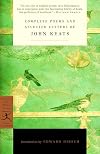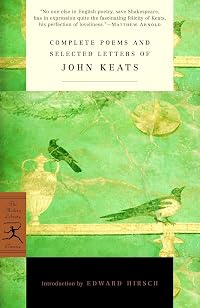
Complete Poems and Selected Letters of John Keats
by John Keats
On This Page
Description
Collects the poetry and correspondence of the English poet.Tags
Recommendations

Member Recommendations


Member Reviews
The introduction speaks of Keat's "verbal sumptuousness" and that's apt--particularly if you read these out loud, they're a feast for the ears. That said, I didn't love everything. I was less than wild about Keats' two longest poems, particularly the longest, Endymion, which at over a hundred pages is the only one that could be described as "epic" and the only one that after reading part of it I skipped. I think part of what I don't much like about that poem is that it feels less personal than the others. Although the shorter poetry has a lot of classical allusions, here the world of Greek myth is central, and strikes me as too artificial and pedantic unlike the way it hits me when it comes from a Homer or Vergil. Poems such as "On show more Chapman's Homer," "Ode to a Grecian Urn" and "On Seeing the Elgin Marbles For the First Time" are about Keats' reaction to things classical, which is a different story. Or maybe it's just Keats wasn't then ready to handle an epic theme. He himself said he was stretching himself and saw the poem as flawed, if a great learning experience, and when it was published, the poem drew scathing reviews.
Yet, even Endymion has its riches--the first line is "a thing of beauty is a joy forever." That certainly can be said of Keats' poetry. There are so many of the shorter lyric poetry and sonnets that are so absolutely gorgeous it would just be too long to list all I loved in a review, but I'll try to list my five favorites in order they're found in the book--even though I know the choices are rather predictable.
1) "On First Looking into Chapman's Homer" - because it expresses so well the wonder of discovery to be found in reading with its "realms of gold."
2) "When I Have Fears" - because it's heartbreaking, especially knowing Keat's fate.
3) "La Belle Dame sans Merci" - because it's a creepy, haunting horror story.
4) "Ode on a Grecian Urn" - because well, it's brilliant. ("Beauty is truth, truth beauty.")
5) "To Autumn" - because the imagery is so lush. ("Season of mists and mellow fruitfulness")
Yet it's not just famous ones such as "Ode to a Grecian Urn" or "La Belle Dans Merci" but it's the ones such as say "Fancy" that don't often make it into anthologies that thus justify reading a book devoted to Keats alone. Ordinarily, given I didn't like a poem which takes up a quarter of the book's length, I'd mark the book down in the rating, but with Keats I can't bear to. Absolutely a first-rate poet, it's obscene that he died at twenty-five years old. show less
Yet, even Endymion has its riches--the first line is "a thing of beauty is a joy forever." That certainly can be said of Keats' poetry. There are so many of the shorter lyric poetry and sonnets that are so absolutely gorgeous it would just be too long to list all I loved in a review, but I'll try to list my five favorites in order they're found in the book--even though I know the choices are rather predictable.
1) "On First Looking into Chapman's Homer" - because it expresses so well the wonder of discovery to be found in reading with its "realms of gold."
2) "When I Have Fears" - because it's heartbreaking, especially knowing Keat's fate.
3) "La Belle Dame sans Merci" - because it's a creepy, haunting horror story.
4) "Ode on a Grecian Urn" - because well, it's brilliant. ("Beauty is truth, truth beauty.")
5) "To Autumn" - because the imagery is so lush. ("Season of mists and mellow fruitfulness")
Yet it's not just famous ones such as "Ode to a Grecian Urn" or "La Belle Dans Merci" but it's the ones such as say "Fancy" that don't often make it into anthologies that thus justify reading a book devoted to Keats alone. Ordinarily, given I didn't like a poem which takes up a quarter of the book's length, I'd mark the book down in the rating, but with Keats I can't bear to. Absolutely a first-rate poet, it's obscene that he died at twenty-five years old. show less
Complete Poems and Selected Letters of John Keats takes the reader on the ride through mythology and Keats's time in the world. Keats wrote new imaginings on old mythologies in the form of poetry. At times I found myself a little awash in a story that felt both oddly familiar and completely foreign at the same time. Keats plays with language in a way that feels both deliberate and carefree. I often found myself looking for a hidden message in the simplest of text and longing for a straightforward message in more complex text. Complete Poems and Selected Letters of John Keats sometimes veers into unfinished thoughts and unfinished works with an honesty that disarms even as it brings up one's defenses. I found some of his unfinished work show more quite compelling as it was, even complete, and some of it... well, unfinished. Complete Poems and Selected Letters of John Keats is an intriguing look inside the work and the mind of John Keats that somehow feels like a complete work even with the inclusion of his unfinished works. show less
What a brilliant mind to have died so young. His poetry simply pulls me into its depths; each time I read it, I find something new to enjoy in his words. I find his letters to be even more complex and challenging then his poetry, actually, but fun to read when I just want to wander off into his voice.
There is something in poetry that I will call the Sublime. Dante, Virgil, Ovid did it. After them Shakespeare and I think, Only Keats, the keats of the odes and Bright Star, did like them. What is the sublime - it is not just quality, many others are as exceptional - it is a poetry that just flows, steady, special... It is the poetry with the invisible wings.
Regarding the Modern Library edition as a Kindle e-book. Fairly extensive notes, but no links in the poems. Would have to bookmark each poem when obscurities & allusions need to be checked. Given that this is a Complete Poems, would result in quite a few bookmarks. Life is too short.
Shows how rapidly Keats developed as a poet in so short a span of years.
Members
- Recently Added By
Lists

Harold Bloom - The Western Canon: C. The Democratic Age
336 works; 15 members

Trinity College Booklist (1951): Class Ten, English Literature
358 works; 5 members
Author Information

444+ Works 13,707 Members
John Keats was born in London, the oldest of four children, on October 31, 1795. His father, who was a livery-stable keeper, died when Keats was eight years old, and his mother died six years later. At age 15, he was apprenticed to an apothecary-surgeon. In 1815 he began studying medicine but soon gave up that career in favor of writing poetry. show more The critic Douglas Bush has said that, if one poet could be recalled to life to complete his career, the almost universal choice would be Keats, who now is regarded as one of the three or four supreme masters of the English language. His early work is badly flawed in both technique and critical judgment, but, from his casually written but brilliant letters, one can trace the development of a genius who, through fierce determination in the face of great odds, fashioned himself into an incomparable artist. In his tragically brief career, cut short at age 25 by tuberculosis, Keats constantly experimented, often with dazzling success, and always with steady progress over previous efforts. The unfinished Hyperion is the only English poem after Paradise Lost that is worthy to be called an epic, and it is breathtakingly superior to his early Endymion (1818), written just a few years before. Isabella is a fine narrative poem, but The Eve of St. Agnes (1819), written soon after, is peerless. In Lamia (1819) Keats revived the couplet form, long thought to be dead, in a gorgeous, romantic story. Above all it was in his development of the ode that Keats's supreme achievement lies. In just a few months, he wrote the odes "On a Grecian Urn" (1819), "To a Nightingale" (1819), "To Melancholy" (1819), and the marvelously serene "To Autumn" (1819). Keats is the only romantic poet whose reputation has steadily grown through all changes in critical fashion. Once patronized as a poet of beautiful images but no intellectual content, Keats is now appreciated for his powerful mind, profound grasp of poetic principles, and ceaseless quest for new forms and techniques. For many readers, old and young, Keats is a heroic figure. John Keats died in Rome on February 23, 1821 and was buried in the Protestant Cemetery, Rome. His last request was to be placed under a tombstone bearing no name or date, only the words, "Here lies One whose Name was writ in Water." (Bowker Author Biography) show less
Series
Belongs to Publisher Series
Common Knowledge
- Canonical title
- Complete Poems and Selected Letters of John Keats
- First words
- John Keats's poems and letters were for me—as they have been for so many others over the past two centuries—the portals of poetry itself, the highly decorated doors through which one passed into a magisterial kingdom, a r... (show all)ealm of pure feeling, passionate thought.
- Last words
- (Click to show. Warning: May contain spoilers.)I always made an awkward bow. Good bless you! John Keats.
Classifications
Statistics
- Members
- 559
- Popularity
- 52,866
- Reviews
- 7
- Rating
- (4.31)
- Languages
- English
- Media
- Paper, Ebook
- ISBNs
- 3
- ASINs
- 5