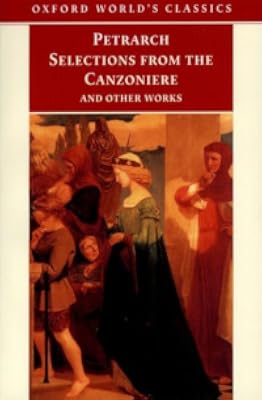
Selections from the Canzoniere and Other Works
by Francesco Petrarch
On This Page
Description
This entirely new translation includes Petrarch's short autobiographical prose works, The Letter to Posterity and The Ascent of Mount Ventoux, and a selection of twenty-seven poems from the Canzoniere, Petrarch's best-known work in Italian.Tags
Recommendations





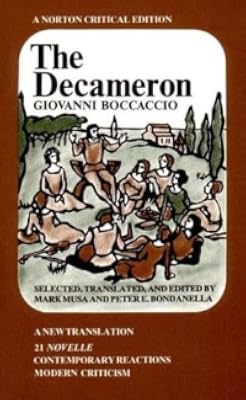
Member Recommendations
Member Reviews
A model selected poems, inasmuch as it's short, contains a couple of prose pieces, and every single poem is worth reading. This is particularly impressive, inasmuch as I don't care at all about love poetry... and Petrarch launched more love poets than any one else, ever. But that's because he's so good, even if his epigones are not.
Of the two prose pieces, the 'Letter to Posterity' is less essential; Mark Musa's lovely introduction is more readable, and gives you the same information. But 'The Ascent of Mount Ventoux' is fascinating as a self-standing piece--a more or less fictional letter, describing events that probably didn't happen, obviously harking back to Dante and forward to anyone who's ever stood at the base of a mountain and show more thought "my, that's pretty," as well as everyone who's ever thought that maybe they could be a better person. I wasn't prepared for how approachable it was; highly recommended.
As for the poems, I can't help but prefer the more political, and the more melancholy, rather than the "my lover's super hot, man" stuff. Consider the anger in 136,
May heaven's fire pour down on your tresses
since doing evil gives you so much pleasure,
impious one, who, after stream and acrons
got fat and rich by starving other people,
you nest of treachery in which is hatched
all evil that today spreads through the world,
you slave of wine, of bedrooms, and of food,
high testing-ground for every kind of lust!
Usw. The New Atheists have nothing on the renaissance/medieval pious when it comes to ripping the church.
And Musa's translations are charming, and occasionally excellent self-standing poems. Consider the second stanza of 190, which inspired Wyatt's famous Whoso List to Hunt:
The sigh of her was so sweetly austere
that I left all my work to follow her,
just like a miser who in search of treasure
with pleasure makes his effort bitterless.
Not sure I know what that means, but who cares? I plan to use 'bitterless' in everything I say or write from now on. Not to mention, tackling more Petrarch. show less
Of the two prose pieces, the 'Letter to Posterity' is less essential; Mark Musa's lovely introduction is more readable, and gives you the same information. But 'The Ascent of Mount Ventoux' is fascinating as a self-standing piece--a more or less fictional letter, describing events that probably didn't happen, obviously harking back to Dante and forward to anyone who's ever stood at the base of a mountain and show more thought "my, that's pretty," as well as everyone who's ever thought that maybe they could be a better person. I wasn't prepared for how approachable it was; highly recommended.
As for the poems, I can't help but prefer the more political, and the more melancholy, rather than the "my lover's super hot, man" stuff. Consider the anger in 136,
May heaven's fire pour down on your tresses
since doing evil gives you so much pleasure,
impious one, who, after stream and acrons
got fat and rich by starving other people,
you nest of treachery in which is hatched
all evil that today spreads through the world,
you slave of wine, of bedrooms, and of food,
high testing-ground for every kind of lust!
Usw. The New Atheists have nothing on the renaissance/medieval pious when it comes to ripping the church.
And Musa's translations are charming, and occasionally excellent self-standing poems. Consider the second stanza of 190, which inspired Wyatt's famous Whoso List to Hunt:
The sigh of her was so sweetly austere
that I left all my work to follow her,
just like a miser who in search of treasure
with pleasure makes his effort bitterless.
Not sure I know what that means, but who cares? I plan to use 'bitterless' in everything I say or write from now on. Not to mention, tackling more Petrarch. show less
I came to Petrarch as part of my reading of the trio of Italian literary giants of the 14th century, which, in addition to Petrarch, includes Dante and Boccaccio. Whereas Boccaccio, at least in "The Decameron", is consumed with the visceral aspects of life (primarily sex, greed, and deceit), and Dante is, of course, occupied with presenting his view of the world as if it were the only view, Petrarch is something quite different. His greatness was universally acclaimed while he was still fairly young (he was invited to be poet laureate of both France and Italy), but he seems to have retained a surprising degree of humility and common sense. One thing that Dante and Petrarch shared was an odd obsession with women who seem to have barely show more recognized their existence. In Dante's case he elevated his Beatrice to the level of a god, whereas Petrarch kept his obsession for Laura to a more recognizable form that we might recognize as the gut-wrenching pining of a teenager who develops an infatuation with the most popular guy or girl in school.
This particular Oxford World's Classics volume is a selection from Petrarch's "Canzoniere", a poetry collection devoted to Laura and divided into parts written both before and after Laura's untimely and early death. In addition to the "Canzoniere", the volume includes the "Letter to Posterity", which provides a valuable biographical sketch of Petrarch, as well as his description of climbing Mont Ventoux in southern France. Being something of a mountaineer myself, I looked forward to Petrarch's account of the climb, which is regularly mentioned during Tour de France coverage when the Tour route either includes a climb of the daunting volcanic cone, or else gets anywhere near it. Unfortunately, Petrarch was not exactly inspired by his experience. Rather, once he reaches the summit after making many stupid decisions regarding the optimal route, he initially recognizes the spectacular view and seems prepared to set forth his description of the exhilaration that a climber feels on reaching the summit, but he instead allows his religious indoctrination to take over in declaring that, while the view from the top is spectacular, it is nothing more than a distraction from what he should be doing with his life, which is dedicating himself to the cultivation of his soul. The remainder of the time on the summit and then the descent are spent in a religiously-inspired daze.
As mentioned above, the Canzoniere divide themselves to the periods before and after Laura's death. While, I'm no poetry enthusiast in general, I was quite moved by Mark Musa's translations of the post-death selections, e.g. selection number 333. The pre-death selections, on the other hand, struck me as over-wrought and too enthusiastic, something of the feeling I get from reading Don Quixote's praise and lamentations of his Lady Dulcinea de Tobosa. show less
This particular Oxford World's Classics volume is a selection from Petrarch's "Canzoniere", a poetry collection devoted to Laura and divided into parts written both before and after Laura's untimely and early death. In addition to the "Canzoniere", the volume includes the "Letter to Posterity", which provides a valuable biographical sketch of Petrarch, as well as his description of climbing Mont Ventoux in southern France. Being something of a mountaineer myself, I looked forward to Petrarch's account of the climb, which is regularly mentioned during Tour de France coverage when the Tour route either includes a climb of the daunting volcanic cone, or else gets anywhere near it. Unfortunately, Petrarch was not exactly inspired by his experience. Rather, once he reaches the summit after making many stupid decisions regarding the optimal route, he initially recognizes the spectacular view and seems prepared to set forth his description of the exhilaration that a climber feels on reaching the summit, but he instead allows his religious indoctrination to take over in declaring that, while the view from the top is spectacular, it is nothing more than a distraction from what he should be doing with his life, which is dedicating himself to the cultivation of his soul. The remainder of the time on the summit and then the descent are spent in a religiously-inspired daze.
As mentioned above, the Canzoniere divide themselves to the periods before and after Laura's death. While, I'm no poetry enthusiast in general, I was quite moved by Mark Musa's translations of the post-death selections, e.g. selection number 333. The pre-death selections, on the other hand, struck me as over-wrought and too enthusiastic, something of the feeling I get from reading Don Quixote's praise and lamentations of his Lady Dulcinea de Tobosa. show less
A base desses poemas - como Beatriz de Dante e Lesbos de Catulo - é o amor eterno de Petrarca por Laura, mas às vezes seu verso ressoa com temas políticos e religiosos, e com louvores ao passado de Roma e da Itália de seu próprio tempo . Há mais beleza, por exemplo, nos sonetos de Michelangelo, apesar de sua falta de rigor. E, a propósito, a admiração de Michelangelo por Petrarca também não era TÃO grande assim: o sonetista era menos um intelectual completo do que um esteta da forma fixa.
Jan 3, 2019Portuguese (Brazil)
Ratings
Members
- Recently Added By
Lists

Harold Bloom - The Western Canon: B. The Aristocratic Age
231 works; 13 members
Author Information

490+ Works 4,182 Members
Son of an exiled Florentine clerk, Petrarch was born in Arezzo, Italy, but was raised at the court of the Pope in Avignon in southern France. He studied the classics in France and continued his education at the University of Bologna in Italy. Less than a year after his return to Avignon in 1326, Petrarch fell in love with the woman he referred to show more as Laura in his most famous poetry. Although he never revealed her true name, nor, apparently, ever expressed his love to her directly, he made her immortal with his Canzoniere (date unknown), or songbook, a collection of lyric poems and sonnets that rank among the most beautiful written in Italian, or in any other language. Like the major Italian poet Dante Alighieri, Petrarch chose to write his most intimate feelings in his native Italian, rather than the Latin customary at that time. Petrarch used Latin for his more formal works, however. He incorrectly assumed that he would be remembered for the Latin works, but it was his Italian lyric poetry that influenced both the content and form of all subsequent European poetry. Petrarch's sonnet form was prized by English poets as an alternative to English poet William Shakespeare's sonnet form. (Bowker Author Biography) show less
Some Editions
Series
Belongs to Publisher Series
Common Knowledge
- Dedication
- For JULIA
- First words
- You may, perhaps, have heard tell of me, though even this is doubtful, since a poor and insignificant name like mine will hardly have travelled far in space or time.
Classifications
- Genres
- Poetry, Fiction and Literature
- DDC/MDS
- 851.1 — Literature & rhetoric Italian, Romanian & related literatures Italian poetry Early Italian; Age of Dante –1375
- LCC
- PQ4496 .E21 — Language and Literature French, Italian, Spanish and Portuguese literatures Italian literature Individual authors and works to 1400
- BISAC
Statistics
- Members
- 343
- Popularity
- 92,157
- Reviews
- 3
- Rating
- (3.79)
- Languages
- English
- Media
- Paper
- ISBNs
- 3
- UPCs
- 1