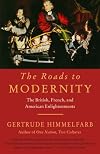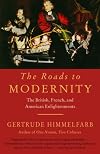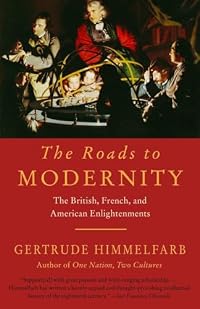
The Roads to Modernity: The British, French, and American Enlightenments
by Gertrude Himmelfarb
On This Page
Description
"The Roads to Modernity reclaims the Enlightenment - an extraordinary time bursting with new ideas about the human condition in the realms of politics, society, and religion - from historians who have downgraded its importance and from scholars who have given preeminence to the Enlightenment in France over concurrent movements in England and America. Contrasting the Enlightenments in the three nations, Gertrude Himmelfarb demonstrates the primacy of the British and the wisdom and foresight show more of thinkers such as Adam Smith, David Hume, Thomas Paine, the Earl of Shaftesbury, Edward Gibbon, and Edmund Burke, who established its unique character and historic importance. It is this Enlightenment, she argues, that created a moral and social philosophy - humane, compassionate, and realistic - that still resonates strongly today, in America perhaps ever more so than in Europe." "This is a contribution to the history of ideas."--Jacket. show lessTags
Recommendations















Member Reviews
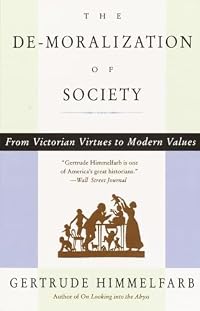
Enlightenments was perfect. I read Gertrude Himmelfarb's The Demoralization of Society: From Victorian Virtues to Modern Values a few years ago, and thought it was extremely thought provoking and well-written. I think the same of The Roads; however, I would recommend becoming familiar with the basics of western philosophy before reading this one. If you're unfamiliar with Kant, Hume, Smith etc...(the list goes on and on), then it would be really difficult to follow or identify with the ideas in this one.
A Wonderful read –– I learnt differences among British, French Philosophers in Enlightenment.
I learnt more on John Wesley, And how Methodism influenced lower class in British Society.
As, I knew earlier –– Man is a religious animal, And Religion helps, contributes so much to society.
I was surprised to read Jefferson saying, "No Nation has ever been existed or governed without a religion."
I would recommend this book to someone, who wants to understand more about Enlightenment.
--Deus Vult
Gottfried
I learnt more on John Wesley, And how Methodism influenced lower class in British Society.
As, I knew earlier –– Man is a religious animal, And Religion helps, contributes so much to society.
I was surprised to read Jefferson saying, "No Nation has ever been existed or governed without a religion."
I would recommend this book to someone, who wants to understand more about Enlightenment.
--Deus Vult
Gottfried
A Wonderful read –– I learnt differences among British, French Philosophers in Enlightenment.
I learnt more on John Wesley, And how Methodism influenced lower class in British Society.
As, I knew earlier –– Man is a religious animal, And Religion helps, contributes so much to society.
I was surprised to read Jefferson saying, "No Nation has ever been existed or governed without a religion."
I would recommend this book to someone, who wants to understand more about Enlightenment.
--Deus Vult
Gottfried
I learnt more on John Wesley, And how Methodism influenced lower class in British Society.
As, I knew earlier –– Man is a religious animal, And Religion helps, contributes so much to society.
I was surprised to read Jefferson saying, "No Nation has ever been existed or governed without a religion."
I would recommend this book to someone, who wants to understand more about Enlightenment.
--Deus Vult
Gottfried
Ratings
Members
- Recently Added By
Author Information

25+ Works 1,964 Members
Gertrude Himmelfarb was born in New York City and studied at Brooklyn College and the University of Chicago. A distinguished historian, she has received numerous honorary degrees, fellowships, and awards, including the 2004 National Humanities Medal. She is a fellow of the British Academy, the Royal Historical Society, the American Philosophical show more Society, the American Academy of Arts and Sciences, and the Society of American Historians. She has written extensively on Victorian England and more generally on intellectual and cultural history. show less
Common Knowledge
- People/Characters
- Edmund Burke; Denis Diderot; Charles-Louis de Secondat, Baron de Montesquieu; Anthony Ashley-Cooper, 3rd Earl of Shaftesbury; Adam Smith; Thomas Paine (show all 10); Alexis de Tocqueville; Voltaire "François-Marie Arouet", 1694-1778; Rousseau, Jean-Jacques, 1712-1778; Hume, David, 1711-1776
- Important events
- French Revolution (1789 | 1799); French Enlightenment; British Enlightenment; American Revolution (1775 | 1783); American Enlightenment
- Last words
- (Click to show. Warning: May contain spoilers.)We are, in fact, still floundering in the verities and fallacies, the assumptions and convictions, about human nature, society, and the polity that exercised the British moral philosophers, the French philosophes, and the American Founders.
- Blurbers
- Johnson, Paul; Nash, Robert; Whitehead, Barbara Dafoe; Teachout, Terry
Classifications
- Genres
- History, Nonfiction, Philosophy, General Nonfiction
- DDC/MDS
- 190.9033 — Philosophy and Psychology Modern western philosophy Modern western and other noneastern philosophy Biography; Enlightenment - History By Place 18th-century philosophers
- LCC
- B802 .H65 — Philosophy, Psychology and Religion Philosophy (General) By period Modern
- BISAC
Statistics
- Members
- 329
- Popularity
- 95,931
- Reviews
- 3
- Rating
- (3.59)
- Languages
- English, French, Portuguese
- Media
- Paper, Ebook
- ISBNs
- 7
- ASINs
- 4