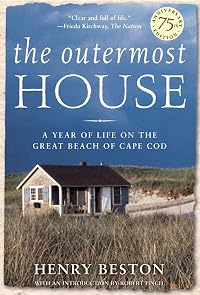
The Outermost House: A Year of Life on the Great Beach of Cape Cod
by Henry Beston
On This Page
Description
The classic nature memoir of Cape Cod in the early twentieth century, "written with simplicity, sympathy, and beauty" (New York Herald Tribune). When Henry Beston returned home from World War I, he sought refuge and healing at a house on the outer beach of Cape Cod. He was so taken by the natural beauty of his surroundings that his two-week stay extended into a yearlong solitary adventure. He spent his time trying to capture in words the wonders of the magical landscape he found himself in show more thrall to. In The Outermost House, Beston chronicles his experiences observing the migrations of seabirds, the rhythms of the tide, the windblown dunes, and the scatter of stars in the changing summer sky. Beston argued: "The world today is sick to its thin blood for the lack of elemental things, for fire before the hands, for water, for air, for the dear earth itself underfoot." Nearly a century after publication, Beston's words are more true than ever. show lessTags
Recommendations

























Member Recommendations


Member Reviews
In this gem of a book, Beston calls for a return to nature, an escape from a world “sick to its thin blood for lack of elemental things.” After experiencing civilization at its worst as an ambulance driver in World War One, he returns to Massachusetts and buys property on the eastern shore of Cape Cod, the upper arm bent at the elbow, bravely flexed to face the Atlantic Ocean. He has a two-room house built intended for vacation use. Then, when it is finished, he decides to experience all four seasons. This is a record of that year.
Like his spiritual precursor, Thoreau, Beston carefully observes nature. He names plants, insects, fish, and other aquatic life. He is particularly attentive to birds, noting their comings and goings. show more There are summer and winter species. Some hover close to shore, and others venture far out to sea.
His closest human companions are those who man the Coast Guard station at the Nauset light. He details their night watches and efforts to save storm-wrecked ship crews.
One of my favorite passages begins the next-to-last chapter of the book, in which Beston laments our neglect of the sense of smell and describes the fragrances of sand and surf in the changing seasons and weather.
Nearly a century on, the world Beston describes has continued to change. Much of what he lived among is now endangered; his call for “another and a wiser and perhaps a more mystical concept of animals” has gone unheeded, except for by the few. The house, named a national literary landmark, only stood for a half-century before being rent asunder in a fierce winter storm. But that loss, of a mark of civilization, is minor compared to that of the wildlife he lovingly observes. Seeing this passing world through Beston’s eyes, whether through the ten windows of his Fo’castle (as he named his house) or outdoors at all hours of the day and night, whether on the beach, dune, or at the salt marsh, tinged the pleasure of my reading with an elegiac sadness. show less
Like his spiritual precursor, Thoreau, Beston carefully observes nature. He names plants, insects, fish, and other aquatic life. He is particularly attentive to birds, noting their comings and goings. show more There are summer and winter species. Some hover close to shore, and others venture far out to sea.
His closest human companions are those who man the Coast Guard station at the Nauset light. He details their night watches and efforts to save storm-wrecked ship crews.
One of my favorite passages begins the next-to-last chapter of the book, in which Beston laments our neglect of the sense of smell and describes the fragrances of sand and surf in the changing seasons and weather.
Nearly a century on, the world Beston describes has continued to change. Much of what he lived among is now endangered; his call for “another and a wiser and perhaps a more mystical concept of animals” has gone unheeded, except for by the few. The house, named a national literary landmark, only stood for a half-century before being rent asunder in a fierce winter storm. But that loss, of a mark of civilization, is minor compared to that of the wildlife he lovingly observes. Seeing this passing world through Beston’s eyes, whether through the ten windows of his Fo’castle (as he named his house) or outdoors at all hours of the day and night, whether on the beach, dune, or at the salt marsh, tinged the pleasure of my reading with an elegiac sadness. show less
First published in 1928, the beauty of the language is timeless. Who knew someone could describe the sand and sea in so many ways? Beston's book is a poetic gift and left me with an even greater appreciation of the Cape and our natural world in general.
Excerpt:
"Touch the earth, love the earth, honour the earth, her plains, her valleys, her hills, and her seas; rest your spirit in her solitary places."
(Personally, I recommend skipping the introduction by Robert Flinch. Seems to me he's in love with his own writing. Go back and read it at the end if you like.)
Excerpt:
"Touch the earth, love the earth, honour the earth, her plains, her valleys, her hills, and her seas; rest your spirit in her solitary places."
(Personally, I recommend skipping the introduction by Robert Flinch. Seems to me he's in love with his own writing. Go back and read it at the end if you like.)
One hundred years ago Cape Cod was a very different place than the busy area it is today. In 1924, when Henry Beston first saw the ocean side of the peninsula wrapping Cape Cod Bay, it was a wild and uninhabited place. As Beston described it For twenty miles this last and outer earth faces the ever hostile ocean in the form of a great eroded cliff of earth and clay, the undulations and levels of whose rim now stand a hundred, now a hundred and fifty feet above the tides. Worn by the breakers and the waves, it still stands bold."
The immediate attraction and pull of the shoreline was such that the next year he bought fifty acres of dunes, and built himself the Fo'castle, a 20' x 16' two room cottage. There was no road in, only a trail. show more The closest neighbours were the coast guards at the Nauset station two miles away. In September 1926, Beston went to his cottage for a couple of weeks. Somehow, without any real plan, the two weeks lengthened into a year. As Beston put it, "... as the year lengthened into autumn, the beauty and mystery of this earth and outer sea so possessed and held me that I could not go ... The flux and reflux of ocean, the incomings of waves, the gatherings of birds, the pilgrimages of the peoples of the sea, winter and storm, the splendour of autumn and the holiness of the spring - all these were part of the great beach. The longer I stayed the more eager I was to know this coast and to share its mysterious and elemental life."
So began a remarkable immersion year in the natural world. Beston's observations and writing are such that the reader hears the sea, smells the salt, feels the wind the sun and the rain. Bird populations change with the season, so prevalent in spring and fall, almost absent in winter apart from the eternal gulls. Beaton is able to put all these natural phenomena into words. Speaking of the ocean, he said "The sea has many voices. Listen to the surf, really lend it your ears, and you will hear in it a world of sounds: hollow boomings and heavy roarings, great watery tumblings and tramplings, long hissing seethes, sharp, rifle-shot reports, splashes, whispers, the grinding undertone of stones, and sometimes vocal sounds that might be the voices of people in the sea. And not only is the great sound varied in the manner of its making, it is also constantly changing its tempo, its pitch, its accent and its rhythm, being now loud and thundering, now almost placid, now furious, now grave and solemn-slow, now a simple measure, now a rhythm monstrous and with a sense of elemental will. "
This will is dangerous at times. Fishing schooners wash ashore. That winter even a Coast Guard vessel was destroyed. Wreckage from previous disasters lies entombed in the constantly shifting sand. "Eighteenth century pirates, stately British merchantmen of the mid-Victorian years, whaling brigs, Salem East India traders, Gloucester fishermen, and a whole host of forgotten Nineteenth Century schooners -- all these have strewn this beach with broken spars and dead. "
Although this book covers only the one year, there is a remarkable sense of the eternal cycle of the seasons, of the paradox of repeating patterns coupled with constant change. There is a reassurance in these rituals, something that those who live by the ocean recognize, if only subconsciously, something that keeps bringing them back.
Beston's writing is still as fresh today as when his book was first published in 1928. This edition was a 75th anniversary publication. As for the Fo'castle, Beston donated it to the Massachusetts Audubon Society in 1960. It was swept out to sea in February 1978 in a huge storm. Beston's dunes survive, however, in the Cape Cod National Seashore, the creation of which was partly inspired by his writing. show less
The immediate attraction and pull of the shoreline was such that the next year he bought fifty acres of dunes, and built himself the Fo'castle, a 20' x 16' two room cottage. There was no road in, only a trail. show more The closest neighbours were the coast guards at the Nauset station two miles away. In September 1926, Beston went to his cottage for a couple of weeks. Somehow, without any real plan, the two weeks lengthened into a year. As Beston put it, "... as the year lengthened into autumn, the beauty and mystery of this earth and outer sea so possessed and held me that I could not go ... The flux and reflux of ocean, the incomings of waves, the gatherings of birds, the pilgrimages of the peoples of the sea, winter and storm, the splendour of autumn and the holiness of the spring - all these were part of the great beach. The longer I stayed the more eager I was to know this coast and to share its mysterious and elemental life."
So began a remarkable immersion year in the natural world. Beston's observations and writing are such that the reader hears the sea, smells the salt, feels the wind the sun and the rain. Bird populations change with the season, so prevalent in spring and fall, almost absent in winter apart from the eternal gulls. Beaton is able to put all these natural phenomena into words. Speaking of the ocean, he said "The sea has many voices. Listen to the surf, really lend it your ears, and you will hear in it a world of sounds: hollow boomings and heavy roarings, great watery tumblings and tramplings, long hissing seethes, sharp, rifle-shot reports, splashes, whispers, the grinding undertone of stones, and sometimes vocal sounds that might be the voices of people in the sea. And not only is the great sound varied in the manner of its making, it is also constantly changing its tempo, its pitch, its accent and its rhythm, being now loud and thundering, now almost placid, now furious, now grave and solemn-slow, now a simple measure, now a rhythm monstrous and with a sense of elemental will. "
This will is dangerous at times. Fishing schooners wash ashore. That winter even a Coast Guard vessel was destroyed. Wreckage from previous disasters lies entombed in the constantly shifting sand. "Eighteenth century pirates, stately British merchantmen of the mid-Victorian years, whaling brigs, Salem East India traders, Gloucester fishermen, and a whole host of forgotten Nineteenth Century schooners -- all these have strewn this beach with broken spars and dead. "
Although this book covers only the one year, there is a remarkable sense of the eternal cycle of the seasons, of the paradox of repeating patterns coupled with constant change. There is a reassurance in these rituals, something that those who live by the ocean recognize, if only subconsciously, something that keeps bringing them back.
Beston's writing is still as fresh today as when his book was first published in 1928. This edition was a 75th anniversary publication. As for the Fo'castle, Beston donated it to the Massachusetts Audubon Society in 1960. It was swept out to sea in February 1978 in a huge storm. Beston's dunes survive, however, in the Cape Cod National Seashore, the creation of which was partly inspired by his writing. show less
I'm not sure how—being a naturalist of sorts who has spent a significant amount of time in coastal Massachusetts—that it is just now that I've become aware of this book. I came across it on the shelf at Everyone's Books in Brattleboro.
The premise: Beston, in his late thirties at the time, built a two-room cottage, two miles from the closest neighbor (the National Coast Guard), on the dunes of Eastham Beach on the Eastern outer banks of Cape Cod. This was in the 1920s. In September of 1926, Beston went out to the cottage, meaning to spend two weeks in retreat. Caught by the charm and magic of the place, he found he couldn't leave until a year had passed. His fiancé, Elizabeth Coatsworth, told him, "no book, no marriage." So over show more that winter he prepared his notes into a manuscript, and the book was published the following fall.
It is a tranquil book, short. The pages are split between Beston's time with the birds throughout the shifting seasons, and the Coast Guard—his human interlocutors throughout the year. When we first think of coastal wilderness, we think of the crash of the surf and the isolation. And then we remember—New England has incredible busy shipping and fishing routes. I recall a few days I spent sea kayaking Down East Maine; even as we were camping on various remote uninhabited islands, we'd awake each morning to the smell of diesel exhaust and the yell of of lobster fisherman checking their traps. Beston had a similar experience; half a dozen wrecks throughout his winter there, and numerous jaunts with members of the Coast Guard.
This book is credited with helping to inspire the conservation of the Cape Cod National Seashore.
The book has a very narrow scope, and is by no means a memoir, not speaking to any of Beston's interior. Apparently Beston saw the place as a psychological refuge to help his recovery from his service in World War I. What demons did he face in his cottage by the surf? This book does not say. Additionally, not once does he mention going for a swim down in the water, or speak about the books he was reading (I assume he was doing a lot of reading that year). So it does serve as a journal of his time there, but a very focused journal, which omits more than it includes. On the other hand, maybe this narrative focus contributed to the book's success.
If you thought a century back, the Cape was a pristine untouched wilderness, this book will set you straight! Although there wasn't nearly as much terrestrial development, apparently it was common practice to dump the sludge remaining from oil refining off the coast. Beston would collect oil-drenched sea birds, and attempt to nurse them back to health in his cottage. That said, there is no mention of ticks nor poison ivy, which I think are arrivals of the past century.
I also happen to be reading Iain McGilchrist's "The Matter With Things," about the differing worldviews of the right and left hemispheres of the brain. The right hemisphere allows us to interact with depth and with change. In this book, Beston beautifully articulates something essential about the costal landscape. This essence is intertwined with its constantly shifting sands, tides, winds, weather, and wildlife. Each day Beston spent at his cottage was a new world—a new slope to the beach, a different sky, new wildlife passing through. This is the world as only the right hemisphere is able to experience it. show less
The premise: Beston, in his late thirties at the time, built a two-room cottage, two miles from the closest neighbor (the National Coast Guard), on the dunes of Eastham Beach on the Eastern outer banks of Cape Cod. This was in the 1920s. In September of 1926, Beston went out to the cottage, meaning to spend two weeks in retreat. Caught by the charm and magic of the place, he found he couldn't leave until a year had passed. His fiancé, Elizabeth Coatsworth, told him, "no book, no marriage." So over show more that winter he prepared his notes into a manuscript, and the book was published the following fall.
It is a tranquil book, short. The pages are split between Beston's time with the birds throughout the shifting seasons, and the Coast Guard—his human interlocutors throughout the year. When we first think of coastal wilderness, we think of the crash of the surf and the isolation. And then we remember—New England has incredible busy shipping and fishing routes. I recall a few days I spent sea kayaking Down East Maine; even as we were camping on various remote uninhabited islands, we'd awake each morning to the smell of diesel exhaust and the yell of of lobster fisherman checking their traps. Beston had a similar experience; half a dozen wrecks throughout his winter there, and numerous jaunts with members of the Coast Guard.
This book is credited with helping to inspire the conservation of the Cape Cod National Seashore.
The book has a very narrow scope, and is by no means a memoir, not speaking to any of Beston's interior. Apparently Beston saw the place as a psychological refuge to help his recovery from his service in World War I. What demons did he face in his cottage by the surf? This book does not say. Additionally, not once does he mention going for a swim down in the water, or speak about the books he was reading (I assume he was doing a lot of reading that year). So it does serve as a journal of his time there, but a very focused journal, which omits more than it includes. On the other hand, maybe this narrative focus contributed to the book's success.
If you thought a century back, the Cape was a pristine untouched wilderness, this book will set you straight! Although there wasn't nearly as much terrestrial development, apparently it was common practice to dump the sludge remaining from oil refining off the coast. Beston would collect oil-drenched sea birds, and attempt to nurse them back to health in his cottage. That said, there is no mention of ticks nor poison ivy, which I think are arrivals of the past century.
I also happen to be reading Iain McGilchrist's "The Matter With Things," about the differing worldviews of the right and left hemispheres of the brain. The right hemisphere allows us to interact with depth and with change. In this book, Beston beautifully articulates something essential about the costal landscape. This essence is intertwined with its constantly shifting sands, tides, winds, weather, and wildlife. Each day Beston spent at his cottage was a new world—a new slope to the beach, a different sky, new wildlife passing through. This is the world as only the right hemisphere is able to experience it. show less
Henry Beston lived in a simple but well made two room house on Cape Cod for a year. He had the little house made by a local carpenter as an ocasional getaway but decided to spend an entire year living in it. Outermost may have been an understatement, there were no other houses near it on the Cape and Beston's nearest neighbor was a Coast Guard live saving station. The Outermost House is a summary of Beston's diary of the that year which ended with the fall of 1927. The natural world around him was the subject of the book. He also wrote about his contacts with the Captain and men of the Coast Guard Station, the visits from friends and the tragic shipwrecks that were too common on Cape Cod. There were still sailing ships carrying goods show more along the coast in 1926 and 27. His recording of a year in the natural world is one of the best I've ever read. Henry Beston described the weather, the wildlife and the vegetation of Cape Cod in a poetic manner that makes me want to go see it in every season. His attention to the birds and fish was particularly good. I had never heard of this book before it was suggested for a book discussion course I attend. I would now include it along Walden, A Sand County Almanac and Desert Solitaire as one of the best books about life with the natural world. show less
The author's 1928 account of the year he spent in an isolated house on the outer edge of Cape Cod. His emphasis is very much on the natural world around him there, including close observations of a wide array of seabirds and an extended attempt to capture the movements of the ocean in words. The human world is not entirely missing, either, however, as he was visited regularly by coast guard patrols: men who would walk the beach alone every night on the lookout for shipwrecks, which were numerous and terrible.
I found some parts of Beston's writing more engaging than others, but none of it is bad, and there are occasional passages that are impressively poetic (and that remain effective despite the introduction to 75th anniversary edition show more I read, which seems to be imitating the example of annoying movie trailers in its attempt to spoil all the best bits). Beston also has some profound and beautifully expressed thoughts on the the natural world as a whole, on its animal inhabitants as beings who exist on their own terms as much as any of us do, on the ways in which nature is so much bigger than humanity at the same time as we are within and a part of it, and on the rhythms of that world from which we disconnect only to our detriment.
I have no idea what this part of Cape Cod is like now, nearly a century later, but I can say that whatever might or might not have changed, this piece of writing still holds up and is still saying things that are just as relevant now as they were then. show less
I found some parts of Beston's writing more engaging than others, but none of it is bad, and there are occasional passages that are impressively poetic (and that remain effective despite the introduction to 75th anniversary edition show more I read, which seems to be imitating the example of annoying movie trailers in its attempt to spoil all the best bits). Beston also has some profound and beautifully expressed thoughts on the the natural world as a whole, on its animal inhabitants as beings who exist on their own terms as much as any of us do, on the ways in which nature is so much bigger than humanity at the same time as we are within and a part of it, and on the rhythms of that world from which we disconnect only to our detriment.
I have no idea what this part of Cape Cod is like now, nearly a century later, but I can say that whatever might or might not have changed, this piece of writing still holds up and is still saying things that are just as relevant now as they were then. show less
One of Rachel Carson's favorite books, which is enough of a recommendation, written in long hand "on the kitchen table overlooking the North Atlantic and the dunes, the little room full of the yellow sunlight reflected from the sands and the great sound of the sea.
When I began to read this book, I grabbed a bookmark from a pile, and fortuitously took the one that has on it a poem entitled "Ocean Poem".
Henry Beston built a small house atop a dune on Eastham bar, his nearest neighbors the coast guard at Nauset, two miles away. Going there in September with the intention of spending a fortnight, he lingered, "the beauty and mystery of this earth and outer sea so possessed and held me that I could not go." So he stayed for a year. This is show more the journal of that year.
A good nature writer must be a good observer, and Beston certainly was. He paid attention. To the "tracks of hungry crows . . . the webbed impressions of a gull", the sound of the ocean, the shape of a wave, the swarming of butterflies. He made me smell the ocean, feel the tide and sand between my toes.
He teaches the beauty and the danger, as he writes of the shipwrecks that winter, of a deer trapped in the freezing water, the bravery of the Coast Guard. Nature gives us lovely things, but she takes her due.
And he writes of the dangers caused by men:
"A new danger, moreover, now threatens the birds at sea. An irreducible residue of crude oil, called by refiners "slop," remains still after oil distillation, and this is pumped into southbound tankers and emptied far offshore. This wretched pollution floats over large area, and the birds light in it and get it on their feathers. They inevitably die." Things haven't changed.
An unexpected gift. At one point, Beston is describing "sea horses", "waves rolling in fighting a strong breeze . . . the manes of white, sun brilliant spray streaming behind them for thirty and even forty feet . . . If you would see them at their best, come to this beach on a bright October day when a northwest wind is billowing off to sea across the moors." And someone (perhaps Martha Chester, whose name is written on the cover?) has written in the margin, "We did! Oct. 12, '63".
I leave you with his closing words, take them to heart:
"Do no dishonour to the earth lest you dishonour the spirit of man. Hold your hands out over the earth as over a flame. To all who love her, who open to her the doors of their veins, she gives of her strength, sustaining them with her own measureless tremor of dark life. Touch the earth, love the earth, honour the earth, her plains, her valleys, her hills, and her seas; rest your spirit in her solitary places. For the gifts of life are the earth's and they are given to all, and they are the songs of birds at daybreak, Orion and the Bear, and dawn seen over ocean from the beach." show less
When I began to read this book, I grabbed a bookmark from a pile, and fortuitously took the one that has on it a poem entitled "Ocean Poem".
Henry Beston built a small house atop a dune on Eastham bar, his nearest neighbors the coast guard at Nauset, two miles away. Going there in September with the intention of spending a fortnight, he lingered, "the beauty and mystery of this earth and outer sea so possessed and held me that I could not go." So he stayed for a year. This is show more the journal of that year.
A good nature writer must be a good observer, and Beston certainly was. He paid attention. To the "tracks of hungry crows . . . the webbed impressions of a gull", the sound of the ocean, the shape of a wave, the swarming of butterflies. He made me smell the ocean, feel the tide and sand between my toes.
He teaches the beauty and the danger, as he writes of the shipwrecks that winter, of a deer trapped in the freezing water, the bravery of the Coast Guard. Nature gives us lovely things, but she takes her due.
And he writes of the dangers caused by men:
"A new danger, moreover, now threatens the birds at sea. An irreducible residue of crude oil, called by refiners "slop," remains still after oil distillation, and this is pumped into southbound tankers and emptied far offshore. This wretched pollution floats over large area, and the birds light in it and get it on their feathers. They inevitably die." Things haven't changed.
An unexpected gift. At one point, Beston is describing "sea horses", "waves rolling in fighting a strong breeze . . . the manes of white, sun brilliant spray streaming behind them for thirty and even forty feet . . . If you would see them at their best, come to this beach on a bright October day when a northwest wind is billowing off to sea across the moors." And someone (perhaps Martha Chester, whose name is written on the cover?) has written in the margin, "We did! Oct. 12, '63".
I leave you with his closing words, take them to heart:
"Do no dishonour to the earth lest you dishonour the spirit of man. Hold your hands out over the earth as over a flame. To all who love her, who open to her the doors of their veins, she gives of her strength, sustaining them with her own measureless tremor of dark life. Touch the earth, love the earth, honour the earth, her plains, her valleys, her hills, and her seas; rest your spirit in her solitary places. For the gifts of life are the earth's and they are given to all, and they are the songs of birds at daybreak, Orion and the Bear, and dawn seen over ocean from the beach." show less
Members
- Recently Added By
Published Reviews
Even though millions loved Beston's little house, they, like him, realized it was merely a material possession and nature was just taking its course when the ocean consumed the "Fo'castle" in 1978.
The Outermost House is not just about a day or even a year at the beach. Even though the House and the dunes are gone, the spirit of what Beston tried to convey lives on.
The Outermost House is not just about a day or even a year at the beach. Even though the House and the dunes are gone, the spirit of what Beston tried to convey lives on.
added by John_Vaughan
Lists

Recommended Nature Writing
346 works; 180 members

Really Good Narrative Non-Fiction
65 works; 24 members

Phi Beta Kappa reading list
260 works; 8 members

Sense of place
156 works; 13 members

The Great Courses: Earth at the Crossroads
48 works; 1 member

Mustich's 1000 Books to Read Before You Die: A Life Changing List
1,001 works; 19 members

Which house?
423 works; 16 members
Author Information

18+ Works 1,639 Members
Henry Beston (1888-1968) was the author of many books, including White Pine and Blue Water, Northern Farm, and The St. Lawrence. His Cape Cod house was proclaimed a National Literary Landmark in 1964. It was destroyed by a massive winter storm in 1978
Some Editions
Awards and Honors
Notable Lists
Work Relationships
Is abridged in
Inspired
Common Knowledge
- Canonical title
- The Outermost House: A Year of Life on the Great Beach of Cape Cod
- Original publication date
- 1928
- Important places*
- Massachusetts, Verenigde Staten
- Dedication
- To Miss Mabel Davison and Miss Mary Cabot Wheelwright
- First words
- East and ahead of the coast of North America, some thirty miles and more from the inner shores of Massachusetts, there stands in the open Atlantic the last fragment of an ancient and vanished land.
- Quotations
- That immense, ovewhelming, relentless burning ardency of Nature for tthe stir of life! (p. 145)
And what conscious resolution of men can equal their impersonal, their congregate will to yield self life to the will of life universal? (p. 145)
For a moment of night we have a glimpse of ourselves and of our world islanded in its stream of stars -- pilgrims of mortality, voyaging between horizons across eternal seas of space and time. (p. 153)
Poetry is as necessary to comprehension as science. It is impossible to live without reverence as it is without joy. (pp. 191-192) - Last words
- (Click to show. Warning: May contain spoilers.)For the gifts of life are the earth's and they are given to all, and they are the songs of birds at daybreak, Orion and the Bear, and dawn seen over ocean from the beach.
- Blurbers
- Kirchway, Frieda; Warner, Arthur
- Original language
- English US
*Some information comes from Common Knowledge in other languages. Click "Edit" for more information.
Classifications
Statistics
- Members
- 1,134
- Popularity
- 22,217
- Reviews
- 34
- Rating
- (4.10)
- Languages
- English, German, Italian, Spanish
- Media
- Paper, Audiobook, Ebook
- ISBNs
- 27
- ASINs
- 26