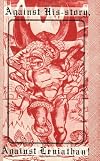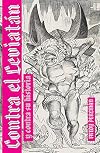
Against His-story, Against Leviathan!: an Essay
by Fredy Perlman
On This Page
Description
His major work, a vast study of the rise of totalitarian lifestyles and a profound affirmation of the struggle to reassert human values. One of the most significant and influential anarchic texts of the last few decades.Tags
Recommendations













































Member Recommendations

Member Reviews
This is likely the only historical survey of western civilization that I'll ever read with genuine excitement and interest, and my most naive wish after reading it was that it could become a standard introductory text for students of world history.
It goes without saying that Perlman's essay is not "objective". In other words, it is no candidate for perpetuating the business of progress, which is the unspoken agenda of "objectivity". This account of His-Story is openly disparaging of the He's which constitute and write it as well as the Leviathans which they run. It is an account that is zealously life-affirmative. And it is written in conscious contrast to the libraries of historical literature that demean life and freedom by glorifying show more the abstract, artificial constructs of Progress, Civilization, and production.
Some readers might find the author's linguistic liberties and central analogy peculiar, but they are critical devices for shifting the reader's perspective outside the historical narratives we're accustomed to learning. He uses "Levaithan" prominently as a synonym for the state and civilization and "zek" (actual slang from [b:The Gulag Archipelago|70561|The Gulag Archipelago: 1918-1956|Aleksandr I. Solzhenitsyn|http://photo.goodreads.com/books/1170735849s/70561.jpg|2944012] for inmates in Soviet labor camps) for worker, slave, or proletarian. The Leviathan is depicted visually as a monstrous mechanical worm and conceptually as Thomas Hobbes's [b: formulation|91953|Leviathan (Penguin Classics)|Thomas Hobbes|http://photo.goodreads.com/books/1171239204s/91953.jpg|680963] of the state as a head (the king) and a body (the citizens), all zeks--human beings incorporated into the beast.
Compared to the somber prose of [a:Frederick W. Turner|181381|Frederick W. Turner|http://www.goodreads.com/images/nophoto/nophoto-U-50x66.jpg]'s equally critical [b:Beyond Geography|1133668|Beyond Geography: The Western Spirit Against the Wilderness|Frederick W. Turner|http://photo.goodreads.com/books/1181257100s/1133668.jpg|1120884], Perlman's is straightforward yet full of passion. Turner's style suits his tragic work, while Perlman wrote what feels like an unfinished hero story, the hero, Ahura Mazda, the light, life, community, and freedom struggling against Ahriman, darkness, death, hatred, and enslavement. This history is no uninformed polemic; it is a thorough, exhaustive, informative polemic that spans from the origin of the species to the present, looking forward to the end of Leviathan and the return of the light.
Despite my wish, although it is as valid as any standard account, I know that this book or one like it could never be accepted as a valid account of history anywhere Leviathan functions, which, at present, is the whole planet. If this account of history became widely accepted, Leviathan would face its end.
Check out the first chapter here show less
It goes without saying that Perlman's essay is not "objective". In other words, it is no candidate for perpetuating the business of progress, which is the unspoken agenda of "objectivity". This account of His-Story is openly disparaging of the He's which constitute and write it as well as the Leviathans which they run. It is an account that is zealously life-affirmative. And it is written in conscious contrast to the libraries of historical literature that demean life and freedom by glorifying show more the abstract, artificial constructs of Progress, Civilization, and production.
Some readers might find the author's linguistic liberties and central analogy peculiar, but they are critical devices for shifting the reader's perspective outside the historical narratives we're accustomed to learning. He uses "Levaithan" prominently as a synonym for the state and civilization and "zek" (actual slang from [b:The Gulag Archipelago|70561|The Gulag Archipelago: 1918-1956|Aleksandr I. Solzhenitsyn|http://photo.goodreads.com/books/1170735849s/70561.jpg|2944012] for inmates in Soviet labor camps) for worker, slave, or proletarian. The Leviathan is depicted visually as a monstrous mechanical worm and conceptually as Thomas Hobbes's [b: formulation|91953|Leviathan (Penguin Classics)|Thomas Hobbes|http://photo.goodreads.com/books/1171239204s/91953.jpg|680963] of the state as a head (the king) and a body (the citizens), all zeks--human beings incorporated into the beast.
Compared to the somber prose of [a:Frederick W. Turner|181381|Frederick W. Turner|http://www.goodreads.com/images/nophoto/nophoto-U-50x66.jpg]'s equally critical [b:Beyond Geography|1133668|Beyond Geography: The Western Spirit Against the Wilderness|Frederick W. Turner|http://photo.goodreads.com/books/1181257100s/1133668.jpg|1120884], Perlman's is straightforward yet full of passion. Turner's style suits his tragic work, while Perlman wrote what feels like an unfinished hero story, the hero, Ahura Mazda, the light, life, community, and freedom struggling against Ahriman, darkness, death, hatred, and enslavement. This history is no uninformed polemic; it is a thorough, exhaustive, informative polemic that spans from the origin of the species to the present, looking forward to the end of Leviathan and the return of the light.
Despite my wish, although it is as valid as any standard account, I know that this book or one like it could never be accepted as a valid account of history anywhere Leviathan functions, which, at present, is the whole planet. If this account of history became widely accepted, Leviathan would face its end.
Check out the first chapter here show less
"And so the problem remained; lots of people were mean, and most of them were miserable, even the ones with digital watches.
Many were increasingly of the opinion that they’d all made a big mistake in coming down from the trees in the first place. And some said that even the trees had been a bad move, and that no one should ever have left the oceans."
--Douglas Adams, The Hitchhikers Guide to the Galaxy
Round about the three quarters mark, Fredy Perlman states that he's sick of writing this book and would rather be doing something else. I had a similar sensation reading it.
It's not that his ideas are bad or even wrong; instead it’s the contempt with which he seems to treat everything along the way. Those within states are slaves or show more “zeks”, those without are noble savages and helpless victims. Historians are liars and anthropologists are racists. Citations and facts are tools of the oppressors.
In rejecting historians he falls into their worst traps: the books is pretty standard european history, even devolving to tedious lists of kings. Although he stops to tell us --not show, not demonstrate, tell-- that so and so and their state is bad, it’s still great man history.
His rejection of archaeology and anthropology is both unfair and damaging. By the 80s anthropology had been rejecting the very concept of civilization and barbarism for a couple decades. Certainly anthropology gives us a window into the “free people” whom Perlman so esteems that he almost completely ignores.
In the 2000s another anarchist, David Graeber, took the same topics but treated them with respect. He went into the weeds, talked to the people instead of projecting on them and came out with Debt: The First 5000 Years. It is so jam packed with novel ideas and fascinating observations that is a joy to read at twice the length of Leviathan.
Go read that instead. show less
Many were increasingly of the opinion that they’d all made a big mistake in coming down from the trees in the first place. And some said that even the trees had been a bad move, and that no one should ever have left the oceans."
--Douglas Adams, The Hitchhikers Guide to the Galaxy
Round about the three quarters mark, Fredy Perlman states that he's sick of writing this book and would rather be doing something else. I had a similar sensation reading it.
It's not that his ideas are bad or even wrong; instead it’s the contempt with which he seems to treat everything along the way. Those within states are slaves or show more “zeks”, those without are noble savages and helpless victims. Historians are liars and anthropologists are racists. Citations and facts are tools of the oppressors.
In rejecting historians he falls into their worst traps: the books is pretty standard european history, even devolving to tedious lists of kings. Although he stops to tell us --not show, not demonstrate, tell-- that so and so and their state is bad, it’s still great man history.
His rejection of archaeology and anthropology is both unfair and damaging. By the 80s anthropology had been rejecting the very concept of civilization and barbarism for a couple decades. Certainly anthropology gives us a window into the “free people” whom Perlman so esteems that he almost completely ignores.
In the 2000s another anarchist, David Graeber, took the same topics but treated them with respect. He went into the weeds, talked to the people instead of projecting on them and came out with Debt: The First 5000 Years. It is so jam packed with novel ideas and fascinating observations that is a joy to read at twice the length of Leviathan.
Go read that instead. show less
„The resistance is the only human component of the entire His-story. All the rest is Leviathanic Progress” (page 184)
On September 13, 2009, Dr. Graeme MacQueen presented a speech titled, 9/11 Truth: the Challenge to the Peace Movement, at the conference, "We Demand Transparency! For Peace, Truth, and a New Economics:
9/11 Truth: the Challenge to the Peace Movement
1 of 4 http://www.youtube.com/watch?v=NUISz8Uwh6A
2 of 4 http://www.youtube.com/watch?v=eY9IlDDpvzc
3 of 4 http://www.youtube.com/watch?v=C3Bte5ULPD8
4 of 4 http://www.youtube.com/watch?v=mCzHeCCDp74
On September 13, 2009, Dr. Graeme MacQueen presented a speech titled, 9/11 Truth: the Challenge to the Peace Movement, at the conference, "We Demand Transparency! For Peace, Truth, and a New Economics:
9/11 Truth: the Challenge to the Peace Movement
1 of 4 http://www.youtube.com/watch?v=NUISz8Uwh6A
2 of 4 http://www.youtube.com/watch?v=eY9IlDDpvzc
3 of 4 http://www.youtube.com/watch?v=C3Bte5ULPD8
4 of 4 http://www.youtube.com/watch?v=mCzHeCCDp74
May 18, 2011 (Edited)German
Ratings
Members
- Recently Added By
Author Information
27+ Works 536 Members
Common Knowledge
- Canonical title
- Against His-story, Against Leviathan!: an Essay
Classifications
- Genres
- Fiction and Literature, Literature Studies and Criticism, Philosophy
- DDC/MDS
- 809 — Literature & rhetoric Literature, rhetoric & criticism History, description, critical appraisal of more than two literatures
- LCC
- CB151 .P455 — Auxiliary Sciences of History History of Civilization History of Civilization
- BISAC
Statistics
- Members
- 190
- Popularity
- 171,906
- Reviews
- 3
- Rating
- (4.07)
- Languages
- 5 — English, Italian, Portuguese, Spanish, Turkish
- Media
- Paper
- ISBNs
- 8
- ASINs
- 1