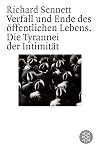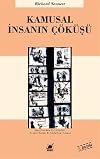
The Fall of Public Man
by Richard Sennett
On This Page
Description
Examines the modern imbalance between our public and our private lives - covering everything from the history of fashion to revolutionary mobs and the career of Richard Nixon.Tags
Recommendations








































Member Reviews
Note: I only read one-third of this title. The author analyzes the multiple factors determining how humans function in public and private (i.e., family) environments. He uses as his laboratory Paris and London from the mid-17th to the mid-18th century, as both cities exploded in population. How individuals dealt with all these new strangers created the impetus to develop communication skills (verbal, dress, clothing) appropriate to either public or private experiences. Private, in Sennett's usage, denotes a natural law (which evolved into a human right). It is certainly a worthwhile topic--in this age of privatization--but Sennett's writing style is so dense and impenetrable that frequently one will need to read the same sentence over show more three of four times to coax the meaning out. It's a style that flourishes in theoretical sociology (i.e., Adorno and Habermas), but since I am no longer a graduate student, I gave it a good college try and then said "Enough." show less
Scritto nel 1976, è un testo sociologico fondamentale per comprendere l'inversione valoriale tra esterno e interno, tra pubblico e privato, avvenuta nella società tra XVIII e XIX secolo. L'uomo "intimista" del XX secolo (per inciso: l'ultima parte del libro risulta forse la più debole, forse perché un po' datata rispetto agli stessi scritti successivi di Sennett - non a caso in un passo si anticipa "l'uomo flessibile") non è che il logico prodotto di questo ripiegamento verso l'interno di tutti i valori sociali, sia quelli incarnati dall'uomo stesso, sia quelli visibili nello spazio (la città) e nelle sovrastrutture economiche e produttive.
In The Fall of Public Man, Richard Sennett (1976) argues that the public realm now has become a mere formality (3) and that the private life has become interoriorized (4), leading to confusion between intimate life and public life (5). Thus, there is a question for the "authentic" self rather than a public of presenting ideas (8). Sennett argues that this is a function of changes in the 19th century. Before this time, public relations were more about "theatricality" than "representation" of the self, the former of which Sennett sees as more friendly to public life (37). According to Sennett, people understood publicity as presenting and theatrical in a sense in the 18th century, but the 19th and 20th centuries brought upon a "ideology show more of intimacy" (259) with "openness of expression" (262). Thus, we've started to judge character and "authenticity" in our leaders who "can dramatize his own motivations" (265). show less
shelved in HT Green Library - by Reception - Monograph Library (R)
H1.31.6
Jan 20, 2021Catalan
Ratings
Members
- Recently Added By
Author Information

47+ Works 4,962 Members
Richard Sennett founded and served as first director of the New York Institute of the Humanities and is now a professor of sociology at both New York University and the London School of Economies.
Some Editions
Awards and Honors
Notable Lists
Series
Belongs to Publisher Series
Common Knowledge
- First words
- Modern times are often compared to the years the Roman Empire went into decline: Just as moral rottenness is supposed to have sapped Rome's power to rule the West, it is said to have sapped the modern West's power to rule the... (show all) globe. For all the silliness of this notion, it contains an element of truth.
Classifications
- Genres
- Sociology, Nonfiction, General Nonfiction, History, Philosophy
- DDC/MDS
- 306.09 — Society, government, & culture Social sciences, sociology & anthropology Social Behavior - Dating, Marriage, Divorce Social history
- LCC
- HN13 .S45 — Social sciences Social history and conditions. Social problems. Social reform Social history and conditions. Social problems.
- BISAC
Statistics
- Members
- 592
- Popularity
- 49,662
- Reviews
- 5
- Rating
- (3.70)
- Languages
- 12 — English, French, German, Hungarian, Italian, Norwegian (Bokmål), Norwegian, Polish, Portuguese (Portugal), Russian, Spanish, Turkish
- Media
- Paper, Ebook
- ISBNs
- 34
- ASINs
- 8